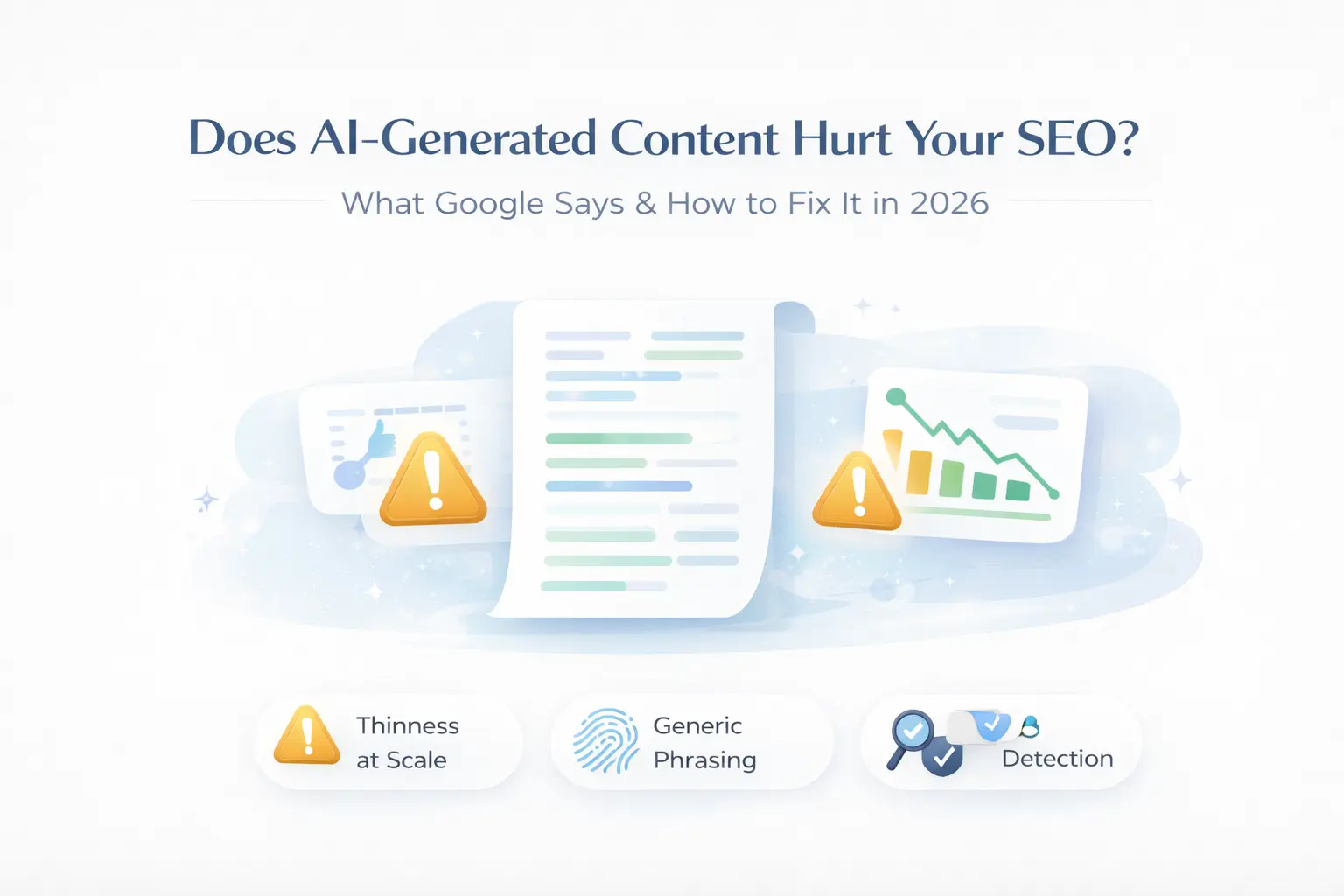
Does AI-Generated Content Hurt Your SEO? What Google Says and How to Fix It

Half the SEO world thinks AI content will kill their rankings. And the other half is pumping out 10,000 words a week with ChatGPT or Jasper and asking: then what? Both sides are right to some extent -- but the disagreements are costing a lot of people rankings they didn't need to drop.
There isn't really an easy yes or no to this question. Google doesn't penalize an article because it's been written by an AI. However, there are four distinct signals that unedited AI content will unconsciously get you demoted -- and all four have been exaggerated after the December 25th Google Core Update refined ranking criteria.
This article dissects precisely how Google's stance is, what is actually resulting in penalty drops for AI-dense sites, and what is the workflow SEO practitioners are having when publishing AI-guided content that maintains rankings.
What Google Actually Says About AI Content
Google itself has stressed this unchanged since its 2023 Search Central statement, and this being reiterated by each subsequent update: Google does not judge webpages by who wrote it, but by the quality of what it contains. A page written totally by a human that is thin content, and just generic boilerplate, will rank worse than a coherent and high quality AI-augmented article.
That was solidified by the December 2025 Core Update. The analysis from SEO professionals tracking the algorithm, which we wrote about here, show that the update didn‘t introduce an “AI detection” penalty. Instead it just refined Google‘s method of pinpointing low E-E-A-T content, added or not by AI. The sites that were harmed all had certain traits: thin coverage of the topic, no original insights, repetitive sentence structure and content that sounded more like an answer to a question than something produced by someone with real expertise.
And completely owned by Google, their own documentation states, ‘Using AI or automation in the right way isn‘t a violation of our policies.’ The relevant word here is right way. What they always punish is what their own algorithms see as unhelpful, no matter how they achieved that unhelpfulness.
The 4 Real SEO Risks of Unedited AI Content
Understanding that there's no blanket AI penalty is only half the picture. Here are the four specific failure modes that cause ranking drops when AI content goes up unedited.
1. Thin Content at Scale
The practical risk is less that any one page owned by AI: it‘s that AI makes it extremely easy to pump out shallow content at scale. 50 pages of ChatGPT content, all with the same structure, all with the same transition words, all dealing with topic‘s at exactly the same surface level will expose a pattern to Google‘s algorithms. Pages can get some initial rankings, then drop out of the index at Google‘s descretion as the algo reevaluates the overall quality of the site. It pummeled those who suddenly grew large publishing on AI volume without editorial depth in December 2025.
2. Generic Phrasing That Signals Low E-E-A-T
The raw Signal AI output has a visible fingerprint -- not because Google is scanning for “AI writing,” but because that fingerprint intersects with signals Google already looks for when determining quality. Heavy use of transition signs (“It‘s interesting to point out that,” “With regards to today‘s digital landscape,”, “In addition,”), short, uniform sentence lengths, and a refusal to include first person or original thought or observation were all statistically associated with low expertise signals. Google‘s E-E-A-T structure -Experience, Expertise, Authoritativeness, Trustworthiness -incents writing as if a real person with expertise in the field wrote it.
3. Duplicate Topical Patterns Across a Site
Multiple pages on a site may cover similar niche subjects with similar structures and wordings, especially where team are using exactly the same ChatGPT prompts across multiple articles. Google‘s systems will recognize the cannibalization of topics and the replication of format, penalizing all pages involved, not just the one with the weakest ranking.
4. AI Detection Flagging by Manual Reviewers
Google employs human quality raters whose job it is to look through hits and compare the quality of the page to their Search Quality Evaluator Guidelines. They don‘t directly influence the search algorithm, but roll up into the calibration of the algorithm so that, for example, on topics such as health, finance and legal that require high quality content, pages that sound ‘robotic’ get rated ‘low quality’ and contribute to algorithm adjustments.
Why the Writing Pattern Is the Real Problem
The issue isn't that Google knows your content was AI-generated. It's that AI output, left unedited, reproduces the exact writing patterns that Google's quality systems are trained to discount.
Uniform perplexity (predictable word choices), low burstiness (consistent sentence length with no natural variation), absence of hedging language, personal anecdote, or counter-argument, these are the measurable linguistic characteristics of AI writing, and they're also the characteristics that differentiate low-value content from high-value content in Google's models.
When SEO teams run raw AI output through detection tools, they're not just checking whether the content will "look AI" to a human reader. They're checking whether the text's underlying linguistic profile aligns with what Google's systems are trained to reward.
The Fix: What SEO Professionals Are Actually Doing
The workflow that's working in 2026 among SEO teams who publish AI-assisted content at scale isn't complicated, but it requires discipline at every stage.
Step 1 - Use AI for structure and draft, not final copy. ChatGPT, Claude, or Gemini are excellent for building outlines, generating first drafts, and covering the basic factual territory of a topic. Use that output as a starting point, not a finished product.
Step 2 - Humanize the AI output before any editing. Before adding your own edits, run the draft through a tool specifically designed to rewrite AI-generated text into natural, varied prose. TextToHuman is one of the few completely free options that handles this at scale, no account required, no word limits, and it includes sentence-level alternatives so you can adjust individual lines rather than accepting a full rewrite blindly. The goal at this stage is to eliminate the mechanical fingerprint before you layer in editorial voice.
Step 3 - Add original perspective and experience signals. After humanizing, this is where the real editorial work happens: first-person observations, specific examples from your industry, counter-arguments to the obvious take, actual data points that aren't in the AI draft. These are the E-E-A-T signals that differentiate content Google ranks from content it ignores.
Step 4 - Verify the output. Before publishing, run the edited piece through an AI detection tool to confirm the linguistic profile has shifted. This isn't paranoia, it's quality control. Detection scores tell you how much the mechanical fingerprint has been reduced, which correlates with how much you've added original editorial substance.
Step 5 - Check for topical cannibalization. If you're publishing AI-assisted content at scale, audit regularly for pages covering similar ground with similar structure. Consolidate where necessary.
How Much Humanizing Actually Moves the Needle?
The data from independent tool testing is fairly consistent. A 2026 analysis that tested 35+ AI humanizers, running ChatGPT output through each tool and scoring results on ZeroGPT, found that top-performing humanizers reduced AI detection scores from 93% to 0%, with multiple free tools achieving the full reduction. The full breakdown and test methodology is worth reading if you want to compare tools before committing to one.
From an SEO perspective, what matters isn't just the detection score, it's whether the humanized output reads with enough variation, natural rhythm, and specificity to satisfy E-E-A-T requirements. Detection score reduction is a proxy for that, but editorial review is always the final check.
What This Means for Your Content Strategy
The practical takeaway from Google's position in 2026 is straightforward: the AI-vs-human origin of your content is not the metric Google cares about. The quality signals in the final published piece are.
A useful way to think about the risk is this: if you removed the byline from your content and gave it to a subject-matter expert in your industry to read, would they find specific insight, original perspective, and genuine depth? Or would it read like a well-organized summary of information already available everywhere?
Most unedited AI output fails that test. Most properly edited, humanized, and enriched AI-assisted content passes it.
The teams seeing ranking drops from AI content in 2026 aren't being penalized for using AI, they're being penalized for publishing content that lacks quality signals, and AI makes it easy to produce that at scale without noticing.
Quick Reference: AI Content SEO Checklist
Use this before publishing any AI-assisted content:
| Check | What to Look For |
| Thin coverage | Does this page add something not already covered better elsewhere? |
| E-E-A-T signals | Is there original perspective, experience, or expertise visible? |
| Mechanical patterns | Does the text have natural sentence variation and phrasing? |
| Humanization pass | Has the AI fingerprint been reduced before editorial review? |
| Detection score | Does the final draft pass a reliable AI detector at acceptable levels? |
| Topical overlap | Does this page cannibalize other pages on the same site? |
The Bottom Line
Google's algorithm doesn't penalize AI content. It penalizes low-quality content, and AI, used carelessly, is one of the most efficient ways to produce low-quality content at scale.
The fix isn't to stop using AI. It's to treat AI output the same way a good editor treats any rough draft: with a clear workflow that adds quality at each stage, removes mechanical patterns before they become ranking liabilities, and produces a final piece that a real person with domain knowledge would be proud to put their name on.
Run the AI draft through a humanizer. Edit for E-E-A-T. Verify the output. Publish with confidence.