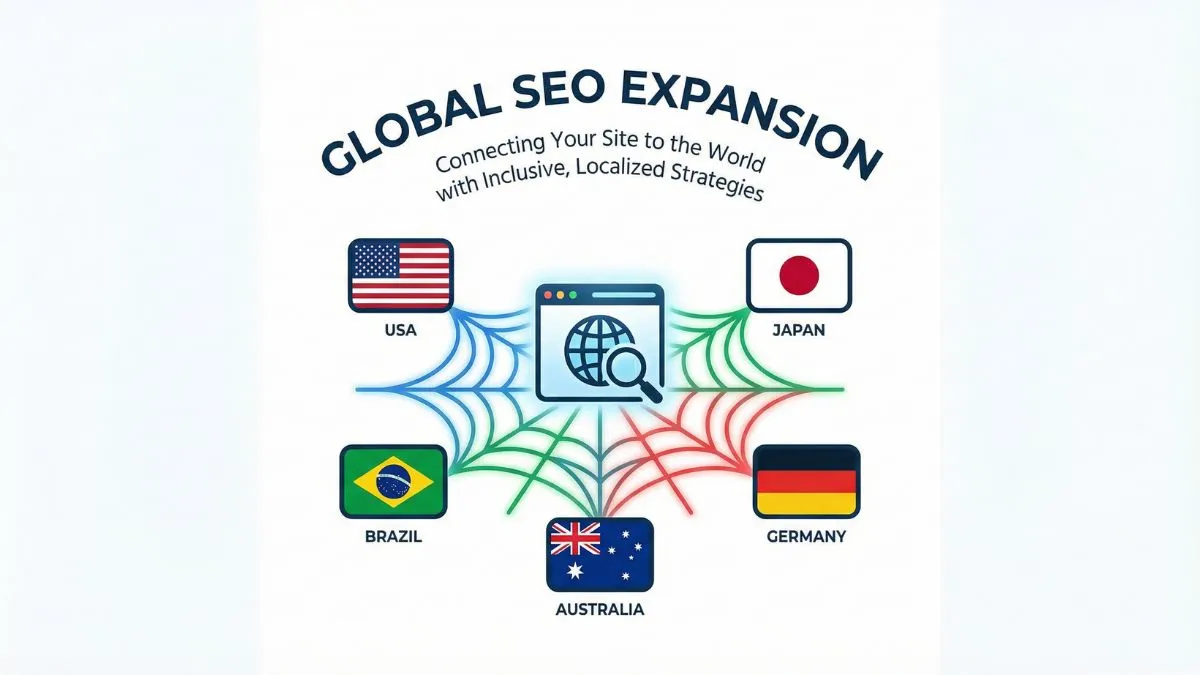
How to Optimize Your Site for Multiple Countries

How to Optimize Your Site for Multiple Countries: The 2026 Global Playbook
Direct Answer: To optimize your site for multiple countries in 2026, you must implement a Hybrid Global Architecture that combines the SEO consolidation of Subdirectories with the low-latency performance of a Point-of-Presence (PoP) CDN. Critical technical pillars include a bilateral Hreflang Sitemap Implementation, Contextual Localization (adapting currency, units, and cultural nuances), and Server-Side Language Headers to prevent indexation bloat. Google's SGE prioritized "Localized Knowledge Graphs"—meaning your site must prove its regional physical presence and cultural relevance through first-party data and local backlink clusters to rank in overseas SERPs.
🌏 Executive Summary: The Multi-Regional Expansion Framework
- Architecture Consolidation: Leverage subdirectories (/uk/, /de/) to inherit the root domain's authority, rather than diluting power across separate ccTLDs.
- Reciprocal Hreflang Logic: Ensure every regional URL points to its siblings to prevent "Duplicate Content" flags and ensure users land on the correct regional variation.
- Dynamic CDN Layer: Use Edge-side logic to serve cached content from the nearest geographic node, reducing TTFB (Time to First Byte) to sub-100ms globally.
- Cultural Entity Verification: Localize contact information, legal disclaimers, and social signals to align with regional Search Quality Rater Guidelines.
As we briefly discussed in what is international SEO, your URL structure is the most fundamental technical signal you send to search engines. For a multi-country site, your choice determines how authority is inherited and how segments are managed.
1. Global Architecture Comparison (GAC)
Choosing the wrong structure can lead to years of technical debt. We recommend the Subdirectory approach for 90% of global brands due to its Authority Inheritance properties.
| Architecture | Primary Benefit | SEO Risk |
|---|---|---|
| ccTLD (brand.fr). | Maximum Local Trust. | Authority Dilution. |
| Subdirectory (brand.com/fr/). | Consolidated Power. | Complex Hreflang. |
| Subdomain (fr.brand.com). | Flexible Hosting. | Inconsistent Crawling. |
2. The Subdirectory Powerhouse (Recommended)
Using brand.com/uk/ and brand.com/ca/ is the industry standard for 2026. This allows you to consolidate all your SEO efforts into a single root domain. When a high-authority site in Australia links to your `/au/` folder, it benefits the entire global site. This is the most efficient way to scale. It avoids the Link Equity Fracture common with ccTLDs.
Chapter 2: Implementing a Flawless Hreflang System
Hreflang tags are the "traffic controllers" of multi-country SEO. Without them, search engines will struggle to determine which version of your site to show a user, potentially leading to "Redirect Loops" or duplicate content flags.
1. Creating the Reciprocal Bond
If you have a US English page and a CA English page, each page must "know" about the other. In hreflang tags explained for international SEO, we dive deep into the XML sitemap method, which is the most reliable way to manage thousands of regional URLs without bloating your HTML code.
2. The 'x-default' Safety Net
Always include an `x-default` tag. This tells Google: "If a user is searching from a country for which I don't have a specific version, show them this page." Usually, this is your global English site.
Chapter 3: Localizing Keyword Research for Different Markets
SEO success in Italy doesn't come from translating your English keywords into Italian. It comes from understanding how Italians search for your specific solution.
1. The Search Behavior Audit
Use local search data from tools like Semrush or Ahrefs, segmented by country. You will often find that "High Volume" terms in your home market have zero volume in a target market, even if the literal translation is correct. You must identify local synonyms, slang, and specific regional pain points.
2. Localization Complexity Index (LCI)
Not all markets require the same level of investment. Use the LCI to determine the ROI of your expansion efforts.
| Market Tier | Requirement | SEO Strategy |
|---|---|---|
| Tier 1 (Same Language). | Dialect Alignment. | Hreflang Only. |
| Tier 2 (Close Language). | Full Translation. | Linguistic Keywords. |
| Tier 3 (Different Writing System). | Full Transcreation. | Cultural Intent Mapping. |
Chapter 4: Beyond Language: Cultural and Regional Localization
A "Multi-Regional" site must behave like a local site. If a user in the UK sees a phone number with a US area code, they will view your business as "foreign" and less reliable.
1. The Localized User Experience (UX)
- NAP Consistency (International): If you have physical offices in your target countries, ensure you follow the protocols in schema for local businesses for each country version.
- Payment Methods: Does your target country use credit cards, or do they prefer local systems like iDEAL (Netherlands) or Mercado Pago (Latin America)?
- Measurements and Industry Terms: Metric vs. Imperial is the obvious one, but industry-specific jargon can vary wildly (e.g., "Elevator" vs. "Lift").
Chapter 5: Building Authority in Foreign Markets
Link building is the most difficult part of multi-country SEO. You cannot "Export" your home-country links to rank in a new region. You must build "Geographic Authority" from scratch.
1. Securing Region-Specific Backlinks
To rank in Japan, you need `.jp` links. To rank in Brazil, you need `.br` links. This requires localized PR and outreach. Partnering with local influencers, getting featured in regional news outlets, and sponsoring local events (as discussed in how to leverage events for local SEO) are the most effective ways to secure these high-trust signals. Google's algorithm treats regional links as Validation of Entity Presence.
2. The TLD-Link Paradox
A backlink from a high-authority global site (like Wikipedia or NYT) is valuable everywhere, but a link from a niche local blog in the target country is often the "tipping point" for ranking in the Local Pack. Balance your link-building between global authority and local relevance.
Chapter 6: Technical Global Performance and CDNs
Global search engines prioritize speed. If your server is in New York and a user in Singapore is trying to access your site, the latency will destroy your mobile rankings.
1. Utilizing a Global Content Delivery Network (CDN)
Implement a CDN like Cloudflare or Akamai. This ensures that your site's files are cached on servers located physically close to the user, regardless of where they are in the world. This is the global application of how to reduce page load time for SEO.
2. Handling Geo-Redirection
Never use automatic IP-based redirection. Googlebot often crawls from US IP addresses; if you automatically redirect all US IPs to your `.com` site, Google may never be able to crawl or index your `.fr` or `.de` versions. Use "Language Pop-ups" or quiet banners instead to guide the user to the correct version.
Chapter 7: Managing and Tracking Global Growth
How do you manage 20 different country versions without going insane? You must have a centralized tracking system.
Utilize Google Search Console's "International Targeting" report to monitor your hreflang health. Segment your Google Analytics data by "Country" to identify regions that are underperforming. If a specific country has a high bounce rate despite good rankings, it's a clear sign that your localization (not your SEO) is the problem.
1. Global SERP Monitoring
Use a rank tracker that allows for "Geo-Specific" reporting down to the city level in foreign markets. A keyword might rank #2 in London but #15 in Manchester. Understanding these hyper-local variations is essential for optimizing a multi-regional site effectively.
Conclusion: Building a Borderless Brand
Optimizing for multiple countries is not a one-time project; it is an ongoing commitment to understanding the world. In 2026, the brands that win globally are those that refuse to take shortcuts. They don't just "Translate" their site; they "Re-imagine" their site for every culture they serve.
By selecting a scalable architecture, implementing meticulous hreflang tags, and committing to deep linguistic and cultural localization, you transform your business from a regional player into a global entity. The internet has unified the world's markets, but it has not homogenized the world's cultures. Respect the local nuances, and the global search engines will reward you with dominance. The world is yours to conquer—one country at a time.
Frequently Asked Questions on Multi-Country SEO
1. What is the biggest mistake businesses make when going global?
The most common mistake is relying on automated translation (like Google Translate) without cultural review. This leads to inaccuracies, poor user trust, and keywords that don't match how locals actually search, resulting in zero organic growth.
2. How do I decide which countries to target first?
Start with countries where you already have existing traffic or leads, even if it's small. Also, prioritize markets where you have a competitive advantage or where your product has high organic demand (determined via international keyword research).
3. What are 'Geographic Signals' and how do I use them?
Geographic signals tell Google where your business is relevant. These include ccTLDs, hreflang tags, local NAP (Name, Address, Phone) data, and backlinks from region-specific websites. Using all of these creates a strong "trust signal" for a specific country.
4. Do I need a different hosting server for every country?
No. In 2026, using a high-quality global CDN (Content Delivery Network) is more effective than managing multiple hosting servers. A CDN serves your content from the location closest to the user, ensuring fast speeds worldwide.
5. How do I prevent Google from seeing my regional sites as duplicate content?
The primary solution is the correct implementation of hreflang tags. These tags explain to Google that the content is intentionally duplicated (or translated) for different regional audiences, which prevents "Duplicate Content" penalties or suppression.
6. Should I use different images for different countries?
Yes, this is part of localization. Using images that reflect the local culture, demographics, and environment builds trust. A photo of a desert will not resonate with a user in the UK, just as a photo of a snowy London street won't resonate in Dubai.
7. How many languages should my site support?
Start with the languages spoken by your primary target markets. It is better to have three perfectly localized language versions than twenty poorly translated ones. Quality and brand trust are far more important than raw volume.
8. How do I link between my different country sites?
Use a clear "Country Selector" menu (often a globe icon in the header or footer). Avoid using flags to represent languages (e.g., using a Spanish flag for Mexico), as this can be culturally insensitive. Use the name of the language/country in its native script.
9. Does international SEO take longer than domestic SEO?
Generally, yes. You are building authority from a lower base in new markets. However, in less-competitive international markets, you might see results faster than in highly saturated domestic markets if you optimize correctly from day one.
10. What is 'Semantic Localization?'
Semantic localization is adapting the meaning of your message, not just the words. It involves adjusting your tone of voice, your value propositions, and your marketing slogans to align with the social and cultural norms of the target region.
11. What is the difference between multi-regional and multi-lingual SEO?
Multi-regional SEO targets specific geographic locations (e.g., UK vs. Canada), while multi-lingual SEO focuses on users speaking different languages regardless of location (e.g., Spanish speakers globally).
12. Why is hreflang called 'reciprocal'?
Because page A must point to page B, and page B must point back to page A. If the link is not mutual, Google may ignore the signals, leading to incorrect regional results.
13. What is 'Geo-Redirection' and why should I avoid it?
Automatically redirecting users based on their IP address. It's risky because it can prevent search engine bots (which often crawl from US IPs) from seeing your other country versions.
14. How does a CDN improve global SEO?
A CDN reduces latency by serving content from a server physically closer to the user. Fast loading times are a critical ranking factor in every global market.
15. What are 'Localized Knowledge Graphs'?
Google's ability to understand entities (like your brand) within a specific regional context, using local reviews, NAP data, and regional backlinks to verify your presence.
16. Can I use the same content for UK and US English?
You can, but it's better to adapt spelling (flavor vs. flavour) and terminology (apartment vs. flat) to improve user trust and avoid appearing 'foreign'.
17. What is 'Transcreation' in SEO?
It's the process of re-creating content to maintain the same intent, style, and tone for a different culture, rather than just translating the words literally.
18. How do I monitor rankings in a country where I don't live?
Use rank tracking tools with 'Geo-Specific' settings or use a VPN to perform localized searches manually to see the exact SERP features in that region.
19. What is the 'x-default' hreflang attribute?
It identifies the 'fallback' page for users whose language or region doesn't match any of your specified hreflang tags. Usually, this is a global English landing page.
20. Does domain authority transfer across subdirectories?
Yes. This is the main reason we recommend subdirectories over ccTLDs; the authority of your root domain helps all regional folders rank faster.
21. How do local backlinks influence international rankings?
Backlinks from sites within the target country (e.g., a .de link for a German page) provide strong signals to Google that your content is relevant to that specific region.
22. What is 'Linguistic Keyword Matching'?
It's finding the exact phrases that native speakers use to search for a product, which may differ significantly from a literal dictionary translation.
23. How important is localized customer support for SEO?
It's vital for user signals. If users find your site but can't get help in their language, bounce rates will spike, which eventually hurts your rankings.
24. Can I use subdomains for global SEO efficiently?
Yes, especially if you need separate hosting environments. However, you must work harder to build authority for each subdomain compared to subdirectories.
25. What role does social media play in multi-country SEO?
Local social profiles provide entity verification signals and can drive localized traffic, which helps Google understand your brand's regional footprint.
26. Should my Sitemap include all regional URLs?
Yes. A multi-regional XML sitemap containing all regional variations and their hreflang cross-references is the most robust way to guide Google's indexer.
27. What is 'Cultural Intent Mapping'?
The practice of identifying why people search for a product in a certain country, which may differ from your home market (e.g., searching for 'safety' vs. 'status').
28. How does currency localization affect SEO?
It improves conversion and dwell time. If people see prices in a foreign currency, they are likely to leave, sending negative signals to the algorithm.
29. What is 'Authority Inheritance'?
The process where child pages (regional folders) benefit from the established trust and backlink profile of the parent root domain.
30. How do I handle 'Right-to-Left' (RTL) languages for SEO?
You must ensure your HTML and CSS (where relevant for structure) support RTL, as poor rendering leads to high bounce rates and lower rankings.
31. What are the legal requirements for global SEO?
You must comply with local data laws (like GDPR) and display appropriate legal disclaimers for each region to maintain trust and compliance.
32. How do I scale global content production?
Use a centralized content hub with localized regional editors to ensure consistency while allowing for necessary cultural nuances.
33. What is the impact of global site speed on core web vitals?
Global speed ensures that your Core Web Vitals remain high across all markets, regardless of the user's physical distance from your main server.
34. Should I use 'Language Pop-ups'?
Yes, as long as they are non-intrusive. They are a much safer alternative to automatic redirection for guiding users to the right regional version.
35. What is the 'Global Context' of a brand?
The aggregate of all your regional signals that Google uses to determine your overall international authority and trust level.