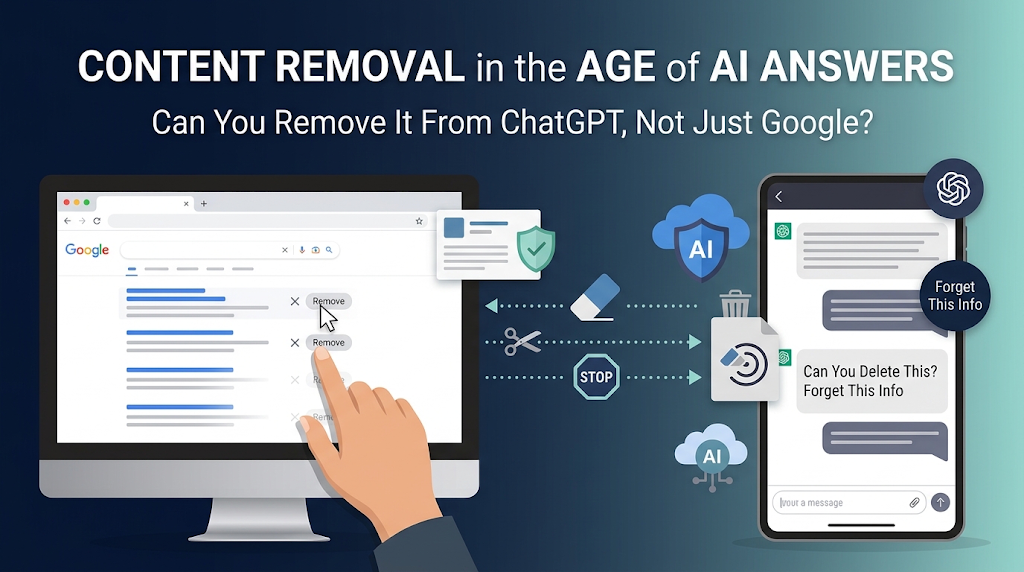
Content Removal in the Age of AI Answers Can You Remove It From ChatGPT, Not Just Google

A client gets the news they've been waiting months for. The old article is gone. The publisher took it down, Google dropped the URL, and their name finally searches clean. Then a prospective business partner mentions, over lunch, what ChatGPT told him about them. It's the same story. Sometimes word for word.
This is where most removal work falls apart in 2026. Getting a page off Google used to be the finish line. Now it's roughly the halfway point.
Content removal is the process of taking harmful, false, outdated, or private information down at its source and clearing it from the systems that index and repeat it. Those systems used to mean search engines. Today they also mean ChatGPT, Gemini, Perplexity, Claude, and Google's own AI Overviews, and each one keeps its own copy of the story in a slightly different place.
So yes, you can get content out of ChatGPT's answers. But you rarely do it by asking ChatGPT. You do it by understanding where the model got the information and cutting off each supply line.
Can You Remove Content From ChatGPT?
Partially, and the answer depends on which part of ChatGPT is talking.
ChatGPT pulls what it says about you from two places. The first is its training data: a huge snapshot of the web, frozen at a point in time and baked into the model's weights. The second is live retrieval: when ChatGPT runs a web search mid-conversation, reads current pages, and summarizes them with citations.
These need completely different fixes.
Live retrieval is the easier one. If ChatGPT cites a page, and that page disappears from the web and from the search indexes it relies on, the citation goes with it. Usually within days or weeks.
Training data is the stubborn one. A model trained on a snapshot that included the article still "remembers" it after the article is deleted. Nobody can reach into the weights and erase a single fact. What you can do is request that the provider suppress it in outputs, and wait for future models trained on cleaner data.
Scale is why this matters. OpenAI's Nick Turley said in early 2026 that ChatGPT had passed 900 million weekly users. Google said at I/O 2026 that AI Overviews reach about 2.5 billion people a month. For many people, whatever those systems say about you is your entire first impression.
Why Removing It From Google Doesn't Fix ChatGPT
People assume Google and ChatGPT share a brain. They don't, and the gaps between them are where damaging content survives.
ChatGPT's search feature has leaned heavily on Bing's index, alongside OpenAI's own crawler (OAI-SearchBot) and licensed news partners. A URL that Google has dropped can still sit happily in Bing for months. Nobody files a Bing request because nobody thinks about Bing. ChatGPT keeps finding the page.
Then there are copies. A single negative article spawns a long tail: scraper sites, aggregators, syndication partners, forum threads quoting it, cached versions, PDF reposts. Google may have consolidated those into one result you can tackle. An AI model doing a broad search sees all of them, and three low-quality reposts are enough for it to treat the claim as established.
And there's time lag. Google can drop a URL in hours once it's gone. A language model's training snapshot might be a year old. The article you removed in March can still shape answers from a model trained on February's web.
One more problem: AI answers compress. Google shows ten blue links and lets the reader weigh them. An AI tool picks a narrative and states it. Pew Research Center found in 2025 that users who saw a Google AI summary clicked a traditional result in 8% of visits, versus 15% when no summary appeared. Only about 1% clicked a link inside the summary itself. People aren't checking the sources. They're taking the summary.
What OpenAI Actually Lets You Request
OpenAI runs a privacy portal at privacy.openai.com. One of the request types is "Remove personal data from ChatGPT responses." You verify your identity, describe the information, explain where it appears, and submit.
It's worth filing. It's also worth being clear-eyed about what it is.
It's built for individuals, and it covers personal data. A company trying to remove a negative claim about its products won't get far through a personal-data form. It works best for private details: home addresses, phone numbers, family information, and false claims about a private person.
It's a suppression request, not a deletion. OpenAI hasn't claimed it can surgically erase a fact from a trained model. It can filter outputs so the model stops repeating specific information. The underlying training data doesn't change.
It's discretionary. OpenAI weighs requests against things like public interest. A politician or CEO asking to scrub reporting on their public conduct will have a much harder time than a private citizen asking to remove a home address.
The limits got a very public test in 2025. A Norwegian man, Arve Hjalmar Holmen, asked ChatGPT who he was. It told him he'd been convicted of murdering two of his sons. None of it was true, though it was mixed in with real details like his hometown and the number of children he had. The privacy group Noyb filed a GDPR complaint, arguing that OpenAI violated the regulation's accuracy requirement and asking for the output to be deleted and the model corrected. That case is a good reminder that even with the strongest privacy law in the world behind you, getting an AI provider to fix what its model "knows" is slow.
If you're in the EU or UK, you have stronger legal footing under GDPR's rights to erasure and rectification. In the US, the tools are thinner, and most leverage still comes from removing the source.
A Content Removal Plan That Covers Search and AI Answers
Here's how a thorough case runs today. The order matters. Most failed attempts skip the first step and the last two.
- Audit what the AI tools are saying: Ask ChatGPT, Gemini, Perplexity, Claude, and Google (watch the AI Overview) the questions a stranger would ask. "Who is [name]?" "Is [company] legit?" "[Name] lawsuit." Write down the exact claims and every citation the tools show. This is your real target list, and it's usually longer than the Google results page suggests.
- Remove at the source first: Everything downstream depends on this. Depending on the content, that means a direct request to the publisher, a platform policy report (reviews, social posts, forums), a DMCA notice for stolen photos or text, or a legal route for defamatory or court-ordered material. Effective content removal starts at the origin, because a page that still exists will keep getting re-indexed and re-cited.
- Clear both search indexes: Once the page is down, use Google's Refresh Outdated Content tool so the old snippet and cache go away. Then do the same in Bing with its Content Removal Tool. Skipping Bing is the single most common reason a removed page keeps showing up in ChatGPT.
- Chase the copies: Search distinctive phrases from the original in quotes. Find the scrapers, aggregators, and reposts. File removal requests with each, and with their hosts if they ignore you. One surviving copy is enough for an AI tool to keep repeating the claim.
- File the AI-side requests: Submit the OpenAI privacy request for personal information. Use Google's personal-information removal tools ("Results about you") for contact details. If you're covered by GDPR, cite it specifically. Keep screenshots of the problem outputs with dates. You'll need them if you escalate.
- Fill the gap you just created: When a source vanishes, the AI tool doesn't go quiet. It answers from whatever's left. If the only other material about you is thin, it may stitch together something worse, or just as wrong. Publish accurate, specific, well-sourced material on platforms AI tools trust: a strong bio, third-party profiles, interviews, industry coverage. This is the work generative engine optimization services are built for, and it's what keeps the answer from drifting back.
- Re-test monthly: Run the same prompts from step one every month. Note what changed, what's still cited, and which tools are lagging. Live retrieval usually updates quickly. Model memory takes longer, and new model releases can bring back old claims.
What Can't Be Removed (and What You Do Instead)
Some content isn't coming down. Accurate news reporting about a public figure, court records, government filings, and truthful reviews usually fall in this bucket. Publishers have every right to keep accurate stories up, and AI providers won't suppress reporting on matters of public interest because someone finds it uncomfortable.
That doesn't mean you're stuck. It means the job shifts from removal to context.
AI tools build answers from the full body of sources they can find. If the only substantial thing written about you is a five-year-old lawsuit, the model will lead with the lawsuit. If there's also current coverage, an outcome to the case, interviews, verified profiles, and professional accomplishments, the model has more to weigh, and the old item becomes a footnote instead of the headline.
There's also a middle ground worth pushing for. Publishers that won't delete an article will sometimes update it. A note that charges were dropped, a correction, a de-named version, or a noindex tag. Each of those changes what search engines and AI tools pick up, even though the page technically stays live.
At NetReputation, a lot of current removal work looks like this: take down what can legally come down, update what can't, and build enough accurate material around it that AI answers stop treating the old story as the whole story.
How Long Does It Take?
Expect three different clocks running at once.
Source removal ranges from days (a cooperative publisher, a clear policy violation) to months (legal processes, unresponsive hosts). Search index cleanup usually follows within days to a few weeks once you file the right requests with Google and Bing.
AI live retrieval tends to catch up within weeks after the indexes are clean. Perplexity and ChatGPT's search mode cite current pages, so when the pages are gone, the citations usually go too.
Model memory is the slow one. A claim that made it into training data can linger until the provider ships a model trained on a newer, cleaner snapshot. That can take many months. Output suppression requests can shorten this for personal data, but there's no guaranteed timeline.
So anyone promising to "remove you from ChatGPT in 48 hours" is either selling output-level tricks that won't hold or doesn't understand how the models work.
The Bottom Line
Google removal is still necessary. It's just not sufficient anymore. The page that hurt you has more than one home now, and AI tools are the ones most likely to keep reciting it long after you thought it was handled.
Start at the source, clean both search engines, kill the copies, file the AI-side requests, and replace the gap with accurate information. Then check again next month, because the answer people get about you isn't fixed. It's rebuilt every time someone asks.
Frequently Asked Questions
Can I ask ChatGPT to delete information about me?
Not inside a chat. Telling ChatGPT to forget something only affects your own conversation. To request removal of personal data from ChatGPT's responses for everyone, use OpenAI's privacy portal at privacy.openai.com, verify your identity, and specify the information and where it appears. Approval isn't guaranteed and depends on the type of data.
If an article is removed from Google, will ChatGPT stop mentioning it?
Not automatically. ChatGPT's search relies heavily on Bing, so the page also needs to be cleared from Bing's index. Copies on other sites must be removed too. And if the article was in the model's training data, it can linger in answers until a newer model is released or OpenAI suppresses that output.
Does content removal work for businesses as well as individuals?
Yes, at the source and search level. Businesses can remove defamatory articles, fake reviews, and policy-violating posts, then clear them from Google and Bing. AI privacy portals mainly focus on personal data, so businesses rely more on source removal and on publishing accurate material that AI tools will cite instead.
How do I find out what AI tools say about me?
Ask them directly. Run the same questions in ChatGPT, Gemini, Perplexity, Claude, and Google's AI Overviews: your name, your company, plus words like "reviews," "lawsuit," or "scam." Record the exact answers and every cited source. Repeat monthly, since answers change as indexes update and new models launch.
What if the AI tool is saying something false about me?
Document it with dated screenshots first. Then find and correct the source it's drawing from, since many errors come from a real page being misread or mixed up with another person. File a correction or removal request with the AI provider. In the EU or UK, GDPR's accuracy and rectification rights give you stronger grounds to demand a fix.