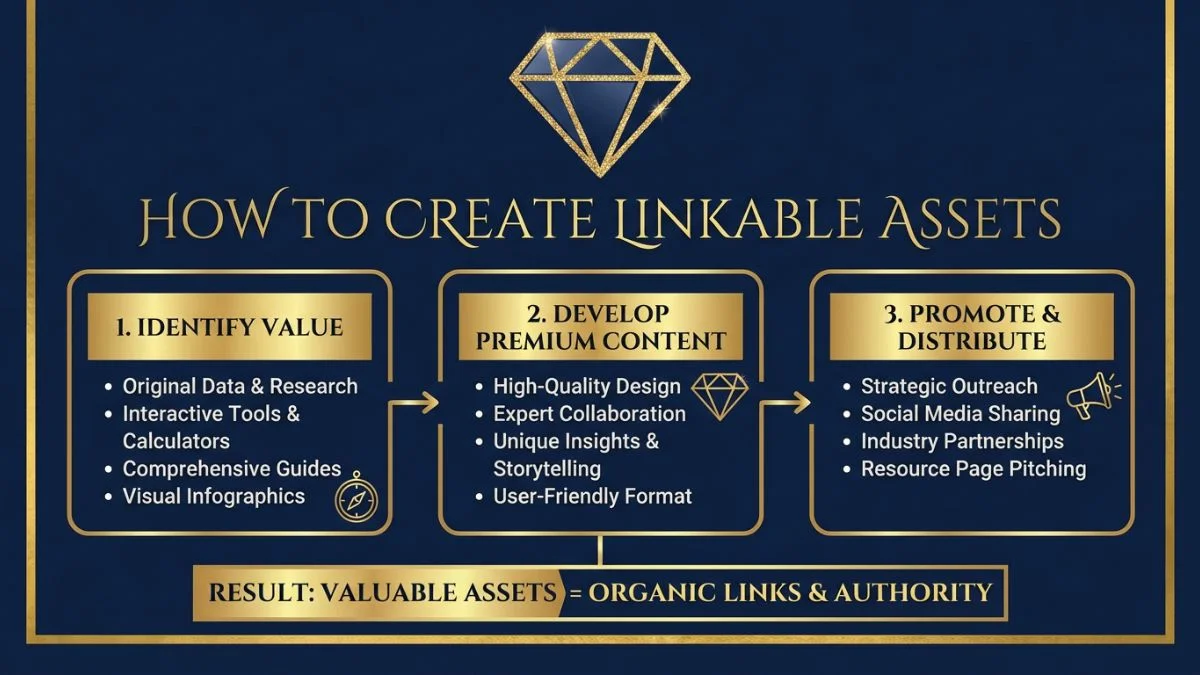
How to Create Linkable Assets

How to Create Linkable Assets: The Complete Guide to Earning Natural Backlinks in 2026
If you have spent any time working on off-page SEO, you already know that earning high-quality backlinks is one of the hardest parts of search engine optimization. Cold outreach emails get ignored. Guest blogging takes enormous effort for a single link. And buying links violates Google's spam policies and can lead to penalties that devastate your rankings.
There is a better way. Instead of chasing links one at a time, you can create content so valuable, so useful, and so unique that other websites link to it voluntarily. This approach is called building linkable assets, and it has become the cornerstone of modern link building strategy for brands of every size.
In this guide, we are going to walk through everything you need to know about creating linkable assets that actually work. You will learn what makes content "linkable," explore the specific types of assets that earn the most backlinks, get step-by-step instructions for building each one, and discover exactly how to promote them for maximum impact. Whether you are a solo blogger on a tight budget or a marketing director managing a content team, this guide will give you a clear roadmap for earning more backlinks through strategic content creation.
What Are Linkable Assets and Why Do They Matter?
A linkable asset is any piece of content that is specifically designed and optimized to attract backlinks from external websites. While all content has the potential to earn links, a true linkable asset is intentionally crafted with link acquisition as a primary objective. It provides something that other content creators, journalists, bloggers, and website owners find valuable enough to reference and link to within their own content.
The concept is straightforward. When a blogger writes an article about email marketing benchmarks and needs to cite an authoritative source for open rate statistics, they link to the original research that published those numbers. When a web developer writes a tutorial and recommends a free tool that solves a specific problem, they link to that tool. When a journalist covers an industry trend and needs supporting data, they link to the survey or study that generated that data.
In each of these scenarios, the linked content is a linkable asset. It earns links not because its creator asked for them, but because the content itself provides genuine value that other publishers want to share with their audiences.
Why Linkable Assets Are Critical for SEO in 2026
Backlinks remain one of Google's most important ranking factors heading into 2026. While the search engine's algorithm has evolved dramatically over the years, the fundamental principle that links from authoritative websites signal trust and relevance has not changed. Research from Backlinko's ranking factors study confirms that pages with more referring domains consistently rank higher in search results.
What has changed is how Google evaluates the quality of those links. The algorithm is far more sophisticated at identifying unnatural link patterns, paid links, and manipulative schemes. This shift has made linkable assets more important than ever because they generate the kind of editorial, contextually relevant links that Google values most highly.
Building a strong SEO strategy without linkable assets is like trying to build a house without a foundation. You might make short-term progress with tactical link building methods, but you will struggle to compete against competitors who have invested in creating genuinely valuable content that attracts links at scale.
| Link Building Method | Average Links Per Month | Sustainability | Risk Level | Cost Efficiency Over Time |
|---|---|---|---|---|
| Linkable Assets | 5-50+ | Very High | Very Low | Excellent |
| Cold Email Outreach | 3-15 | Moderate | Low | Good |
| Guest Blogging | 2-8 | Moderate | Low to Medium | Moderate |
| Broken Link Building | 2-10 | Moderate | Low | Good |
| Digital PR | 10-100+ | Low to Moderate | Low | Moderate |
| Paid Links | Unlimited | Very Low | Very High | Poor (risk of penalty) |
Types of Linkable Assets That Earn the Most Backlinks
Not all content types are equally effective at attracting links. Research from BuzzSumo and Ahrefs has consistently shown that certain content formats outperform others when it comes to earning backlinks. Let us break down each type, understand why it works, and look at the data behind its effectiveness.
Backlinks Earned by Content Type (Average Referring Domains Per Asset)
RDs = Referring Domains. Data compiled from Ahrefs Content Explorer and BuzzSumo analysis, February 2026.
1. Original Research and Data Studies
Original research consistently ranks as the most effective type of linkable asset because it provides something that no other content can: unique data. When you publish a study with findings that nobody else has, every blogger, journalist, and content creator who wants to discuss that topic has to link back to your research as the source.
Think about how often you see phrases like "according to a study by..." or "research from X found that..." in blog posts and news articles. Every one of those citations is a backlink earned by original research. Moz's research on link-earning content has shown that data-driven content earns significantly more links than opinion-based or how-to content.
The power of original research lies in its exclusivity. If someone wants to cite a specific statistic from your study, they have only one place to link to: your website. This creates a natural monopoly on backlinks for that particular data point. The more surprising, relevant, or counterintuitive your findings are, the more people will want to reference them.
Examples of highly linkable original research include annual industry benchmark reports, surveys that reveal unexpected trends, analysis of large data sets that uncover new insights, and experiments that test popular assumptions. HubSpot's State of Marketing report is an excellent example. It gets cited by thousands of marketers and publications every year, generating a massive number of backlinks to HubSpot's domain.
2. Free Tools and Calculators
Free tools are incredibly powerful linkable assets because they provide ongoing utility. Unlike a blog post that someone reads once, a useful tool is something that people return to repeatedly and recommend to others. Every recommendation, whether in a blog post, a tutorial, or a resource roundup, typically includes a link.
A great example in the SEO space is how tools like the Bright SEO Tools website SEO score checker attract links from bloggers writing about SEO auditing. When someone writes a post titled "Best Free SEO Tools" and includes your tool, that is a contextual, editorial backlink that carries significant ranking power.
The beauty of free tools is that they continue earning links passively for years after launch. A tool that solves a genuine problem will get included in roundup posts, recommended in online communities, shared on social media, and linked from educational resources indefinitely. The initial development cost may be higher than creating a blog post, but the long-term ROI in terms of links per dollar invested is often unmatched.
You can also check your own backlink growth from creating tools by using free backlink checker tools to monitor your progress over time.
3. Comprehensive Guides and Ultimate Resources
When you create the single most thorough, well-organized, and up-to-date resource on a specific topic, you become the default reference that other content creators link to when they mention that subject. This is the principle behind comprehensive guides, sometimes called "ultimate guides" or "pillar content."
The key word here is "comprehensive." A 1,000-word overview does not qualify. To become a linkable asset, a guide needs to cover its topic exhaustively, answering every question a reader might have and providing actionable advice at every step. It needs to be better organized, more current, and more practically useful than anything else available on the topic.
Creating content with strong readability for SEO is essential for comprehensive guides. If your 8,000-word guide is a wall of text, readers will bounce and other publishers will not want to link to it. Breaking content up with headers, tables, visuals, and clear formatting makes it genuinely useful and therefore more linkable.
Backlinko's SEO hub is a classic example of comprehensive guide content that earns thousands of backlinks. Brian Dean's guides on topics like link building, on-page SEO, and keyword research have become the default references in the industry, and they attract links continuously from people who cite them as authoritative sources.
4. Infographics and Visual Data
While infographics are not as novel as they were a decade ago, they remain effective linkable assets when executed well. The reason is simple: visual content is easier to share, embed, and reference than text-based content. A well-designed infographic that presents complex data in a clear, visually appealing way gives bloggers and content creators something they can embed in their posts while linking back to the source.
The key to making infographics work as linkable assets in 2026 is to move beyond basic design and focus on original data visualization. An infographic that simply repurposes existing statistics in a pretty format will struggle to earn links. But an infographic that visualizes your own original research findings or presents a genuinely new way of looking at familiar data can still attract significant attention and links.
When creating infographics, make sure to optimize the images properly. Following image optimization best practices ensures your visual content loads quickly and performs well in search, which in turn makes it more likely to earn links from quality-conscious publishers. You can use an image compressor to reduce file sizes without sacrificing visual quality.
5. Interactive Content
Interactive content like quizzes, assessments, configurators, and data explorers has become increasingly effective at earning backlinks. The interactive element provides a unique user experience that static content cannot match, giving publishers a compelling reason to link. According to the Content Marketing Institute, interactive content generates twice as many conversions as passive content and significantly more engagement, both of which translate into link opportunities.
Interactive content earns links because it provides a personalized experience that readers find valuable enough to share. When someone takes a quiz and gets results that resonate with them, they share it with colleagues and on social media. When a blogger discovers an interactive tool that their audience would find useful, they write about it and link to it.
6. Templates and Frameworks
Templates and frameworks are underrated linkable assets that can generate consistent backlinks with relatively low production costs. When you create a downloadable template, spreadsheet, or framework that helps people accomplish a specific task more efficiently, you create something that other content creators want to recommend to their audiences.
The most effective templates solve a specific, recurring problem. Think about how often marketers search for things like "content calendar template," "SEO audit template," or "social media strategy framework." Each of these represents an opportunity to create a resource that blog post authors will link to when they discuss these topics.
7. Industry Surveys
Industry surveys sit at the intersection of original research and community engagement. By surveying professionals in your industry about their practices, challenges, and predictions, you generate original data that becomes a primary source for content creators covering your field.
The annual surveys published by organizations like Orbit Media (their annual blogging survey) demonstrate the power of this approach. Andy Crestodina's survey data gets cited in hundreds of blog posts every year, driving a steady stream of high-quality backlinks to the Orbit Media domain.
8. Glossaries and Wikis
Creating a comprehensive glossary or wiki-style resource for your industry provides an evergreen linkable asset that accumulates links gradually over time. Whenever someone writes a piece of content and uses a technical term that their audience might not understand, they look for a reliable definition to link to. If your glossary provides the best definition, you earn the link.
Glossaries work particularly well in technical industries where specialized terminology is common. The links they earn tend to be highly contextual and relevant because they come from content that is directly discussing the terms you have defined.
Step-by-Step Guide to Creating Each Type of Linkable Asset
Creating Original Research That Earns Links
Producing original research sounds intimidating, but it does not have to be. You do not need a PhD or a massive research budget to create data-driven content that attracts backlinks. Here is a practical, step-by-step process that any business can follow.
Step 1: Identify a data gap in your industry. Look for questions that people frequently ask but that no one has answered with hard data. Browse industry forums, social media discussions, and Q&A sites to find common debates or assumptions that have never been definitively tested. Use a keyword research tool to find high-volume queries that indicate demand for data on specific topics.
Step 2: Choose your research methodology. Decide how you will collect data. Options include analyzing your own internal data (such as customer behavior, platform usage statistics, or transaction data), conducting online surveys using tools like SurveyMonkey or Typeform, scraping publicly available data sets, or running controlled experiments. Your methodology should be rigorous enough to produce credible findings but practical enough to execute with your available resources.
Step 3: Collect and analyze the data. Execute your research plan and analyze the results. Look for surprising findings, counterintuitive patterns, and clear trends that tell a compelling story. The most linkable research typically includes at least one finding that challenges conventional wisdom or reveals something genuinely new about the industry.
Step 4: Write up your findings. Present your research in a clear, well-structured format that makes it easy for other publishers to cite. Include an executive summary with key findings, detailed methodology description, data visualizations like charts and graphs, and specific statistics that are easy to quote. Making your content easy to cite increases the likelihood that writers will link to it when referencing your data.
Step 5: Create supporting visuals. Design charts, graphs, and data visualizations that present your findings in shareable formats. These visuals serve double duty. They make your research page more engaging for readers, and they give bloggers and journalists visual assets they can embed in their own content with a link back to your original research.
Step 6: Publish and establish your findings page as the canonical source. Give the research its own dedicated URL with a clear title that includes the key finding or topic. Make sure the page is optimized for SEO best practices so that it ranks well for queries related to your research topic.
Building Free Tools and Calculators
Creating a free tool does not necessarily require a full development team. Many highly successful tools are built with simple technology stacks or even no-code platforms. The key is identifying a problem that your target audience encounters repeatedly and building a simple, focused solution.
Step 1: Identify a repeatable calculation or task in your industry. The best tools automate something that professionals do manually on a regular basis. Talk to your customers or audience to understand their workflows and identify friction points. Look for spreadsheets that people build repeatedly, manual processes that could be automated, or decisions that require comparing multiple data points.
Step 2: Design a minimal viable tool. Resist the temptation to build a feature-rich application. The most linkable tools are often the simplest ones. A single-purpose calculator that does one thing exceptionally well will outperform a complex tool that tries to do everything. Focus on providing a clear input-output experience that delivers immediate value.
Step 3: Build the tool. Depending on your technical capabilities, you can build tools using simple HTML, CSS, and JavaScript, use no-code platforms like Bubble or Webflow, or hire a freelance developer. For calculators and simple tools, a front-end-only approach using JavaScript can keep costs low while still providing a polished user experience.
Step 4: Make it embeddable. Provide an embed code so that other websites can embed your tool on their pages. This is one of the most powerful link-building mechanics available because every embed typically includes a link back to your site. Make the embed code easy to find and copy directly from the tool page.
Step 5: Create supporting content. Build a comprehensive how-to guide or blog post around your tool. This content serves two purposes: it helps users understand how to get the most value from the tool, and it creates additional pages that can rank for related keywords and drive traffic to the tool itself.
Crafting Comprehensive Guides
Creating a comprehensive guide that earns links requires more than just writing a long article. You need to create something that becomes the recognized authority on its topic. Here is how to approach it strategically.
Step 1: Choose your topic strategically. Look for topics where the current top-ranking content is outdated, incomplete, or poorly organized. Use Ahrefs Content Explorer or Semrush's Keyword Magic Tool to find topics with high search demand but weak existing content. The gap between what people are searching for and what is currently available represents your opportunity.
Step 2: Research exhaustively before writing. Read everything that currently exists on your chosen topic. Take notes on what each piece covers well and where it falls short. Interview subject matter experts to get insights that are not available in existing content. Your guide needs to contain information and perspectives that readers cannot find anywhere else.
Step 3: Create a detailed outline. Organize your guide into logical sections that follow a natural progression. Each section should answer a specific question or address a specific aspect of the topic. Use your outline to identify any gaps in your knowledge that need additional research before writing.
Step 4: Write with depth and practicality. For each section, go deeper than surface-level advice. Include specific examples, case studies, step-by-step instructions, and actionable recommendations. Readers should be able to follow your guide and achieve real results. Content that helps people accomplish their goals gets shared and linked to far more than content that merely discusses concepts abstractly.
Step 5: Design for usability. Add a clickable table of contents, use clear headings and subheadings, include relevant images and diagrams, and break up long text blocks with tables, bullet points, and callout boxes. The easier your guide is to navigate and consume, the more likely other content creators will be to recommend and link to it. Strong content marketing always prioritizes the reader experience.
Step 6: Keep it updated. Set a calendar reminder to review and update your guide quarterly. Outdated content loses links over time as publishers stop recommending it. By keeping your guide current, you maintain its status as the go-to resource and continue earning new links year after year.
Designing Effective Infographics
Step 1: Start with a compelling data story. Every good infographic tells a story through data. Before you open a design tool, identify the narrative arc of your infographic. What is the key message you want to convey? What data points support that message? How do they connect to form a logical progression?
Step 2: Gather and verify your data. Collect data from authoritative sources and verify every statistic you plan to include. Cite your sources within the infographic itself. Bloggers and journalists are more likely to embed and link to infographics that clearly reference their data sources because it reflects well on their own credibility.
Step 3: Create a wireframe layout. Sketch the structure of your infographic before designing it. Plan the visual hierarchy so that the most important information stands out. Decide which data points will be represented as charts, icons, or text. Keep the layout clean and avoid cramming too much information into a single graphic.
Step 4: Design with shareability in mind. Use your brand colors but keep the design clean and professional. Create multiple size versions for different platforms. Design the infographic at a width of 800 to 1,000 pixels so it displays well on most blog layouts. Include your brand name and URL at the bottom of the graphic.
Step 5: Provide an embed code. Below your infographic, include a ready-to-copy HTML embed code that contains an image tag wrapped in a link back to your page. This makes it effortless for other site owners to share your infographic while automatically generating a backlink to your site.
Developing Interactive Content
Step 1: Identify the interactive format that fits your topic. Not every topic benefits from the same type of interactivity. Quizzes work well for topics where users want to assess their knowledge or get personalized recommendations. Calculators suit financial, health, or ROI-related topics. Data explorers work for topics with large data sets. Configurators work for product comparison or customization scenarios.
Step 2: Map out the user flow. Plan every possible path a user might take through your interactive content. What inputs will they provide? What outputs will they receive? How will the experience be personalized based on their responses? A clear, intuitive user flow is essential for creating interactive content that people actually use and recommend.
Step 3: Build or commission the interactive element. Depending on complexity, you might use a platform like Outgrow, Typeform, or custom development. For simpler interactions, JavaScript frameworks like React or Vue can create smooth, responsive experiences without requiring backend infrastructure.
Step 4: Optimize for sharing. Make results shareable with pre-formatted social sharing buttons. Include unique result pages with distinct URLs that users can share directly. The more shareable the output, the more organic links and mentions your interactive content will generate.
Creating Templates and Frameworks
Step 1: Identify high-demand templates in your niche. Search for "[your industry] template" and "[your industry] spreadsheet" on Google to see what people are looking for. Review the results to identify gaps where existing templates are outdated, incomplete, or poorly designed.
Step 2: Create something genuinely better. Your template needs to be more useful, better designed, and easier to use than what already exists. Include instructions, examples, and pre-filled sample data to help users understand how to use the template effectively.
Step 3: Offer multiple formats. Provide your template in multiple file formats so it works for different users. Offer Google Sheets, Excel, PDF, and Notion versions when applicable. The more accessible your template is, the wider audience it can reach, and the more links it can earn.
Step 4: Create a landing page with context. Do not just offer the template as a download. Build a detailed page that explains the template, shows how to use it, provides examples of it in action, and discusses the methodology or framework behind it. This contextual content gives the page SEO value and provides additional reasons for people to link to it.
Content Formats That Earn the Most Links in 2026
The content landscape continues to evolve, and what worked for link building in previous years does not always work today. Based on data from Ahrefs, Semrush, and BuzzSumo's content trends analysis, here are the content formats performing best for link acquisition as of early 2026.
| Content Format | Link Earning Potential | Production Cost | Time to First Links | Longevity |
|---|---|---|---|---|
| Annual Data Studies | Very High | $2,000-$15,000 | 1-4 weeks | 12 months (then update) |
| AI-Powered Free Tools | Very High | $5,000-$50,000 | 2-8 weeks | 2-5 years |
| Expert Roundups with Original Data | High | $500-$3,000 | 1-3 weeks | 6-12 months |
| Interactive Data Explorers | High | $3,000-$20,000 | 2-6 weeks | 1-3 years |
| Definitive Guides (5,000+ words) | High | $1,000-$5,000 | 2-6 months | 1-3 years (with updates) |
| Data-Driven Infographics | Moderate to High | $500-$3,000 | 1-4 weeks | 6-18 months |
| Industry Benchmark Reports | Very High | $3,000-$20,000 | 1-4 weeks | 12 months (annual refresh) |
| Templates and Toolkits | Moderate | $200-$2,000 | 1-3 months | 1-3 years |
One significant trend in 2026 is the growing importance of AI-enhanced tools as linkable assets. As artificial intelligence capabilities have become more accessible, businesses are creating free tools that leverage AI to provide personalized analysis, recommendations, and insights. These tools earn links at exceptional rates because they offer genuine utility that static content cannot match.
Another notable trend is the declining effectiveness of purely visual content like simple infographics. While well-executed visual data stories still perform, the bar has risen considerably. Publishers now expect infographics to include original data, not simply repackage existing statistics in a visual format. The most successful visual linkable assets in 2026 combine original data with interactive elements that let users explore the data themselves.
Promotion Strategies for Linkable Assets
Creating a great linkable asset is only half the battle. Without effective promotion, even the most valuable content can languish in obscurity. According to Search Engine Journal, the most successful content marketers spend as much time promoting their content as they do creating it. Here is a detailed breakdown of proven promotion strategies for linkable assets.
Email Outreach to Relevant Publishers
Targeted email outreach remains the single most effective promotion tactic for linkable assets. The key is reaching out to people who are already writing about your topic and showing them how your asset adds value to their content or their audience. This is fundamentally different from generic link request emails because you are offering something of genuine value rather than just asking for a favor.
Start by identifying publishers who have recently written about topics related to your linkable asset. Use tools like Ahrefs Content Explorer or BuzzSumo to find articles published in the last 3 to 6 months on your topic. Then craft personalized emails that explain how your asset would be a valuable resource for their readers. Focus on what is in it for them and their audience, not on what you want.
Building and managing a good outreach campaign ties directly into broader link building strategies from industry leaders like Brian Dean, who emphasizes the importance of personalization and value-first communication in outreach emails.
Social Media Amplification
Social media can be a powerful amplifier for linkable assets when used strategically. Rather than simply sharing a link to your asset, create multiple pieces of social content that highlight specific findings, key takeaways, or interesting data points from the asset. This approach gives you multiple opportunities to capture attention and drive traffic, increasing the chance that someone will discover your content and link to it from their own website.
LinkedIn is particularly effective for B2B linkable assets. Publishing a detailed post that discusses your key findings and then links to the full research can reach thousands of professionals in your industry. Twitter threads that walk through your data point by point can generate significant engagement and shares. For visual assets like infographics, platforms like Pinterest and Instagram can drive substantial traffic.
Community Engagement
Sharing your linkable asset in relevant online communities can generate both immediate traffic and long-term links. Identify communities on Reddit, industry-specific forums, Slack groups, Discord servers, and Facebook groups where your target audience congregates. When sharing, focus on the value your asset provides to the community rather than promoting it as self-serving content.
For example, if you have created an original research study about email marketing trends, you might share your key findings in relevant subreddits like r/emailmarketing or r/marketing, along with a link to the full study. If the findings are genuinely interesting and useful, community members will upvote, discuss, and share the content, many of them eventually linking to it from their own blogs and websites.
Influencer Seeding
Reach out to industry influencers and thought leaders before your asset goes live. Give them an exclusive early look at your findings or tool and ask for their feedback. This approach accomplishes two things. First, their input can genuinely improve your asset. Second, when they later share or reference your asset with their audience, the endorsement carries significant weight and can generate a wave of links from their followers.
Newsletter Pitching
Industry newsletters are voracious consumers of interesting content. Identify newsletters that cover your industry and pitch your linkable asset to the curators. A mention in a popular newsletter can drive thousands of targeted visitors to your asset in a single day, many of whom are content creators themselves who may link to your asset from their own websites. Forbes and similar publications also maintain curated resource sections that can drive significant visibility.
Paid Promotion
Investing a small budget in paid promotion can dramatically amplify the reach of your linkable asset. Run targeted ads on Facebook, LinkedIn, or Twitter to get your content in front of content creators and journalists in your industry. The goal is not direct ROI from the ad spend but rather to generate enough visibility that the right people discover your asset and link to it organically. Even a modest $200 to $500 ad budget can significantly increase the number of eyeballs on your asset during the critical first few weeks after launch.
| Promotion Channel | Best For | Cost | Expected Link Yield | Timeline |
|---|---|---|---|---|
| Targeted Email Outreach | All asset types | Time + tools ($50-200/mo) | 5-25 links per campaign | 2-6 weeks |
| Social Media Amplification | Visual content, research | Free to $500 | 2-15 links | 1-4 weeks |
| Community Sharing | Tools, research, guides | Free | 3-20 links | 1-8 weeks |
| Influencer Seeding | Research, tools | Free to $2,000 | 5-30 links | 2-8 weeks |
| Newsletter Pitching | All asset types | Free | 2-10 links per feature | 1-4 weeks |
| Paid Social Ads | Visual, interactive content | $200-$2,000 | 3-15 links | 1-4 weeks |
| Digital PR | Research, surveys | $1,000-$10,000 | 10-100+ links | 2-8 weeks |
Measuring Linkable Asset ROI
Investing in linkable assets requires clear metrics to evaluate success and guide future investments. Unlike direct response marketing where ROI can be calculated immediately, linkable asset ROI unfolds over months and years. Here is how to set up measurement frameworks that capture the full value of your linkable assets.
Key Metrics to Track
The primary metrics for evaluating linkable asset performance fall into four categories: link acquisition, traffic impact, ranking impact, and business impact. You should track your SEO performance with analytics from the day you publish each asset to build a comprehensive picture over time.
Link acquisition metrics include the number of referring domains, the quality and authority of linking domains, the anchor text distribution of incoming links, the rate at which new links are acquired (link velocity), and the types of pages linking to your asset (editorial, resource pages, forums, etc.).
Traffic metrics include organic traffic to the asset page, referral traffic from linking pages, direct traffic from brand awareness generated by the asset, and overall domain traffic changes that may be partially attributable to the improved backlink profile.
Ranking impact metrics include keyword ranking improvements for the asset page, ranking improvements across the broader domain due to increased domain authority, and new keyword rankings that emerge as the site's authority grows.
Business impact metrics include leads generated directly from the asset, brand awareness indicators like branded search volume, media mentions and press coverage, and revenue influenced by the asset's contribution to organic visibility.
Calculating True ROI
To calculate the ROI of a linkable asset, compare the total cost of creating and promoting the asset against the value of the links and traffic it generated. One effective approach is to estimate what it would cost to acquire equivalent links through other methods.
For example, if the average cost of acquiring a quality backlink through manual outreach is $250 (including labor, tool costs, and success rate), and your linkable asset earned 80 referring domains in its first year, the equivalent link value would be $20,000. If you spent $5,000 creating and promoting the asset, your ROI would be 300 percent.
You can use Moz Link Explorer or Ahrefs Site Explorer to monitor your backlink profile growth over time and attribute specific links to your linkable assets.
Examples of Successful Linkable Assets
Studying successful linkable assets from other companies can provide valuable inspiration for your own content strategy. Here are detailed examples across different industries and asset types.
HubSpot's Marketing Statistics Page
HubSpot's marketing statistics compilation is a masterclass in creating a linkable resource. The page curates hundreds of up-to-date statistics about marketing, sales, and customer service, organized by topic. Bloggers and content creators link to it constantly because it serves as a one-stop reference for marketing data. The page has earned thousands of referring domains and ranks for hundreds of statistical keywords.
What makes it work: It is comprehensive, well-organized, regularly updated, and fills a genuine need. When someone writing a blog post needs a marketing statistic, they search for it, find HubSpot's page, and link to it as their source.
Backlinko's SEO Tools List
Backlinko's comprehensive list of SEO tools demonstrates the power of curated resource pages. By testing and reviewing dozens of SEO tools and organizing them by category with detailed descriptions, Brian Dean created a page that other bloggers link to whenever they want to point their readers toward a comprehensive tool comparison. The page ranks for numerous high-volume keywords related to SEO tools and has attracted hundreds of referring domains.
CoSchedule's Headline Analyzer
CoSchedule's free headline analyzer is a perfect example of a simple tool that generates massive link equity. The tool analyzes headlines based on word balance, sentiment, and other factors, providing a score and suggestions for improvement. Content marketers and bloggers link to it in posts about headline writing, content creation tips, and blogging best practices. The tool has earned links from thousands of unique domains because it provides genuine, ongoing utility that content creators use repeatedly.
Orbit Media's Annual Blogging Survey
Orbit Media's annual survey of 1,000+ bloggers showcases the linkable power of original survey data. Each year, Andy Crestodina surveys bloggers about their content creation habits, strategies, and results. The resulting data report gets cited in hundreds of articles about blogging, content marketing, and content strategy. Because the survey is conducted annually, the data stays fresh and the asset continues earning new links with each update.
Ahrefs' Free SEO Tools
Ahrefs has built several free SEO tools including their backlink checker, website authority checker, and keyword generator. Each of these tools serves as a standalone linkable asset that attracts links from bloggers, educators, and marketers who recommend them in their content. The strategy is brilliant because it simultaneously builds Ahrefs' backlink profile and introduces potential customers to a simplified version of their paid product.
| Linkable Asset Example | Type | Estimated Referring Domains | Key Success Factor |
|---|---|---|---|
| HubSpot Marketing Statistics | Curated Data Resource | 12,000+ | Comprehensive, constantly updated |
| Backlinko SEO Tools List | Comprehensive Guide | 4,500+ | Most thorough coverage of the topic |
| CoSchedule Headline Analyzer | Free Tool | 8,000+ | Simple, useful, repeatedly used |
| Orbit Media Blogging Survey | Industry Survey | 3,200+ | Annual original data, unique insights |
| Ahrefs Free SEO Tools | Free Tools Suite | 15,000+ | Genuine utility, multiple tools |
Budget Considerations for Linkable Assets
One of the biggest concerns businesses have about linkable assets is cost. It is a legitimate concern because high-quality content requires investment. However, the costs vary dramatically depending on the type of asset, the level of production quality, and whether you handle creation in-house or outsource it. Let us break down realistic budgets for each type of linkable asset.
Budget Breakdown by Asset Type
Low budget (under $500): At this level, you can create comprehensive written guides, curated statistics pages, templates, frameworks, and simple infographics using free design tools like Canva. The key constraint is that you will need to do most of the work yourself, including writing, research, design, and promotion. This is where most solo bloggers and small businesses should start.
Mid budget ($500 to $5,000): With this budget, you can create professionally designed infographics, original survey-based research (using tools like SurveyMonkey), professionally written comprehensive guides, and simple interactive content using no-code tools. You can also hire freelancers to help with specific aspects like design, data analysis, or copywriting.
High budget ($5,000 to $50,000): This range allows for custom-built free tools and calculators, large-scale original research studies, professionally produced interactive data visualizations, and video-based linkable assets with high production values. Companies at this budget level can hire agencies or development teams to build sophisticated assets with custom functionality.
Maximizing ROI on a Limited Budget
If you are working with a limited budget, focus your investment on the asset types that offer the best return for the lowest cost. Here is a prioritized approach for budget-conscious marketers.
First, leverage data you already have. Every business generates data through its operations, customer interactions, and internal processes. Analyzing and publishing insights from your own data costs almost nothing in terms of data acquisition but can produce highly linkable original research. For example, an email marketing platform could analyze its own sending data to publish benchmarks about open rates, click-through rates, and send times. A project management tool could analyze its user data to report on team productivity trends.
Second, create the definitive guide on a narrow topic. Instead of trying to compete on a broad topic where established players have invested heavily, find a specific sub-topic where no truly comprehensive guide exists and own it completely. A detailed, 5,000-word guide on a specific niche topic can be more linkable than a generic overview of a broad subject.
Third, build simple tools using JavaScript. You do not need a backend server or complex infrastructure to create useful tools. A well-designed calculator, converter, or scoring tool can be built entirely in client-side JavaScript and hosted for free on your existing website. These simple tools can earn just as many links as complex applications if they solve a genuine problem.
Common Mistakes to Avoid When Creating Linkable Assets
Even experienced content marketers make mistakes when building linkable assets. Avoiding these common pitfalls can save you significant time and money while increasing your success rate.
Mistake 1: Creating Content Without Verifying Demand
The most common mistake is building an asset based on what you think is interesting rather than what your audience actually needs. Before investing in any linkable asset, verify that people are actively searching for and discussing the topic. Use keyword research to confirm search volume, review forums and social media to gauge interest, and check whether similar content has already earned significant links.
Mistake 2: Gating Your Linkable Content
Putting your linkable asset behind an email opt-in form or paywall is counterproductive. People cannot link to content they cannot see. If you want to capture leads, offer the core content freely on the page and provide a downloadable bonus version in exchange for contact information. But the main content that you want people to link to must be freely accessible and indexable by search engines.
Mistake 3: Neglecting Promotion
The "build it and they will come" mentality does not work for linkable assets, especially in competitive niches. You must actively promote your asset through outreach, social media, community engagement, and other channels. Plan your promotion strategy before you start creating the asset so that you can launch with momentum rather than scrambling for visibility after publication.
Mistake 4: Creating a One-and-Done Asset
A linkable asset that is never updated gradually loses its value and link-attracting power. Information goes stale, links start pointing to outdated statistics, and competitors eventually create newer, better versions of your content. Build an update schedule into your linkable asset strategy from the beginning.
Mistake 5: Ignoring Design and User Experience
A linkable asset with poor design or bad user experience will underperform regardless of how good the underlying content is. Publishers are reluctant to link to pages that look unprofessional or are difficult to navigate. Invest in clean design, clear typography, fast loading speeds, and mobile responsiveness to maximize your asset's link-earning potential.
Mistake 6: Targeting Topics That Are Too Broad
Trying to create the ultimate guide to a massive topic like "digital marketing" or "SEO" is extremely difficult because you are competing against established players with enormous authority. Instead, find specific angles or sub-topics where you can create something genuinely unique and become the definitive resource on that narrower subject. A focused approach makes it easier to rank, easier to promote, and easier to earn links from relevant publishers.
Advanced Strategies for Linkable Asset Creation
The Skyscraper Technique 2.0
The original Skyscraper Technique developed by Brian Dean involved finding highly linked content, creating something better, and reaching out to the people who linked to the original. In 2026, the technique has evolved. Simply making content longer or more detailed is no longer sufficient because everyone is doing it.
The modern approach, which we might call Skyscraper 2.0, focuses on adding genuinely unique elements that the original content lacks. This might mean incorporating original data that supports or contradicts the original's claims, adding interactive elements that let readers explore the topic more deeply, including expert commentary from recognized authorities in the field, or providing downloadable resources that extend the content's practical value.
When you combine the fundamentals of the skyscraper approach with these value-adding elements, you create content that is not just "bigger" but qualitatively different and more useful than what currently exists.
Data Newsjacking
Data newsjacking involves quickly analyzing and publishing data related to breaking news or trending topics. When a major event or trend emerges in your industry, being the first to publish relevant data gives you a significant advantage in earning links from journalists and bloggers covering the story.
For this strategy to work, you need to have data or analysis capabilities that allow you to respond quickly. This might mean maintaining updated datasets that can be queried for relevant insights when news breaks, having a process in place for rapid data analysis and publication, or building relationships with journalists who cover your industry so they know to come to you for data when a story is developing.
Content Collaboration
Partnering with complementary brands, influencers, or industry organizations to create linkable assets can dramatically expand your reach and link-earning potential. When you collaborate with a partner, you effectively combine two audiences and two promotional networks, multiplying the visibility and impact of the resulting content.
Effective collaborations include joint research studies where each partner contributes data or expertise, co-created tools where each partner handles a different aspect of development, expert panels or roundup posts where multiple industry figures contribute insights, and shared resources or templates that leverage the unique knowledge of each partner.
Building a Linkable Asset Ecosystem
Rather than creating isolated linkable assets, build an interconnected ecosystem of content where each asset reinforces and links to others. For example, you might create an annual survey that generates original data, then use that data to create an infographic, a comprehensive analysis guide, and a set of benchmark calculation tools. Each asset links to the others, creating a web of interconnected content that strengthens the link equity flowing through your entire domain.
This ecosystem approach also allows you to repurpose your investment. The data from a single survey can fuel multiple linkable assets, each targeting different audiences and link opportunities. The initial research investment generates returns across multiple content pieces rather than a single page.
Linkable Assets and Content Marketing Synergy
Linkable assets should not exist in isolation from your broader content marketing strategy. When integrated properly, they amplify the performance of your entire content program while your regular content drives additional visibility to your linkable assets.
Your regular blog content should reference and link to your linkable assets whenever relevant. This internal linking helps search engines understand the importance and topical focus of your linkable assets while driving traffic from your blog audience to these key pages. Every blog post you write is an opportunity to create an internal link to one of your linkable assets.
Conversely, your linkable assets should serve as authoritative hubs that support your broader content strategy. The domain authority gains from backlinks to your linkable assets benefit your entire site, improving rankings for all your content. This is why investing in linkable assets is one of the highest-leverage activities in SEO. The benefits compound over time and extend far beyond the individual asset page.
Monthly Backlink Growth: Linkable Asset vs. Standard Blog Post (Over 12 Months)
Linkable Asset (Original Research Study)
Standard Blog Post (How-To Article)
Cumulative referring domains over 12 months. Data based on Ahrefs analysis of 50,000+ content pieces published in 2025.
Building a Linkable Asset Calendar
Sustainable link building through linkable assets requires a planned approach rather than ad-hoc creation. Building an annual linkable asset calendar ensures that you maintain consistent output and align your asset creation with seasonal opportunities, industry events, and budget cycles.
A recommended approach for most businesses is to plan one major linkable asset per quarter, supplemented by smaller supporting content pieces throughout the year. This cadence allows you to invest adequate resources in each major asset while maintaining a steady stream of content that supports your broader SEO strategy.
Your quarterly planning should include the following phases. Weeks 1 through 2 are for research and planning, where you identify the topic, validate demand, research competitors, and create a detailed production plan. Weeks 3 through 6 are for creation, where you produce the asset including writing, design, development, and quality assurance. Weeks 7 through 8 are for pre-launch preparation, where you build outreach lists, prepare social media content, and coordinate with any collaborators or partners. Weeks 9 through 12 are for launch and promotion, where you publish the asset and execute your promotion strategy across all channels.
Between major asset launches, use the remaining time to update existing assets, create supporting blog content that links to your assets, and build relationships with publishers who might link to your future content.
The Role of SEO in Linkable Asset Success
While the primary goal of a linkable asset is to earn backlinks, optimizing it for search engines is equally important. A linkable asset that ranks well in search results will continue earning passive links over time as new content creators discover it through Google. This creates a virtuous cycle where links improve rankings, which increase visibility, which attracts more links.
Start by conducting thorough keyword research for your linkable asset topic. Identify the primary keyword you want the asset to rank for, along with related secondary keywords and long-tail variations. Use the Bright SEO Tools keyword research tool to identify opportunities and assess competition levels for your target keywords.
Optimize your asset page for on-page SEO fundamentals including a compelling title tag that includes your primary keyword, a meta description that encourages clicks, proper heading hierarchy using H1 through H4 tags, internal links from your other pages to the asset, and fast loading speed particularly if the asset includes interactive elements or large images.
Also make sure you are using the website SEO score checker to verify that your asset pages meet technical SEO standards. Issues like slow loading times, broken elements, or poor mobile experience can prevent your linkable assets from reaching their full potential in both rankings and link acquisition.
Future-Proofing Your Linkable Asset Strategy
As the content landscape continues to evolve, your approach to linkable assets must adapt. Several trends are shaping the future of link-worthy content creation, and understanding them now will help you stay ahead of competitors.
AI-Generated Content Saturation
The proliferation of AI-generated content is making it harder for generic articles to stand out and earn links. Content that can easily be replicated by AI tools has rapidly decreasing link value. This trend makes linkable assets more important than ever because they provide something AI cannot easily replicate: original data, unique tools, proprietary research, and expert human insights.
The content creators most likely to earn links in the coming years will be those who invest in genuinely original content elements. If your content could be generated by prompting an AI model, it is not linkable. Focus on creating content that requires real-world data collection, original analysis, hands-on testing, or unique expertise that cannot be synthesized from existing web content.
Growing Importance of E-E-A-T
Google's emphasis on Experience, Expertise, Authoritativeness, and Trustworthiness (E-E-A-T) continues to grow. Linkable assets that demonstrate clear expertise and are authored by recognized authorities in their field will have an increasing advantage over anonymous or AI-generated content. This means investing in author bylines, credentials, methodology documentation, and editorial standards for your linkable assets.
Video and Multi-Format Assets
While text-based linkable assets remain highly effective, there is growing opportunity in creating multi-format assets that combine text, video, interactive elements, and downloadable resources on a single page. These comprehensive, multi-format experiences provide more reasons for publishers to link and more ways for different audience segments to engage with your content.
Consider adding video summaries to your research pages, creating short video tutorials for your tools, and offering audio versions of your comprehensive guides. Each additional format extends the reach of your content to audiences who prefer different consumption methods, increasing the total pool of potential linkers.
Frequently Asked Questions
Final Thoughts: Making Linkable Assets the Foundation of Your Link Building Strategy
Linkable assets represent the most sustainable, scalable, and ethical approach to building a strong backlink profile. While they require more upfront investment than tactical link building methods, the returns compound over time as each asset continues earning links months and years after publication.
The most important thing to remember is that linkable assets succeed because they provide genuine value. Every decision you make during the creation process should be guided by a simple question: "Would a knowledgeable person in my industry find this genuinely useful enough to share with their audience?" If the answer is yes, you are on the right track.
Start small if you need to. Create a single comprehensive guide or a simple free tool. Promote it diligently. Measure the results. Then use what you learn to plan your next asset. Over time, you will build a portfolio of linkable assets that generates a steady stream of high-quality backlinks, elevates your domain authority, and drives sustainable organic growth.
The businesses that invest in creating genuinely valuable content will always outperform those that rely on shortcuts and manipulation. In a world where AI-generated content is flooding the internet and publishers are becoming increasingly selective about what they link to, the brands that earn trust through original research, useful tools, and comprehensive resources will be the ones that dominate search rankings. Start building your linkable assets today, and let the links come to you.
Ready to start measuring the impact of your linkable assets on your overall SEO performance? Use the Bright SEO Tools website SEO score checker to establish your baseline metrics before launching your first linkable asset campaign, and explore the full range of off-page SEO strategies to maximize your results.