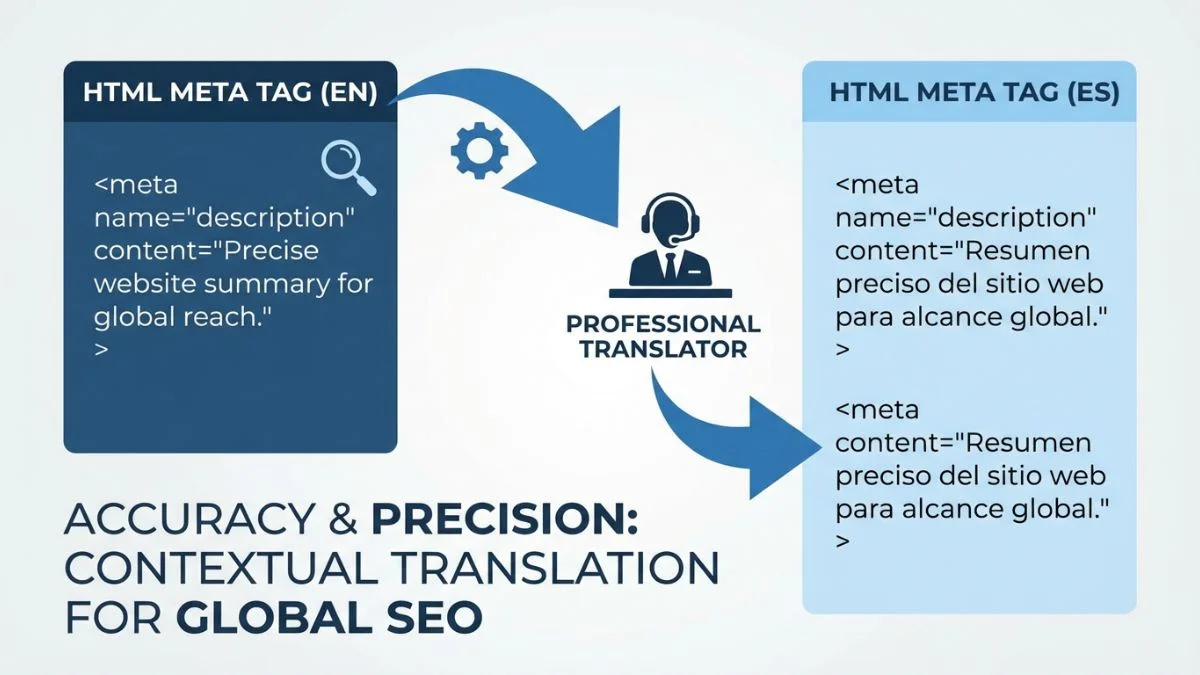
How to Translate SEO Metadata Correctly

How to Translate SEO Metadata Correctly in 2026
A practical guide to localizing title tags, meta descriptions, and structured metadata without losing rankings.
Translating SEO metadata is not a copy-and-paste task. Title tags and meta descriptions are your first impression in a new market, and bad translations can reduce click-through rate, confuse search engines, and misalign with local intent. In international SEO, metadata localization is often the difference between ranking and being ignored.
This guide explains how to translate SEO metadata correctly for multilingual websites in 2026. You will learn how to adapt titles and descriptions for local search intent, how to align metadata with hreflang, and how to avoid common translation mistakes that hurt performance.
Why Metadata Translation Matters
Meta titles and descriptions influence rankings indirectly through click-through rate and relevance signals. When metadata is poorly translated, users may not click, or they may bounce quickly due to mismatched expectations. According to Google Search Central, titles should be descriptive, unique, and match page content. This is even more important in international SEO.
What Metadata Includes
- Title tag (SEO title)
- Meta description
- Open Graph title and description
- Twitter card metadata
- Schema title/description fields
Translation vs Localization for Metadata
Translation converts words. Localization adapts them to local search intent. For metadata, localization matters more than literal accuracy.
| Element | Translation Risk | Localization Fix |
|---|---|---|
| Title Tag | Unnatural phrasing, wrong keyword order | Use local keywords and intent-based phrasing |
| Meta Description | Too long or too short for local language | Adjust length for language expansion |
| Structured Data | Mismatched schema text vs page content | Localize schema fields to match page copy |
How to Translate Title Tags Correctly
- Start with localized keyword research
- Keep within pixel limits (roughly 50-60 chars in English)
- Match local phrasing and syntax
- Include brand name when needed
- Avoid literal translations that sound unnatural
For example, "Best CRM Software for Small Businesses" may become "Mejor software CRM para pymes" in Spain, but in Latin America, a more common phrase might be "Software CRM para pequeñas empresas".
How to Translate Meta Descriptions Correctly
Meta descriptions are not direct ranking factors, but they strongly influence CTR. Localized descriptions should align with what users expect in the local SERP.
- Highlight local benefits (pricing, support, delivery)
- Use local terminology and tone
- Adjust length for language expansion
- Include a localized call to action
Metadata Alignment with Hreflang
Each language version should have its own metadata that matches the hreflang mapping. If your page is /de/ and hreflang is de-DE, the metadata should be in German and aligned with the localized content.
Use hreflang guidance and test with Search Console.
Metadata Translation Workflow
- Extract all metadata fields from the source language
- Localize keywords and intent for the target market
- Rewrite titles and descriptions to fit local syntax
- Check character and pixel length
- Align with page copy and H1
- Validate with native review
- Publish and test CTR by market
Common Mistakes to Avoid
- Using the same title tag across multiple languages
- Literal translations that ignore local intent
- Overstuffing keywords in translated titles
- Leaving meta descriptions blank in some locales
- Misaligned schema descriptions
Tools for Metadata Localization
- DeepL for high-quality translations
- Google Translate for quick drafts
- Ahrefs and Semrush for localized keyword research
- SISTRIX for European market insights
- Similarweb for market behavior
Internal Resources from Bright SEO Tools
- Write SEO-Friendly Meta Descriptions
- Improve CTR with SEO Titles
- Use Keywords Effectively
- On-Page SEO Checklist
- SEO for Beginners
- Keyword Research Tool
- Website SEO Score Checker
- SEO-Friendly Landing Pages
- Content Marketing and SEO
- Improve Content Readability
Frequently Asked Questions
Should I translate or localize title tags?
Localize them. Use local keywords and natural phrasing rather than direct translations.
Do meta descriptions need translation?
Yes. Meta descriptions should be localized for each language to improve CTR and relevance.
How long should translated titles be?
Keep within pixel limits. Some languages are longer, so prioritize the main keyword early.
Can I use machine translation for metadata?
Only as a starting point. Always have a native reviewer adjust for intent and tone.
Should schema descriptions be translated?
Yes. Schema text should match the page language and content.
What is the biggest metadata mistake in international SEO?
Reusing English metadata across all locales. This causes mismatch and poor CTR.
How do I test localized metadata?
Track CTR by market in Search Console and adjust titles and descriptions based on performance.
Should brand names be translated in titles?
Usually no. Keep brand names consistent, but translate descriptors and benefits.
Do I need different metadata for each country sharing a language?
Sometimes. If search intent or wording differs, create separate metadata for each country.
How do I align metadata with hreflang?
Ensure each hreflang URL has metadata in the correct language and consistent with the localized page content.