How to Turn an AI Essay Outline Into Your Own Authentic Writing

It's 11:40 p.m. The essay is due at nine. You asked an AI tool for help, and it handed you a tidy outline: an introduction, three body sections with Roman numerals, a conclusion that "ties it all together." It looks finished. It also looks exactly like the outline everyone else in your class got.
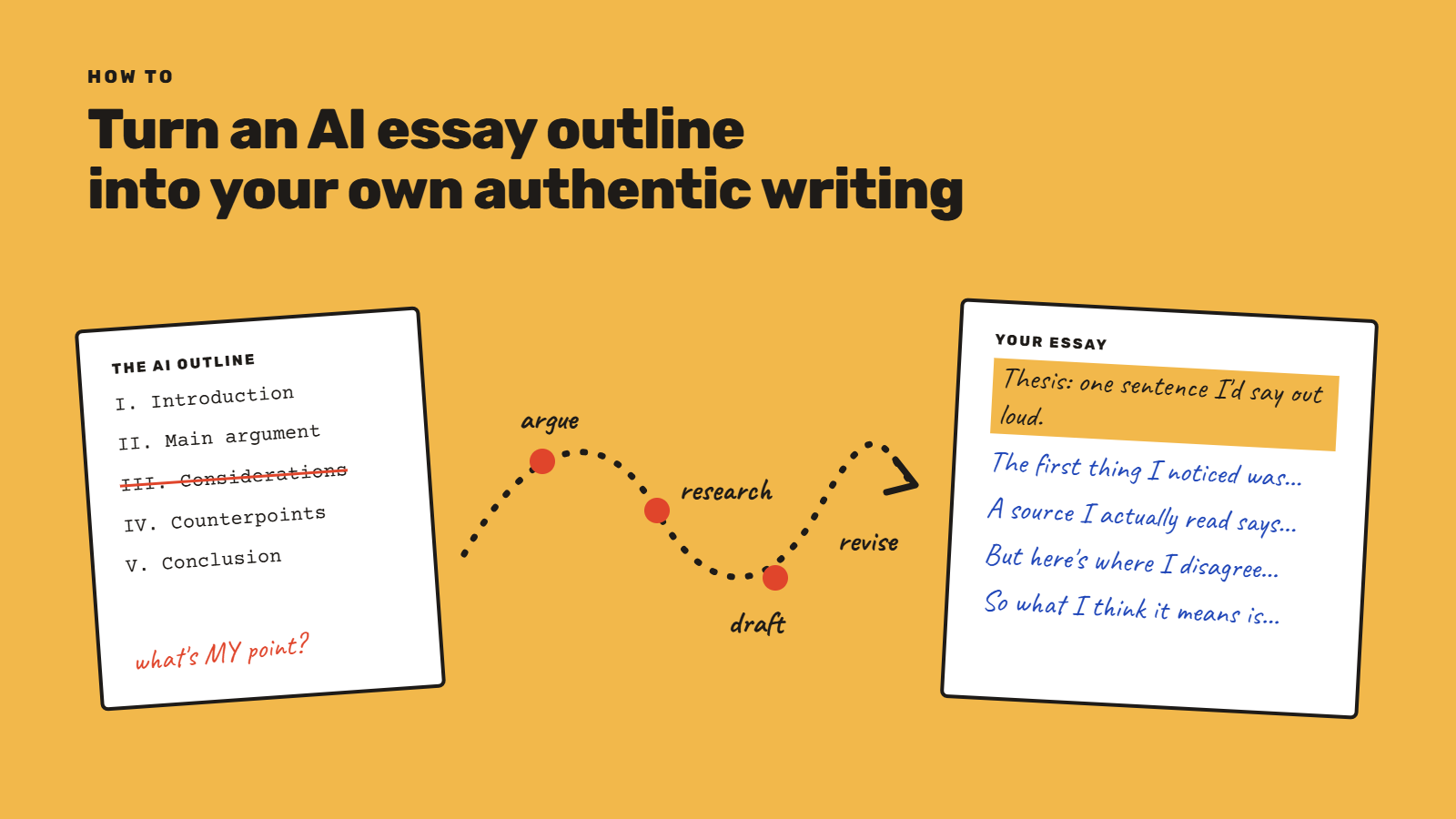
That outline is a map. The essay is the trip, and nobody can take it for you. If you've typed "turn AI essay into human" into a search bar tonight, this guide is the honest answer: the way to go from AI essay to human writing is to use the outline as scaffolding and put every sentence on the page yourself. Below are six moves that make that faster than it sounds, a before-and-after example, and what to keep on hand in case a detector ever questions your work.
First, Check What Your Course Allows
Before anything else, read your syllabus or ask your instructor. Rules differ wildly. Some courses welcome AI for brainstorming and outlining. Others ban it outright. A few ask you to disclose exactly how you used it.
You're far from alone in asking. In the 2026 HEPI survey of UK undergraduates, 95% said they now use generative AI in some form, and 39% use it to structure their thoughts for assessed work. The same survey found 12% were pasting AI-generated text directly into assignments, up from 3% two years earlier. That last group is the one taking the real risk. Trying to turn an AI essay into human-sounding text for a course that bans AI is still submitting work you didn't write, however much the wording changes. Using AI for an outline, where it's allowed, is a very different thing.
Everything that follows assumes AI-assisted outlining is permitted. If it isn't, close the tab and outline on paper. The six moves still work.
Why Following the Outline Word for Word Backfires
AI outlines are built from the most common way a topic gets discussed. That makes them sensible and safe. It also makes them generic. Ten students using the same prompt get ten nearly identical skeletons, and essays built on identical skeletons start to sound alike. Most people looking for a way to go from AI essay to human writing are really asking how to make the result sound like them, and a shared skeleton works against that from the start.
There's a learning cost too. In an MIT study that followed 54 students over four months, participants who wrote essays with ChatGPT showed lower brain engagement, and most struggled to accurately quote from essays they had just written. Their essays were also more uniform than those written without help. The small study has its critics, but the finding matches what most teachers see. When the thinking happens somewhere else, you remember less of it, and your essay sounds less like you.
So the goal when you turn an AI essay into human work is to move the thinking back to you. The outline can stay. The decisions have to become yours.
Six Moves to Turn an AI Essay Outline Into Human Writing
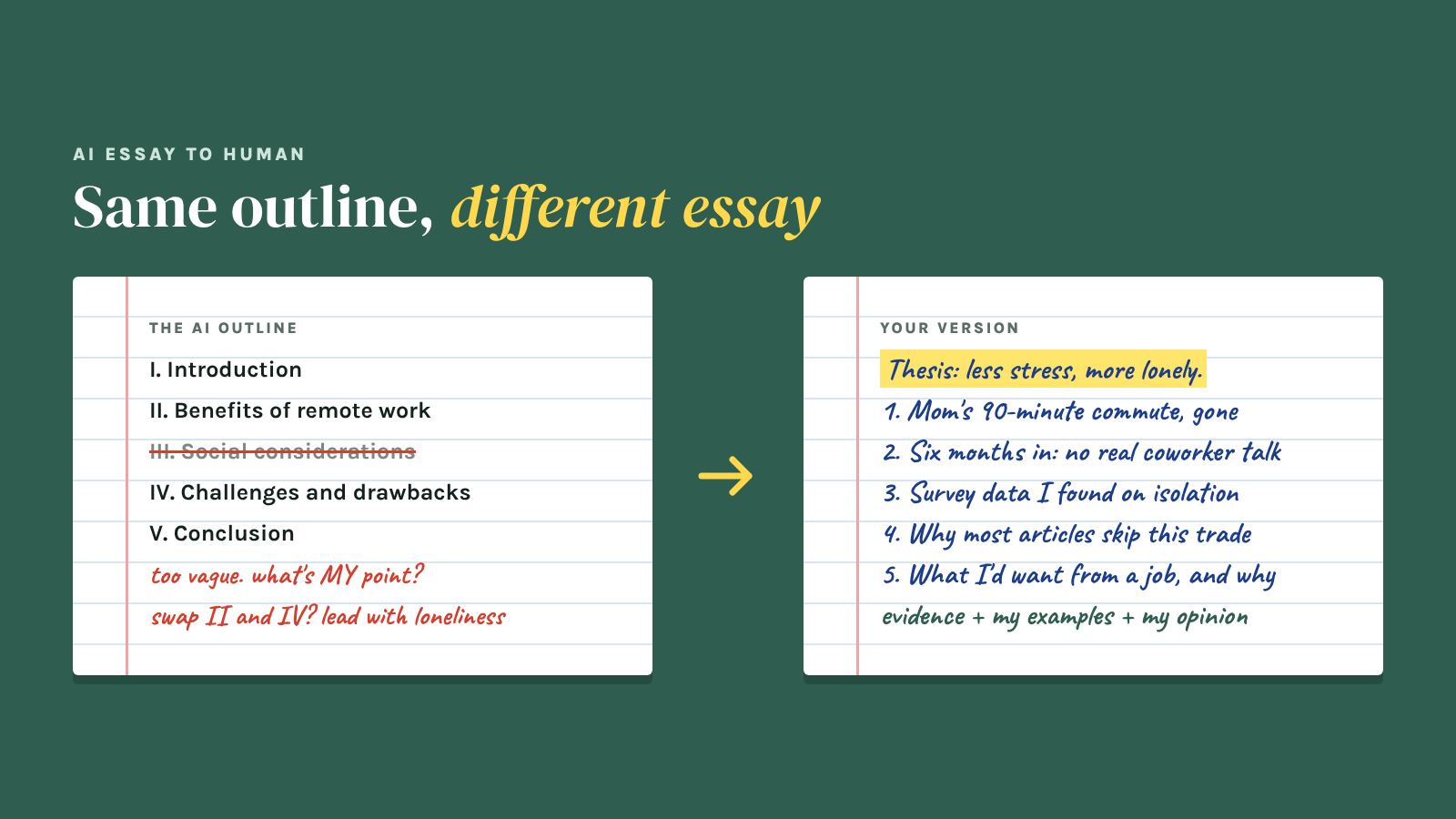
Move 1: Argue with the outline
Print it or paste it into a blank document and mark it up. Cross out the point you find boring. Circle the one you disagree with. Swap the order if the strongest idea is buried in section three. An outline you've argued with is already halfway to being yours.
Move 2: Rewrite the thesis in one sentence you'd say out loud
AI theses tend to sound like this: "This essay will explore the multifaceted impacts of remote work on employee wellbeing." Nobody talks like that. Try: "Remote work made me less stressed and more lonely, and I think most people my age feel the same trade-off." It's specific, it takes a side, and it tells you what the rest of the essay has to prove.
Move 3: Replace every generic point with evidence you found
Outline points like "economic impacts" or "social considerations" are placeholders. For each one, find a real source, a statistic, a quote, or a case you read yourself. This is where the shift from AI essay to human argument really starts, because research turns a template into a case, and it's also where AI outlines most often go wrong, since they sometimes suggest sources that don't exist. Check every reference.
Move 4: Draft with the AI closed
This is the move that matters most. Close the chat window and write your first draft from your marked-up outline and your notes. It will be messy. Good. A messy first draft written from your own memory is far more useful than a clean one you copied, because it shows you what you actually understand. Students who make the jump from AI essay to human draft this way usually find the second draft comes much faster.
Move 5: Add your fingerprints
Every paragraph should contain something an AI couldn't have produced on its own: an example from your life or your reading, a connection to something from class, an opinion you'd defend, a question you still have. These details are what make writing feel human to a reader, and they're impossible to fake convincingly.
Move 6: Read it out loud, then revise
Read the full draft aloud. You'll hear sentences that run too long, transitions that don't connect, and phrases you'd never say. Fix them in your own words. If one sentence still sounds stiff after three tries, cut it. This last pass is where you finally turn an AI essay into human writing that sounds like you on a good day.
AI Essay to Human: A Quick Before-and-After
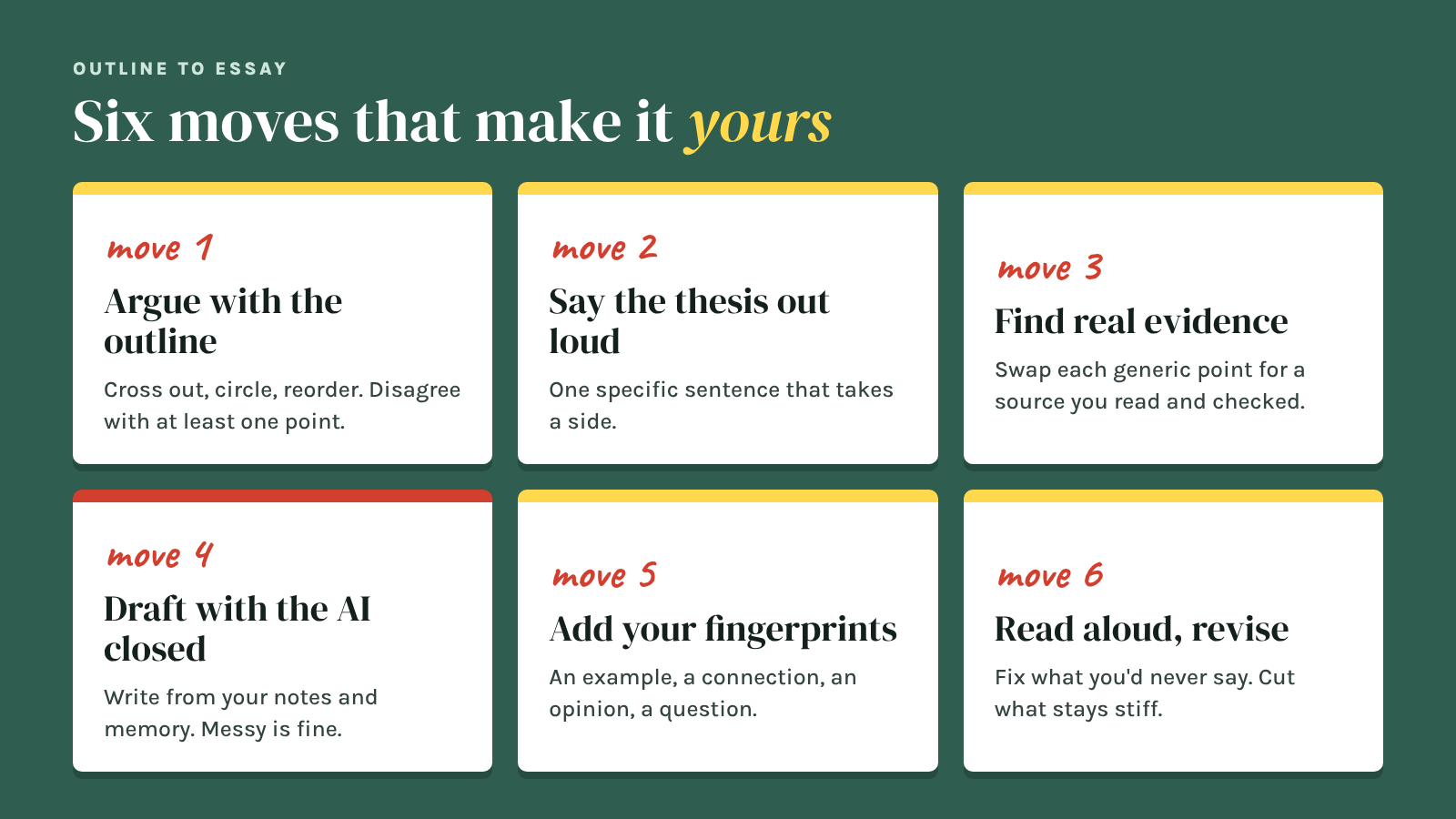
Here's what the shift from AI essay to human writing looks like on one body paragraph, using that remote work thesis.
Following the outline word for word:
Remote work offers numerous benefits for employee well-being. Workers save time on commuting, enjoy greater flexibility, and often report lower stress levels. Additionally, remote work allows individuals to better balance personal and professional responsibilities, leading to improved overall satisfaction.
After the six moves:
The first thing my mom noticed when she started working from home was the missing commute. Ninety minutes a day, gone. She slept later, cooked real dinners, and stopped snapping at us on Sunday nights. But six months in, she admitted she hadn't had a real conversation with a coworker in weeks. That trade, less stress for less contact, is the part most articles about remote work skip.
Same point in the outline. Completely different essay. The second version has a real person, a number, a turn in the middle, and a claim that sets up the next paragraph. No tool wrote it, so no tool can claim it.
What About AI Detectors?
Writing it yourself is the safest path from AI essay to human work, and it puts you in the strongest possible position. That doesn't mean detectors will always agree. They make mistakes, and some groups get hit harder than others. One widely cited Stanford-led study found that detectors misclassified essays by non-native English speakers as AI-written at an average rate of 61%, as this roundup of Turnitin false positives explains.
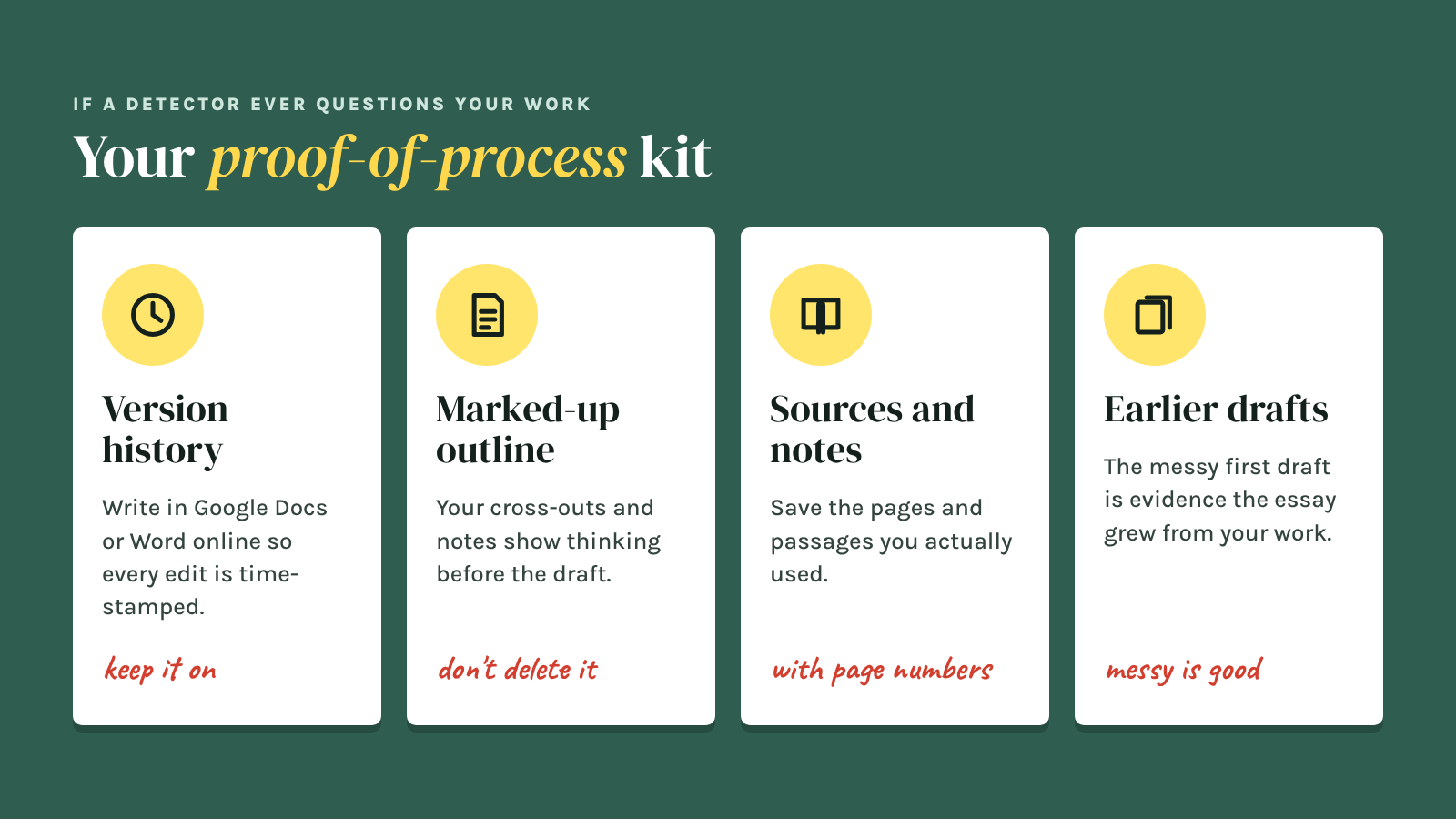
Three habits protect you:
- Write in a document with version history, like Google Docs or Word online. Your edit history shows the essay growing over hours or days.
- Keep your marked-up outline and notes. They show your thinking before the draft existed.
- Save your sources, with the pages or passages you used.
You can also run a final self-check before submitting. A free AI detector shows which passages read as predictable, which often points to sentences that came out stiff or formulaic.
Where do humanizer tools fit? A tool can help smooth the rhythm of sentences you wrote, or of AI-assisted text in settings where that's permitted, like a blog post or a work email. It can't make an essay you didn't write into your own work, and using one to hide AI writing in a course that bans it is still a breach of the rules. The only reliable way to turn an AI essay into human writing that's genuinely yours is to write it.
Signs Your Draft Still Sounds Like the Outline
Even after you turn an AI essay into human writing, outline habits can linger. Watch for these:
- Every body paragraph starts with "Firstly," "Additionally," or "Furthermore."
- Each section is almost the same length.
- Your thesis could be pasted into a classmate's essay without anyone noticing.
- There isn't a single example, name, number, or place you chose yourself.
- The conclusion repeats the introduction with the words shuffled.
If two or more sound familiar, go back to moves 3 and 5. Those are where an outline becomes an essay.
The Takeaway
An AI outline can save you from a blank page, and that's useful. But the essay your instructor wants to read lives in the parts no outline can supply, and that's where the real move from AI essay to human writing happens: your thesis in your words, evidence you tracked down, examples from your life, and sentences you'd actually say. Argue with the outline, draft with the AI closed, add your fingerprints, and keep a record of how you got there. That's how to turn an AI essay outline into human writing you can put your name on and defend if anyone ever asks.