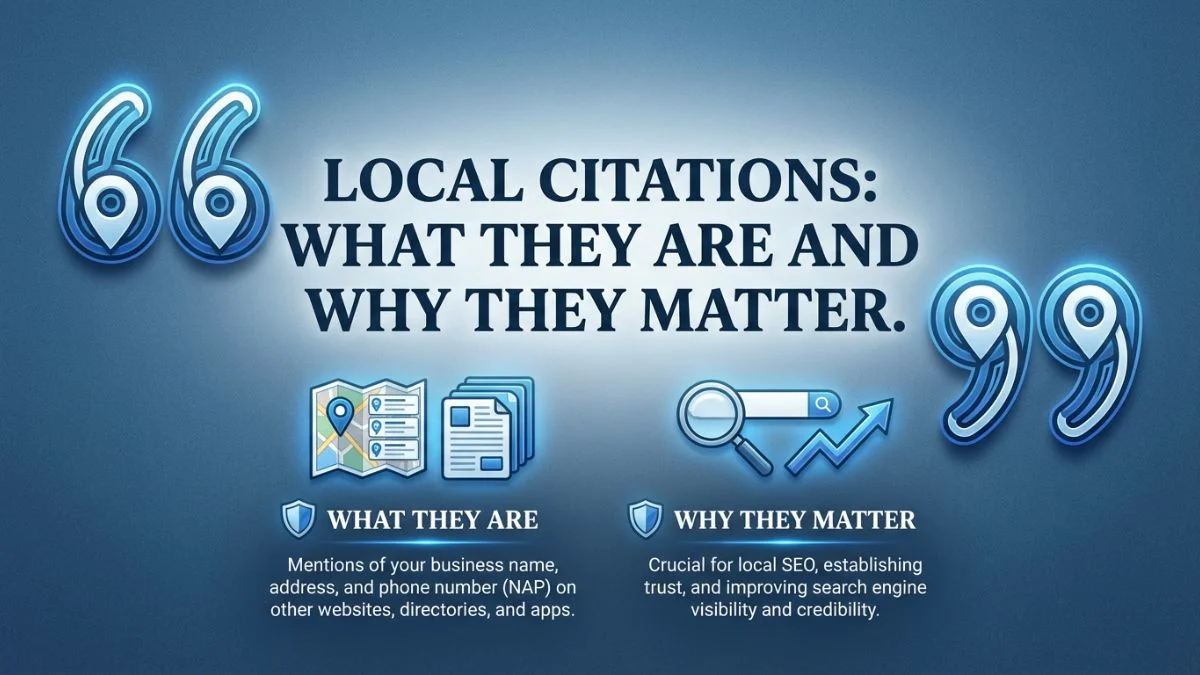
Local Citations What They Are and Why They Matter

Local Citations: What They Are and Why They Matter [2026]
Master local citations to build authority, improve rankings, and dominate local search.
If you're serious about Local SEO, you can't ignore local citations. These online references to your business information are one of the foundational ranking factors that determine whether you appear in the Google Map Pack or get buried on page three of search results.
According to Moz's Local Search Ranking Factors study, citation signals account for approximately 11% of local ranking factors. While that might not sound like a massive number, in competitive local markets, that 11% can be the difference between ranking #1 and ranking #10—which is essentially the difference between thriving and struggling.
Yet many businesses treat citations as an afterthought. They might claim their Google Business Profile and perhaps a Yelp listing, then wonder why they're not ranking. The reality is that BrightLocal's research shows top-ranking businesses have an average of 89 citations, while businesses on page two have an average of just 47.
This comprehensive guide will teach you everything about local citations—what they are, why they matter, how to build them effectively, and how to avoid the mistakes that sabotage your Local SEO efforts.
📋 Key Takeaway
Local citations are online mentions of your business NAP (Name, Address, Phone) that validate your business existence to search engines. Building consistent, high-quality citations across authoritative directories improves local rankings, builds trust, and helps customers find accurate information about your business.
What Are Local Citations?
A local citation is any online mention of your business's NAP (Name, Address, Phone number). Citations can appear in various formats and locations across the web:
- Business directories: Yelp, YellowPages, Better Business Bureau
- Search engines: Google Business Profile, Bing Places, Apple Maps
- Social media: Facebook Business Page, LinkedIn, Instagram
- Review sites: TripAdvisor, Healthgrades, Avvo
- Local websites: Chamber of commerce, local news sites, community blogs
- Data aggregators: Acxiom, Data Axle, Factual, Neustar Localeze
- Apps: Navigation apps, food delivery platforms, booking services
Not all citations are created equal. They fall into two main categories:
Structured vs. Unstructured Citations
| Type | Description | Examples |
|---|---|---|
| Structured Citations | Formal directory listings with NAP in designated fields, often including categories, hours, photos, and reviews | Yelp, Google Business Profile, YellowPages, TripAdvisor |
| Unstructured Citations | Mentions of your business information within content without standardized format | Blog posts, news articles, event listings, sponsor mentions |
Both types matter. Structured citations are easier to build systematically and carry more direct SEO weight. Unstructured citations come naturally through PR, partnerships, and community involvement, and they signal authenticity and local engagement.
For broader context on how citations fit into Local SEO, see our guide on what is Local SEO and how it works.
Why Local Citations Matter for SEO
Citations serve multiple critical functions in Local SEO:
1. Validation and Trust
Citations act as votes of confidence for your business. When Google sees your NAP consistently mentioned across hundreds of authoritative websites, it validates that your business is real, legitimate, and established. This builds trust in Google's algorithm.
Think of it like this: if you tell someone you own a business, they might believe you. If 100 other sources independently confirm it, there's no doubt. That's what citations do for search engines.
2. Direct Ranking Impact
According to Moz's research, citation signals include:
- NAP consistency: How uniform your information is across all citations
- Citation volume: The total number of citations you have
- Authority of sources: Citations from high-authority sites carry more weight
- IYP/aggregator NAP consistency: Consistency on major data aggregators
These signals combine to account for approximately 11% of local pack ranking factors.
3. Discovery and Visibility
Citations don't just help rankings—they provide additional discovery channels. A customer searching on Yelp, browsing the chamber of commerce directory, or looking at TripAdvisor can find your business through these citations, even if they never visit Google.
According to BrightLocal's Consumer Survey, 87% of consumers use multiple sources to evaluate local businesses, not just Google.
4. NAP Data Consistency
Citations create a web of interconnected data that search engines use to verify information accuracy. When your NAP is consistent across 100 directories, and all those directories point to the same website, Google has high confidence that the information is correct.
Conversely, inconsistent citations confuse search engines and weaken your local authority. Learn more in our guide on NAP consistency for Local SEO.
The Top Local Citation Sites for 2026
Not all citation sources are equally valuable. Focus on these high-priority directories first:
Tier 1: Essential Citations (Must-Have)
🏆 Top 10 Citations Every Business Needs
- Google Business Profile - Most important, highest impact
- Bing Places for Business - Second-largest search engine
- Apple Maps - Critical for iOS users
- Yelp - High authority, heavy consumer usage
- Facebook Business Page - Social proof and reviews
- Better Business Bureau - Trust and credibility signal
- YellowPages - Traditional but still relevant
- MapQuest - Navigation and directory
- Foursquare - Location data provider
- Tripadvisor - Hospitality and travel focus
Tier 2: Important General Directories
Tier 3: Industry-Specific Citations
These vary by business type but carry significant weight in your industry:
| Industry | Key Citation Sites |
|---|---|
| Restaurants | OpenTable, Zomato, Grubhub, DoorDash, UberEats |
| Healthcare/Medical | Healthgrades, Vitals, WebMD, Zocdoc, RateMDs |
| Legal | Avvo, Justia, Lawyers.com, FindLaw, Martindale |
| Hotels/Lodging | TripAdvisor, Hotels.com, Booking.com, Expedia |
| Real Estate | Zillow, Trulia, Realtor.com, Redfin |
| Automotive | Cars.com, Edmunds, CarGurus, DealerRater |
| Home Services | Angie's List, HomeAdvisor, Thumbtack, Houzz |
Data Aggregators: The Citation Multipliers
Data aggregators are companies that collect and distribute business information to hundreds of directories, GPS systems, and apps. Getting listed on these multiplies your citation reach:
- Data Axle (formerly Infogroup): Powers YellowPages, Superpages, and 100+ others
- Acxiom: Major data aggregator for multiple platforms
- Factual: Supplies data to Apple Maps, Bing, and others
- Neustar Localeze: Distributes to major search engines and directories
Services like Moz Local and Yext submit your information to these aggregators, which then distribute it widely.
How to Build Local Citations: Step-by-Step
Method 1: Manual Submission (DIY Approach)
Manual submission gives you complete control and ensures accuracy on high-priority sites.
📝 Manual Citation Building Process
- Prepare your information: Create a master document with exact NAP, website URL, business description, categories, hours, photos
- Search for existing listings: Google "[your business name] + [city]" to find unclaimed listings
- Claim existing listings first: Many directories auto-generate listings—claim and verify these
- Create new listings: For sites without existing listings, create accounts and submit
- Use identical information: Copy-paste from your master document to ensure consistency
- Complete all fields: Fill out every available field including hours, categories, descriptions
- Add photos: Upload your logo and business photos to each listing
- Track progress: Use a spreadsheet to track which citations you've completed
Pros: Free, complete control, highest accuracy
Cons: Time-intensive (20-40 hours for 50 citations), tedious,
requires ongoing maintenance
Method 2: Citation Distribution Services
Automated services streamline the process by submitting your information to hundreds of directories.
| Service | Cost | Coverage |
|---|---|---|
| Moz Local | $14/month | Distributes to top aggregators and ~50 directories |
| Yext | Custom pricing (typically $500+/year) | 150+ directories, real-time sync, advanced features |
| BrightLocal | $29-$249/month | Citation building, tracking, and audit tools |
| Whitespark | $20/citation (done-for-you service) | Manual citation building by experts |
| Synup | $50+/month | 100+ directories, multi-location support |
Pros: Fast, scales easily, ongoing monitoring
Cons: Monthly/annual cost, less control over quality, may not
cover niche directories
Method 3: Hybrid Approach (Recommended)
The most effective strategy combines both methods:
- Manually build top 20 citations: Google Business Profile, Yelp, BBB, Bing, Apple Maps, Facebook, and top industry directories
- Use Moz Local or similar: For broad distribution to aggregators and mid-tier directories
- Monitor and maintain: Regularly audit for accuracy and update as needed
This gives you quality control for high-impact citations while efficiently scaling to hundreds of directories.
Citation Audit: Finding and Fixing Problems
Before building new citations, audit your existing ones to identify issues that might be hurting your rankings.
Step 1: Discovery
Find all existing citations using these methods:
- Google your business name + city: See what appears in search results
- Use citation audit tools: BrightLocal Citation Finder, Moz Local, Whitespark Citation Finder
- Check competitors: See where competitors are listed that you're not
- Search for variations: Try different spellings or old addresses if you've moved
Step 2: Analyze for Issues
Common citation problems to look for:
🔍 Citation Issues Checklist
- ☐ Inconsistent NAP: Variations in name, address format, or phone number
- ☐ Duplicate listings: Multiple profiles for same location
- ☐ Outdated information: Old addresses, disconnected phone numbers, closed locations
- ☐ Incomplete listings: Missing hours, categories, descriptions, or photos
- ☐ Wrong categories: Incorrect business classifications
- ☐ Broken website links: Links to 404 pages or wrong URLs
- ☐ Low-quality directories: Citations on spam or irrelevant sites
- ☐ Unclaimed listings: Existing profiles you don't control
Step 3: Prioritize Fixes
Fix issues in this order:
- High-priority inconsistencies: Google, Yelp, Facebook, Bing, Apple Maps first
- Duplicate listings: Merge or delete duplicates (contact directory support if needed)
- Top 20 directories: Ensure these are 100% accurate and complete
- Data aggregators: Fix information at the source to cascade corrections
- Lower-priority directories: Address systematically over time
Step 4: Ongoing Monitoring
Citations require maintenance:
- Monthly: Check top 10 citations for accuracy
- Quarterly: Full audit of top 50 citations
- Immediately: Update all citations when NAP changes (new phone, moved location)
- Annually: Comprehensive review of entire citation profile
For detailed NAP management, see our guide on NAP consistency for Local SEO.
NAP Consistency: The Golden Rule of Citations
NAP consistency is the most critical factor in citation effectiveness. Even minor variations confuse search engines and dilute your authority.
✅ NAP Consistency Rules
- Identical formatting: If you use "Street" in one place, use "Street" everywhere (not "St.")
- Suite/unit numbers: Include or omit consistently across all citations
- Phone format: Choose one format and stick to it: (555) 123-4567 vs. 555-123-4567 vs. 555.123.4567
- Business name: Use your legal business name exactly, without keywords or extra descriptors
- Abbreviations: Avoid abbreviations or use them consistently
- Punctuation: Commas, periods, and special characters should match exactly
Example of inconsistent NAP (bad):
Citation 1: Joe's Plumbing & Heating, 123 Main Street, Suite 5, Austin, TX 78701, (512) 555-1234
Citation 2: Joes Plumbing, 123 Main St #5, Austin TX 78701, 512-555-1234
Citation 3: Joe's Plumbing, 123 Main Street, Austin, Texas 78701, 512.555.1234
Example of consistent NAP (good):
Citation 1: Joe's Plumbing, 123 Main Street Suite 5, Austin, TX 78701, (512) 555-1234
Citation 2: Joe's Plumbing, 123 Main Street Suite 5, Austin, TX 78701, (512) 555-1234
Citation 3: Joe's Plumbing, 123 Main Street Suite 5, Austin, TX 78701, (512) 555-1234
Advanced Citation Strategies
1. Competitor Citation Analysis
Analyze where your top competitors are listed to find opportunities:
- Use BrightLocal's Citation Tracker to compare your citations to competitors
- Identify directories where competitors are listed but you're not
- Prioritize building citations on these sites
- Look for industry-specific directories you may have missed
2. Local Citations from Community Involvement
Unstructured citations from local organizations carry significant weight:
- Join local chamber of commerce (includes directory listing)
- Sponsor local sports teams, events, or charities
- Participate in community events (often listed on community calendars)
- Partner with local nonprofits
- Get featured in local news or blogs
These not only provide citations but also build local backlinks.
3. Niche and Vertical-Specific Citations
Don't overlook specialized directories in your industry:
- Professional associations: State bar associations, medical boards, trade groups
- Industry marketplaces: Houzz for home improvement, WeddingWire for wedding services
- Local vertical directories: City-specific business directories
- Niche review sites: Industry-specific review platforms
4. Citations for Multi-Location Businesses
Managing citations for multiple locations requires special attention:
- Create separate listings for each physical location
- Use unique phone numbers for each location when possible
- Include location-specific information (photos of each location, unique descriptions)
- Track citations per location independently
- Use tools like Yext or Synup for efficient multi-location management
Common Citation Building Mistakes
❌ Mistakes That Sabotage Citation Efforts
- Inconsistent NAP across platforms: Even small variations hurt rankings
- Claiming without completing: Partially filled profiles are almost useless
- Ignoring duplicate listings: Multiple profiles for one location confuse Google
- Using P.O. boxes: Physical street addresses perform better (unless you're a Service Area Business)
- Keyword stuffing business name: Adding keywords to your business name violates guidelines
- Building citations on spam sites: Low-quality directories can hurt more than help
- Failing to update after changes: Moving or changing phone without updating citations
- No ongoing monitoring: Citations require maintenance to stay effective
- Quantity over quality: Focusing on volume instead of authoritative sources
- Not claiming existing listings: Unclaimed listings can contain incorrect information
Measuring Citation Impact
Track these metrics to assess your citation building efforts:
📊 Citation Performance Metrics
- Total citation count: Number of citations across all platforms
- NAP consistency score: Percentage of citations with accurate NAP
- Citation authority score: Quality/authority of citation sources
- Completed vs. incomplete: Ratio of fully completed citations
- Duplicate listings identified/resolved: Track cleanup efforts
- Competitor citation gap: How you compare to top competitors
- Local pack rankings: Your position for target keywords (citations influence this)
- Citation-driven traffic: Visits from citation sources (Google Analytics)
Use tools like BrightLocal, Moz Local, or Whitespark to automate citation monitoring and reporting.
For comprehensive tracking, see our guide on how to track Local SEO performance.
Frequently Asked Questions
What are local citations?
Local citations are online mentions of your business name, address, and phone number (NAP) on websites, directories, apps, and platforms. They validate your business existence to search engines and contribute to local SEO rankings. Citations can be structured (directory listings) or unstructured (mentions on blogs, news sites).
Why do local citations matter for SEO?
Local citations matter because they account for approximately 11% of local ranking factors according to Moz. They validate your business information, build trust with Google, improve local search visibility, and help customers find accurate information about your business across the web.
How many citations do I need for Local SEO?
Start with 30-50 quality citations from authoritative directories, then expand to 100+ over time. Quality and consistency matter more than quantity. Focus on the top 20 general directories first, then add 10-20 industry-specific citations. Competitive markets may require 150-200+ citations.
What is the difference between structured and unstructured citations?
Structured citations are formal directory listings with your NAP in designated fields (Yelp, Yellow Pages). Unstructured citations are mentions of your business information within content on websites, blogs, news articles, or social media posts without a standardized format.
How do I build local citations?
Build citations by manually submitting to top directories (Google Business Profile, Yelp, Bing Places), using citation distribution services (Moz Local, Yext), claiming existing listings, getting listed in industry-specific directories, and earning mentions through local PR and community involvement.
What are the best citation sites for Local SEO?
The best citation sites include Google Business Profile, Yelp, Facebook Business, Bing Places, Apple Maps, Better Business Bureau, YellowPages, Foursquare, MapQuest, and industry-specific directories like Healthgrades (medical), Avvo (legal), or TripAdvisor (hospitality).
How do I audit my existing citations?
Audit citations using tools like Moz Local, BrightLocal, or Whitespark to scan the web for your business mentions. Check for NAP consistency, duplicate listings, incorrect information, and missing citations. Fix inconsistencies and claim unclaimed listings to strengthen your citation profile.
Can citations hurt my Local SEO?
Yes, inconsistent or inaccurate citations can hurt Local SEO by confusing search engines and diluting your authority. Duplicate listings, varying NAP formats, outdated information, or citations on low-quality spam sites can negatively impact rankings. Regular audits and corrections are essential.
How long does it take for citations to affect rankings?
New citations typically begin affecting rankings within 4-8 weeks as search engines crawl and index them. The impact compounds over time—building 50 citations might show results in 2-3 months, while establishing a comprehensive citation profile can take 6-12 months to reach full potential.
Should I use citation building services or do it manually?
A hybrid approach works best: manually submit to top 20 directories for accuracy and control, then use services like Moz Local or Yext for efficient distribution to hundreds of smaller directories. Manual submissions ensure quality for critical citations, while services scale efficiently for broader coverage.
Conclusion: Building a Powerful Citation Foundation
Local citations are one of the foundational pillars of Local SEO success. While they might not be as glamorous as reviews or as immediately impactful as Google Business Profile optimization, they provide the structural integrity that supports all your other local SEO efforts.
Your Citation Building Action Plan:
- Week 1: Audit existing citations, fix top 10 inconsistencies, create NAP master document
- Week 2: Manually build citations on top 10 essential directories
- Week 3: Add 10-20 industry-specific citations, consider Moz Local or Yext for broader distribution
- Week 4: Monitor for duplicates, complete all profile fields, add photos
- Ongoing: Quarterly audits, immediate updates when NAP changes, continuous expansion
Remember: citations are a long-term investment. You won't see overnight results, but consistent effort building quality, accurate citations will compound over months to give you a significant competitive advantage in local search.
The businesses dominating local search results aren't there by accident—they've systematically built strong citation profiles that validate their legitimacy to both search engines and potential customers. With this guide, you have everything you need to do the same.
For additional Local SEO strategies, explore our guides on optimizing Google Business Profile, Local SEO checklist for small businesses, and how to rank in Google Maps.
Start building your citation foundation today.