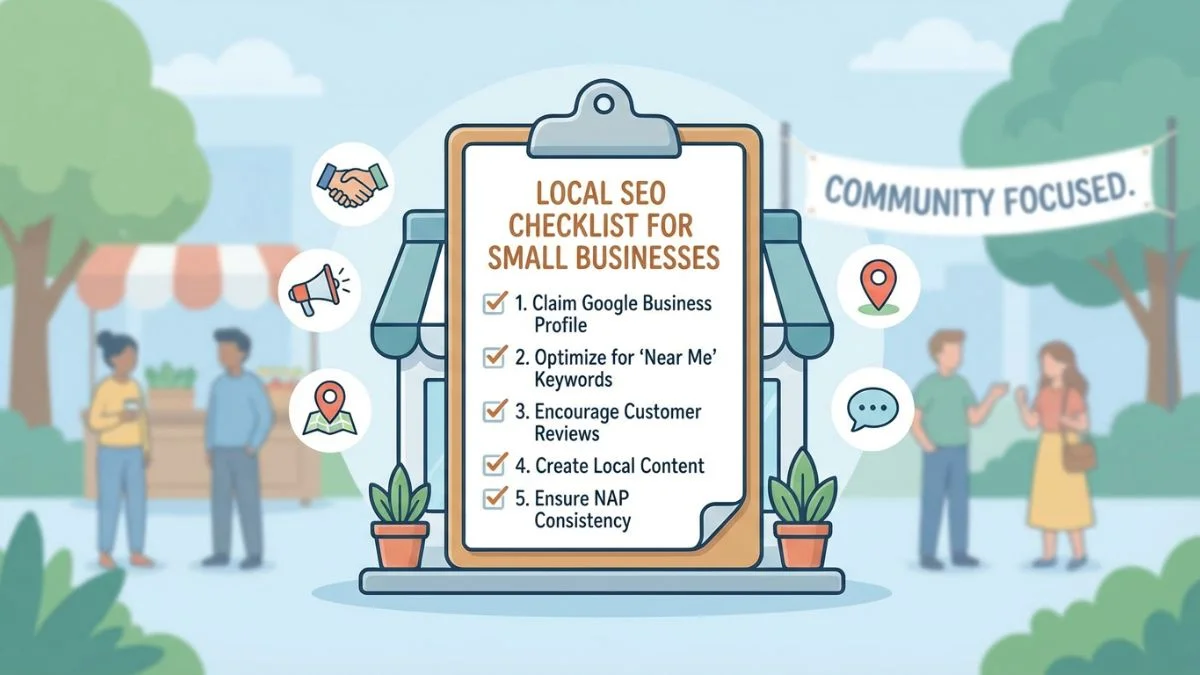
Local SEO Checklist for Small Businesses

Local SEO Checklist for Small Businesses: 2026 Edition
Complete step-by-step checklist to dominate local search and attract nearby customers.
Local SEO can feel overwhelming for small business owners juggling a thousand priorities. You know you need it—46% of all Google searches have local intent—but where do you start? Which tasks actually move the needle, and which are just noise?
This comprehensive Local SEO checklist cuts through the complexity. It's specifically designed for small businesses with limited time and budget, focusing on high-impact tasks that deliver real results. Whether you're a restaurant owner, dentist, plumber, or retail store, this checklist will guide you through every essential step of Local SEO.
According to BrightLocal's research, 87% of consumers used Google to evaluate local businesses in 2025, and 98% read online reviews. If you're not visible in local search, you're invisible to the vast majority of potential customers.
This checklist is organized into priority tiers—from foundational must-dos to advanced optimizations—so you can tackle the most impactful items first and build from there.
📋 How to Use This Checklist
Priority 1 (Foundation): Essential tasks every small
business must complete. Start here.
Priority 2 (Growth): Important optimizations to increase
visibility and rankings.
Priority 3 (Advanced): Competitive tactics to dominate your
local market.
Ongoing: Regular tasks to maintain and improve your Local
SEO.
Priority 1: Foundation (Week 1-2)
These are the non-negotiable basics. Complete these first before moving to more advanced tactics.
✅ Google Business Profile Setup
Your Google Business Profile (GBP) is the single most important Local SEO asset. According to Google's data, complete profiles receive 7x more clicks than incomplete ones.
Google Business Profile Checklist:
- ☐ Claim your business at business.google.com
- ☐ Verify your listing (via postcard, phone, email, or video)
- ☐ Enter exact legal business name (no keyword stuffing)
- ☐ Select best primary category (be specific, not generic)
- ☐ Add up to 9 relevant secondary categories
- ☐ Enter complete physical address or service areas
- ☐ Add local phone number (not toll-free)
- ☐ Include website URL
- ☐ Set accurate business hours (+ special hours for holidays)
- ☐ Write compelling 750-character business description
- ☐ Add booking/appointment URL if applicable
- ☐ Enable messaging feature
- ☐ Select all accurate attributes (accessibility, amenities, etc.)
For complete GBP optimization guidance, see our detailed guide on how to optimize Google Business Profile.
✅ Add High-Quality Photos
Visual content dramatically impacts engagement. Google reports businesses with photos receive 42% more direction requests.
Photo Checklist:
- ☐ Upload logo (square, minimum 720x720px)
- ☐ Add cover photo (landscape, high-quality)
- ☐ Include 3-5 exterior photos (storefront, building, signage)
- ☐ Add 5-10 interior photos (atmosphere, workspace, facilities)
- ☐ Upload 10-20 product/service photos
- ☐ Include 3-5 team photos (staff at work, group photos)
- ☐ Add action shots (team providing services)
- ☐ Upload videos if available (30-60 seconds, tour or demo)
Photo specs: JPG or PNG, 10 KB - 5 MB, minimum 720px tall and wide, well-lit, in focus, no filters or watermarks.
✅ Website NAP Consistency
NAP (Name, Address, Phone) consistency is critical for local rankings. Your business information must match exactly across your Google Business Profile, website, and all online directories.
NAP Consistency Checklist:
- ☐ Add NAP to website header or footer (appears on every page)
- ☐ Create dedicated Contact page with full NAP
- ☐ Use identical formatting as Google Business Profile
- ☐ Ensure phone number format is consistent (e.g., (555) 123-4567)
- ☐ Match street abbreviations exactly (Street vs. St.)
- ☐ Include/exclude suite numbers consistently
- ☐ Use same business name (don't add keywords)
For detailed guidance, read our article on NAP consistency for Local SEO explained.
✅ Implement Local Schema Markup
Schema markup is structured data that helps Google understand your business information. It's essential for appearing in rich snippets and improving local visibility.
Schema Markup Checklist:
- ☐ Add LocalBusiness schema to homepage
- ☐ Include name, address, phone, hours in schema
- ☐ Add geographic coordinates (latitude/longitude)
- ☐ Include price range indicator
- ☐ Add department/location schema for multi-location businesses
- ☐ Validate with Google's Schema Validator
For implementation details, see our guide on structured data and rich snippets explained.
✅ Claim Top Citation Listings
Local citations are online mentions of your NAP on directories and platforms. They validate your business existence and contribute to local rankings.
Essential Citation Checklist:
- ☐ Yelp for Business
- ☐ Facebook Business Page
- ☐ Bing Places for Business
- ☐ Apple Maps
- ☐ Better Business Bureau
- ☐ YellowPages
- ☐ Local chamber of commerce
- ☐ Industry-specific directories (e.g., Healthgrades for medical, Avvo for legal)
Learn more in our comprehensive guide on local citations: what they are and why they matter.
Priority 2: Growth (Week 3-8)
Once your foundation is solid, these tasks will accelerate your visibility and rankings.
✅ Generate Customer Reviews
Reviews are a major ranking factor, accounting for approximately 16% of local search signals according to Moz's research.
Review Generation Checklist:
- ☐ Get your Google review link from GBP dashboard
- ☐ Create short branded URL (e.g., yoursite.com/review)
- ☐ Train staff to ask for reviews verbally
- ☐ Send email requests post-purchase/service
- ☐ Add review request to receipts/invoices
- ☐ Create QR code linking to review page
- ☐ Display QR code in-store at checkout
- ☐ Send SMS follow-ups with review link
- ☐ Target: 3-5 new reviews per month minimum
- ☐ Respond to ALL reviews within 24-48 hours
- ☐ Implement review response templates
For proven strategies, read our detailed guide on how to get more reviews for Local SEO.
✅ Create Google Posts Weekly
Google Posts keep your profile active and provide additional visibility in search results and Maps.
Google Posts Checklist:
- ☐ Post at least once per week
- ☐ Include high-quality images with each post
- ☐ Write 100-300 words of compelling copy
- ☐ Add call-to-action buttons (Learn More, Call, Book, etc.)
- ☐ Use relevant keywords naturally
- ☐ Create posts for: updates, offers, events, products
- ☐ Set specific start/end dates for offers and events
- ☐ Repurpose blog content and social media posts
- ☐ Track post engagement in GBP Insights
✅ Optimize Website for Local Search
Your website must signal local relevance to search engines.
Website Local Optimization Checklist:
- ☐ Add city/region to homepage title tag
- ☐ Include location in H1 tag
- ☐ Write location-specific content on homepage
- ☐ Create dedicated service pages for each service
- ☐ Add location modifiers to service pages (e.g., "Plumbing Services in Austin")
- ☐ Create location pages for multi-location businesses
- ☐ Embed Google Map on contact page
- ☐ Add location to meta descriptions
- ☐ Include NAP in footer (linked to contact page)
- ☐ Create local content (city guides, local events, community involvement)
- ☐ Add location to image alt text naturally
- ☐ Ensure mobile-friendly design (test with Google's tool)
For technical optimization, see our guide on what is technical SEO and why you need it.
✅ Build Additional Citations
Expand beyond the top directories to build more local authority.
Extended Citation Checklist:
- ☐ Submit to 20+ general directories (Manta, Superpages, Citysearch)
- ☐ Add to 10+ industry-specific directories
- ☐ Get listed in local newspaper/news sites
- ☐ Join local meetup/event platforms
- ☐ List on chamber of commerce directory
- ☐ Add to neighborhood/community websites
- ☐ Submit to government/city business directories
- ☐ Use citation finder tools to discover opportunities
- ☐ Audit existing citations for accuracy monthly
✅ Manage Q&A Section
The Questions & Answers section on your Google Business Profile is often overlooked but provides optimization opportunities.
Q&A Optimization Checklist:
- ☐ Seed 10-15 common questions (use different accounts)
- ☐ Answer all questions within 24 hours
- ☐ Include keywords naturally in answers
- ☐ Provide detailed, helpful responses
- ☐ Monitor weekly for new questions
- ☐ Flag inappropriate or spam questions
- ☐ Correct misinformation from other users
Priority 3: Advanced (Months 3-6)
These tactics give you a competitive edge in crowded markets.
✅ Build Local Backlinks
Local backlinks from community websites, news outlets, and local organizations strengthen your local authority. According to Moz, link signals account for 13% of local ranking factors.
Local Link Building Checklist:
- ☐ Sponsor local sports teams or events
- ☐ Join local business associations
- ☐ Get featured in local news/press
- ☐ Partner with complementary local businesses
- ☐ Host or sponsor community events
- ☐ Contribute to local charity fundraisers
- ☐ Guest post on local blogs
- ☐ Get listed on "best of" local lists
- ☐ Offer scholarships (generates .edu links)
- ☐ Speak at local events or workshops
For comprehensive strategies, see our guide on local link building strategies.
✅ Create Location-Specific Content
Publishing local content establishes topical relevance and attracts local search traffic.
Local Content Checklist:
- ☐ Write city/neighborhood guides related to your industry
- ☐ Create "best [your service] in [city]" comparison content
- ☐ Cover local events and how they relate to your business
- ☐ Share customer success stories (with location mentions)
- ☐ Create seasonal content (e.g., "Winter Preparedness for [City] Homeowners")
- ☐ Publish local industry statistics and trends
- ☐ Interview local customers or partners
- ☐ Document community involvement
- ☐ Create location-specific FAQs
- ☐ Target: 1-2 local blog posts per month
✅ Optimize for Voice Search
With voice assistant usage growing, optimizing for conversational queries is increasingly important.
Voice Search Optimization Checklist:
- ☐ Create FAQ content answering natural language questions
- ☐ Target long-tail keywords ("where can I find...")
- ☐ Implement FAQ schema markup
- ☐ Optimize for "near me" searches
- ☐ Ensure fast page load times (voice prioritizes speed)
- ☐ Keep business hours updated (voice assistants pull this data)
- ☐ Use conversational language in content
- ☐ Claim voice assistant business profiles (Alexa, Siri)
✅ Monitor Competitor Performance
Understanding what competitors are doing helps you identify opportunities and stay ahead.
Competitor Analysis Checklist:
- ☐ Identify top 5 local competitors
- ☐ Analyze their Google Business Profiles
- ☐ Check their review count, rating, and velocity
- ☐ Review their photo quantity and quality
- ☐ Examine their Google Posts frequency
- ☐ Audit their website for local optimization
- ☐ Research their backlink profiles (use Ahrefs or Moz)
- ☐ Track their local rankings vs. yours
- ☐ Monitor their citation profiles
- ☐ Identify gaps you can exploit
Ongoing Monthly Tasks
Local SEO isn't one-and-done. These recurring tasks maintain and improve your rankings.
| Task | Frequency | Time Required |
|---|---|---|
| Post on Google Business Profile | Weekly | 15-30 minutes |
| Add new photos | Bi-weekly | 10-20 minutes |
| Request and respond to reviews | Daily/Weekly | 10-30 minutes |
| Answer Q&A questions | Weekly | 5-10 minutes |
| Monitor GBP Insights | Monthly | 15-20 minutes |
| Track local rankings | Monthly | 10-15 minutes |
| Audit citation accuracy | Quarterly | 1-2 hours |
| Publish local blog content | Monthly | 2-4 hours |
| Monitor competitor activity | Monthly | 30-60 minutes |
| Update business information (hours, services) | As needed | 5-10 minutes |
Total monthly time investment: 4-8 hours depending on your business size and competition level.
Essential Local SEO Tools for Small Businesses
The right tools streamline Local SEO and provide valuable insights:
Free Tools
- Google Business Profile: Manage your listing and track insights
- Google Search Console: Monitor search performance and technical issues
- Google Analytics 4: Track website traffic and conversions
- Google Posts: Share updates directly on your GBP
- Schema Markup Validator: Check structured data implementation
Affordable Paid Tools
- BrightLocal: $29-$129/month—local rank tracking, citation management, reporting
- Moz Local: $14/month—citation distribution and management
- Whitespark: $20/month—citation finder and local rank tracking
- Semrush: $119.95/month—comprehensive SEO suite with local tools
- Yext: Custom pricing—citation distribution to 100+ directories
Local SEO Budget Guide for Small Businesses
You don't need a massive budget to see results. Here's how to allocate resources effectively:
| Budget Level | Monthly Investment | What You Can Do |
|---|---|---|
| Bootstrap | $0-$50 | DIY everything using free tools, manual citations, self-generated content |
| Starter | $100-$300 | Add BrightLocal or Moz Local, use citation distribution service, outsource content writing |
| Growth | $500-$1,500 | Hire part-time Local SEO specialist, premium tools, review management platform, monthly content |
| Competitive | $2,000-$5,000 | Full-service agency, aggressive link building, multi-location management, comprehensive content strategy |
ROI Reality Check: According to BrightLocal's industry survey, 92% of businesses report positive ROI from Local SEO, with an average return of $14 for every $1 spent.
Measuring Your Local SEO Success
Track these key performance indicators to measure progress:
📊 Local SEO KPIs to Track
- Google Business Profile views: How many times your profile appeared (track in GBP Insights)
- GBP actions: Calls, direction requests, website visits from your profile
- Local Pack rankings: Your position in the Map Pack for target keywords
- Local organic rankings: Website rankings for location-based keywords
- Review metrics: Quantity, average rating, response rate, velocity
- Website traffic from local searches: Filter GA4 by location and search queries
- Phone calls and form submissions: Track conversions with call tracking and form analytics
- Foot traffic: In-store visits (if measurable)
- Citation accuracy score: Percentage of correct NAP across directories
For comprehensive tracking guidance, read our article on how to track Local SEO performance.
Common Local SEO Mistakes Small Businesses Make
❌ Avoid These Critical Errors
- Inconsistent NAP across platforms: Even minor variations hurt rankings
- Incomplete Google Business Profile: Leaving fields blank reduces visibility by 7x
- Ignoring negative reviews: Failing to respond damages reputation and rankings
- Keyword stuffing business name: Violates Google guidelines and risks suspension
- No local content on website: Generic content doesn't signal local relevance
- Buying fake reviews: Google detects this and penalizes your business
- Creating duplicate listings: Multiple profiles for one location confuses Google
- Neglecting mobile optimization: Most local searches happen on mobile
- Not tracking results: You can't improve what you don't measure
- Expecting instant results: Local SEO takes 3-6 months to show significant impact
Industry-Specific Local SEO Tips
Restaurants
- Upload menu photos and update seasonally
- Use Google Posts to highlight daily specials
- Enable reservations through OpenTable or similar
- Add attributes like "outdoor seating," "vegan options," etc.
- See our full guide: Local SEO for restaurants
Healthcare/Dental
- List all accepting insurance plans
- Add doctor bios and credentials
- Include before/after photos (with consent)
- Emphasize same-day appointments if available
- Read more: Local SEO for dentists
Home Services (Plumbers, Electricians, HVAC)
- Show service areas instead of address
- Highlight 24/7 emergency availability
- Display licensing and insurance information
- Add job completion photos regularly
- Learn about: Service area business optimization
Frequently Asked Questions
What is Local SEO for small businesses?
Local SEO for small businesses is the process of optimizing your online presence to attract customers from local searches. It includes claiming your Google Business Profile, building local citations, generating reviews, creating local content, and earning local backlinks to rank higher in Google Maps and local search results.
What is the first step in Local SEO for small businesses?
The first step is claiming and verifying your Google Business Profile. This free listing is the foundation of Local SEO and directly impacts your visibility in Google Maps and local search results. Complete verification and fill out 100% of your profile for maximum impact.
How long does Local SEO take to show results for small businesses?
Basic Local SEO optimizations like claiming your Google Business Profile can show improvements within 2-4 weeks. More competitive ranking improvements typically take 3-6 months. Consistent effort with review generation, posting, and citation building accelerates results.
Do small businesses need a website for Local SEO?
While not strictly required, a website significantly improves Local SEO performance. Google Business Profile alone can generate visibility, but having a website with local content, schema markup, and NAP information provides additional ranking signals and conversion opportunities. Even a simple one-page website helps.
What are the most important local citations for small businesses?
The most important citations include Google Business Profile, Yelp, Facebook Business, Bing Places, Apple Maps, Better Business Bureau, YellowPages, and industry-specific directories. Focus on accuracy and consistency across all platforms rather than quantity alone.
How many reviews does a small business need for Local SEO?
There's no magic number, but aim for at least 10-20 reviews to start, then continuously generate 3-5 new reviews per month. Quality and recency matter more than volume. Maintain a 4.0+ star average rating while consistently adding fresh reviews to signal an active business.
Can small businesses do Local SEO themselves or do they need an agency?
Small businesses can absolutely do Local SEO themselves, especially the foundational tasks like claiming profiles, generating reviews, and posting updates. Start with the basics yourself using free tools, then consider hiring help for advanced tactics like technical SEO, link building, or managing multiple locations.
What is NAP consistency and why does it matter?
NAP (Name, Address, Phone) consistency means your business information is identical across all online platforms. It matters because inconsistent information confuses Google and weakens your local ranking signals. Even minor variations like 'Street' vs. 'St.' can dilute your Local SEO effectiveness.
How much does Local SEO cost for small businesses?
DIY Local SEO using free tools (Google Business Profile, manual citations) costs $0-$100/month for optional tools. Professional Local SEO services range from $500-$3,000/month depending on market competitiveness and services included. Many small businesses succeed with a hybrid approach doing basics themselves.
What Local SEO tasks should small businesses do monthly?
Monthly tasks include: posting 4-8 times on Google Business Profile, requesting and responding to reviews, adding new photos, updating business information if changed, monitoring local rankings, checking citation accuracy, and creating local content for your website.
Conclusion: Your Local SEO Action Plan
Local SEO isn't rocket science—it's systematic execution of proven tactics. By following this checklist, you'll build a strong local presence that attracts customers actively searching for your services.
Your 30-Day Quick Start:
- Week 1: Claim and complete Google Business Profile, add photos, implement NAP consistently
- Week 2: Build top 10 citations, add schema markup to website, create review request system
- Week 3: Start generating reviews, make first Google Posts, optimize website for local keywords
- Week 4: Seed Q&A, expand citations, monitor early results, plan ongoing content strategy
Remember: Local SEO is a marathon, not a sprint. Consistency matters more than perfection. Start with Priority 1 tasks, then build from there. Even dedicating just 1-2 hours per week to Local SEO will yield significant results over time.
The businesses dominating local search aren't necessarily the biggest or oldest—they're the ones consistently optimizing and engaging with customers. With this checklist, you have everything you need to compete and win in your local market.
For additional guidance, explore our related resources on what is Local SEO, how to rank in Google Maps, and how to audit your off-page SEO profile.
Start checking off these items today, and watch your local visibility grow.