Best Backlink API in 2026: SE Ranking, Ahrefs, Semrush, and More Compared

If you need a backlink API that actually works at scale without burning through your budget in a week, SE Ranking is where most SERM teams end up. Ahrefs has the richest data. Semrush has the biggest brand. Majestic has the deepest link-specific metrics. DataForSEO is cheapest per row if you're a developer. Serpstat is the wildcard.
Which one you pick depends on what you're actually doing — reputation monitoring, bulk disavow research, white-label client dashboards, or raw data pipelines. Those are four different answers.
The rest of this article breaks down the specific tradeoffs, including a few things vendors don't advertise on their pricing pages.
TL;DR: What Is the Best Backlink API in 2026?
SE Ranking is the best backlink API for most SERM professionals in 2026.
It gives you a genuinely usable backlink checker API, solid index freshness, bulk backlink analysis API endpoints that don't require enterprise pricing, and a REST interface developers can actually work with. For SERM work specifically (brand monitoring, toxic link audits, competitor link gap analysis across multiple clients), SE Ranking hits the right balance between data quality and cost.
Ahrefs wins on index size and freshness. But if you're managing 30+ client domains and need to run automated backlink data API pulls without the finance team crying, SE Ranking is the realistic choice. SE Ranking's backlink API documentation is also cleaner than most, which matters when you're onboarding junior developers or handing off a project.
The SE Ranking backlink analysis API covers: new/lost links, referring domains, anchor text, URL rating, domain rating equivalents, link type (dofollow/nofollow/UGC/sponsored), and historical data going back several years. For SERM purposes (particularly tracking brand mentions that became links or monitoring competitor attack campaigns), that's enough data to do real work.
Comparison Table: Best Backlink APIs in 2026
Feature | SE Ranking | Serpstat | Semrush | Ahrefs | Majestic | DataForSEO |
| Index Size | ~2.7T links | ~2T links | ~43T links | ~35T links | ~8.7T links | Aggregated |
| Freshness | Daily crawl | Weekly | Daily | Near-real-time | Weekly | Varies by source |
| REST API | Yes | Yes | Yes | Yes | Yes | Yes |
| Bulk endpoints | Yes | Partial | Yes | Yes | Partial | Yes |
| Historical data | Yes | Yes | Yes | Yes | Yes | Yes |
| White-label support | Yes | Yes | Partial | No | No | Yes |
| Pay-as-you-go | No | No | No | No | No | Yes |
| Free tier/trial | Yes | Yes | Yes | Yes | Yes | Yes |
| Developer docs quality | Good | Average | Good | Excellent | Average | Excellent |
| Best for SERM | ✅ Yes | Partial | Yes | Yes | Link metrics only | Dev-heavy setups |
SE Ranking API
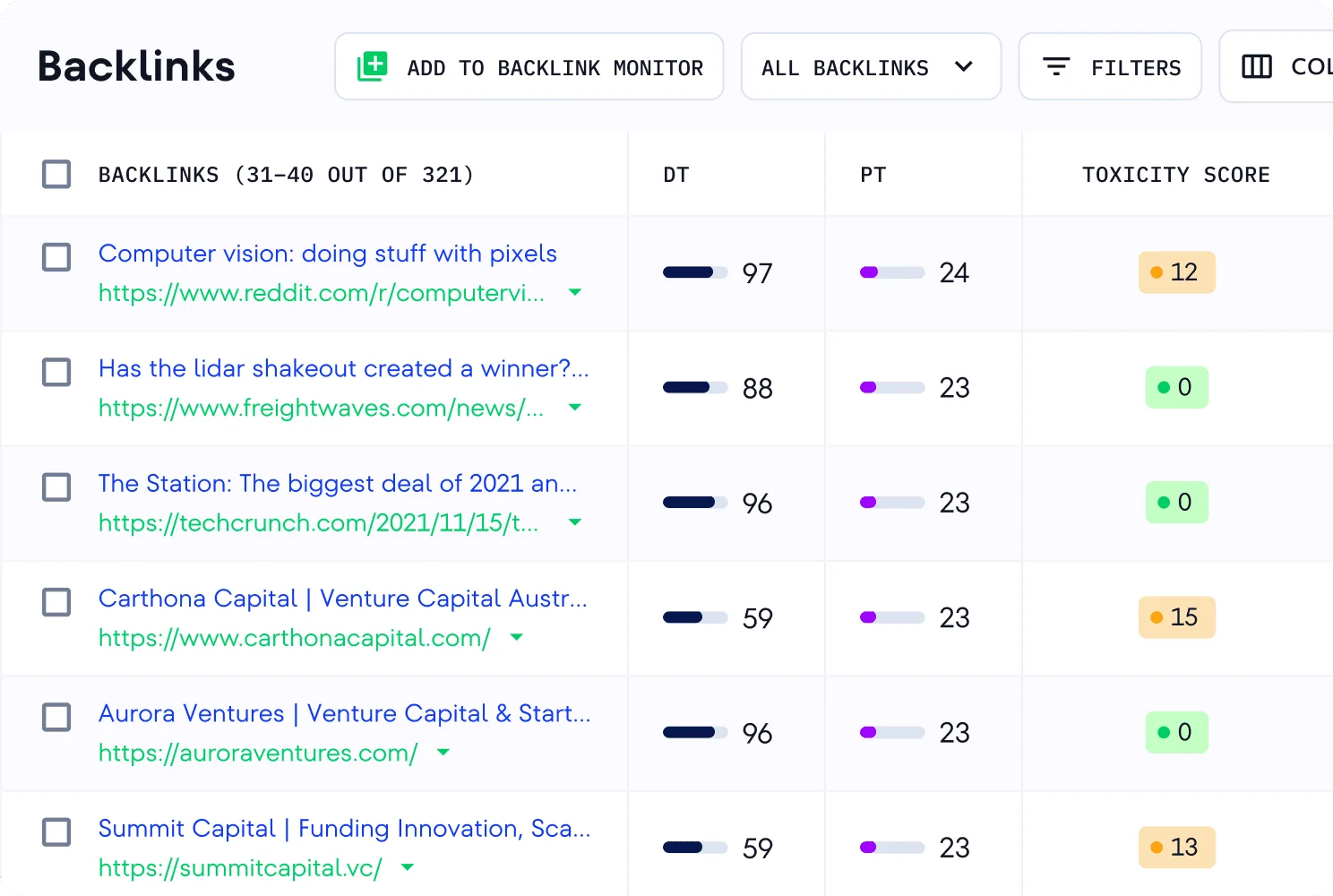
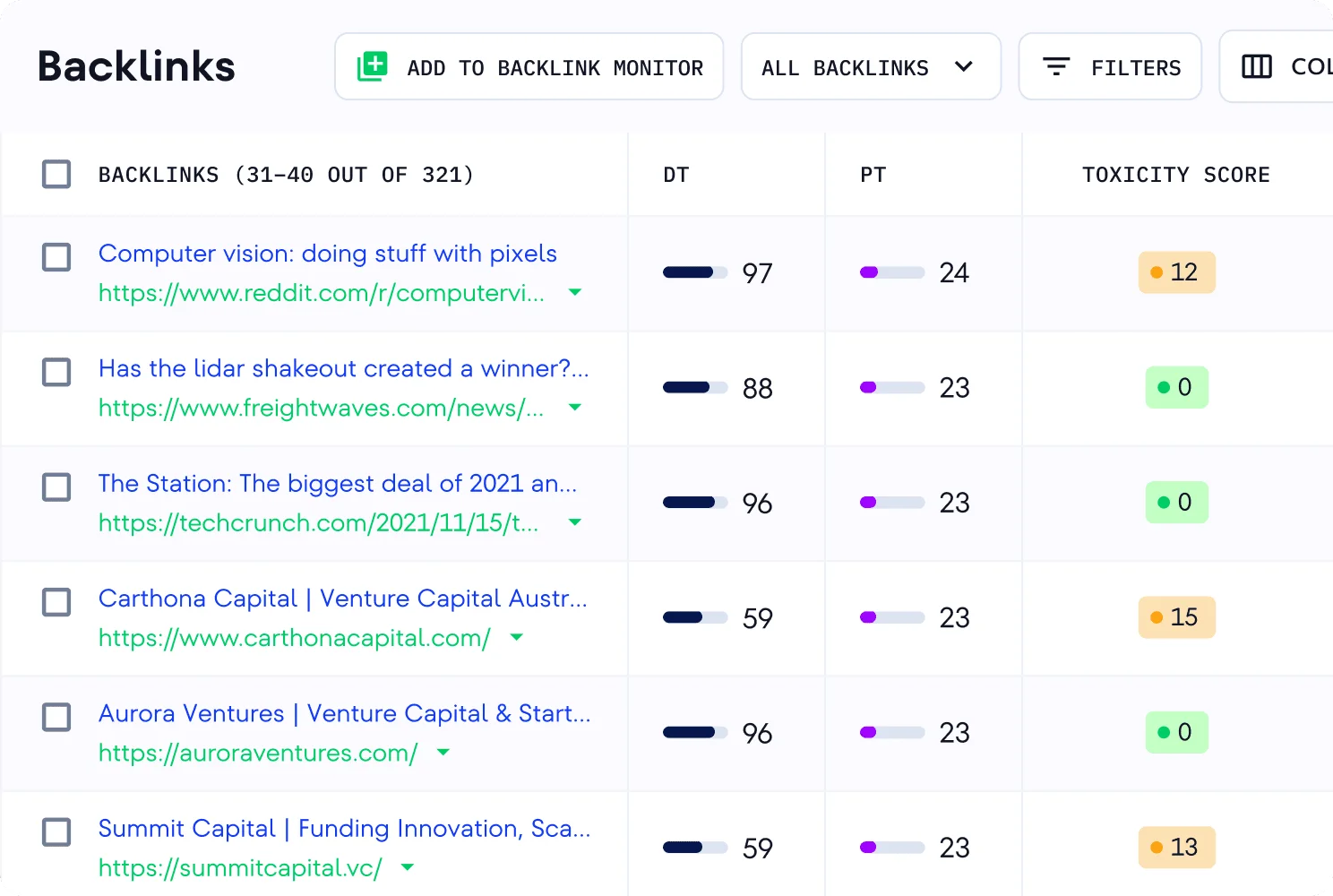
SE Ranking launched its backlink API as part of a broader platform push that, frankly, a lot of SEOs underestimated. It's not as old as Majestic's index or as large as Ahrefs', but for day-to-day SERM and agency work, it covers ground well.
Key features:
- Backlink checker API with link-level data (URL, anchor, type, status)
- Referring domain analysis with domain trust score and page trust score
- Historical backlink data with timestamps for new/lost link tracking
- Bulk backlink analysis API supporting batch domain queries
- Anchor text distribution reports
- Competitor backlink gap endpoint
- Dofollow/nofollow filtering
- Integration with SE Ranking's wider platform (rank tracking, site audit, keyword research)
Best for
SE Ranking's backlink API is the right choice for:
- SERM agencies managing multiple client domains
- In-house SEO teams needing clean API access without a developer-heavy setup
- Anyone running reputation monitoring workflows that need to catch new brand-mention links as they appear
Pros and Cons of SE Ranking API
Pros:
- The link building toolkit covers the full workflow — from prospecting donor sites to tracking backlink changes over time
- Pay-as-you-go pricing model starting at $50 minimum deposit
- Clean REST API with well-structured JSON responses
- Bulk backlink analysis API endpoints that work for batch audits
- Good historical data for tracking link building or attack campaigns over time
- White-label options for client reporting
- Strong integration with rank tracking, so SERM professionals get a unified view
- The platform scales reasonably as client portfolios grow
Cons:
- The crawler is weaker than Ahrefs or Semrush — you will occasionally miss links that competitors catch
- API rate limits can feel tight on large-scale projects
- No data on external links a site points to, which matters for certain audit workflows
- A few advanced features have a real learning curve (not a dealbreaker, but budget time for it)
Pricing Overview of SE Ranking API
- The pay-as-you-go tier requires a $50.00 minimum deposit for 250,000 credits
- Core Plan ($129/month or $103.20 billed annually): 10 projects & 1 seat, 2,000 keywords + 100 prompts daily, 5 GEO domains, 250k audit pages/month, 25k API credits with MCP access, rank tracking, unlimited keyword/backlink research, site audit, and integrations (GA, GSC, Looker Studio, Matomo)
- Growth Plan ($279/month or $223.20 billed annually): 30 projects & 3 seats, 5,000 keywords + 250 prompts daily, 15 GEO domains, 2M audit pages/month, 100k API credits with MCP access, all Core features plus historical data, collaboration tools, page monitoring, and dedicated support
- Agency Pack (+$69/month, annual): add-on with 30 projects, 30 client seats, full white-label platform & reports, unlimited scheduled reports with AI summaries, agency catalog placement, and lead generator
- AI Search Add-on ($89/month or $71.20 annually): 200 prompts, tracking across AI platforms (ChatGPT, Perplexity, AI Overviews), unlimited competitor research, SE Visible dashboard, and automated reporting
- API Add-on ($149/month, annual): 12M credits, access to backlinks, domain analysis, keyword research, AI search, and website audit APIs for automation
- SMM Platform (from $33/month): social media scheduling, collaboration workflows, content planning, analytics, and asset management
- SEO Data API (from $179/month): standalone API with scalable volume, access to backlinks, domains, AI search queries, MCP integration, and automation via tools like Looker Studio, n8n, and Make
- 24M Credits Plan ($318/month effective): 24M credits/year (billed $3,816/year upfront), suitable for large-scale API usage and automation workflows
Use Cases of SE Ranking API
- Tracking new backlinks pointing to a brand's domain for SERM monitoring
- Running batch toxic link audits ahead of disavow file submissions
- Monitoring competitor backlink acquisition in real time
- Automating client link profile reports inside white-label dashboards
- Identifying which anchor texts competitors use most for brand queries
Serpstat API
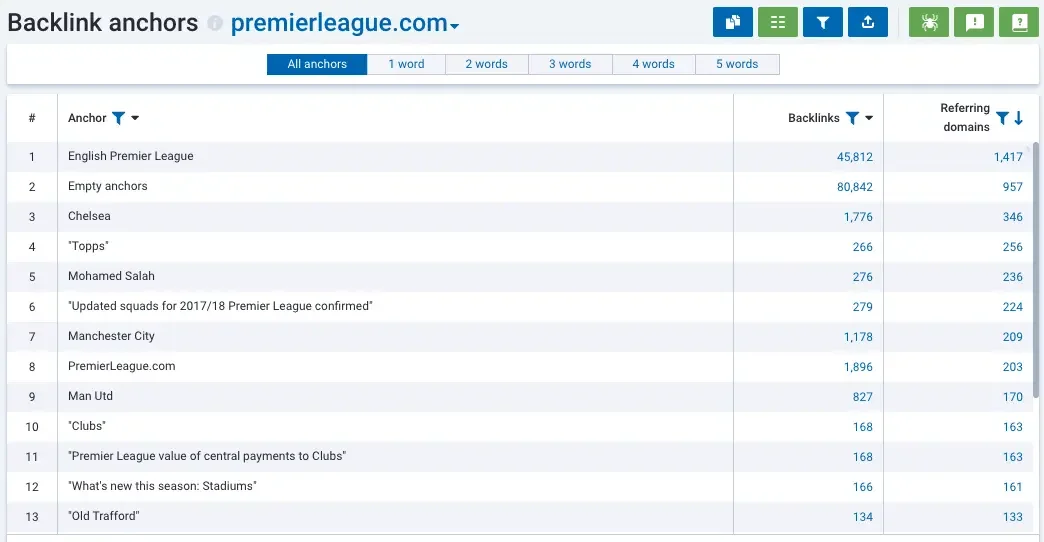
Serpstat occupies a strange middle position in this market. It's a full SEO platform (keyword research, rank tracking, site audit). The backlink module sometimes feels like it was added to complete a checklist rather than lead the product. That said, it's not bad. For teams already embedded in Serpstat's ecosystem, the SEO backlink API functionality does real work.
Key features:
- Backlink checker API with referring domain data
- Anchor text analysis
- Domain vs. URL-level link queries
- New/lost backlink tracking
- Link type filtering (dofollow/nofollow)
- Historical snapshots
- Competitor backlink comparison
Best for
Serpstat's API is best for teams already using Serpstat for keyword and rank tracking who want to pull backlink data without paying for a second platform. It's also reasonable for regional SEO work, particularly Eastern European markets where Serpstat's crawl data historically has better coverage.
Pros and Cons of Serpstat API
Pros:
- Unified platform — one subscription covers keyword, rank, and backlink data
- Decent bulk query support for domain-level analysis
- Historical data for trend analysis
- Lower cost than Semrush or Ahrefs for comparable feature sets
Cons:
- Index size is smaller and crawl frequency is lower than top-tier competitors
- API documentation is inconsistent — some endpoints are poorly described
- Data freshness can lag on less-crawled domains
- Not the strongest choice as a standalone backlink API provider
Pricing Overview of Serpstat API
- Individual Plan ($69/month): 5 projects, 100 daily searches (sites, keywords, backlinks), 10k rank checks, 30k audit pages, 50k export rows, core SEO tools including keyword research, site analysis, rank tracking, site audit, and backlink analysis
- Team Plan ($129/month): unlimited projects, 500 daily searches, 50k rank checks, 150k audit pages, 250k export rows, all Individual features plus API access, ChatGPT & Claude integration (MCP), collaboration tools, AI features, batch analysis, scheduled reports, and invoicing tools
- Agency Plan ($499/month): unlimited projects, 5,000 daily searches, 500k rank checks, 1.5M audit pages/month, 2.5M export rows/month, all Team features plus white-label reports, data engineer consulting, and phone support
Use Cases of Serpstat API
- Cross-platform SEO audits where keyword and backlink data are pulled from one API
- Competitor backlink research for regional or mid-market clients
- Anchor text audits for on-page and off-page SEO correlation studies
- Link profile monitoring as part of broader quarterly SEO reporting
Semrush API
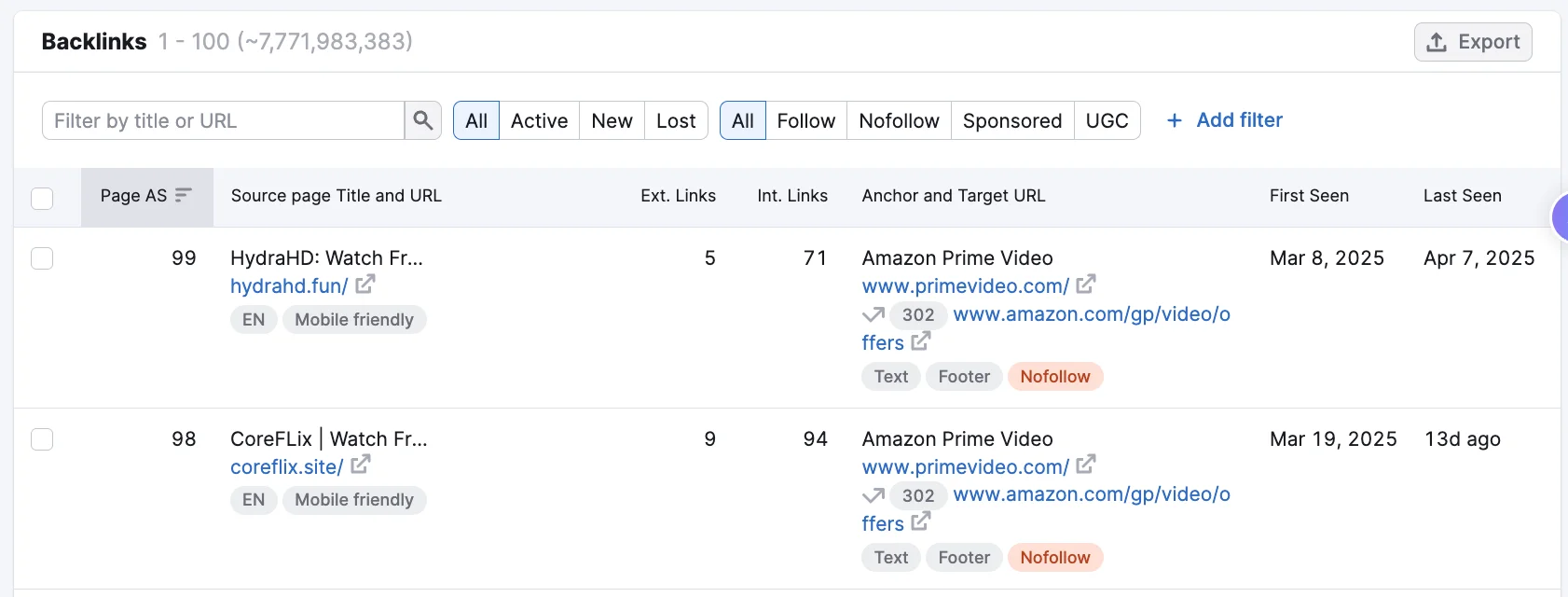
Semrush has the biggest brand in SEO, and it's earned. The database is genuinely enormous — over 43 trillion links as of 2025, which is the largest index in this comparison. The SEO backlink API they provide is mature, well-documented, and capable of handling serious enterprise workflows.
What you're paying for with Semrush is breadth. The backlink data sits alongside one of the best competitive intelligence databases in the industry, meaning you can correlate backlink acquisition with traffic changes, keyword ranking shifts, and display advertising in ways that other platforms can't match.
Key features:
- Backlink audit tool with toxic score per link
- Referring domain data with Authority Score
- Bulk backlink analysis API for batch domain queries
- New/lost link tracking with date accuracy
- Full anchor text analysis
- Link type classification
- Backlink gap analysis for competitor comparison
- Integration with Semrush's broader analytics suite
Best for
Semrush's backlink API is best for:
- Enterprise SEO teams
- Large agencies with high-volume client portfolios
- SERM professionals who need to run link analysis alongside competitive keyword and traffic data in a single platform
Semrush's backlink API is also the go-to for Google Penalty recovery workflows, given the toxic link scoring.
Pros and Cons of Semrush API
Pros:
- Largest index among the tools reviewed here
- High data freshness with daily crawl updates
- Excellent toxic score system useful for disavow audits
- Mature, stable API with strong documentation
- Wide range of endpoints beyond just backlinks
- Bulk backlink analysis API handles enterprise volumes
Cons:
- Expensive. The pricing is genuinely hard to justify for smaller agencies or solo practitioners
- API units are consumed per request; costs add up fast on bulk workflows
- White-label options exist but are limited compared to SE Ranking
- Some endpoints require higher-tier plans that most users don't need
Pricing Overview of Semrush API
- Pro Plan ($139.95/month): monitor up to 5 websites, keyword research tools, competitor analysis, position tracking, backlink analysis, site audit, and MCP access
- Guru Plan ($249.95/month): all Pro features plus monitoring for up to 15 websites, historical data, multi-location and device tracking, and content optimization tools
- Business Plan ($499.95/month): all Guru features plus monitoring for up to 40 websites, share of voice tracking, extended limits, API access, and migration support from third-party tools
Use Cases of Semrush API
- Enterprise-scale toxic link auditing before manual penalty recovery
- Competitive backlink gap analysis for content marketing planning
- Automated brand monitoring for SERM clients with high link velocity
- Integration into internal BI dashboards pulling backlink trends alongside organic traffic
- Agency-level client reporting with Authority Score as a trust metric
Ahrefs API
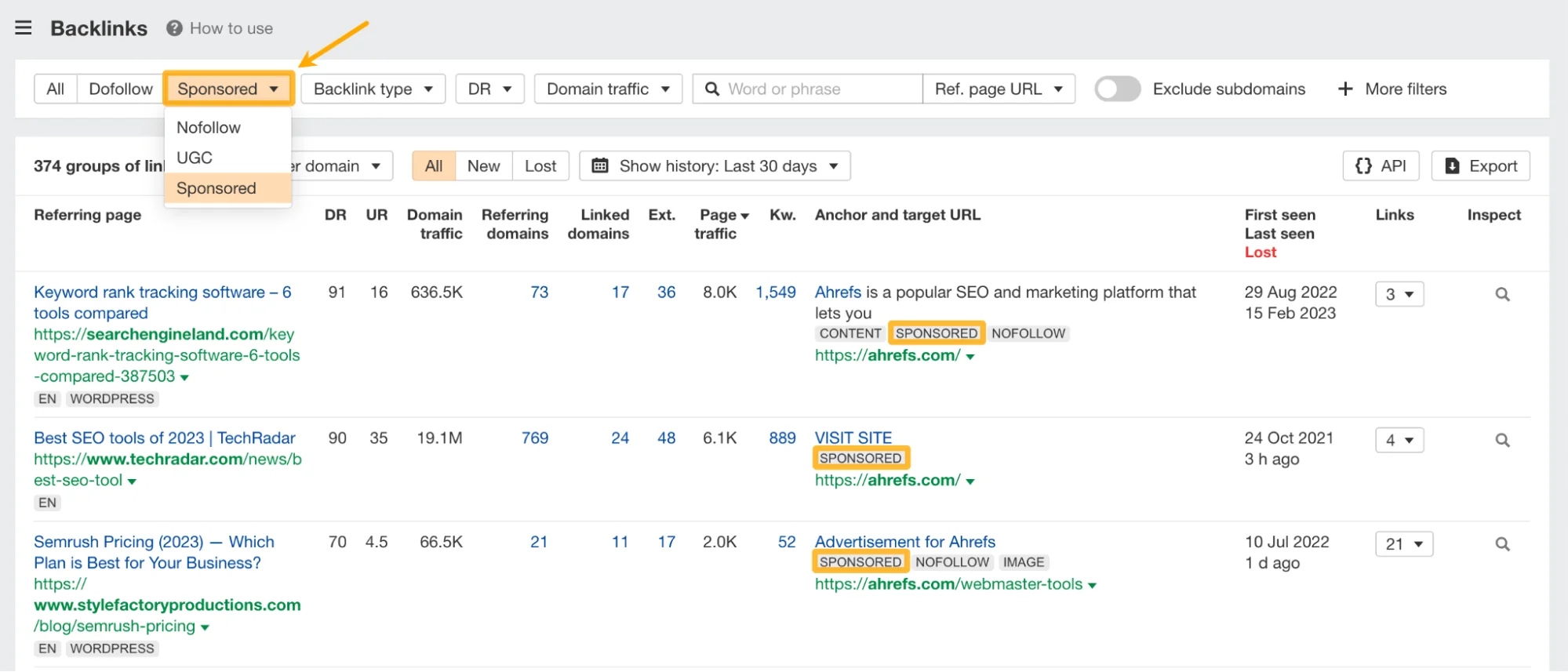
Ahrefs is the tool that most SEOs point to when someone asks what the best backlinks API is, and they're not wrong — but they're also not fully right. Ahrefs has the second-largest index, the best crawl freshness of any tool reviewed here, and a data model that feels built for practitioners rather than product managers.
The problem is access. Ahrefs' API is not the most developer-friendly in the world, and pricing is structured in a way that punishes high-volume usage fast. The SEO backlink extractor API use case specifically — pulling large volumes of link data for processing — gets expensive quickly.
Key features:
- Backlink checker API with near-real-time crawl data
- URL Rating (UR) and Domain Rating (DR) per link
- Link type breakdown (dofollow, nofollow, UGC, sponsored)
- New/lost links with precise date stamping
- Historical index going back to 2010
- Anchor text analysis
- Referring domain data with full link profile
- Broken backlink detection
- Best-by-links and best-by-links-growth sorting
Best for
Ahrefs' backlink API is best for teams that prioritize raw data quality above all else:
- Agencies doing deep-dive link audits
- Content teams doing original research into link patterns
- SERM professionals tracking high-stakes brand link profiles where missing a single link could matter
If that is your case, we recommend you use the Ahrefs backlink API.
Pros and Cons of Ahrefs API
Pros:
- Best-in-class data freshness and accuracy
- Largest active crawled index with strong coverage
- Historical data depth is unmatched for trend analysis
- DR/UR metrics are widely trusted and cited
- Broken link detection for proactive link reclamation
- Genuinely useful for backlink analysis API work that requires precision
Cons:
- API pricing scales steeply with usage — bulk backlink analysis API workflows get costly
- No white-label support, which limits agency use cases
- Fewer built-in automation features compared to SE Ranking or Semrush
Pricing Overview of Ahrefs API
- Lite Plan ($129/month): 5 projects, 6 months historical data, 750 tracked keywords, 5 tracked prompts, 100k crawl credits, 1,000 credits per user, 1 user (+2 at $40/mo), core tools (Site Explorer, Keywords Explorer, Rank Tracker, Site Audit, Competitive Analysis, API & MCP access, reports, dashboards)
- Standard Plan ($249/month): 20 projects, 2 years historical data, 2,000 tracked keywords, 10 tracked prompts, 500k crawl credits, unlimited credits per user, 1 user (+5 at $60/mo), all Lite features plus Content Explorer, batch analysis, SERP comparison, keyword clusters, AI suggestions, deeper analytics & reporting
- Advanced Plan ($449/month): 50 projects, 5 years historical data, 5,000 tracked keywords, 20 tracked prompts, 1.5M crawl credits, unlimited credits per user, 1 user (+10 at $80/mo), all Standard features plus Looker Studio integration, advanced site audit options, segmentation, and extended data insights
- Enterprise Plan ($1,499/month): all Advanced features plus unlimited API access, SSO & enterprise-grade security, access management & audit logs, unlimited historical data, custom limits & exports, and forecasting & trend analysis (annual commitment required)
Use Cases of Ahrefs API
- High-stakes SERM campaigns where missing backlinks is not an option
- Content research requiring accurate link velocity data over time
- Link reclamation workflows using broken backlink detection
- Cross-domain competitor analysis for enterprise accounts
- Building internal link intelligence databases that require trusted DR/UR scores
Majestic API
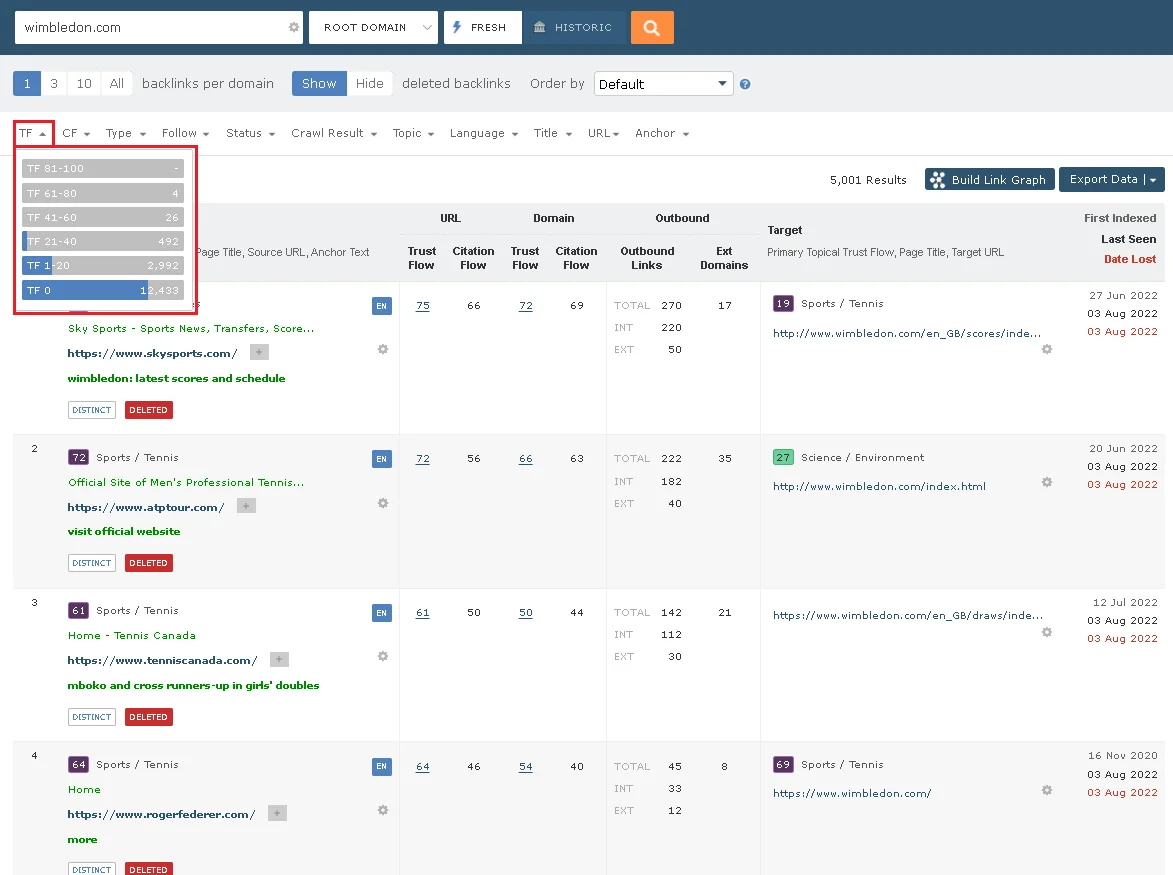
Majestic is the old guard. It's been crawling the web since 2004, and it shows — in good ways and bad. The backlink API Majestic provides is uniquely built around its two proprietary metrics: Trust Flow (TF) and Citation Flow (CF). No other tool in this list has metrics with the same link-quality philosophy, and for certain SERM use cases — particularly identifying low-quality manipulative links — TF/CF is still the most actionable signal available.
The downside is that Majestic is essentially a backlink-only tool. There's no keyword tracking, no rank monitoring, no site audit. If you need the full SEO suite, you'll be paying for another platform too.
Key features:
- Trust Flow and Citation Flow per URL and domain
- Topical Trust Flow (categorized TF by topic)
- Fresh Index (last 120 days) and Historic Index (all crawls)
- Backlink checker API with link-level detail
- Referring domain and IP analysis
- Anchor text breakdown
- Bulk backlink analysis API via batch endpoints
- Link context (surrounding text on linking page)
Best for
Majestic is best for:
- SERM professionals and link auditors who need Trust Flow / Citation Flow as part of their toxic link identification workflow
- Developers building custom link quality scoring systems
Pros and Cons of Majestic API
Pros:
- Trust Flow and Citation Flow are genuinely useful for link quality analysis
- Topical Trust Flow is unique — no other tool categorizes links by topic this way
- Historic Index gives deep archive coverage going back years
- Competitive API pricing relative to data depth
- Good bulk backlink analysis API support
- Solid documentation for the backlink checker API for developers use case
Cons:
- No keyword, traffic, or rank data — backlinks only
- Fresh Index crawl frequency is lower than Ahrefs or Semrush
- UI feels dated, which matters less for API use but signals slower product investment
- TF/CF metrics aren't always aligned with modern Google quality signals
Pricing Overview of Majestic API
- Lite Plan ($49.99/month): 1 million analysis units, 1 user, access to Fresh Index, Site Explorer, Link Graph, Trust Flow metrics, backlink tools, keyword checker, bulk backlink checker, PDF reports, and core website tools
- Pro Plan ($99.99/month): 20 million analysis units, 1 user, everything in Lite plus Historic Index, raw data exports, custom reports, site comparison, backlink history, Search Explorer, email alerts, and extended analytics tools
- API Plan ($399.99/month): 100 million analysis units, 5 users, everything in Pro plus full API access, scalable data volumes (up to 1B units), and custom data integration capabilities for agencies and developers
Use Cases of Majestic API
- Trust Flow / Citation Flow-based toxic link audits
- Building topical relevance scoring for link profiles using Topical Trust Flow
- Archival research using Historic Index for penalty recovery timelines
- Developer projects building custom backlink scoring engines
- Cross-referencing link quality against Ahrefs or Semrush data as a second opinion
DataForSEO API
DataForSEO is the one tool on this list that isn't really competing with the others. It's a data infrastructure provider, not an SEO platform. There's no UI to speak of — it's endpoints all the way down. The backlink checker API for developers use case is literally the product.
What does DataForSEO do differently? It aggregates backlink data from multiple sources (including its own crawler plus third-party data partnerships), which means you can pull from Majestic, Moz, or proprietary sources through a single API interface. For developers building tools on top of link data, this is genuinely useful. For SERM professionals who just want a dashboard and clean reports, it's probably not the right fit.
Key features:
- Multi-source backlink data aggregation (own crawler + data partnerships)
- Bulk backlink analysis API with high throughput
- Pay-as-you-go pricing (unique in this comparison)
- Backlink by page/domain endpoints
- Referring domains and referring IPs data
- Anchor text data
- New/lost backlinks endpoint
- Historical data availability
- Sandbox environment for development testing
- Full REST API with excellent developer documentation
Best for
DataForSEO is best for:
- Developers building SEO tools or internal platforms
- Agencies running high-volume automated audits who need raw data at low cost per unit
- SERM teams with in-house development resources who can build custom processing pipelines
Pros and Cons of DataForSEO API
Pros:
- Pay-as-you-go pricing — lowest cost per row for bulk backlink analysis API work
- Best developer documentation in this comparison
- Sandbox environment for building without burning credits
- Multi-source aggregation is a genuine differentiator
- High throughput for SEO backlink extractor API pipelines
- No forced subscription commitment
Cons:
- No built-in UI or reporting — everything requires development work
- Data quality varies by source when using aggregated endpoints
- Requires developer resources to use effectively
- Not suitable for teams without technical staff
- Less reliable for real-time use cases given data pipeline latency
Pricing Overview of DataForSEO API
DataForSEO uses pay-as-you-go pricing. Backlink data tasks typically cost fractions of a cent per request, but costs add up fast at scale. A rough benchmark: $50 goes a long way for exploratory use, but production-level bulk backlink analysis API runs across thousands of domains will cost hundreds to low thousands monthly. No subscription required; you prepay credits and spend them as needed. This is the cheapest option per data row in the comparison, assuming you have the developer time to build around it.
Use Cases of DataForSEO API
- Building custom SEO tools or SaaS products that require backlink data API functionality
- High-volume automated link auditing in CI/CD pipelines
- Aggregating backlink data from multiple sources for research or client reporting
- SERM teams with development resources running bespoke brand monitoring workflows
- Cost-sensitive bulk operations where Ahrefs or Semrush pricing is prohibitive
Conclusion
There is no single best backlink API. There's the best one for your workflow, your budget, and your team's technical capacity:
- For SERM professionals managing clients across SaaS, e-commerce, and IT: SE Ranking handles most of what you need at a price that scales reasonably. The backlink analysis API coverage is good, the bulk endpoints work, and the platform ties together enough adjacent data to avoid context-switching constantly.
- For teams where data quality is the only thing that matters, and budget is a secondary concern: Ahrefs. Full stop.
- For enterprise or penalty recovery work where toxic scoring matters: Semrush.
- For developers building tools or running high-volume pipelines: DataForSEO isn't glamorous, but the economics are hard to beat.
If you've been using Majestic's Trust Flow for years and it's baked into your audit methodology — keep using it. Some workflows don't need disrupting.
FAQ
1. What is a backlink API?
A backlink API is a programmatic interface that lets you query a backlink database to retrieve link data — referring domains, anchor text, link types, trust metrics — for any given URL or domain. Instead of using a tool's UI manually, you call the API and process the data in your own system or workflow.
2. Which backlink API has the largest index?
Semrush currently claims the largest index at 43+ trillion links. Ahrefs is close behind at around 35 trillion. Both are significantly larger than SE Ranking, Serpstat, or Majestic.
3. Is there a free backlink API?
Most backlink API providers offer a free trial or limited free tier, but there's no fully free production-grade backlink API. DataForSEO has a sandbox environment for development testing without credits. Google's own Search Console API provides link data for your own domain only, at no cost.
4. Which backlink API is best for developers?
DataForSEO is the most developer-oriented option — pay-as-you-go pricing, excellent documentation, a sandbox environment, and high throughput. Ahrefs API documentation is also strong. SE Ranking is the best balance for developers who need both a usable API and a platform UI.
5. How does SE Ranking compare to Ahrefs for backlink data?
Ahrefs has a larger index, better crawl freshness, and more trusted DR/UR metrics. SE Ranking has lower pricing, better bulk endpoint access at lower plan tiers, and white-label support. For most SERM workflows, SE Ranking's data is sufficient. For high-precision audits, Ahrefs wins.
6. What is bulk backlink analysis API and when do I need it?
Bulk backlink analysis API endpoints let you query backlink data for multiple domains in a single batch request rather than one at a time. You need this when running link audits across a large client portfolio, processing competitor lists, or building automated monitoring that covers hundreds of domains.
7. Can I use a backlink API for SERM (Search Engine Reputation Management)?
Yes. A backlink checker API is essential for SERM work. Monitoring new links to a brand domain, identifying toxic or manipulative links, tracking whether negative coverage is acquiring backlinks, and auditing competitor link profiles are all standard SERM tasks that require API-level access at any meaningful scale.
8. What's the difference between Majestic's Trust Flow and Ahrefs' Domain Rating?
Trust Flow (Majestic) measures link quality based on proximity to trusted seed sites — it's a quality signal. Domain Rating (Ahrefs) measures the strength of a domain's backlink profile based on volume and quality of referring domains — closer to an authority signal. They measure related but distinct things, and SERM professionals often use both.
9. Which SEO backlink API is most cost-effective for agencies?
SE Ranking offers the best value for agencies managing multiple client domains — good data quality, pay-as-you-go model, bulk endpoints, and white-label support. DataForSEO is cheaper per data row but requires developer resources to be useful. Semrush and Ahrefs become expensive at scale.
10. Do I need a different backlink API for different industries?
Not usually. The same backlink data API covers any industry — the data model doesn't change based on sector. What changes is how you interpret the data. E-commerce sites have different normal link profiles than SaaS companies or IT services firms, so your quality benchmarks and alert thresholds should be calibrated per vertical rather than per tool.