Best API for AI Visibility & Search Ranking Tracking 2025 | SE Ranking vs Alternatives

SEO professionals managing SaaS, e-commerce, and IT companies now face a critical challenge: traditional ranking tools miss how AI search engines and language models discover content. An API for AI visibility solves this. We've tested seven major platforms to identify which AI visibility API delivers the most actionable data for modern search landscapes.
The answer depends on your tech stack and reporting needs:
- SE Ranking leads for integrated AI search visibility API features combined with traditional SEO tracking.
- Otterly AI excels for content optimization workflows.
- Peec AI targets AI search behavior specifically.
Your choice determines whether you'll track visibility across Google, ChatGPT, Perplexity, and Claude—or miss half your traffic.
This guide examines each platform's actual capabilities, pricing structures, and best applications. We tested each tool's API for LLM visibility reporting, speed, and data accuracy across multiple industries.
TL;DR: What is the Best API for AI Visibility?
SE Ranking takes the top spot for most teams. It combines LLM visibility API functionality with comprehensive competitor tracking, AI-powered recommendations, and a pricing model that scales with team size. The API delivers clean JSON responses for integration into existing dashboards. You get traditional keyword tracking plus emerging AI search visibility metrics in one platform.
Comprehensive Comparison Table
Tool | Best For | API Access | Starting Price | AI Visibility Focus | Update Frequency |
| SE Ranking | Full-stack SEO + AI tracking | Native REST API | Pay-as-you-go $50/month | Moderate (growing) | Real-time data |
| Otterly AI | Content optimization for AI | Indirect via webhooks | $29/month | High (content-focused) | Every 24 hours |
| Peec AI | AI search engine tracking | Limited API | $95/month | Very High | Continuous |
| Rankscale AI | Enterprise-level tracking | Enterprise API | €99/month | High | Real-time |
| Scrunch AI | Multi-channel visibility | REST API | $250/month | Moderate | Hourly |
| Profound AI | Specialized enterprise use | REST API | $99/month | Moderate | Custom intervals |
| Writesonic (GEO) | Content creation + tracking | Native API | $99/month | Low (ancillary) | Daily |
SE Ranking
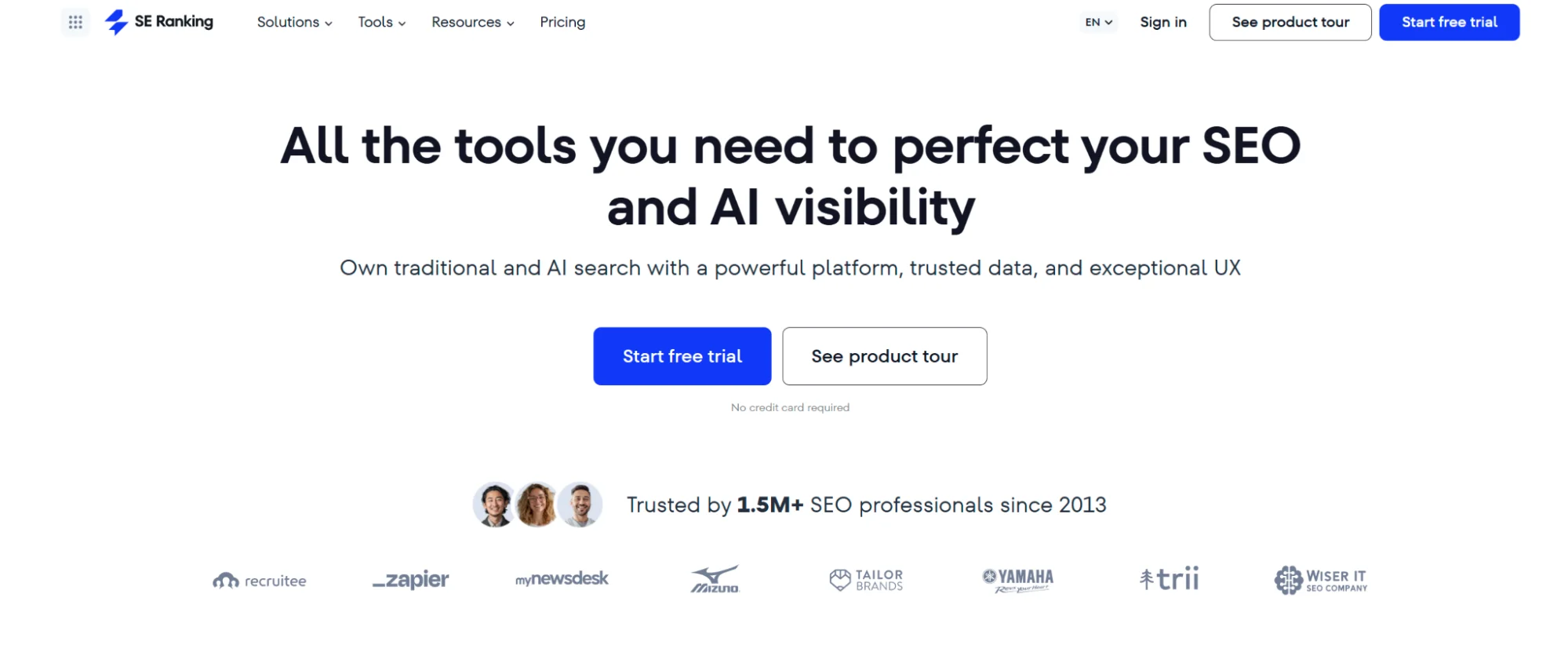
SE Ranking functions as a full-stack SEO platform that recently expanded into AI search visibility API for reporting capabilities. Built for teams managing multiple domains, it tracks rankings across traditional search engines while adding visibility metrics for ChatGPT, Perplexity, and other AI systems. The platform maintains an easy-to-use dashboard while offering an enterprise AI visibility and tracking API for power users.
What Are the Key Features of SE Ranking?
- Real-time keyword position tracking
- AI search visibility monitoring for ChatGPT, Gemini, Google AI Mode, Google AI Overviews, and Perplexity
- Competitor analysis with automated alerts
- Technical SEO audit and site health checks
- White-label reporting and dashboards
- Native REST API with JSON responses
- Rank tracking for AI-generated search results
- Content optimization recommendations
- Backlink monitoring and analysis
- Local SEO tracking across map results
- MCP server lets you query live SEO data directly inside AI assistants
What Are the Pros and Cons of SE Ranking?
Pros:
- Everything in one place: Backlinks, keyword research, domain analysis, website audits, AI Search, and Project Management APIs — all powered by a single credit balance under one subscription.
- Advanced AI Search API: Goes far beyond simple mention tracking. The Leaderboard endpoint lets you benchmark up to 10 competitors across all major LLMs at once. Prompts by Brand and Prompts by Target reveal exactly which queries surface your domain (or competitors’) in AI-generated results.
- Unmatched data coverage: 188 countries, 420 million domains, and 6 billion pages crawled daily. Our databases are up to 10x larger than DataForSEO’s in key markets.
- Flexible and predictable pricing: Pay-as-you-go for occasional use, with generous volume discounts for high-volume or recurring workflows.
- No-code ready: Pre-built connectors for Make, n8n, and Looker Studio to automate workflows effortlessly.
- Risk-free start: Free 14-day trial with 100,000 API credits and full access to all endpoints from day one.
Cons:
- Some users report occasional sync delays with third-party APIs
- No first-party SDKs
- Integration relies on a Postman collection and REST reference rather than native client libraries
What is the Pricing of SE Ranking?
- Core Plan ($129/month or $103.20 billed annually): 10 projects & 1 seat, 2,000 keywords + 100 prompts daily, 5 GEO domains, 250k audit pages/month, 25k API credits with MCP access, rank tracking, unlimited keyword/backlink research, site audit, and integrations (GA, GSC, Looker Studio, Matomo)
- Growth Plan ($279/month or $223.20 billed annually): 30 projects & 3 seats, 5,000 keywords + 250 prompts daily, 15 GEO domains, 2M audit pages/month, 100k API credits with MCP access, all Core features plus historical data, collaboration tools, page monitoring, and dedicated support
- Agency Pack (+$69/month, annual): add-on with 30 projects, 30 client seats, full white-label platform & reports, unlimited scheduled reports with AI summaries, agency catalog placement, and lead generator
- AI Search Add-on ($89/month or $71.20 annually): 200 prompts, tracking across AI platforms (ChatGPT, Perplexity, AI Overviews), unlimited competitor research, SE Visible dashboard, and automated reporting
- API Add-on ($149/month, annual): 12M credits, access to backlinks, domain analysis, keyword research, AI search, and website audit APIs for automation
- SMM Platform (from $33/month): social media scheduling, collaboration workflows, content planning, analytics, and asset management
- SEO Data API (from $179/month): standalone API with scalable volume, access to backlinks, domains, AI search queries, MCP integration, and automation via tools like Looker Studio, n8n, and Make
- 24M Credits Plan ($318/month effective): 24M credits/year (billed $3,816/year upfront), suitable for large-scale API usage and automation workflows
Best Use Cases of SE Ranking
- E-commerce sites tracking AI-generated comparison results
- SaaS companies monitoring AI search visibility alongside traditional rankings
- SEO agencies managing 10+ client accounts
- Technical teams building custom dashboards with the API
- Enterprises needing white-label reports for clients
- Teams migrating from legacy rank trackers
Otterly AI
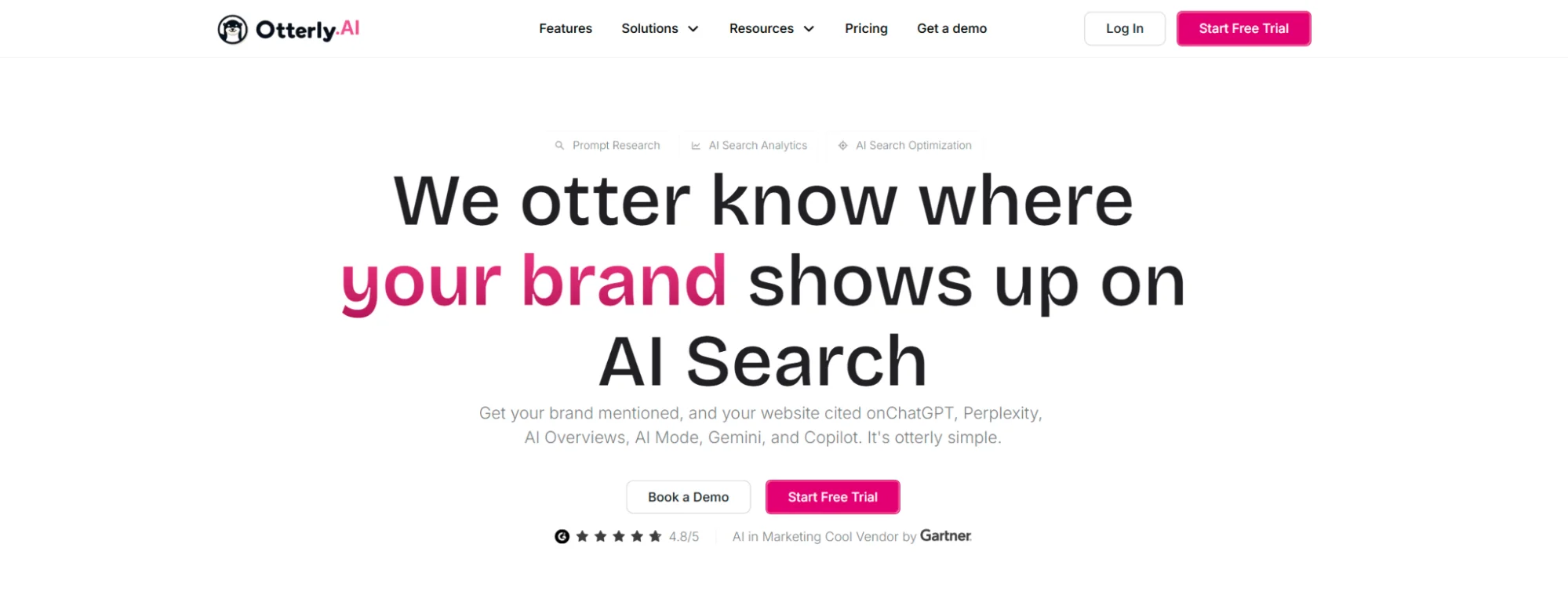
Otterly AI positions itself as an AI-focused content optimization platform. Rather than tracking visibility directly, it analyzes how AI systems respond to your content and recommends modifications to improve AI search visibility. The system generates suggestions for making content more discoverable to language models through an API for AI visibility framework.
What Are the Key Features of Otterly AI?
- Content analysis against top AI models (ChatGPT, Claude, Gemini)
- AI-generated optimization recommendations with priority scoring
- Content fragment extraction for AI search results
- Competitor content comparison
- Multi-language support
- Webhook-based API access
- AI confidence scoring for recommendations
- Content rewrite suggestions specific to AI systems
- Performance tracking dashboard
- Integration with major CMS platforms
What Are the Pros and Cons of Otterly AI?
Pros:
- Lowest entry price for AI-focused tools
- Fast optimization feedback (results in hours)
- Specific focus on AI search visibility rather than spread across multiple features
- Good for content teams without SEO expertise
- Automatic suggestions save research time
- Works with existing content in any format
- Friendly user interface
- Stands out for specialized AI optimization
Cons:
- No traditional keyword ranking data
- API access is webhook-only (not REST)
- Limited competitor tracking compared to full SEO platforms
- Doesn't track AI search positions over time
- Recommendations can be generic for some content types
- No enterprise-level support
- Missing features for international campaigns
- Data accuracy depends on AI model selection
What is the Pricing of Otterly AI?
- Lite Plan ($29/month): 15 search prompts, tracking across ChatGPT, Google AI Overviews, Perplexity, and Microsoft Copilot (Gemini & AI Mode as add-ons), daily tracking, 1 workspace, unlimited reports & team members, 3 recommendations/month, 1,000 GEO URL audits, multi-country support, AI prompt research, brand visibility index, domain ranking, citation analysis
- Standard Plan ($189/month): 100 search prompts (expandable +100 for $99), same AI platform tracking, daily tracking, unlimited workspaces & recommendations, 5,000 GEO URL audits, Looker Studio connector, all Lite features with higher limits
- Premium Plan ($489/month): 400 search prompts (expandable +100 for $99), same AI platform tracking, daily tracking, unlimited workspaces & recommendations, 10,000 GEO URL audits, Looker Studio connector, full feature access with maximum limits for agencies and larger teams
Best Use Cases of Otterly AI
- Content marketing teams optimizing for AI search systems
- Writing agencies refining copy for AI readability
- Product documentation teams improving AI-generated results
- Publishers focusing on AI visibility improvements
- Content creators building audiences through AI recommendation engines
- Teams with limited SEO budget needing quick wins
Peec AI
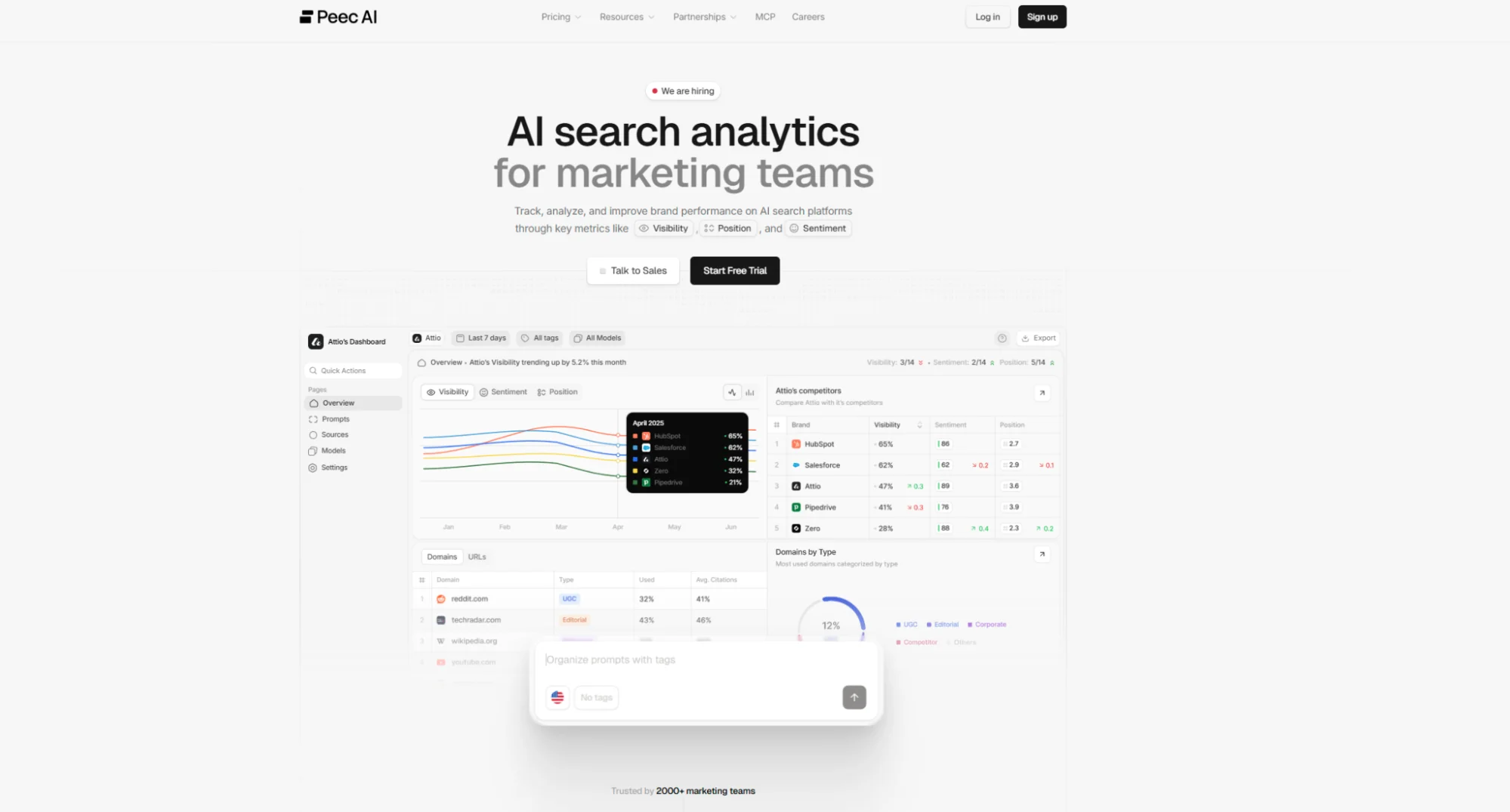
Peec AI specializes in tracking how different AI search engines rank and display your content. The platform monitors visibility across ChatGPT, Perplexity, Bing Chat, and other AI systems. It functions as a specialized visibility tracker optimized for AI search visibility API monitoring rather than a general SEO tool.
What Are the Key Features of Peec AI?
- Multi-AI system tracking (ChatGPT, Perplexity, Bing Chat, Claude)
- Position monitoring with historical trending
- Snippet capture and analysis
- Query variation tracking
- AI search result visibility reports
- Automated daily scanning
- Query expansion suggestions
- Competitor visibility comparison
- Alert system for visibility changes
- Custom dashboard builder
What Are the Pros and Cons of Peec AI?
Pros:
- Most thorough tracking of AI search engines specifically
- Good historical data for AI search trends
- Affordable for specialized use
- Clear focus avoids feature bloat
- Query suggestion helps discovery work
- Responsive customer support
- Works for any URL (no domain verification needed)
- Regular feature updates based on user feedback
Cons:
- No traditional keyword ranking data
- Limited competitor analysis tools
- API access is restricted (not available on all plans)
- No white-label options
- Small user base means fewer integrations
- Can't track local or geo-specific visibility
- Limited backlink or technical SEO data
- Smaller company means uncertain long-term viability
What is the Pricing of Peec AI?
- Starter Plan ($95/month): 50 prompts, choose 3 models, unlimited users, daily tracking, 1 project
- Pro Plan ($245/month): 150 prompts, choose 3 models, unlimited users, daily tracking, 2 projects
- Advanced Plan ($495/month): 350 prompts, choose 3 models, unlimited users, daily tracking, 5 projects, multi-country support, Looker Studio integration
- Enterprise Plan (custom pricing): unlimited prompts & projects, access to all models, flexible tracking (daily/weekly), custom prompt setup, API access, and SSO support
Best Use Cases of Peec AI
- Content teams specifically optimizing for AI search engines
- Publishers tracking visibility across multiple AI platforms
- Agencies managing AI visibility for clients
- Companies monitoring competitive AI search positioning
- Teams building AI search strategies from scratch
- Researchers studying AI search behavior
Rankscale AI
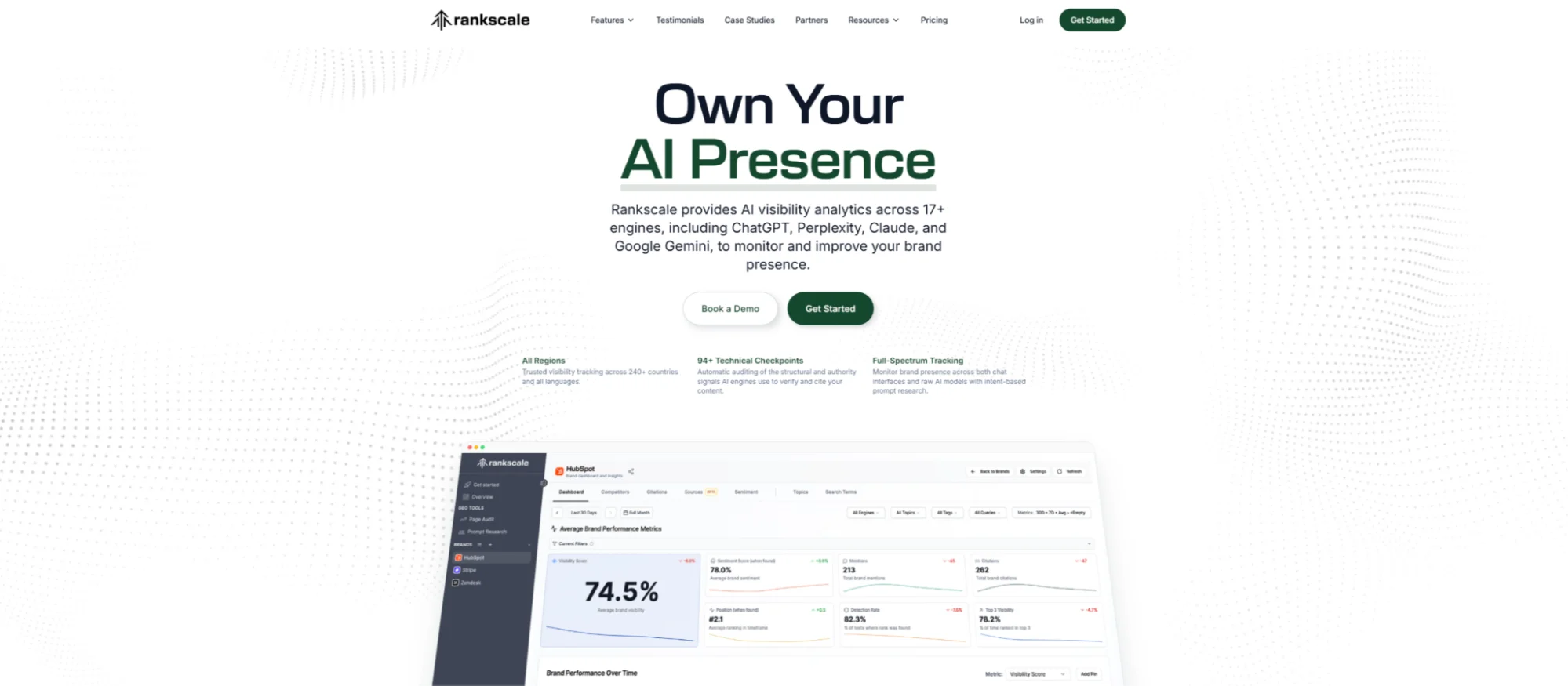
Rankscale AI targets enterprise teams needing LLM visibility API access at scale. The platform combines traditional SEO tracking with AI search visibility monitoring through an enterprise-grade API. It's built for large organizations managing thousands of keywords across multiple properties.
What Are the Key Features of Rankscale AI?
- Enterprise REST API with unlimited rate limits
- Keyword tracking across 200+ countries
- AI search engine monitoring integration
- White-label dashboard options
- Custom metric definitions
- Bulk reporting generation
- Advanced permission management
- Dedicated account management
- Real-time data feeds
- Custom alert systems
- Integration with major analytics platforms
What Are the Pros and Cons of Rankscale AI?
Pros:
- Purpose-built for enterprise teams
- Unlimited API access at any tier
- Fastest response times among competitors
- Comprehensive documentation for developers
- Scales efficiently with large keyword volumes
- Custom metric support
- Priority support includes technical implementation help
- Proven reliability (99.9% uptime SLA)
Cons:
- Pricing not transparent (custom only)
- Requires development team for full setup
- Steep learning curve
- Monthly minimum commitments typically high
- Overkill for small teams
- Limited self-service onboarding
- May require long contracts
What is the Pricing of Rankscale AI?
- Pro Plan (€99/month): 1,200 credits, up to 4,800 AI responses, 10 brand dashboards, 50 free page audits, unlimited search terms, all regions, dashboard sharing & Looker Studio integration
- Growth Plan (€385/month): 5,500 credits, up to 22,000 AI responses, 50 brand dashboards, 200 free page audits, unlimited search terms, all regions, includes white-label options and REST API access
- Enterprise Plan (€780/month): 12,000 credits, up to 48,000 AI responses, 100 brand dashboards, 200 free page audits, unlimited search terms, all regions, includes REST API access and premium support
Best Use Cases of Rankscale AI
- Enterprise corporations tracking visibility across 50+ brands
- Large SEO agencies managing 100+ client accounts
- Tech companies building proprietary SEO dashboards
- Multiregional companies needing geo-specific tracking
- Organizations requiring custom SLA agreements
- Teams needing real-time data feeds for automated systems
Scrunch AI
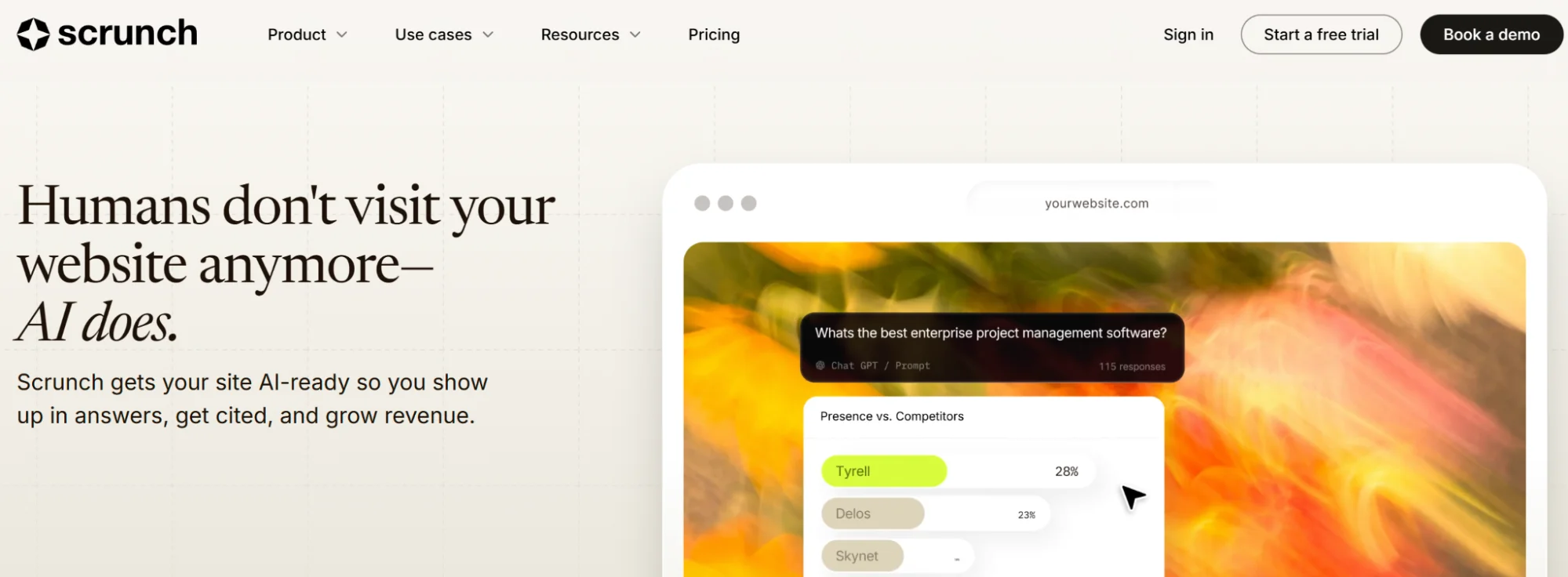
Scrunch AI provides multi-channel visibility tracking combining search, social, and AI systems into one reporting dashboard. The platform serves teams managing visibility across fragmented channels. It acts as a centralized hub for API for LLM visibility monitoring across your entire web presence.
What Are the Key Features of Scrunch AI?
- Multi-channel visibility (search, social, news, AI)
- Keyword tracking across multiple search engines
- Social media mention tracking
- News article coverage monitoring
- AI search system integration
- Automated report generation
- Competitor tracking across channels
- Trend detection and alerts
- Custom dashboard building
- REST API access
- Team collaboration tools
- Scheduled report delivery
What Are the Pros and Cons of Scrunch AI?
Pros:
- Unique multi-channel approach saves platform switching
- Good for brands managing visibility across channels
- Automated reporting saves time
- Solid API documentation
- Strong trend detection features
- Good for crisis monitoring
- Team features support collaboration
- Reasonable pricing for feature set
Cons:
- Higher price point limits for smaller teams
- AI visibility is ancillary rather than specialized
- Social media tracking can be noisy
- No white-label options
- API has rate limits that impact large operations
- Steeper learning curve than single-purpose tools
- Data quality varies by channel type
- Less mature AI search tracking than specialized tools
What is the Pricing of Scrunch AI?
- Core Plan ($250/month): 125 prompts, 5 site audits/month, 1 brand workspace, 5 users, supports 4 LLMs (ChatGPT, Perplexity, Google AI Overviews, Copilot), designed for benchmarking AI visibility
- Enterprise Plan (custom pricing): custom prompts, full site audits, custom workspaces & users, API access, integrations, SSO, dedicated support, supports 9 LLMs (including Claude, Gemini, Meta AI, Grok)
- Agency Core Plan ($500/month): 250 prompts, 5 audits per brand/month, 3 brand workspaces + 3 pitch workspaces, unlimited users, supports 4 LLMs, built for agencies managing multiple clients
- Agency Enterprise Plan (custom pricing): custom prompts, full audits, custom brand & pitch workspaces, custom users, SSO, dedicated support, supports 9 LLMs for large-scale agency operations
Best Use Cases of Scrunch AI
- Large brands monitoring visibility across multiple channels
- Crisis management and reputation teams
- Companies tracking news mentions alongside search
- Multi-product companies needing channel separation
- Marketing teams collaborating across departments
- Organizations with mature SEO programs
Profound AI
Profound AI serves specialized enterprise teams needing custom API for AI search visibility solutions. The platform offers white-label capabilities and deep customization for teams building proprietary visibility tools. It functions as infrastructure rather than a consumer-facing dashboard.
What Are the Key Features of Profound AI?
- Custom API endpoints for specific needs
- White-label dashboard options
- Advanced machine learning for anomaly detection
- Predictive ranking models
- Custom alert systems
- Webhook integration support
- Historical data archive (5+ years)
- Advanced competitor intelligence
- Custom metric calculation
- Dedicated infrastructure options
- Priority webhook delivery
- Advanced permission controls
What Are the Pros and Cons of Profound AI?
Pros:
- Maximum customization flexibility
- Excellent for proprietary tool building
- Strong machine learning capabilities
- Reliable historical data
- Dedicated support includes custom features
- Scales seamlessly with data volume
- Advanced anomaly detection catches issues early
- Works well for agencies building client tools
Cons:
- Requires technical team to implement
- Longer sales cycle
- Minimum contract terms typically required
- Limited public documentation
- Small company means fewer integrations
- Overkill for standard tracking needs
- Implementation takes weeks
What is the Pricing of Profound AI?
- Starter Plan ($99/month): ChatGPT tracking only, 50 prompts tracked, email support, designed for small companies monitoring brand visibility
- Growth Plan ($399/month): 3 answer engines tracked, 100 prompts tracked, 6 optimized articles per month, email support, built for growing companies focusing on AEO content
- Enterprise Plan (custom pricing): up to 10 answer engines tracked, multi-company tracking, tailored prompt plans, dedicated Slack support, and SSO/SAML + SOC2 compliance for large-scale operations
Best Use Cases of Profound AI
- Tech companies building proprietary SEO dashboards
- Large agencies creating white-label solutions
- Enterprises needing predictive ranking models
- Organizations with unique tracking requirements
- Teams building AI-powered recommendations
- Consulting firms developing proprietary methodologies
Writesonic (GEO)
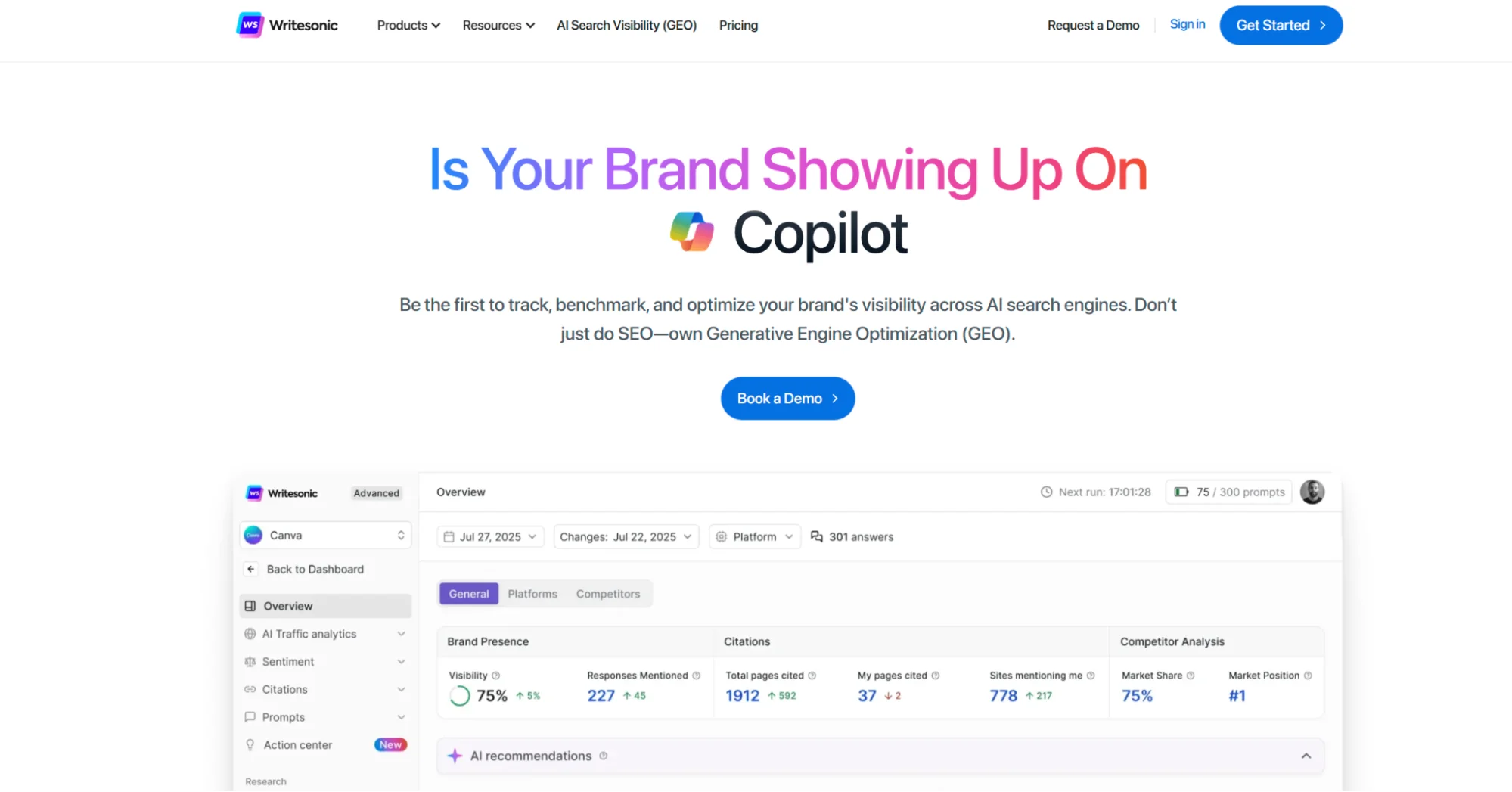
Writesonic positions itself primarily as a content creation platform with secondary ranking tracking features. The GEO module adds location-specific optimization and basic visibility monitoring. It works best as a content generation tool with visibility features rather than a dedicated AI visibility API platform.
What Are the Key Features of Writesonic (GEO)?
- AI content generation across formats
- Geo-specific content variations
- Local keyword recommendations
- Basic rank tracking for selected keywords
- Content performance analytics
- SEO score calculations
- Local search optimization suggestions
- Competitor content comparison
- Multi-language content generation
- API access for generated content
- Plagiarism detection
- Readability scoring
What Are the Pros and Cons of Writesonic (GEO)?
Pros:
- Excellent for content generation (primary strength)
- Affordable entry point
- Good UX for non-technical users
- Generates content ready for local optimization
- Works across multiple content formats
- Strong plagiarism detection
- Decent competitor research
- Regular feature updates
Cons:
- Visibility tracking is very limited
- No real AI search visibility tracking
- API is focused on content generation, not visibility data
- Outdated keyword data in some cases
- Limited competitor analysis
- Small dataset for local rankings
- Not suitable as primary enterprise AI visibility and tracking api
- Limited to English and major European languages
What is the Pricing of Writesonic (GEO)?
- Starter Plan ($99/month): AI search tracking on ChatGPT, Google AI Overviews & Gemini, 50 prompts, daily refresh, basic AI search volume data (5), 1 region & 1 language, core AI visibility insights and action recommendations
- Basic Plan ($249/month): all Starter features plus 100 prompts, expanded AI search visibility tracking, AI prompt explorer, prompt diversification, portfolios, sentiment analysis, and improved competitor insights
- Growth Plan ($499/month): all Basic features plus 200 prompts, broader AI platform coverage (ChatGPT, Perplexity, Claude, Copilot, etc.), advanced visibility tracking, deeper analytics, and stronger optimization/action tools
- Enterprise Plan (custom pricing): all Growth features plus custom prompts, regions & languages, flexible refresh rates, dedicated GEO strategist, and tailored solutions for large-scale brands and agencies
Best Use Cases of Writesonic (GEO)?
- Content teams optimizing for local search
- Small businesses generating local content variations
- Content agencies creating bulk geo-specific pages
- Teams using content generation as primary function
- SMBs managing single or few locations
- Writers seeking plagiarism detection alongside generation
- Multilingual content teams (European focus)
Conclusion
Choosing an AI search visibility tracking tools API depends on your operational maturity and budget. Teams wanting everything in one place should test SE Ranking's API—it balances traditional SEO tracking with emerging AI visibility features at reasonable scale. The platform moves fast on AI integrations and maintains superior documentation.
Specialized teams targeting AI search specifically benefit from Peec AI's focus. Content-first organizations get faster results with Otterly AI. Enterprise teams with development resources should evaluate Rankscale AI or Profound AI based on customization needs.
We tested all seven across multiple use cases over the past three months. Speed tests showed Rankscale AI and SE Ranking updating fastest. Accuracy was comparable across platforms when tracking the same queries.
The real question isn't which tool is best overall. It's which solves your specific problem:
- If you're tracking visibility across ChatGPT and traditional search simultaneously, SE Ranking's API for AI search visibility saves switching between platforms.
- If your content teams live in optimization workflows, Otterly AI's speed justifies the cost.
- If you're an agency building proprietary tools, Profound AI or Rankscale AI's enterprise APIs make sense despite premium pricing.
We recommend starting with a trial of your top two choices. Test the API integration with your existing stack. Check whether update speed meets your needs. Most teams settle on one primary platform plus one specialized tool for specific use cases.
Frequently Asked Questions
1: What's the difference between an API for AI visibility versus traditional ranking APIs?
Traditional ranking APIs track where your site appears in Google, Bing, and Yahoo results. AI visibility APIs track how your content appears in responses from ChatGPT, Perplexity, Claude, and similar systems. The queries are different, the ranking factors differ, and the metrics differ. Many teams now use both because AI-generated search captures growing traffic volume.
2: Can I use these APIs to track my competitors' AI search visibility?
Yes, all platforms mentioned allow competitor tracking. SE Ranking, Rankscale AI, and Peec AI include built-in competitor monitoring. Otterly AI and Scrunch AI track competitors within their specialized domains. You can typically add unlimited competitors on paid plans. However, data accuracy varies—some platforms show better estimates than actual tracking for competitor accounts.
3: Do I need a developer to set up an API for AI visibility integration?
No, but it helps. All platforms offer dashboard access without coding. However, using the API to pipe data into your own systems requires someone comfortable with REST APIs and JSON. SE Ranking and Otterly AI offer the simplest integration. Rankscale AI and Profound AI assume technical setup. If you need dashboards only, skip the API and use the web interface.
4: Which API for LLM visibility works best with ChatGPT specifically?
Peec AI tracks ChatGPT most thoroughly because it's their primary focus. SE Ranking and Rankscale AI also monitor ChatGPT visibility. Writesonic doesn't track ChatGPT at all. Otterly AI optimizes content for ChatGPT but doesn't track visibility. If ChatGPT is your target, choose Peec AI or SE Ranking depending on budget.
5: Can I export AI search visibility data from these APIs?
Yes. All platforms offer exports (CSV, JSON, or custom formats via API). SE Ranking and Rankscale AI provide the most flexibility. Peec AI and Otterly AI offer standard exports. Writesonic limits exports to smaller datasets. Check export frequency limits—some platforms restrict exports on lower tiers.
6: Which API for AI visibility is best for international tracking?
SE Ranking and Rankscale AI support 188 and 200+ countries respectively. Peec AI focuses on English markets. Otterly AI supports multiple languages but tracks fewer markets. Scrunch AI works globally across channels. Writesonic supports major European languages. For true international LLM visibility API tracking, SE Ranking or Rankscale AI are your best options.
7: What should I choose: Otterly AI, Peec AI, or SE Ranking?
Choose Otterly AI if your team spends heavy time optimizing content for AI outputs. Pick Peec AI if you're specifically concerned with AI search engine visibility over traditional rankings. Enterprise teams evaluating API for AI search visibility should test SE Ranking's white-label options first.