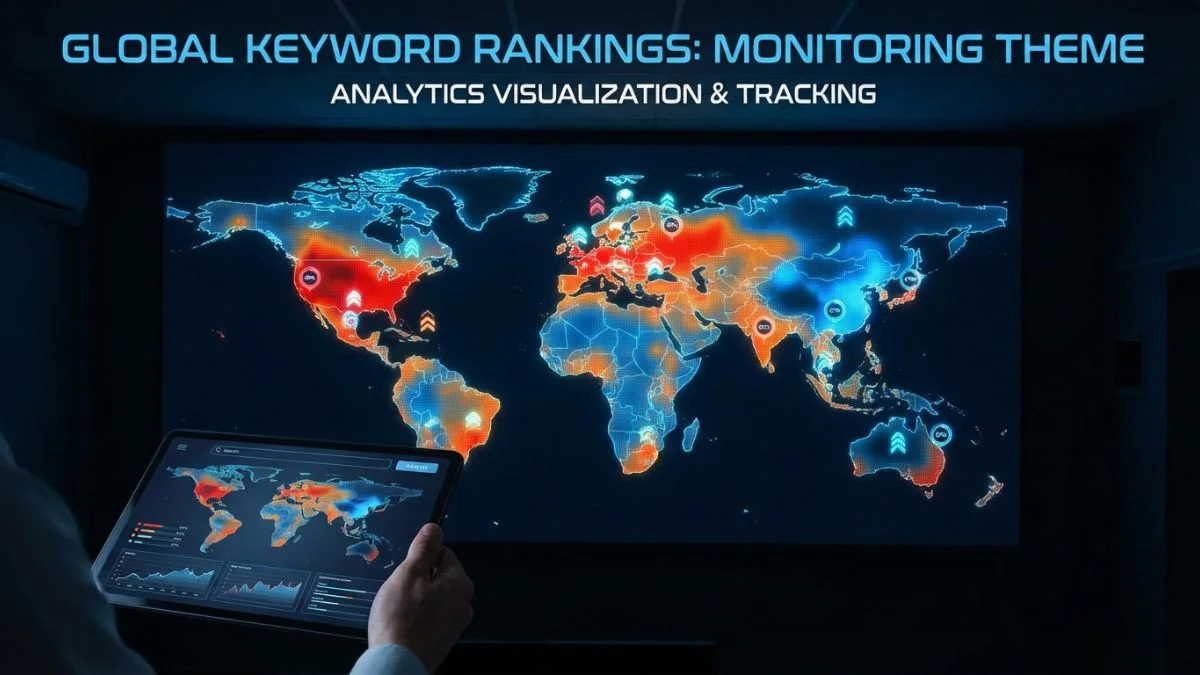
How to Monitor Global Keyword Rankings

How to Monitor Global Keyword Rankings: The 2026 Performance Guide
Direct Answer: To monitor global keyword rankings in 2026, you must utilize Clean Room GEO-Simulations—a combination of residential proxy networks and headless browser agents that bypass personalized search history. Monitoring should be segmented by Localized Intent Clusters (e.g., informational vs. transactional per region) across all relevant engines including Google, Baidu, and Yandex. Enterprise brands should track their Global Share of Voice (GSoV), which measures visibility across an entire market's keyword universe rather than just individual positions. Success is defined by Cross-Border SERP Parity, where your localized pages appear correctly in their respective markets without hreflang conflicts or geo-mismatches.
📈 Executive Summary: The Global Search Auditing Framework
- Clean Room GEO-Verification: Use residential proxies to see the raw, unweighted SERP that a local user actually experiences.
- Intent-Based Cluster Tracking: Group keywords by user intent (Research, Comparison, Purchase) and track performance by market maturity.
- GSC Country Segmentation: Leverage Google Search Console's Country API to identify CTR anomalies that signal poor localization.
- Multi-Engine Syndication: Monitor non-Google engines (Baidu, Yandex, Naver) using local-specific webmaster tools for true global coverage.
Your first and most accurate source of international ranking data is GSC. Unlike third-party tools, GSC provides First-Party Impression Data, showing where you actually appeared for real users.
In 2026, the 'Performance' report in GSC is the gold standard for verifying actual search visibility. By using the 'Country' filter, you can see your organic clicks, impressions, and 'Average Position' for any nation. If you see a discrepancy between your 'Position' and your 'CTR' in a specific country, it may imply a Content Localization issue, as we explored in localizing content for global SEO. For details on the technical reports, see how to use search console for international SEO.
1. The Global Search Volatility Index (GSVI)
International SERPs are more volatile than domestic ones because of varying algorithmic refresh rates per region. Track your market's GSVI to understand if a ranking drop is a site-wide issue or a regional market shift.
| Volatility Level | Daily Position Shift | Monitoring Frequency |
|---|---|---|
| Stable Market (Tier 1) | ± 1-2 Positions. | Weekly Sync. |
| Dynamic Market (Tier 2/3) | ± 5-10 Positions. | Daily Real-Time. |
| High-Alpha (Emerging) | ± 20+ Positions. | Hourly Alerting. |
Chapter 2: choosing and Configuring Global Rank Trackers
Standard rank trackers fail in complex international environments. You cannot use a US-based IP to track rankings in Tokyo.
For a global brand, you need a tool that can track rankings at a City or Postal Code Level across multiple countries. Tools like Semrush, Ahrefs, and BrightEdge allow you to create regional projects. Ensure your tracker is configured to detect Localized SERP Features, such as 'People Also Ask' and 'Knowledge Panels.' As we detailed in optimizing for global SERP features, these elements now account for over 50% of global search visibility. This is a critical factor for what is technical SEO reporting.
Data dashboards can sometimes be misleading. Manual verification is essential to ensure your GEO-Targeting is landing correctly.
To see exactly what a user in Paris sees, you must bypass your own location signals. Use a high-quality VPN or Residential Proxy to simulate a local IP address. This helps you verify if your hreflang tags are working correctly—i.e., is Google showing the /fr/ version of your site to your Parisian proxy? This is how you avoid Geo-Targeting Issues which we analyzed in avoiding geo-targeting issues. This step is mandatory before reporting to global stakeholders.
1. The Keyword Intent Complexity (KIC) Matrix
Monitoring global rankings requires understanding that "Intent" shifts across borders. A keyword that is pure 'Informational' in the US might be 'High-Commercial' in an emerging market where that product is a novelty.
| Intent Strategy | Market Context | Target Metrics |
|---|---|---|
| Education-Led (Top Funnel) | Markets with low awareness. | Impression Volume. |
| Competition-Led (Mid Funnel) | Mature, saturated markets. | Share of Voice. |
| Transaction-Led (Bottom Funnel) | Markets with high brand loyalty. | Conversion Position. |
Chapter 4: Monitoring Non-Google Rankings (Baidu, Yandex)
A global monitoring strategy cannot ignore the "Rest of the World."
If you have a presence in China or Russia, you must monitor Baidu and Yandex Webmaster Tools. These engines have their own ranking metrics and behavioral signals. For instance, Baidu relies heavily on 'Physical Proximity' to local servers, which we explored in IP-based SEO impact. Success in these markets requires specialized monitoring for country-specific SEO best practices. This is how you achieve International Search Dominance.
Global monitoring is about "Themes," not just individual words. Tracking keywords in isolation leads to Data Blindness.
Users in different countries search for the same concept using different terminology. You should track Keyword Clusters across multiple languages. For example, track "Running Shoes" (US), "Runners" (AU), and "Chaussures de course" (FR) within the same thematic report. This requires precise international keyword research. This approach prevents Duplicate Content flags by proving that each language version targets unique regional search intents, as we saw in avoiding duplicate content in international SEO.
1. The Cross-Market Alignment Protocol (CMAP)
Use CMAP to ensure your global content remains synchronized. If a page ranks well in Germany but fails in neighboring Austria, it signals a Semantic Mismatch or a regional UI hurdle, not a technical SEO failure.
Chapter 6: Assessing the Impact of International Backlinks on Rank
Your ranking position is a direct reflection of your 'Regional Authority.'
Monitor which country-code Top-Level Domains (ccTLDs) are linking to your site. A surge in links from .de sites should translate to a surge in rankings on Google.de. If it doesn't, you may have a technical bottleneck. This is the core of implementing international backlinks. Tracking these 'Referral-to-Rank' correlations is how you prove the ROI of global PR and link building efforts.
Chapter 7: Reporting for Global and Regional Stakeholders
Monitoring is only useful if it can be communicated.
Create separate "Regional Views" for your local marketing teams and a "Global Roll-up" for executive leadership. Highlight Share of Voice in different markets rather than just raw rankings. Use tracking international SEO performance methods to normalize data across different time zones and search engines. This ensures that every team knows exactly where they stand in the international search marketplace. This is a critical step for maintaining performance focus across large organizations.
Conclusion: The Insight-Driven Global Brand
Monitoring global keyword rankings is the final, essential stage of a mature international SEO strategy. It is the "Feedback Loop" that tells you if your technical architecture, localized content, and global backlinks are working in harmony. In 2026, the brands that win are those that move from "Tracking" to "Insight," using their data to predict trends before they happen on a global scale.
By leveraging GSC segmentation, configuring cross-border rank trackers, and validating your results with local proxies, you provide your brand with a world-class global foundation. You ensure that you are never surprised by a sudden drop in a key market or a surge in a new territory. Don't leave your global visibility to chance. Master the art of international monitoring, claim your space in the global SERPs, and build a brand that is truly worldwide and data-optimized. The world is searching—it's time you knew exactly where you stand. Start your global monitoring project today.
Frequently Asked Questions on Global Rank Monitoring
1. Why do my rankings differ between countries?
Because search engines localize results based on the user's IP, physical location, language settings, and the local competition in that specific market.
2. What is the best tool for monitoring global keywords?
Semrush, Ahrefs, and BrightEdge are the industry leaders for global brands. For city-level precision, tools like AccuRanker are highly effective.
3. How do I see true local search results?
Use a VPN or a proxy to simulate the location you are targeting, or use specialized tools like 'I Search From' to see the SERPs for a specific country and city.
4. How often should I check my international rankings?
For high-priority markets, daily. For smaller markets, weekly or monthly is usually sufficient to track long-term trends and identify major changes.
5. Can I use Google Search Console for all my monitoring?
GSC is great for seeing real traffic data, but it doesn't show you 'Potential' rankings (where you aren't yet ranking) or your competitors' rankings, which why you need a secondary rank tracker.
6. What is 'Share of Voice' in global SEO?
This is a metric that shows how much of the total search traffic for a set of keywords in a specific country you own compared to your competitors.
7. How do I track rankings on Baidu or Yandex?
You must use specific Baidu or Yandex SEO tools, such as Dragon Metrics for Baidu, or the native Webmaster tools provided by these search engines.
8. Will my international rankings be the same on mobile and desktop?
No. Mobile ranking factors (like speed and responsive design) significantly influence results, especially in 'Mobile-First' markets like India and Southeast Asia.
9. Does hreflang affect my rankings directly?
Not directly as a ranking factor, but it prevents your site from being seen as duplicate and ensures Google serves the right version to the right user, which improves CTR and engagement.
10. How do I handle 'Mobile-First' ranking reports?
In your rank tracker, always prioritize 'Mobile' results, as Google now uses mobile-first indexing globally. Ensure your SERP feature tracking is also set to mobile.
11. What is 'Clean Room' search verification?
It is the process of using fresh proxy IPs, cleared cookies, and neutral browser profiles to see the 'Universal SERP' without the bias of your own search history or corporate network IP.
12. How does GPS-based ranking differ from IP-based ranking?
IP-based tracking identifies your region, but GPS-based tracking (used primarily on mobile) provides hyper-local precision down to a specific street corner, which is critical for local service businesses.
13. What is 'Share of Voice' (SoV) vs. 'Share of Market' (SoM)?
SoV measures your brand's visibility in search results for a keyword set, while SoM measures actual transaction volume. A high SoV with low SoM suggests a conversion optimization problem.
14. How do I track rankings in countries with multiple official languages?
You must track each language independently. For example, in Canada, track 'Running Shoes' for English users and 'Souliers de course' for French users, using the respective regional versions of Google.
15. What are 'Localized Intent Clusters'?
These are groups of keywords that share a common user goal (e.g., 'How to...') but differ in semantic phrasing across regions. Tracking by cluster provides a more accurate view of authority than tracking single words.
16. Why do SERP features (like Snippets) disappear internationally?
Google often tests new SERP features in the US first. A snippet that appears in the US may not exist yet in India or Brazil, even for the exact same query intent.
17. How do I monitor rankings for 'People Also Ask' (PAA)?
Enterprise rank trackers now include PAA tracking. Monitor not just if you appear in the PAA, but which specific question you are answering and the ranking of that answer.
18. What is the impact of 'Zero-Click' searches on global monitoring?
Zero-click searches (where the user gets the answer from the SERP) mean you must track 'Impression Share' as well as 'Clicks' to measure your brand's true mental availability.
19. How do I track rankings for voice-activated search globally?
Voice search often uses the 'Position Zero' or Featured Snippet result. Tracking for voice means identifying results that are conversational and semantically complete.
20. Can competition in one country affect my rankings in another?
Rarely. Google evaluates regional competition independently. However, a global competitor with massive domain authority can use that authority to quickly rank new localized pages.
21. What is 'SERP Parity' in international SEO?
It is the goal of having your localized page appear in the correct regional search engine (e.g., the .fr page on Google.fr) without 'wrong-version' pages outranking it.
22. How do I monitor the impact of regional algorithm updates?
Use tools like 'MozCast' or 'Semrush Sensor' segmented by region. If the sensor is 'Hot' in the UK but 'Cool' in the US, a regional update is likely in progress.
23. What is the role of 'Dynamic Search Ads' (DSA) in rank monitoring?
DSAs can identify new keywords you are ranking for organically but didn't know you had. Use DSA data to expand your organic rank tracking list.
24. How do I track rankings for 'Local Service Ads' (LSAs)?
LSAs are managed via Google Ads, but they influence organic trust. Monitor the correlation between your LSA presence and your Map Pack organic ranking.
25. What is 'Search Intent Mismatch' across borders?
This occurs when a keyword translated literally has a different intent (e.g., 'gift' means 'poison' in German). Monitoring for mismatch requires native-level semantic analysis.
26. How do I track rankings in 'Dark' regions (no local Google)?
In regions like China or Russia, you must use local engines (Baidu, Yandex). In countries without a local Google domain, Google defaults to Google.com but still uses local IP signals.
27. What is the 'Position Weighting' reporting method?
Instead of an average, list the percentage of keywords in the Top 3, Top 10, and Top 30. This provides a better view of 'visibility health' than a single average number.
28. How often should I update my global keyword list?
Add new keywords quarterly based on GSC 'New Queries' data. Remove 'Zombie Keywords' that have no volume or relevance to your current product line.
29. What is 'SERP Crowding'?
It is when Google fills the first page with Ads, Maps, and Snippets, pushing the first organic result below the fold. Monitor 'Pixels from Top' to see your true visibility.
30. How do I monitor the performance of 'Breadcrumb' schema globally?
Check GSC 'Enhancements' report for breadcrumbs. If rankings are high but clicks are low, your breadcrumb trail might be misleading or poorly localized.
31. Can I use AI to automate my global rank monitoring?
AI can automate 'Anomaly Detection' (flagging sudden drops), but human experts are still needed to diagnose why a drop occurred (e.g., a competitor campaign vs. a technical bug).
32. What is 'Domain Dominance' in a specific country?
It is when a single domain (like Wikipedia or a local giant) owns the Top 3 positions for almost every keyword in a niche, making individual rank tracking more difficult.
33. How does 'Search Personalization' affect global reporting?
Personalization based on a user's past history can vary results by up to 30%. This is why 'Clean Room' monitoring is essential for objective reporting.
34. What is 'Regional Keyword Cannibalization'?
It occurs when your /uk/ and /us/ pages compete for the same keyword on Google.com. Monitor GSC to ensure each regional page is ranking in its target territory.
35. Why is 'Average Position' a misleading metric?
Because it doesn't account for volume. Ranking #1 for a zero-volume keyword and #50 for a high-volume keyword yields an 'average' of 25.5, which is useless data.