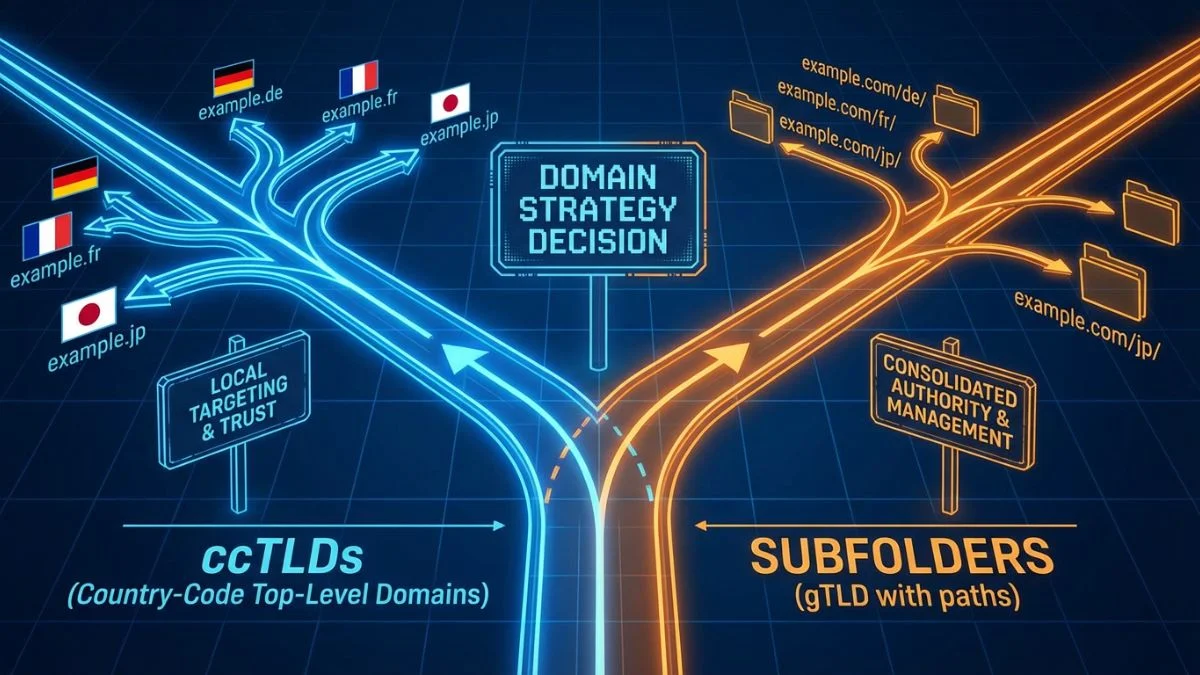
How to Use ccTLDs vs Subfolders

How to Use ccTLDs vs Subfolders for International SEO
A practical decision framework for global expansion with clear SEO tradeoffs and 2026 best practices.
Choosing the right international site structure is one of the most important decisions in global SEO. The choice between ccTLDs (country code top-level domains like example.de) and subfolders (like example.com/de/) affects everything: rankings, trust, link equity, analytics, development overhead, and long-term scale.
In 2026, Google supports both models equally well, but the results are not equal. Your structure should match your business goals, operational capacity, and market priorities. This guide breaks down the tradeoffs, provides a decision matrix, and shows you how to implement each option correctly.
Quick Definitions
- ccTLD: Country code top-level domain (example.fr, example.de, example.co.uk). Strong local signal but separate domain.
- Subfolder: Country or language directory on a main domain (example.com/fr/). Shares authority with the root domain.
- Subdomain: Country or language on a separate hostname (fr.example.com). Treated more like a separate site.
Decision Matrix: ccTLDs vs Subfolders
| Factor | ccTLDs | Subfolders |
|---|---|---|
| Local trust signal | Strong (native domain) | Moderate (shared global domain) |
| SEO authority sharing | Separate (no shared equity) | Shared with root domain |
| Setup and maintenance cost | High (multiple sites) | Lower (single site) |
| Technical complexity | High (multiple properties) | Lower (single property) |
| Scalability | Slower (per-country ops) | Faster (centralized) |
| Geo-targeting clarity | Excellent | Very good (with hreflang) |
When ccTLDs Are the Best Choice
ccTLDs are ideal when local trust and independence matter more than centralized authority. This is common for regulated industries, country-specific branding, or businesses with local teams.
Choose ccTLDs if:
- You operate as a local business in each country
- Regulations require data residency or country-specific domains
- You have separate marketing teams per country
- Local trust is critical (finance, healthcare, legal)
- You can invest in separate SEO and link building per market
When Subfolders Are the Best Choice
Subfolders are the most efficient option for most businesses. They consolidate link equity and reduce operational overhead. This is why many global brands choose subfolders for their international sites.
Choose subfolders if:
- You want faster global scaling with one domain authority
- Your SEO resources are centralized
- You are entering multiple markets quickly
- You need simpler analytics and tracking
- Your site uses a single CMS and infrastructure
SEO Impact: How Google Treats Each Structure
Google supports both ccTLDs and subfolders as valid international structures. According to Google Search Central, structure alone does not determine rankings. However, the signal strength and operational differences can influence outcomes.
ccTLD SEO Advantages
- Strong geotargeting signal by default
- Higher local trust and CTR in some markets
- Clear separation of country content
Subfolder SEO Advantages
- Shared link equity across markets
- Faster indexing due to central authority
- Easier content promotion and internal linking
Implementation Steps: ccTLDs
- Register each ccTLD (example.fr, example.de, example.co.uk)
- Set up hosting and localization by region
- Create localized keyword research per market
- Build local backlinks and citations
- Implement hreflang across all variants
- Set up separate Google Search Console properties
- Align analytics with cross-domain tracking
Implementation Steps: Subfolders
- Create language or country directories (/uk/, /de/, /fr/)
- Localize content and metadata per directory
- Implement hreflang between all versions
- Submit sitemaps per locale
- Segment analytics by directory
- Build localized internal links
Migration Considerations
Switching structures (for example, from subfolders to ccTLDs) is a major migration. It can take months to stabilize. Use the same migration best practices you would use for any large domain change:
- Map old URLs to new URLs with 301 redirects
- Update canonical tags and hreflang
- Submit updated sitemaps
- Monitor indexing and coverage issues
- Expect short-term volatility
Analytics and Reporting Differences
With ccTLDs, you will need separate properties in Google Search Console and separate GA4 data streams. With subfolders, you can use one property and segment by directory. This reduces reporting overhead and makes it easier to compare markets.
Best Practices Checklist
- Use hreflang tags for language and country targeting
- Localize titles, meta descriptions, and URLs
- Build local links and citations per market
- Use local currency, measurements, and examples
- Test SERP intent per region
- Track performance by country and language
Recommended External Resources
- Google Search Central: International SEO
- Google: Localized Versions
- Moz International SEO
- Ahrefs International SEO Guide
- Semrush International SEO
- Search Engine Journal: International SEO
- Search Engine Land: International SEO
- Google: Hreflang Overview
- Google Crawling Overview
- BrightLocal Learning Center
- SISTRIX
- Similarweb
- Google Trends
- Cloudflare: What is a TLD
- W3C Internationalization
Internal Resources from Bright SEO Tools
- SEO for Beginners
- SEO Strategy Guide
- URL Structure Best Practices
- Schema Markup Guide
- On-Page SEO Checklist
- Website SEO Score Checker
- Keyword Research Tool
- Use Keywords Effectively
- SEO-Friendly Landing Pages
- Improve Content Readability
Frequently Asked Questions
Are ccTLDs better for SEO than subfolders?
Not universally. ccTLDs provide stronger local trust and geotargeting, but subfolders share authority and are easier to manage. Choose based on resources and market goals.
Do subfolders rank as well as ccTLDs?
Yes. Google treats both as valid. Subfolders often rank faster because they inherit authority from the root domain.
Should I use subdomains for international SEO?
Subdomains can work, but they are treated more like separate sites. Subfolders are generally recommended for efficiency.
Do I need hreflang with ccTLDs?
Yes. Hreflang helps Google serve the correct language and region version, even with ccTLDs.
Which structure is cheaper to maintain?
Subfolders are cheaper because you manage one domain, one CMS, and one analytics setup.
What is best for fast global expansion?
Subfolders are typically best for rapid expansion because you reuse the main domain authority and infrastructure.
Can I mix ccTLDs and subfolders?
Yes, but it is complex. Some brands use ccTLDs for major markets and subfolders for smaller regions.
How do I track performance across ccTLDs?
Use separate Search Console properties and GA4 streams, then combine data in a unified dashboard.
Which structure improves local trust?
ccTLDs typically improve trust because users see a local domain in the URL.
What is the biggest risk of ccTLDs?
Each ccTLD requires its own SEO investment. Without local links and content, it may underperform.