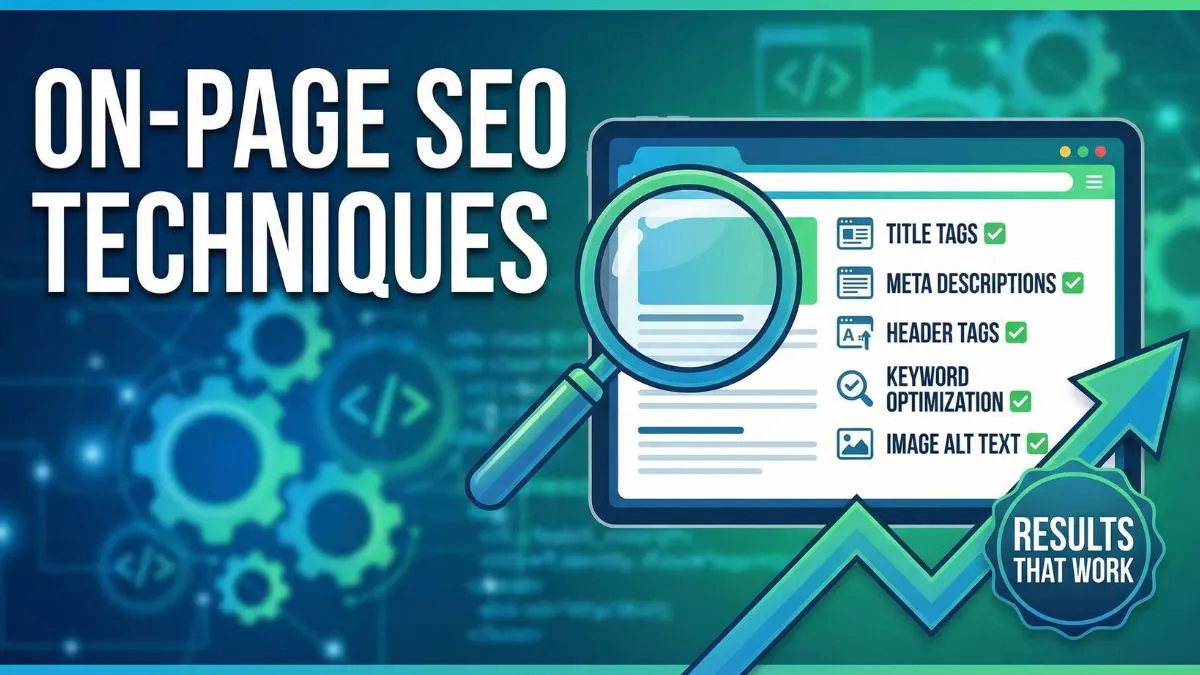
On-Page SEO Techniques That Actually Work

On-Page SEO Techniques That Actually Work
On-page SEO remains one of the most controllable and impactful aspects of search engine optimization. While off-page factors like backlinks are important, what you do on your own website can make or break your rankings. This comprehensive guide explores proven on-page SEO techniques that deliver real results in today's competitive search landscape.
Understanding On-Page SEO in 2025
On-page SEO refers to all the optimization tactics you apply directly to your website's pages to improve their search engine rankings and user experience. Unlike off-page SEO, which focuses on building authority through external signals, on-page SEO is entirely within your control.
The fundamentals of SEO for beginners start with understanding that search engines like Google evaluate hundreds of factors when ranking pages. However, on-page elements form the foundation of your optimization strategy because they directly communicate what your content is about and how valuable it is to users.
1. Strategic Keyword Placement and Optimization
Keywords remain the cornerstone of on-page SEO, but the approach has evolved significantly. Gone are the days of keyword stuffing. Modern keyword optimization requires strategic placement and natural integration.
Title Tag Optimization
Your title tag is arguably the most important on-page SEO element. It should include your primary keyword, preferably near the beginning, while remaining compelling and under 60 characters to avoid truncation in search results.
A website SEO score checker can help you evaluate whether your title tags are optimized correctly. The title should accurately describe your page content while enticing users to click through from search results.
Meta Description Excellence
While meta descriptions don't directly impact rankings, they significantly affect click-through rates. Craft compelling descriptions between 150-160 characters that include your target keyword and a clear value proposition. Think of it as your advertisement in search results.
Header Tag Hierarchy
Headers (H1, H2, H3, etc.) structure your content for both users and search engines. Your H1 should contain your primary keyword and clearly state the page's main topic. Use H2s and H3s to break content into digestible sections, incorporating related keywords and synonyms naturally.
Using a meta tag analyzer helps ensure your header structure is optimized correctly and follows best practices.
Body Content Integration
Incorporate keywords naturally throughout your content, focusing on semantic variations and related terms rather than exact-match repetition. According to research from Backlinko, the first 100 words of your content are particularly important for keyword placement.
2. Content Quality and Depth
Search engines have become remarkably sophisticated at evaluating content quality. Thin, superficial content rarely ranks well anymore.
Comprehensive Coverage
Create content that thoroughly addresses user intent. If someone searches for information about on-page SEO, they expect comprehensive coverage, not a brief 300-word overview. Aim for content length that matches search intent—typically 1,500-3,000 words for informational queries.
Developing an effective SEO strategy requires understanding that content depth signals expertise and authority to search engines.
Original Research and Insights
Content that includes original data, case studies, or unique perspectives tends to perform better. Instead of regurgitating information available elsewhere, provide fresh insights based on experience or research.
Content Freshness
Regularly updating content signals to search engines that your information remains current and relevant. For time-sensitive topics, this is especially critical. Use tools to track when content needs refreshing based on performance declines.
3. URL Structure Optimization
Clean, descriptive URLs help both users and search engines understand page content before even visiting it.
Best Practices for URLs
- Keep URLs short and descriptive
- Include your target keyword
- Use hyphens to separate words
- Avoid unnecessary parameters and numbers
- Maintain a logical hierarchy
For example: brightseotools.com/on-page-seo-techniques is far superior to brightseotools.com/page?id=12345&cat=seo
A URL encoder decoder can help ensure your URLs are properly formatted and search engine friendly.
4. Image Optimization Techniques
Images enhance user experience but can slow down your site if not properly optimized. Image SEO is a critical component of on-page optimization.
File Size and Compression
Large image files are one of the biggest culprits behind slow page speeds. Use an image compressor to reduce file sizes without sacrificing quality. Aim for images under 100KB whenever possible.
Alt Text Optimization
Alt text serves two purposes: accessibility for visually impaired users and context for search engines. Write descriptive alt text that includes relevant keywords naturally while accurately describing the image content.
File Naming Conventions
Before uploading images, rename files with descriptive, keyword-rich names. Instead of "IMG_1234.jpg," use "on-page-seo-checklist-diagram.jpg."
Modern Image Formats
Consider using next-generation formats like WebP, which offer superior compression and quality compared to traditional JPEG and PNG formats.
5. Internal Linking Strategy
Internal links distribute page authority throughout your site and help search engines understand your site's structure and hierarchy.
Strategic Link Placement
Link to relevant pages naturally within your content. Each page should have 2-5 internal links to related content. For instance, when discussing technical SEO secrets, link to pages that provide deeper dives into specific technical aspects.
Anchor Text Optimization
Use descriptive, keyword-rich anchor text that tells users and search engines what to expect on the linked page. Avoid generic phrases like "click here" or "read more."
Link Depth Consideration
Important pages should be no more than three clicks from your homepage. This ensures they receive adequate authority and are easily discoverable by search engine crawlers.
Understanding how search engines rank websites helps you appreciate why internal linking matters so much for SEO success.
6. Page Speed Optimization
Page speed is a confirmed ranking factor and critically impacts user experience. According to Google's research, 53% of mobile users abandon sites that take longer than three seconds to load.
Core Web Vitals
Focus on improving three key metrics:
- Largest Contentful Paint (LCP): Should occur within 2.5 seconds
- First Input Delay (FID): Should be less than 100 milliseconds
- Cumulative Layout Shift (CLS): Should be less than 0.1
Learn 7 proven ways to improve Core Web Vitals to enhance your page speed metrics.
Technical Optimization Tactics
- Minify CSS, JavaScript, and HTML using tools like HTML minifier, JavaScript minifier, and CSS minifier
- Enable GZIP compression using a GZIP compression checker
- Leverage browser caching
- Implement lazy loading for images
- Use a Content Delivery Network (CDN)
Explore 10 speed hacks for lightning fast sites for detailed implementation guides.
7. Mobile Optimization
With mobile-first indexing, Google primarily uses the mobile version of your content for ranking. Mobile optimization is no longer optional.
Responsive Design
Ensure your site adapts seamlessly to different screen sizes. Use a mobile friendly test to verify your pages display correctly across devices.
Mobile-Specific Considerations
- Larger, tappable buttons and links
- Readable font sizes (minimum 16px)
- Adequate spacing between elements
- Simplified navigation
- Fast load times on mobile networks
Check out 7 smart ways to improve mobile SEO for comprehensive mobile optimization strategies.
8. Schema Markup Implementation
Schema markup helps search engines understand your content context and can earn you rich snippets in search results.
Common Schema Types
- Article schema for blog posts
- Product schema for e-commerce
- FAQ schema for question-answer content
- Review schema for ratings and testimonials
- Local business schema for location-based services
Implementing schema can significantly increase your click-through rates by making your listings more prominent and informative in search results.
9. User Experience Signals
Google increasingly prioritizes user experience signals when ranking pages.
Bounce Rate Reduction
High bounce rates suggest users aren't finding what they need. Implement 8 proven tips to reduce bounce rate including:
- Improving content relevance
- Enhancing page speed
- Creating compelling introductions
- Using clear navigation
- Implementing strong calls-to-action
Dwell Time Optimization
Encourage users to spend more time on your pages through:
- Engaging, well-formatted content
- Multimedia elements (videos, infographics)
- Internal linking to related content
- Interactive elements where appropriate
Learn how SEO helps improve user experience to understand the relationship between UX and rankings.
10. Content Structure and Readability
Even excellent content fails if it's difficult to read or navigate.
Formatting Best Practices
- Short paragraphs (2-3 sentences maximum)
- Bullet points and numbered lists
- Strategic use of bold and italics for emphasis
- White space to prevent text walls
- Relevant images and graphics to break up content
Reading Level Consideration
Write for your audience's reading level. Most online content performs best at an 8th-9th grade reading level, making it accessible while maintaining professionalism.
Use an online text editor to review and refine your content formatting.
11. Semantic SEO and Topic Clusters
Modern SEO extends beyond individual keywords to comprehensive topic coverage.
Topic Cluster Strategy
Create pillar pages covering broad topics, then link to cluster content addressing specific subtopics. This structure signals topical authority to search engines.
For example, a pillar page on "what is SEO and why it matters" could link to cluster pages on technical SEO, content optimization, link building, and more.
LSI Keywords
Latent Semantic Indexing (LSI) keywords are terms related to your main keyword. Include natural variations and synonyms throughout your content to demonstrate comprehensive topic coverage.
A keyword research tool and related keywords finder help identify relevant semantic variations.
12. Security and Trust Signals
Security isn't just good practice—it's a ranking factor.
SSL Certification
HTTPS is essential. Use an SSL checker to verify your certificate is properly installed and up to date. Google marks non-HTTPS sites as "Not Secure," which damages trust and rankings.
E-A-T Optimization
Expertise, Authoritativeness, and Trustworthiness (E-A-T) are critical, especially for YMYL (Your Money Your Life) content.
- Display author credentials and expertise
- Include author bios with relevant qualifications
- Link to authoritative external sources
- Maintain accurate, fact-checked content
- Display clear contact information and privacy policies
13. Multimedia Integration
Diverse content formats enhance engagement and time on page.
Video Content
Embedding relevant videos increases engagement and dwell time. According to Wistia's research, pages with videos are 53 times more likely to rank on Google's first page.
Infographics and Visual Content
Visual content is more shareable and easier to digest than text alone. Create original infographics using data from your industry or research.
Interactive Elements
Calculators, quizzes, and interactive tools increase engagement. For example, tools like an age calculator or percentage calculator can attract links and improve user metrics.
14. Content Uniqueness and Plagiarism Prevention
Duplicate content confuses search engines about which version to rank.
Original Content Creation
Every page should offer unique value. Use a paraphrasing tool if you need to reference existing content, but always add your own insights and perspective.
Canonical Tags
When you must have similar content across multiple URLs, implement canonical tags to indicate the preferred version for search engines.
15. Call-to-Action Optimization
Every page should guide users toward a specific action.
Strategic CTA Placement
- Above the fold for immediate visibility
- Within content at natural break points
- At the end of articles
- In sidebars for persistent visibility
CTA Best Practices
- Use action-oriented language
- Create urgency when appropriate
- Make CTAs visually distinct
- Test different versions for performance
16. External Linking to Authority Sites
Linking to high-quality external sources benefits your SEO.
Why External Links Matter
According to Moz's research, linking to relevant authority sites helps:
- Establish content credibility
- Provide additional value to readers
- Demonstrate thorough research
- Build relationships with industry leaders
Best Practices
- Link to authoritative sources (.edu, .gov, established industry sites)
- Use descriptive anchor text
- Ensure links open in new tabs
- Regularly check for broken links using broken link checkers
Quality sources like Search Engine Journal and Search Engine Land provide excellent resources for staying current with SEO best practices.
17. Structured Data and Rich Snippets
Structured data markup helps search engines display enhanced results.
Implementation Strategies
- FAQ schema for question-answer sections
- HowTo schema for instructional content
- Product schema for e-commerce items
- Breadcrumb schema for site navigation
- Review schema for ratings and testimonials
Use Google's Structured Data Testing Tool to validate your implementation.
18. Content Audit and Optimization
Regular content audits identify optimization opportunities.
Audit Process
- Inventory all pages using a sitemap generator
- Analyze performance metrics (traffic, rankings, conversions)
- Identify underperforming content
- Update, consolidate, or remove weak content
- Strengthen internal linking structure
Follow a comprehensive website audit checklist to ensure thorough evaluation.
Performance Metrics
Use a website SEO score checker to track improvements over time and identify areas needing attention.
19. Voice Search Optimization
Voice search is growing rapidly, requiring adapted optimization strategies.
Voice Search Best Practices
- Target long-tail, conversational keywords
- Create content that answers specific questions
- Optimize for local search
- Focus on featured snippet positions
- Use natural language in content
Understanding Zero-Click SEO helps you optimize for voice search results.
20. Local SEO On-Page Factors
For businesses serving specific geographic areas, local on-page optimization is essential.
Local Optimization Elements
- Include city/region names in title tags and content
- Create location-specific pages for multi-location businesses
- Embed Google Maps on contact pages
- Display NAP (Name, Address, Phone) consistently
- Include local schema markup
Use a domain hosting checker to ensure your hosting location aligns with your target market when possible.
21. Crawlability and Indexation
If search engines can't crawl your content, they can't rank it.
Robots.txt Optimization
Your robots.txt file controls which pages search engines can access. Learn 8 key tips for robots.txt perfection to avoid accidentally blocking important pages.
XML Sitemap
Submit a comprehensive XML sitemap through Google Search Console. Generate one using an XML sitemap generator and update it regularly.
Crawl Budget Management
For large sites, optimize crawl budget by implementing 12 crawl budget tips that matter.
22. Tracking and Measurement
You can't improve what you don't measure. Implement comprehensive tracking to evaluate your on-page SEO effectiveness.
Essential Metrics
- Organic traffic volume and trends
- Keyword rankings for target terms
- Click-through rates from search results
- Bounce rate and time on page
- Conversion rates by landing page
- Core Web Vitals scores
Learn how to measure SEO success with the right metrics and tools.
Tools for Monitoring
- Google Search Console for performance data
- Google Analytics for traffic analysis
- SERP checker for ranking monitoring
- Google Cache checker to verify indexation
23. Common On-Page SEO Mistakes to Avoid
Understanding mistakes helps you avoid them.
Critical Errors
Avoid these 5 SEO mistakes killing your rankings:
- Keyword stuffing and over-optimization
- Duplicate content across multiple pages
- Slow page load times
- Poor mobile experience
- Thin or low-quality content
Also steer clear of 6 deadly SEO habits to break now including neglecting technical issues and ignoring user experience.
Advanced On-Page SEO Tactics
Content Hubs and Silos
Organize related content into themed sections or "silos" that comprehensively cover specific topics. This structure strengthens topical authority and improves internal linking.
Progressive Enhancement
Load critical content first, then enhance with additional features. This ensures fast initial rendering even if advanced features take longer to load.
AI and Machine Learning Integration
Leverage AI tools for productivity to enhance content creation, optimization, and analysis. Tools can help identify content gaps, suggest related topics, and optimize for semantic search.
Dynamic Content Optimization
Personalize content based on user behavior, location, or device while maintaining crawlability for search engines. Ensure primary content is always accessible in HTML.
Staying Current with Algorithm Updates
Search algorithms constantly evolve. Stay informed about SEO trends you need to know this year to adapt your on-page optimization strategies.
Resources for Updates
- Google Search Central Blog
- Industry publications like Search Engine Journal
- SEO community forums and discussions
- Regular audits using 9 SEO checker tools you must use
Creating Your On-Page SEO Action Plan
Implementing these techniques requires a systematic approach:
- Audit Current State: Use a comprehensive free website SEO checker to establish your baseline
- Prioritize Issues: Address critical technical issues first, then focus on content optimization
- Implement Systematically: Tackle one category of improvements at a time
- Measure Results: Track changes in rankings, traffic, and conversions
- Iterate and Refine: Continuously test and improve based on data
For new websites, follow a 30-day SEO plan to establish strong on-page foundations.
The Long-Term Perspective
On-page SEO isn't a one-time task but an ongoing process. Search engines evolve, competitors improve, and user expectations change.
Understand why SEO is still relevant despite these changes and commit to continuous improvement.
The 80-20 rule in SEO suggests that 20% of your efforts produce 80% of your results. Focus on high-impact on-page factors that deliver the greatest returns.
Conclusion
On-page SEO techniques that actually work share common traits: they prioritize user experience, provide genuine value, follow technical best practices, and align with search engine guidelines.
By implementing the strategies outlined in this guide—from strategic keyword optimization and content quality to technical performance and user experience—you'll build a solid foundation for search engine success.
Remember that how SEO impacts your website traffic depends on consistent, quality execution across all on-page factors. Start with the fundamentals, measure your progress, and continuously refine your approach based on data and results.
For ongoing success, combine these on-page techniques with content marketing strategies that boost SEO and maintain focus on delivering exceptional user experiences that naturally earn engagement and rankings.
Frequently Asked Questions (FAQs)
1. What is on-page SEO and why does it matter?
On-page SEO refers to optimization techniques applied directly to your website's pages to improve search rankings. It matters because it's entirely within your control and forms the foundation of your SEO strategy. On-page factors directly tell search engines what your content is about and help them determine its relevance and quality.
2. How long does it take to see results from on-page SEO?
Results typically appear within 3-6 months, though this varies based on competition, domain authority, and implementation quality. Technical fixes like improving page speed can show faster results, while content-focused changes may take longer. Consistent effort yields compounding returns over time.
3. What's the most important on-page SEO factor?
While many factors matter, content quality is consistently the most important. High-quality, comprehensive content that satisfies user intent forms the foundation for all other optimization efforts. Without strong content, technical optimizations have limited impact.
4. How many keywords should I target per page?
Focus on one primary keyword and 2-4 closely related secondary keywords per page. This focused approach allows you to create comprehensive content without diluting relevance. Each page should have a clear purpose and target audience.
5. Is keyword density still important for SEO?
Keyword density as a specific percentage is outdated. Instead, focus on natural keyword usage that reads well for humans while incorporating semantic variations. Modern search engines understand context and synonyms, making natural language more effective than rigid keyword formulas.
6. How do I know if my on-page SEO is working?
Monitor key metrics including organic traffic growth, improved keyword rankings, higher click-through rates, lower bounce rates, and increased time on page. Use Google Search Console and Analytics to track these metrics over time and identify trends.
7. Should I optimize old content or create new content?
Both strategies are valuable. Updating existing content that ranks on page 2-3 often yields quicker results than creating new content from scratch. However, creating new content targeting different keywords expands your potential traffic. Balance both approaches based on your resources and goals.
8. How important are meta descriptions for rankings?
Meta descriptions don't directly impact rankings but significantly influence click-through rates from search results. Well-written meta descriptions that include keywords and clear value propositions can improve CTR, which may indirectly benefit rankings through increased engagement signals.
9. What's the ideal word count for SEO content?
There's no universal ideal word count. Content should be as long as necessary to thoroughly address the topic and satisfy user intent. Comprehensive guides typically perform well at 2,000-3,000+ words, while specific queries may only require 500-800 words. Match length to intent and competition.
10. How often should I update my content?
Update content when information becomes outdated, when you can add significant new value, or when performance declines. For time-sensitive topics, review quarterly. For evergreen content, annual reviews often suffice. Prioritize updates that will meaningfully improve user experience or relevance.
11. Do outbound links help or hurt SEO?
Outbound links to high-quality, relevant sources help SEO by establishing credibility, providing additional value to users, and demonstrating thorough research. They signal to search engines that your content is well-researched and trustworthy. Avoid linking to low-quality or spammy sites.
12. How many internal links should each page have?
Most pages should have 3-5 contextual internal links to related content. Avoid over-linking, which dilutes link equity and creates poor user experience. Each internal link should provide genuine value to readers by directing them to relevant, helpful content.
13. What's the difference between on-page and technical SEO?
On-page SEO focuses on content optimization (keywords, structure, user experience), while technical SEO addresses site infrastructure (crawlability, site speed, mobile-friendliness, security). Both are essential and often overlap. For example, page speed impacts both user experience (on-page) and site performance (technical).
14. Should I use H1 tags for anything other than the main heading?
No. Each page should have only one H1 tag containing your primary keyword and main topic. Use H2-H6 tags for subheadings to create a logical content hierarchy. Multiple H1 tags confuse search engines about your page's primary focus.
15. How do I optimize for featured snippets?
Target featured snippets by directly answering common questions in concise formats (40-60 words), using structured data, formatting content with lists or tables, and including clear question-based headers. Position answers early in content and ensure they're immediately useful.
16. Is it better to have one comprehensive page or multiple focused pages?
It depends on user intent and topic complexity. Create one comprehensive page when topics are closely related and users benefit from seeing everything together. Split into multiple pages when subtopics are substantial enough to warrant individual treatment or target different search intents.
17. How important is mobile optimization for on-page SEO?
Mobile optimization is critical since Google uses mobile-first indexing. Your mobile site directly impacts rankings for both mobile and desktop searches. Ensure responsive design, fast mobile load times, and thumb-friendly navigation for optimal performance.
18. Can too much internal linking hurt SEO?
Excessive internal linking can dilute link equity, create poor user experience, and appear manipulative to search engines. Focus on quality over quantity, ensuring each internal link serves a genuine purpose for users. Natural, contextual linking performs best.
19. How do I optimize images without losing quality?
Use image compression tools to reduce file sizes by 50-80% without visible quality loss. Choose appropriate formats (WebP for modern browsers, JPEG for photos, PNG for graphics with transparency). Implement lazy loading and responsive images that serve different sizes based on device.
20. What's the relationship between on-page SEO and user experience?
On-page SEO and user experience are increasingly intertwined. Google's algorithms prioritize pages that deliver excellent user experiences through fast loading, easy navigation, quality content, and mobile-friendliness. Optimizing for users naturally improves SEO performance, making them complementary rather than competing priorities.
Ready to improve your on-page SEO? Start with a comprehensive audit using our website SEO score checker to identify your biggest opportunities for improvement. Then implement these proven techniques systematically to build a strong foundation for search success.