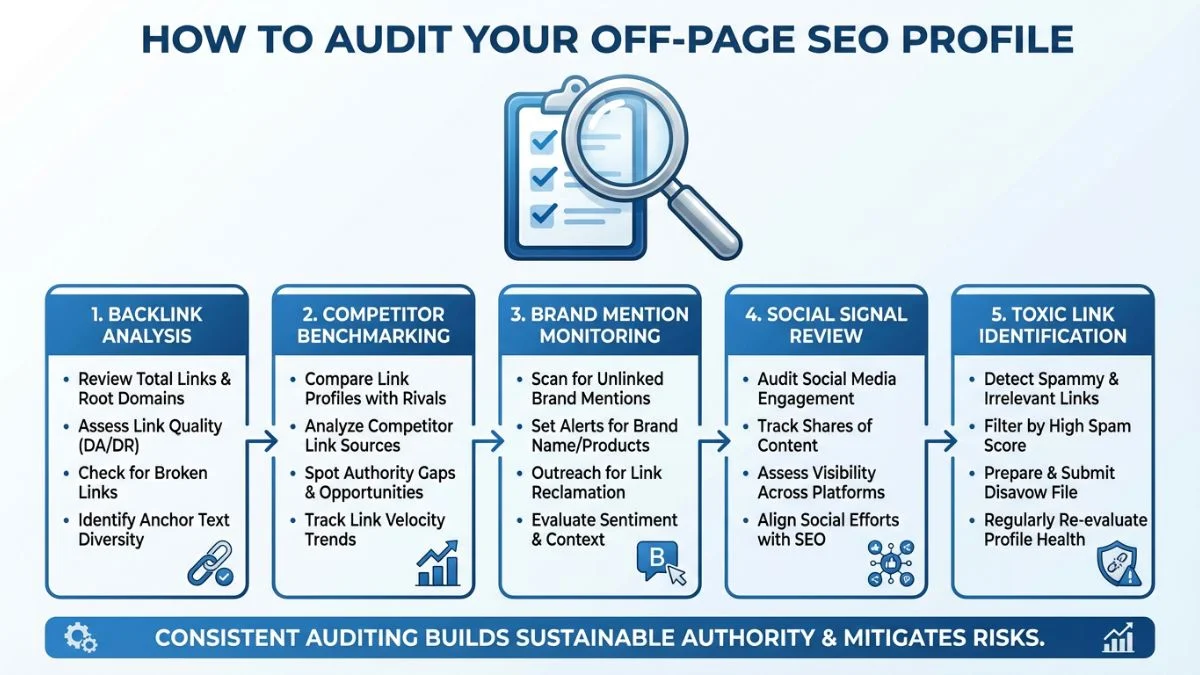
How to Audit Your Off-Page SEO Profile

How to Audit Your Off-Page SEO Profile: The Complete 2026 Guide
Your website's off-page SEO profile is like a financial credit score — it's built over time through the quality and quantity of external endorsements your site receives. Just as you'd regularly check your credit report for errors and opportunities, auditing your off-page SEO profile reveals critical insights about your site's authority, trustworthiness, and competitive standing in search results.
In 2026, Google's algorithms have become increasingly sophisticated at evaluating link quality. The days of quantity-over-quality link building are long gone. According to Semrush's 2025 Ranking Factors Report, the correlation between high-quality referring domains and top-3 rankings has strengthened by 23% compared to 2023. This means a clean, authoritative off-page profile is more important than ever.
Whether you've inherited a website with unknown link history, experienced a sudden traffic drop, or simply want to optimize your link building strategy, this comprehensive guide covers everything you need to know about conducting a professional-grade off-page SEO audit.
What Is an Off-Page SEO Audit?
An off-page SEO audit is a systematic evaluation of all external factors that influence your website's search engine rankings. Unlike on-page SEO which focuses on elements within your website, off-page SEO examines signals from across the web that point to your domain.
According to Moz's SEO learning center, off-page SEO encompasses all optimization activities that happen outside the boundaries of your own website to improve its search rankings.
Core Components of an Off-Page SEO Audit
| Audit Component | What It Covers | Key Metrics | Primary Tools |
|---|---|---|---|
| Backlink Analysis | All inbound links pointing to your site | Total backlinks, referring domains, DR/DA | Ahrefs, Semrush, Moz |
| Anchor Text Profile | Distribution of clickable text in links | Branded %, exact-match %, generic % | Ahrefs, Majestic |
| Toxic Link Detection | Harmful or spammy links to your site | Spam score, toxic score, penalty risk | Semrush, Link Detox |
| Competitor Benchmarking | How your profile compares to competitors | Link gap, DR gap, velocity comparison | Ahrefs, Semrush |
| Brand Mentions | Unlinked and linked mentions across the web | Mention volume, sentiment, link rate | Brand24, Mention, BuzzSumo |
| Social Signals | Social media engagement and sharing | Shares, engagement rate, social links | BuzzSumo, SharedCount |
| Link Velocity | Rate of new link acquisition over time | New/lost links per month, net growth | Ahrefs, Semrush |
Why Off-Page SEO Audits Are Critical in 2026
Google's algorithm updates in 2025 and early 2026 have placed even greater emphasis on link quality signals. The March 2025 core update specifically targeted sites with manipulative link profiles, resulting in significant ranking drops for websites that hadn't cleaned up their backlink portfolios.
According to Ahrefs' penalty research, 67% of sites that recovered from ranking drops in 2025 cited backlink cleanup as a primary recovery factor. Here's why regular auditing matters:
- Algorithm Protection: Google's SpamBrain AI system has become 4x more effective at detecting link spam since 2023, according to Google's Search Central blog
- Negative SEO Defense: Competitors or bad actors may point toxic links at your site — regular audits catch these early
- ROI Optimization: Understanding which link types drive rankings helps allocate your link building budget more effectively
- Penalty Prevention: Identifying risky links before Google flags them prevents costly manual actions
- Competitive Intelligence: Auditing reveals gaps and opportunities in your link profile relative to competitors
- Strategic Planning: Data-driven insights inform your SEO strategy for the coming quarter
Essential Tools for Off-Page SEO Auditing
Before diving into the audit process, you'll need the right toolkit. Here's a comprehensive comparison of the best off-page SEO audit tools available in 2026.
| Tool | Best For | Free Tier | Starting Price | Backlink Index Size |
|---|---|---|---|---|
| Ahrefs | Comprehensive backlink analysis | Webmaster Tools (limited) | $129/mo | 35+ trillion links |
| Semrush | Toxic link detection & competitive analysis | 10 queries/day | $139.95/mo | 43+ trillion links |
| Moz Pro | Domain Authority tracking | 10 queries/month | $99/mo | 44+ trillion links |
| Majestic | Trust Flow & Citation Flow | Limited lookups | $49.99/mo | 2.6+ trillion URLs |
| Google Search Console | Google's own link data | Fully free | Free | Google's index only |
| Link Research Tools | Link detox & penalty recovery | No free tier | $449/mo | Aggregates 25 sources |
For the most comprehensive audit, use the Bright SEO Tools website checker alongside a paid tool like Ahrefs or Semrush. Cross-referencing data from multiple sources gives you the most accurate picture of your off-page profile.
Step 1: Gather Your Backlink Data
The foundation of any off-page SEO audit is collecting comprehensive backlink data. No single tool captures every link, so a multi-source approach is essential.
Data Collection Framework
- Export from Google Search Console: Navigate to Links → External Links → Export. This gives you Google's own view of your link profile. According to Google's documentation, GSC shows a sampling of your links, not the complete picture.
- Pull from Ahrefs/Semrush: Export your complete backlink profile including referring domains, anchor text, and link attributes (dofollow/nofollow/UGC/sponsored).
- Cross-reference with Majestic: Use Majestic's Historic Index for links that may have been removed or expired but still influence your profile.
- Merge and Deduplicate: Combine all data sources into a single spreadsheet, removing duplicates based on the linking URL.
Key Data Points to Collect
| Data Point | Why It Matters | Where to Find It |
|---|---|---|
| Source URL | Identifies the exact page linking to you | All backlink tools |
| Target URL | Shows which of your pages receives the link | All backlink tools |
| Domain Rating / Authority | Indicates the linking site's authority | Ahrefs (DR), Moz (DA) |
| Anchor Text | Reveals anchor text distribution patterns | Ahrefs, Semrush, Majestic |
| Link Attribute | Dofollow vs nofollow/UGC/sponsored | Ahrefs, Semrush |
| First Seen Date | Tracks link velocity and acquisition timing | Ahrefs, Majestic |
| Spam Score | Identifies potentially toxic links | Moz, Semrush |
| Traffic to Linking Page | Indicates if the link drives referral traffic | Ahrefs, Semrush |
Step 2: Analyze Your Backlink Profile Health
With your data collected, it's time to assess the overall health of your backlink profile. This involves examining several key dimensions that Google's search quality guidelines use to evaluate link quality.
Domain Authority / Rating Distribution
A healthy backlink profile has links from a range of authority levels. According to Ahrefs' DR study, the average top-10 result has backlinks from domains with an average DR of 70+.
Ideal DR/DA Distribution Chart
Dofollow vs Nofollow Ratio
A natural link profile has a mix of link attributes. As Search Engine Journal notes, an unnaturally high dofollow ratio can signal manipulation.
| Link Attribute | Healthy Range | Red Flag Range | Notes |
|---|---|---|---|
| Dofollow | 60-70% | 90%+ | Too many dofollow links suggests paid links |
| Nofollow | 25-35% | Below 10% | Social media and forums naturally add nofollow |
| UGC | 3-8% | 20%+ | Forum and comment links |
| Sponsored | 1-5% | 15%+ | Paid partnerships should use rel="sponsored" |
Referring Domain Diversity
Having many links from a single domain provides diminishing returns. According to Moz's research, the first link from a new referring domain provides approximately 75% of the total SEO value that domain will ever pass. Focus your audit on referring domain count and diversity rather than raw backlink numbers.
Step 3: Audit Your Anchor Text Distribution
Anchor text analysis is one of the most revealing parts of an off-page SEO audit. Google's Penguin algorithm specifically targets manipulative anchor text patterns, and in 2026, its real-time integration into the core algorithm means penalties are applied faster than ever.
Anchor Text Categories and Ideal Ratios
| Anchor Type | Example | Ideal Range | Penalty Risk |
|---|---|---|---|
| Branded | "BrightSEOTools," "Bright SEO" | 40-50% | Low |
| Naked URL | "brightseotools.com," "https://..." | 20-25% | Low |
| Generic | "click here," "read more," "this site" | 15-20% | Low |
| Partial Match | "SEO audit tips from Bright SEO" | 10-15% | Medium |
| Exact Match | "off-page SEO audit" | 5-10% | High |
| Image (Alt Text) | [Image alt text used as anchor] | 2-5% | Low |
Anchor Text Health Score Chart
How to Fix Anchor Text Problems
If your audit reveals an over-optimized anchor text profile, here are corrective actions:
- Dilute with branded anchors: Build new links using branded or natural anchor text through content marketing and PR campaigns
- Request anchor changes: Contact webmasters of sites linking with exact-match anchors and request a more natural anchor
- Remove manipulative links: Disavow links that use clearly manipulative anchor text from low-quality sites
- Earn editorial links: Create high-quality content that naturally attracts links with diverse anchor text
Step 4: Identify and Handle Toxic Backlinks
Toxic backlinks are the most dangerous element in an off-page SEO profile. According to Semrush's 2025 toxic backlinks study, the average website has 3-8% toxic links in its profile. Anything above 10% warrants immediate action.
Toxic Link Identification Criteria
| Red Flag | Risk Level | Indicator | Action |
|---|---|---|---|
| PBN (Private Blog Network) links | Critical | Shared hosting, thin content, interlinking pattern | Disavow immediately |
| Link farm sites | Critical | Hundreds of outbound links, no real content | Disavow immediately |
| Foreign-language spam | High | Irrelevant foreign language sites linking | Disavow if unrelated |
| Hacked sites | High | Injected links, pharma/casino spam | Disavow immediately |
| Sitewide footer/sidebar links | Medium | Same link on every page of a site | Request removal or nofollow |
| Paid link directories | Medium | "Submit your site" directories with fees | Evaluate case by case |
| Comment spam links | Low-Medium | Blog comments with keyword-rich anchors | Most are nofollow — monitor |
| Reciprocal link schemes | Medium | Excessive "I link you, you link me" patterns | Reduce reciprocal ratio below 15% |
The Toxic Link Removal Process
Follow this systematic approach to clean up toxic links, as recommended by Google's spam policies documentation:
- Score and prioritize: Use Semrush's Backlink Audit tool to assign a toxicity score to each link. Prioritize links with a score above 60.
- Attempt manual removal: Contact webmasters of toxic sites to request link removal. Use the template below.
- Document outreach attempts: Keep records of all removal requests — dates, contact methods, and responses.
- Create a disavow file: For unresponsive webmasters, compile toxic domains into a Google disavow file.
- Submit and monitor: Upload the disavow file through Google Search Console and track ranking changes over the following 4-8 weeks.
Step 5: Evaluate Link Velocity and Growth Patterns
Link velocity — the rate at which you acquire and lose backlinks — is a critical but often overlooked audit metric. According to Search Engine Journal, abnormal link velocity patterns are one of the top signals Google uses to detect link manipulation.
Understanding Healthy Link Velocity
Your link velocity should reflect your content marketing and promotion activities. A well-developed SEO strategy produces consistent, gradual link growth.
Monthly Link Velocity Patterns
What Link Velocity Patterns Reveal
| Pattern | Interpretation | Action Required |
|---|---|---|
| Steady upward trend | Healthy, organic growth from content marketing | Continue current strategy |
| Sudden spike then drop | Possible viral content, PR campaign, or link scheme | Investigate spike source, ensure legitimacy |
| Flat / stagnant | Content not attracting links, weak promotion | Revamp content strategy and outreach |
| Gradual decline | Links being removed, content becoming outdated | Update content, investigate lost links |
| Extreme spikes from low-DR sites | Possible negative SEO attack | Disavow immediately, set up monitoring |
Step 6: Conduct Competitive Backlink Analysis
Understanding how your off-page profile stacks up against competitors is essential for strategic planning. Ahrefs' competitive analysis guide recommends analyzing your top 5 organic competitors to identify link building opportunities.
Competitive Benchmarking Framework
- Identify true competitors: Use SERP checker tools to find sites ranking for your target keywords — not just business competitors
- Compare domain metrics: Record DR/DA, total referring domains, total backlinks, and organic traffic for each competitor
- Analyze link gap: Find domains linking to competitors but not to you using Ahrefs' Link Intersect or Semrush's Backlink Gap tool
- Evaluate content strategy: Identify which competitor content earns the most links and why
- Benchmark velocity: Compare monthly link acquisition rates to understand the competitive pace
Competitive Metrics Comparison Template
| Metric | Your Site | Competitor A | Competitor B | Industry Avg |
|---|---|---|---|---|
| Domain Rating | [Enter DR] | [Enter DR] | [Enter DR] | [Enter Avg] |
| Referring Domains | [Enter count] | [Enter count] | [Enter count] | [Enter Avg] |
| Total Backlinks | [Enter count] | [Enter count] | [Enter count] | [Enter Avg] |
| Link Velocity (/mo) | [Enter rate] | [Enter rate] | [Enter rate] | [Enter Avg] |
| Dofollow Ratio | [Enter %] | [Enter %] | [Enter %] | [Enter Avg] |
| Avg. Linking Domain DR | [Enter DR] | [Enter DR] | [Enter DR] | [Enter Avg] |
Link Gap Analysis
The link gap reveals domains that link to competitors but not to you. According to Semrush's backlink gap research, the average competitive niche has 150-500 unique referring domains in the gap that represent immediate outreach opportunities.
Prioritize gap opportunities by:
- Domain Rating: Target DR 40+ domains first for maximum impact
- Relevance: Focus on sites in your industry or adjacent niches
- Link type: Editorial links from relevant content pages carry the most weight
- Multiple competitor links: Domains linking to 2+ competitors are more likely to link to you too
- Traffic value: Prioritize domains that also send meaningful referral traffic
Step 7: Audit Brand Mentions and Unlinked Citations
Brand mentions without links — called "implied links" — are increasingly important for SEO. Google's Panda patent specifically references implied links as a ranking signal. Your audit should identify these opportunities to convert mentions into backlinks.
How to Find Unlinked Brand Mentions
- Set up Google Alerts: Create alerts for your brand name, product names, key personnel, and common misspellings
- Use Ahrefs Content Explorer: Search for your brand in quotes, filter for pages without a link to your domain
- Monitor with Brand24 or Mention: These tools track real-time mentions across the web, social media, and news outlets
- Check competitor tools: SEO checker tools can help identify mentions that tools may miss
According to BuzzSumo's brand mentions study, well-crafted outreach for unlinked mentions has a 40-60% success rate — significantly higher than cold link building outreach which averages 8-12%.
Step 8: Assess Social Signals and Off-Site Engagement
While social signals aren't a direct ranking factor, they correlate strongly with link acquisition and brand authority. Your off-page audit should include a social presence assessment.
Social Signal Metrics to Track
| Platform | Key Metrics | SEO Impact | Benchmark (2026) |
|---|---|---|---|
| Shares, comments, article views | High — drives B2B links and PR mentions | 50+ engagements per share | |
| X (Twitter) | Retweets, quotes, bookmark rate | Medium — amplifies content reach | 2-5% engagement rate |
| Upvotes, comments, cross-posts | High — Reddit threads rank on Google | 25+ upvotes for visibility | |
| Shares, reactions, group mentions | Low-Medium — declining organic reach | 20+ shares per post | |
| YouTube | Views, backlinks in description | High — video results appear in SERPs | 1,000+ views with link descriptions |
| Pins, repins, click-throughs | Medium — strong for visual content niches | 100+ repins for visibility |
Use BuzzSumo or Social Blade to track how your most-shared content correlates with backlink acquisition. According to Backlinko's content study, content that receives 1,000+ social shares earns an average of 6.2x more referring domains than content with fewer than 100 shares.
Step 9: Review Directory and Citation Listings
Directory listings remain a relevant off-page signal, particularly for local and niche SEO. Your audit should verify the accuracy and quality of your directory citations.
Directory Listing Audit Checklist
- NAP Consistency: Verify your Name, Address, and Phone number are identical across all listings — inconsistencies confuse search engines
- Listing completeness: Ensure all directory profiles are fully completed with descriptions, categories, hours, and images
- Duplicate detection: Search for and merge or remove duplicate listings that dilute authority
- Quality assessment: Remove listings from low-quality, spammy directories that could harm your profile
- Category accuracy: Verify your business is listed in the correct categories
- Review monitoring: Check for and respond to reviews on directory platforms
High-Value Directories by Industry
| Category | Directories | DA Range | Link Type |
|---|---|---|---|
| General Business | Google Business, Yelp, BBB, Foursquare | 80-95 | Nofollow/Dofollow mix |
| Tech/SaaS | G2, Capterra, Product Hunt, TrustRadius | 70-90 | Mostly dofollow |
| Local Services | Angi, HomeAdvisor, Thumbtack, Nextdoor | 75-90 | Nofollow/Dofollow mix |
| Professional | LinkedIn, Crunchbase, AngelList, Clutch | 85-99 | Mixed |
| Niche/Industry | Varies by industry — identify 10-15 relevant ones | 40-70 | Usually dofollow |
For a deeper dive into how directory listings impact rankings, read our guide on link building best practices and use the domain age checker to verify the authority of directories before submitting.
Step 10: Create Your Off-Page SEO Audit Report
The final step is compiling your findings into an actionable audit report. A well-structured report helps prioritize efforts and track progress over time. Use the SEO success measurement guide to set benchmarks for improvement.
Audit Report Template Structure
- Executive Summary: High-level health score, biggest risks, and top opportunities
- Backlink Profile Overview: Total links, referring domains, DR distribution, link attributes
- Anchor Text Analysis: Distribution breakdown, over-optimization flags, recommendations
- Toxic Link Report: Number of toxic links identified, risk score, removal priority list
- Link Velocity Analysis: Monthly trends, anomalies, growth projections
- Competitive Benchmarking: Gap analysis, metric comparisons, opportunity sizing
- Brand Mention Audit: Unlinked mentions found, conversion opportunities, sentiment analysis
- Social Signals Assessment: Platform performance, content sharing trends
- Directory/Citation Audit: Listing accuracy, quality assessment, gaps
- Action Plan: Prioritized list of fixes and opportunities with timelines
Priority Action Matrix
| Priority | Action | Impact | Effort | Timeline |
|---|---|---|---|---|
| 1 | Disavow critical toxic links | Very High | Low | Week 1 |
| 2 | Send removal requests for toxic links | High | Medium | Weeks 1-2 |
| 3 | Convert unlinked brand mentions | High | Low | Weeks 2-3 |
| 4 | Fix anchor text over-optimization | Medium-High | Medium | Weeks 2-4 |
| 5 | Pursue competitor link gap opportunities | High | High | Weeks 3-8 |
| 6 | Update directory listings and citations | Medium | Low | Weeks 3-4 |
| 7 | Launch link-worthy content campaigns | Very High | Very High | Weeks 4-12 |
| 8 | Amplify social signals and engagement | Medium | Medium | Ongoing |
Off-Page SEO Audit Scoring System
Use this scoring framework to quantify your off-page SEO health and track improvement over time. Each component is scored on a 1-10 scale, then weighted by importance.
| Component | Weight | Score (1-10) | Weighted Score |
|---|---|---|---|
| Referring Domain Quality | 25% | [Your Score] | [Calculated] |
| Anchor Text Health | 20% | [Your Score] | [Calculated] |
| Toxic Link Ratio | 20% | [Your Score] | [Calculated] |
| Link Velocity Stability | 15% | [Your Score] | [Calculated] |
| Competitive Position | 10% | [Your Score] | [Calculated] |
| Brand Mention Coverage | 5% | [Your Score] | [Calculated] |
| Social Signal Strength | 5% | [Your Score] | [Calculated] |
| Total Score | 100% | [Total /100] |
Health Score Interpretation
Advanced Off-Page Audit Techniques for 2026
As SEO evolves, your auditing techniques must keep pace with new signals and algorithm changes. Here are advanced techniques that separate basic audits from professional-grade assessments.
E-E-A-T Signal Evaluation
Google's E-E-A-T framework (Experience, Expertise, Authoritativeness, Trustworthiness) is heavily influenced by off-page signals. Audit your E-E-A-T profile by checking:
- Author backlinks: Are your content authors cited and linked to from authoritative sources?
- Entity associations: Does Google's Knowledge Graph connect your brand with relevant industry entities?
- Expert mentions: Are your team members quoted in industry publications?
- Trust signals: Do trustworthy sources (.gov, .edu, industry associations) link to you?
- Review sentiment: What's the overall sentiment across review platforms? According to BrightLocal's 2025 Consumer Review Survey, 87% of consumers read online reviews for local businesses
Topical Authority Assessment
In 2026, topical authority has become a major ranking factor. Audit whether your backlinks come from topically relevant sources:
- Categorize all referring domains by industry/topic
- Calculate the percentage of topically relevant referring domains
- Compare with competitors' topical relevance scores
- Identify gaps in topical authority coverage
Aim for at least 60% of your referring domains to be topically relevant to your niche. Use keyword research tools to identify relevant topical clusters and cross-reference with your referring domains.
Link Neighborhood Analysis
Your "link neighborhood" — the other sites that your linking domains also link to — affects how Google perceives your site. If your linkers also link to spammy, casino, or adult sites, it can negatively impact your profile through association.
To audit your link neighborhood:
- Sample 50-100 of your top referring domains
- Check their outbound linking patterns using Ahrefs
- Flag domains that heavily link to casino, pharma, adult, or payday loan sites
- Consider disavowing links from domains with toxic neighborhoods, even if the domain itself appears clean
Setting Up Ongoing Monitoring
An audit is a snapshot in time. To maintain a healthy off-page profile, you need continuous monitoring. Here's how to automate your off-page SEO tracking using a combination of analytics tools and alerting systems.
Automated Monitoring Setup
| Monitoring Task | Tool | Frequency | Alert Trigger |
|---|---|---|---|
| New backlink detection | Ahrefs Alerts | Daily | Any new backlink from DR 50+ domain |
| Lost backlink tracking | Ahrefs / Semrush | Weekly | Loss of 5+ referring domains in a week |
| Brand mention alerts | Google Alerts / Brand24 | Daily | Any new mention without link |
| Competitor new links | Ahrefs Alerts | Weekly | Competitor gains link from DR 60+ domain |
| Toxic link spikes | Semrush Backlink Audit | Weekly | Toxic score increases above 5% |
| DR/DA changes | Moz / Ahrefs | Monthly | DR changes by more than 3 points |
| Manual action check | Google Search Console | Weekly | Any manual action notification |
Common Off-Page Audit Mistakes to Avoid
Even experienced SEOs make mistakes during off-page audits. Avoid these common pitfalls to ensure your audit produces accurate, actionable results:
- Disavowing too aggressively: Over-disavowing can remove links that actually help your rankings. Only disavow clearly manipulative or spam links.
- Ignoring nofollow links: While nofollow links don't pass PageRank directly, Google has treated them as "hints" since 2019. They still provide value for traffic and brand visibility.
- Relying on a single tool: No backlink tool captures 100% of links. Always cross-reference data from at least 2-3 sources.
- Focusing only on quantity: Having 10,000 backlinks from low-quality sites is worse than 100 links from authoritative, relevant domains.
- Skipping internal pages: Don't just audit links to your homepage. Deep links to internal pages are often more valuable for ranking specific keywords.
- Ignoring lost links: Reclaiming high-value lost links is often easier than building new ones. Monitor and act on link loss quickly.
Off-Page SEO Audit Timeline
Here's a realistic timeline for completing a thorough off-page SEO audit, from data collection to action plan execution.
| Phase | Tasks | Duration | Deliverables |
|---|---|---|---|
| Phase 1: Data Collection | Export backlinks, gather competitor data, collect mention data | Day 1-2 | Master backlink spreadsheet |
| Phase 2: Analysis | Profile health, anchor text, toxic links, velocity | Day 3-5 | Analysis findings document |
| Phase 3: Competitive Review | Competitor benchmarking, link gap analysis | Day 6-7 | Competitive intelligence report |
| Phase 4: Reporting | Compile findings, score profile, create action plan | Day 8-9 | Full audit report |
| Phase 5: Execution | Toxic link removal, disavow submission, outreach | Day 10-30 | Clean profile, opportunity pipeline |
For additional technical guidance on site auditing, review the complete website audit checklist and the technical SEO secrets guide on Bright SEO Tools.
Tools Integration: Building Your Audit Stack
The most effective off-page SEO audits combine multiple tools to compensate for individual tool limitations. Here's a recommended tool stack based on budget level.
Budget-Based Tool Recommendations
| Budget Level | Tools | Monthly Cost | Coverage |
|---|---|---|---|
| Free | Google Search Console + Ahrefs Webmaster Tools + Moz Free + BrightSEO Checker | $0 | Basic — 40% of data |
| Starter | Ahrefs Lite + Google Search Console + BrightSEO Tools | $129 | Good — 70% of data |
| Professional | Ahrefs Standard + Semrush Pro + Google Search Console | $368 | Excellent — 90% of data |
| Enterprise | Ahrefs Advanced + Semrush Business + Majestic Pro + Link Research Tools | $900+ | Comprehensive — 98%+ of data |
Regardless of budget, start with Google Search Console — it's free and provides Google's own perspective on your link profile. Combine it with the best free SEO tools for a solid foundation.
Case Study: Off-Page Audit Success Stories
Real-world examples demonstrate the impact of thorough off-page SEO auditing.
Case Study 1: E-commerce Recovery
An e-commerce site experienced a 45% organic traffic drop after a core algorithm update. Their off-page audit revealed:
- 12% toxic backlink ratio (well above the 3-8% benchmark)
- Over-optimized anchor text — 35% exact-match anchors (should be under 10%)
- 73% of links from just 8 domains (extreme concentration)
Actions taken: Disavowed 340 toxic domains, launched a content marketing campaign to dilute anchors, and diversified link sources through proven link building strategies.
Results after 6 months: 78% traffic recovery, DR increased from 42 to 51, toxic ratio dropped to 4%.
Case Study 2: SaaS Competitive Breakthrough
A SaaS company was stuck on page 2 for key terms. Their competitive audit revealed a 200-domain link gap versus top-3 competitors. They prioritized:
- Converting 45 unlinked brand mentions (38 successful = 84% conversion rate)
- Creating data-driven content targeting the link gap domains
- Strategic guest posting on domains linking to multiple competitors
Results after 9 months: Gained 167 new referring domains, reached page 1 for 12 target keywords, organic traffic increased 156%.