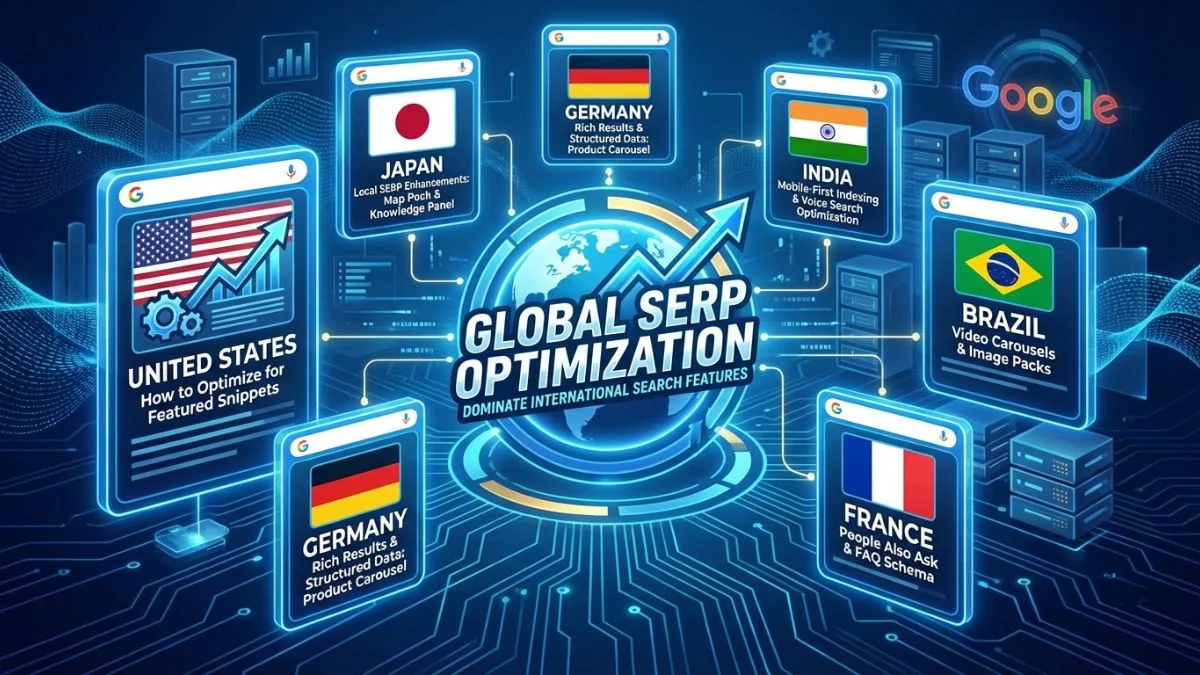
How to Optimize for Global SERP Features

How to Optimize for Global SERP Features: The 2026 Visibility Masterclass
Direct Answer: To optimize for global SERP features in 2026, you must implement a Semantic Feature-First Strategy that prioritizes JSON-LD Entity Linking and Localized Microdata. Core technical pillars include winning Multilingual Featured Snippets through H1-H3 clear-answer structures, triggering Regional Knowledge Panels via third-party entity verification (Wikipedia, Crunchbase), and deploying Dynamic Video/Image Schema tailored to local search engine preferences (Google, Baidu, Yandex). Success is measured by "Pixel Share"—the percentage of the mobile SERP occupied by your rich results—which requires 100% valid schema cross-referenced with your hreflang reciprocal tags.
🌟 Executive Summary: Global SERP Dominance Framework
- Rich Result Saturation: Use Product, FAQ, and Review schema to occupy maximum vertical real estate on mobile devices.
- Entity Trust induction: Build regional authority through local citations to trigger Knowledge Graph panels in target markets.
- Cross-Engine Adaptation: Shift strategies for non-Google markets (Baidu, Yandex) by optimizing for their proprietary rich result formats.
- Intent-Based Rendering: Audit regional SERP layouts to identify if a query triggers "Information" or "Transaction" features in a specific country.
In 2026, Google provides different 'Feature Densities' based on the region. In the US, you will see a massive amount of 'People Also Ask' and 'Video' features. In India, there is a higher density of 'Mobile-First' snippets and 'Direct Answer' boxes. To optimize, you must first perform Regional SERP Audits to see which features your competitors are winning.
1. Global SERP Feature ROI (GSFR)
Not every rich result is worth the same in every market. Use the GSFR matrix to prioritize your technical implementation.
| SERP Feature | Primary Value | Ease of Global Scale |
|---|---|---|
| Featured Snippet. | Authority & CTR. | Moderate (Requires Quality Translation). |
| FAQ Rich Results. | Pixel Share. | High (Template Driven). |
| Knowledge Panel. | Brand Trust. | Low (Requires Local Citations). |
2. Regional Knowledge Induction
The transition from a "String" (keyword) to a "Thing" (entity) is the core of modern SEO. In what is technical SEO, we detail how to map your global entities. In a global context, this means ensuring your brand is recognized as the same entity across all language versions, even if names vary slightly.
Chapter 2: Scaling Localized Schema for Global Rich Results
Schema is the technical bridge to SERP features.
Every language version of your site must have its own JSON-LD Schema. For e-commerce, this includes localized currencies and shipping terms, as we deconstructed in SEO for e-commerce websites internationally.
1. Rich Result Schema Requirements (RRSR)
To win consistently, your schema must go beyond the "Recommended" fields. Add these optional fields to maximize your visibility.
| Schema Type | Critical Localized Field | SERP Impact |
|---|---|---|
| Product. | priceCurrency & priceValidUntil. | Price Snippet with Local Symbol. |
| VideoObject. | transcript (Native Language). | Key Moments Carousel. |
| FAQPage. | acceptedAnswer (Native Dialect). | Expandable Question Drawer. |
Use 'Review' schema to win stars in the SERPs across different countries. Ensure your schema points to the correct hreflang clusters to prove to Google that your "French Rich Result" belongs to your French users. This prevents Cross-Regional Overlap where a US snippet shows up in UK search results.
Chapter 3: Winning Featured Snippets in Multiple Languages
Being 'Position Zero' globally is the ultimate SEO achievement.
To win a Featured Snippet in a foreign language, you must answer the query better than anyone else in that language. Literal translation fails here. You must use the local "Query Syntax"—the exact way people ask questions in that region. This is the goal of international keyword research. A successful snippet in Spain will not necessarily translate to a snippet in Mexico due to linguistic differences. This helps prevent Duplicate Content issues which we explored in avoiding duplicate content in international SEO.
Chapter 4: Managing Regional Knowledge Panels and Entity Trusts
Google views brands as "Entities" in its Knowledge Graph.
To have a Knowledge Panel in different countries, you need localized 'Trust Signals.' This includes having profiles on regional authority sites (like Wikipedia editions or local trade directories). This is part of Entity-Based SEO. For multi-location businesses, this ties directly into how to use schema for local businesses. A strong Knowledge Panel increases your CTR across all international versions of your brand name.
Chapter 5: Localizing Visual Features: Images and Videos
Visual search features are often the easiest way to bypass global competition.
Google's carousels for 'Images' and 'Videos' are highly localized. If you create a video guide in Spanish, ensure it has Spanish metadata, titles, and captions to win the 'Video' snippet in Latin America. This is the global application of image optimization.
1. The Visual Entity Signal
Google's AI (Cloud Vision API) analyzes images to identify entities. If you are targeting the French market with the term "Boulangerie," your images should contain visually recognizable French bakery elements. This builds Visual Topic Authority. For International Mobile SEO, visual snippets often take up 70% of the mobile screen, making this the highest ROI activity for mobile-first markets like Southeast Asia.
Chapter 6: Adapting to Non-Google SERP Features (Baidu, Yandex)
Global SERP optimization means looking beyond Google.
On Baidu (China), you must optimize for 'Baidu Baike' (their Wikipedia) and 'Baidu Zhidao' (Q&A). On Yandex (Russia), you must focus on 'Yandex Market' and behavioral snippets. Each engine has its own 'Rich Result' terminology. For more on these regional nuances, see country-specific SEO best practices. Success here requires a Multi-Search Engine Dashboard approach.
Chapter 7: Tracking Visibility in Google Search Console
How do you verify if you've won a rich result globally?
Use the 'Search Appearance' filter in Google Search Console for international SEO. Segment by 'Country' and see how many clicks are coming from 'Product Snippets' or 'Videos' in each market. If you have high impressions but no appearance in these reports, your schema might be technically invalid.
1. Pixel Share Analysis
In 2026, the #1 spot isn't always the goal. The goal is SERP Saturation. If you rank #3 but have an FAQ dropdown, a Video carousel, and a Knowledge Panel, you are effectively the "Answer" for the user. Track your "Real-Estate" by taking screenshots of your target keywords across different regional mobile devices periodically.
Chapter 8: SGE and the Global Knowledge Graph Interaction
In 2026, Search Generative Experience (SGE) has become the primary interface for complex global queries. SGE does not just "Cite" sources; it "Synthesizes" them based on its understanding of the Global Knowledge Graph. To appear in SGE snapshots across multiple countries, your site must provide High-Density Semantic Clusters.
1. The Synthesis Protocol
Google's AI prioritizes content that provides Comparative Regional Insights. For example, if you are writing about "Global Tax Law," an SGE snapshot will most likely feature the site that compares the UK vs. US vs. EU frameworks in a structured format. This is the new frontier of SGE SEO.
2. E-E-A-T for Rich Result Verification
Experience, Expertise, Authoritativeness, and Trustworthiness (E-E-A-T) are now technically verified through Author Schema. In every regional version, your content should be attributed to an author with a verifiable profile in that region. This prevents "Author Anonymity" flags that can suppress rich results in high-stakes industries (YMYL). Linking your author's LinkedIn or regional industry profiles via 'sameAs' in JSON-LD is no longer optional—it is a requirement for global SERP features.
Conclusion: The Future is Feature-First
Optimizing for global SERP features is the ultimate expression of a technical SEO professional. It is the art of claiming digital real estate in every corner of the world. In 2026, the brands that win are those that appear in the 'Zero-Click' answers, the rich carousels, and the interactive panels of every global search engine.
By implementing localized schema, winning foreign-language featured snippets, and adapting to the specific results of engines like Baidu and Yandex, you provide your brand with a world-class global foundation. You ensure that you aren't just a link in a list, but a featured answer for every global citizen. Don't settle for being just "One of the results." Master the art of global SERP dominance, claim your featured space, and build a brand that is truly worldwide and impossible to ignore. The stage is set—it's time you took the spotlight. Start your SERP feature audit today.
Frequently Asked Questions on Global SERP Features
1. What is a 'SERP Feature'?
A SERP feature is any result on a Search Engine Results Page that is not a traditional organic link, such as Featured Snippets, Knowledge Panels, carousels, or 'People Also Ask' boxes.
2. Does every country have the same SERP features?
No. Google varies the density and type of features based on the region, the local language, and the specific search behavior of that population.
3. How do I win a rich snippet in a different language?
You must use localized Schema markup (JSON-LD) and provide high-quality content that directly answers common questions in that specific language as natively as possible.
4. What is the impact of Baidu's SERP features?
On Baidu, many top results are Baidu's own properties. To rank, you often need to be present on sites like Baidu Baike (Encyclopedia) or Baidu Zhidao (Questions).
5. Can I track my global rich results in Search Console?
Yes. Use the 'Search Appearance' filter in the GSC Performance report and segment your data by country to see where your rich results are most effective.
6. Does Schema help with global rankings?
Schema doesn't always improve rankings directly, but it significantly increases your chances of winning 'Rich Results,' which improves CTR and overall traffic quality.
7. How do I handle currencies in global schema?
Use the 'priceCurrency' attribute in your Product schema for every regional version of your site to ensure Google shows the correct local currency in search results.
8. Why won't my Knowledge Panel show up in other countries?
Google needs 'Local Trust Signals' to verify your entity in that region. This includes mentions in local news and profiles on high-authority regional websites.
9. What is 'Position Zero'?
This refers to the Featured Snippet at the very top of the search results page. Winning it globally is the fastest way to drive massive international traffic.
10. How do I audit local SERP layouts?
Use an 'International SERP Checker' or a VPN to manually search in the country you are targeting to see what the layout looks like and what features are dominant.
11. What is 'Pixel Share' in 2026?
It's the percentage of the mobile screen occupied by your brand's results (snippets, carousels, panels). High pixel share correlates with higher brand authority.
12. Why do some rich results only show in certain countries?
Google tests features in specific markets. Some, like 'Store Pick-up' features, are only available in regions where local inventory feeds are supported.
13. What is the 'VideoObject' transcript field for?
It allows Google to index the words spoken in your video, helping you win 'Key Moments' snippets even in foreign languages.
14. How does 'Entity Mapping' affect global SERPs?
By defining your brand as a unique entity, you help Google consolidate your trust across all regional Knowledge Panels, ensuring consistent visibility.
15. What are Baidu 'Open Platform' features?
These are proprietary rich results on Baidu that require special developer registration and data feeds to trigger for Chinese searchers.
16. Can I use FAQ schema on every page?
Technically yes, but Google only shows them for truly helpful, query-matching content. Overuse can lead to manual actions or suppression.
17. What is 'Visual Topic Authority'?
Google's ability to verify your expertise based on the semantic content of your images (e.g., seeing actual product workshops vs. stock photos).
18. How do I win 'People Also Ask' (PAA) boxes globally?
By creating concise, H3-organized answer blocks that mirror the specific phrasing used by searchers in that local dialect.
19. What role does Wikipedia play in global Knowledge Panels?
Wikipedia remains a primary data source for Google's Knowledge Graph. Profiles in regional Wikipedia editions (French, German, etc.) are critical trust signals.
20. Does 'Review' schema work everywhere?
Star ratings are available globally, but they require third-party verification or internally hosted reviews that meet Google's strict quality guidelines.
21. What is 'SERP Saturation'?
The strategy of winning multiple features for a single keyword to dominate the user's attention and push competitors further down the page.
22. How do I optimize for 'Yandex Market' snippets?
By providing structured XML data feeds of your products specifically designed for Yandex's e-commerce ecosystem in Russia and CIS countries.
23. What is 'priceValidUntil' in Product schema?
A critical field that tells Google when a price expires. Including it increases the trust score of your rich snippet in competitive e-commerce markets.
24. How do I track 'Zero-Click' searches?
By monitoring the delta between GSC impressions and clicks. If impressions are high but clicks are low, you are likely winning the 'Answer' box.
25. What is 'Indented Results'?
When Google shows multiple pages from the same site for a query. This is a form of SERP dominance that effectively doubles your visibility.
26. Can rich results be triggered by Microdata?
Yes, but JSON-LD is Google's preferred format because it is easier to maintain and less likely to break during page layout changes.
27. What are 'Regional Trust Signals'?
Citations from local news, government sites, or regional directories that prove your brand's physical and economic relevance in that country.
28. How does mobile-first indexing affect global SERPs?
Since most global markets are mobile-dominant, Google prioritizes features that render natively and fast on handheld devices.
29. What is 'Semantic Variation' in rich results?
When the same schema triggers different visual features based on the language (e.g., a tutorial snippet vs. a list snippet).
30. How do I optimize for 'Google Discover' globally?
By producing high-quality, high-resolution visual content and entity-rich articles that align with regional user interests and trends.
31. What is the 'Knowledge Graph ID'?
A unique identifier Google assigns to your entity. Using this in your schema helps link all your regional signals to one central authority point.
32. How do local reviews affect 'Product' snippets?
Regional reviews (in the local language) increase the authority of your product stars, leading to higher CTR in that specific market.
33. Can I win snippets with 'Non-Indexable' content?
No. Content must be crawlable and indexable for Google to extract the information required for a SERP feature appearance.
34. What is 'Schema Cross-Referencing'?
The practice of ensuring your hreflang tags and schema geographical values (like 'addressCountry') are perfectly aligned to prevent confusion.
35. What is the 'Feature-First' mindset?
Designing your content structure around the SERP features you want to win, rather than trying to 'Add' schema after the content is written.