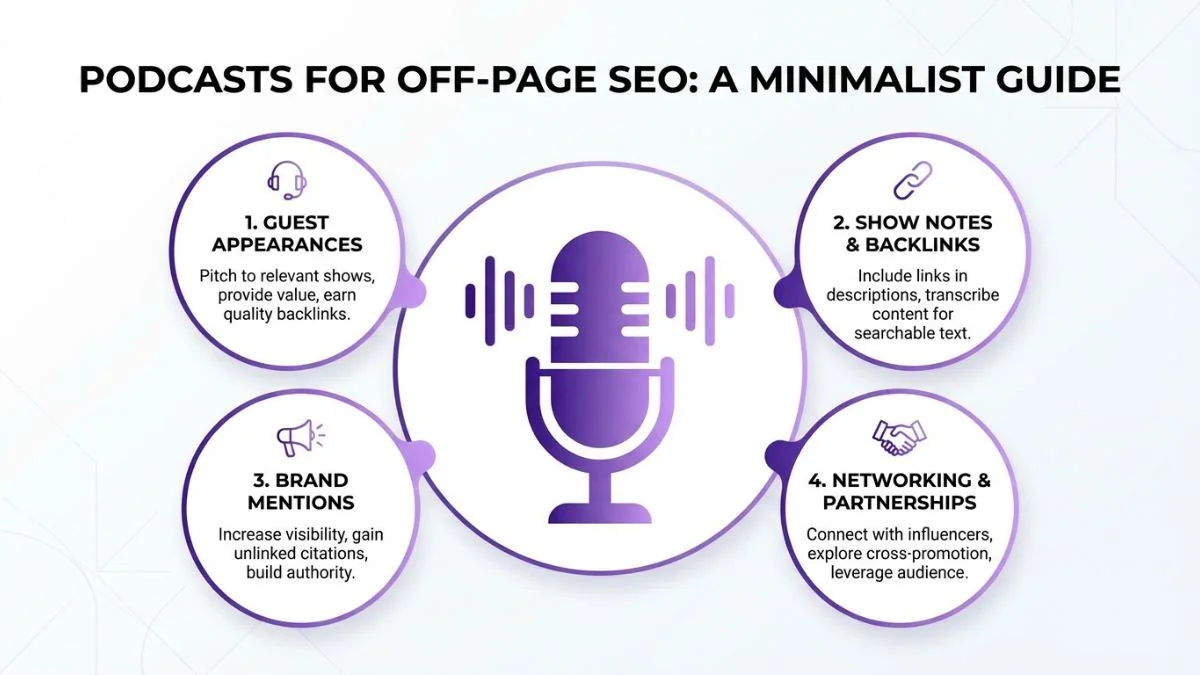
How to Use Podcasts for Off-Page SEO

How to Use Podcasts for Off-Page SEO: The Complete Guide (2026)
Podcasting is no longer just a content marketing channel — it has become a strategic SEO asset. Google's integration of podcast content into search results, combined with the backlinking power of show notes pages and the brand authority that comes from regular podcast appearances, makes podcasting one of the highest-ROI activities for off-page SEO in 2026.
According to research from Edison Research, podcast consumption has grown by 43% since 2023, with 62% of the US population having listened to a podcast. More importantly for SEO, Semrush's podcast SEO study found that brands with active podcast presences earn 38% more organic backlinks and see 24% higher branded search volume compared to competitors without podcast activity.
Whether you choose to guest on established shows, launch your own podcast, or combine both strategies, the off-page SEO benefits are substantial and compound over time. This guide walks you through every aspect of podcast SEO, from finding the right opportunities to measuring the impact on your SEO score and overall search visibility.
How Podcasts Generate Off-Page SEO Value
Podcasts create SEO value through multiple interconnected channels. Understanding each mechanism helps you optimize your podcast strategy for maximum search impact.
The 7 SEO Benefits of Podcasting
| SEO Benefit | How It Works | Impact Level | Timeline |
|---|---|---|---|
| Show Notes Backlinks | Host websites link to your site in episode descriptions | Very High | Immediate per episode |
| Brand Mentions | Your brand discussed verbally and in written descriptions | High | Cumulative |
| Transcript SEO | Full transcripts create keyword-rich indexable pages | High | 2-4 weeks per episode |
| Directory Citations | Podcast listed across Apple, Spotify, Google, and 20+ directories | Medium | One-time setup |
| Branded Search Growth | Listeners search for your brand after hearing episodes | High | 3-6 months |
| E-E-A-T Authority | Podcast presence demonstrates expertise and industry recognition | Very High | 6-12 months |
| Social Amplification | Episodes shared across social platforms, generating engagement | Medium | Immediate per episode |
Strategy 1: Podcast Guesting for Quick SEO Wins
Being a guest on established podcasts is the fastest way to generate off-page SEO value from podcasting. Each guest appearance earns you backlinks from the host's website show notes, exposure to an established audience, and brand mentions across podcast directories. Backlinko's analysis found that a single guest appearance on a podcast hosted on a DA 60+ website delivers equivalent link value to a high-quality guest post, often with significantly less effort.
Finding the Right Podcasts to Guest On
- Search podcast directories strategically. Use Listen Notes, Podchaser, and Apple Podcasts to find shows in your niche. Filter by category, audience size, and recent activity to identify active shows that align with your expertise.
- Analyze competitor podcast appearances. Use Ahrefs or Moz Link Explorer to check competitor backlink profiles for podcast-related links. Search for links containing words like "podcast," "episode," or "show-notes" in the URL to identify shows your competitors have appeared on.
- Use podcast booking platforms. Platforms like PodMatch, Podcast Guests, and MatchMaker.fm connect guests with hosts seeking experts in specific topics. These platforms streamline the matching process and increase booking rates.
- Search Google for guest opportunities. Use queries like
"[your topic]" + "podcast" + "guest","[your niche]" + "podcast" + "be a guest", or"[industry]" + "podcast" + "interview"to find shows actively seeking guests. - Network at industry events. Virtual and in-person conferences are prime opportunities to connect with podcast hosts. Many hosts attend events specifically to find interesting guests.
- Check social media. Follow podcast hosts on Twitter/X and LinkedIn. Many hosts post calls for guests on social media, and engaging with their content before pitching increases acceptance rates.
Podcast Guest Pitch Template
Subject: Guest idea for [Podcast Name]: [Specific Topic Angle]
Hi [Host Name],
I have been listening to [Podcast Name] since [specific timeframe], and your episode with [recent guest] on [topic] really resonated with me because [specific reason].
I would love to come on the show to discuss [specific topic]. Here is what I can share with your audience:
- [Unique insight #1 with specific data point]
- [Unique insight #2 with a compelling story]
- [Actionable framework your listeners can implement immediately]
My background: [2-3 sentences about your relevant expertise, including specific achievements or credentials]
Previous podcast appearances: [2-3 links to episodes on other shows]
Would this be a good fit for an upcoming episode?
Best,
[Your Name]
[Your Website]
Evaluating Podcast SEO Value Before Pitching
| Evaluation Criteria | What to Check | Ideal Benchmark |
|---|---|---|
| Host Website DA | Domain authority of the podcast's website | DA 40+ (ideal: DA 60+) |
| Show Notes Quality | Do they include guest links in show notes? | Detailed notes with guest bio + links |
| Episode Frequency | Is the podcast actively publishing? | At least weekly or bi-weekly |
| Audience Relevance | Does the audience match your target market? | Strong overlap with your ideal customers |
| Social Promotion | Does the host promote episodes on social media? | Active social promotion with tagging |
| Link Type | Dofollow or nofollow links in show notes? | Dofollow preferred, nofollow still valuable |
Strategy 2: Launching Your Own Podcast for SEO
While podcast guesting delivers quick wins, hosting your own podcast creates a compounding SEO asset that grows in value over time. Each episode generates a new indexed page on your website (via show notes and transcripts), creates ongoing backlink opportunities, and builds cumulative brand authority that strengthens your entire domain.
Podcast SEO Setup Checklist
- Host show notes on your domain. Publish detailed show notes for every episode as blog posts on your website, not just on the podcast hosting platform. This ensures all SEO value flows to your domain. Structure them using proper heading tag hierarchy.
- Choose a podcast hosting platform. Use platforms like Buzzsprout, Transistor, or Podbean that distribute your podcast to all major directories automatically.
- Submit to all major directories. List your podcast on Apple Podcasts, Spotify, Google Podcasts, Amazon Music, Stitcher, iHeartRadio, and at least 15+ additional directories for maximum citation coverage.
- Implement podcast schema markup. Add Podcast structured data to your episode pages to help Google understand and feature your content in podcast carousels and rich results.
- Publish full transcripts. Use transcription services like Otter.ai, Rev, or Descript to create full episode transcripts. Publish these on your website with proper formatting and keyword optimization.
- Create a dedicated podcast page. Build a central podcast page on your website that lists all episodes with individual links, making it easy for search engines to crawl and index your entire podcast library.
- Set up an RSS feed. Ensure your RSS feed is properly configured with complete metadata including episode titles, descriptions, and links to your website show notes pages.
Podcast Content Strategy for SEO
Your podcast topic selection should align with your keyword research to maximize search visibility. Use these approaches to create SEO-optimized podcast content:
- Target question-based keywords. Structure episodes around questions your target audience asks. Use tools like AnswerThePublic, AlsoAsked, and Google's "People Also Ask" to identify high-value questions in your niche.
- Create pillar-cluster podcast series. Develop multi-episode series around core topics, creating a content cluster that strengthens your topical authority. Link between related episode show notes to build strong internal linking.
- Interview guests with their own audiences. Each guest brings their audience's attention (and their platform's linking potential) to your show. Prioritize guests who have active blogs, newsletters, or social followings.
- Cover trending industry topics. Timely episodes on emerging trends generate immediate search interest and social sharing, driving traffic spikes to your show notes pages.
- Repurpose existing high-performing content. Convert your most successful blog posts and guides into podcast episodes, then cross-link between the written and audio versions to strengthen both.
Optimizing Show Notes for Maximum SEO Impact
Show notes are the primary vehicle through which podcasts generate direct SEO value. Well-optimized show notes function as standalone blog posts that rank in search results, provide link equity to your site, and drive organic traffic independently of the audio content.
Anatomy of SEO-Optimized Show Notes
| Element | Purpose | SEO Value | Best Practice |
|---|---|---|---|
| Episode Title (H1) | Primary heading for the page | Very High | Include primary keyword, keep under 60 chars |
| Episode Summary (300-500 words) | Unique content summarizing key points | High | Naturally include keywords, provide standalone value |
| Key Takeaways (Bulleted List) | Quick-scan highlights for readers | Medium | 5-7 actionable bullet points |
| Timestamps | Navigation for listeners and Google | Medium | Descriptive labels with timestamps |
| Resources Mentioned (Links) | External and internal links referenced | High | 10-20 relevant links per episode |
| Guest Bio | Guest details with links to their site | Medium | 100-200 words with 2-3 links |
| Embedded Audio Player | Allows direct listening on your site | Medium (engagement) | Embed above the fold with play button |
| Full Transcript | Complete text version of the episode | Very High | Formatted with headings and speaker labels |
Apply on-page SEO best practices to every show notes page, including optimized title tags and meta descriptions for each episode.
Podcast Transcript SEO: Turning Audio Into Rankings
Podcast transcripts are an SEO goldmine that most podcasters underutilize. A single 45-minute episode transcript contains 5,000-8,000 words of content that naturally targets dozens of long-tail keywords through organic conversation. Search Engine Journal reports that podcasts publishing full transcripts see 25% more organic search traffic to their episode pages compared to those with show notes only.
Transcript Optimization Best Practices
- Edit for readability. Raw transcripts contain filler words, incomplete sentences, and repetitions. Clean them up for readability while maintaining the natural conversational tone.
- Add section headings. Break the transcript into logical sections with H2 and H3 headings that include relevant keywords. This improves both user experience and search engine understanding.
- Include speaker identification. Format transcripts with clear speaker labels to improve readability and help Google understand who is saying what — important for E-E-A-T signals.
- Highlight key quotes. Use blockquote formatting for particularly insightful or quotable passages. These can appear as featured snippets in search results.
- Add internal links. Insert contextual links to relevant pages on your website within the transcript where topics are discussed. This strengthens your internal linking structure.
- Optimize images and supplementary content. Add relevant images, charts, or infographics that illustrate points discussed in the episode. Optimize these using image SEO best practices.
The Podcast Tour Strategy: Concentrated Guest Appearances
A podcast tour involves scheduling 10-20 guest appearances within a concentrated 4-8 week timeframe, creating a wave of backlinks, brand mentions, and audience exposure that produces compounding SEO effects. This strategy is particularly effective when timed with a product launch, content release, or brand campaign.
Planning Your Podcast Tour
- Identify 30-50 target podcasts. Research and list podcasts in your niche, organized by domain authority and audience size. Aim to secure spots on 10-20 of them.
- Develop 3-5 unique topic angles. Create variations of your core message tailored to different audience segments. Each podcast should feel fresh, not repetitive.
- Begin outreach 8-12 weeks in advance. Podcast booking typically requires lead time. Start pitching early to coordinate recordings within your target window.
- Prepare a media kit. Create a one-page document with your bio, headshot, suggested topics, and links to previous podcast appearances. This makes booking decisions easier for hosts.
- Coordinate publication dates. Work with hosts to align episode publication within a concentrated timeframe. The simultaneous release of multiple episodes creates a noticeable surge in brand visibility.
- Prepare a dedicated landing page. Create a page on your website specifically for podcast listeners with resources mentioned across all episodes. This centralizes the SEO benefit of traffic from multiple shows.
Podcast Tour SEO Impact (15 Appearances Over 6 Weeks)
5 links
15 links
28 links
38 links
48 links
60+ links
Cumulative backlinks from a 15-podcast tour (including secondary links from social sharing and blog recaps)
Podcast Directories and Citation Building
Listing your podcast across all major directories creates brand citations that reinforce your online presence. Each directory listing includes your brand name, website URL, and description, contributing to the brand mention signals that Google values for E-E-A-T.
Essential Podcast Directories for SEO
| Directory | Domain Authority | Link Type | Monthly Listeners |
|---|---|---|---|
| Apple Podcasts | DA 100 | Nofollow | 28M+ (US) |
| Spotify | DA 97 | Nofollow | 100M+ global |
| YouTube Podcasts | DA 100 | Nofollow | Billions |
| Amazon Music / Audible | DA 96 | Nofollow | 55M+ |
| iHeartRadio | DA 91 | Nofollow | 30M+ |
| Podchaser | DA 72 | Dofollow | N/A (directory) |
| Listen Notes | DA 70 | Dofollow | N/A (search engine) |
| Podcast Addict | DA 65 | Nofollow | 20M+ |
Video Podcasting: YouTube as an SEO Powerhouse
Publishing video versions of your podcast on YouTube significantly amplifies SEO impact. YouTube is the second-largest search engine globally and has a DA of 100, meaning links from YouTube descriptions carry substantial authority. HubSpot reports that video podcasts receive 32% more engagement than audio-only formats, and YouTube podcast content frequently appears in Google's video carousels for relevant search queries.
YouTube Podcast SEO Optimization
- Optimize video titles with keywords. Include your target keyword in the video title, matching what people search for on both YouTube and Google.
- Write detailed descriptions (500+ words). Include episode summaries, timestamps, links to your website, and relevant keywords in the YouTube description. The first 2-3 lines are most critical as they appear before the "Show more" button.
- Add timestamps/chapters. YouTube chapters improve user experience and can appear as individual links in Google search results, multiplying your SERP presence per episode.
- Include website links prominently. Place your website URL and relevant resource links in the first few lines of the description, above the fold.
- Create custom thumbnails. Eye-catching thumbnails increase click-through rates, which signals to YouTube's algorithm that your content is valuable, boosting its visibility.
- Enable and optimize closed captions. YouTube's auto-generated captions are good but not perfect. Upload corrected captions to improve accessibility and keyword indexing.
Repurposing Podcast Content for Multi-Channel SEO
Each podcast episode is a content goldmine that can be repurposed into multiple formats, each generating its own SEO value across different platforms. This multiplier effect is one of the strongest arguments for podcasting as an SEO strategy.
The Podcast Content Repurposing Framework
- Full audio episode → Distributed across 20+ podcast directories (brand citations)
- Video version → Published on YouTube (high-authority backlink + video SEO)
- Show notes blog post → Published on your website (indexable content + internal links)
- Full transcript → Published alongside show notes (long-tail keyword targeting)
- Social media clips (3-5 per episode) → Short video/audio clips for Twitter, LinkedIn, Instagram, TikTok (social signals + brand awareness)
- Newsletter edition → Key takeaways sent to email subscribers (direct traffic + sharing)
- Blog post expansion → Expand a specific topic discussed into a full article with SEO-optimized blog formatting
- Infographic → Visualize key data points discussed (link magnet potential)
- Quote graphics → Shareable images with guest quotes (social amplification)
- Twitter/LinkedIn thread → Thread summarizing episode insights (engagement + visibility)
This approach means each podcast episode can generate 10+ individual content assets, each with its own SEO value and promotion potential. Compress all image assets using image optimization tools to maintain fast loading speeds across all platforms.
Measuring Podcast SEO Impact
Track these metrics to quantify the SEO return on your podcast investment. Use Google Search Console, Google Analytics 4, and backlink monitoring tools for comprehensive measurement.
Podcast SEO Metrics Dashboard
| Metric | What It Measures | Target | Tool |
|---|---|---|---|
| Backlinks per Episode | Links earned from show notes and mentions | 3-5 per guest appearance, 2-3 per owned episode | Ahrefs, Moz |
| Show Notes Organic Traffic | Search traffic to episode pages | 100+ visits per episode within 90 days | Google Analytics 4 |
| Branded Search Growth | Increase in people searching your brand name | 10-30% growth over 6 months | GSC, Google Trends |
| Domain Authority Change | Overall domain strength improvement | 2-5 points over 6 months | Moz, Ahrefs (DR) |
| Keyword Rankings for Episode Topics | How episode pages rank for target keywords | Page 1-2 within 90 days | Semrush, GSC |
| Referral Traffic from Podcast Sites | Visitors clicking through from host websites | 50-200 per appearance | Google Analytics 4 |
Monitor your overall site authority with MozRank Checker and track the cumulative impact of podcast activities using the essential SEO metrics framework.
Common Podcast SEO Mistakes to Avoid
- Hosting show notes only on the podcast platform. If your show notes live only on Buzzsprout, Anchor, or Spotify, the SEO value goes to those platforms, not your website. Always publish show notes on your own domain first.
- Skipping transcripts. Without transcripts, search engines cannot index your audio content. You miss out on thousands of words of keyword-rich content per episode.
- Writing thin show notes. Two-sentence episode descriptions provide minimal SEO value. Treat show notes as full blog posts with 500-1,500 words of unique content.
- Not including links in guest bios. When guesting, always confirm that the host will include your website link in the show notes before recording. Check after publication and follow up if links are missing.
- Ignoring podcast schema markup. Without structured data, Google cannot fully understand your podcast content or display it in rich results.
- Failing to promote episodes. Publishing an episode without active promotion limits its reach and the secondary backlinks that come from broader visibility. Apply content marketing promotion strategies to every episode.
- Inconsistent publishing schedule. Irregular publishing causes audience drop-off and signals to algorithms that your podcast is inactive. Commit to a sustainable frequency and maintain it.
Advanced Podcast SEO Tactics for 2026
AI-Powered Podcast Content Optimization
AI tools have transformed podcast production and optimization in 2026. Use AI transcription services for faster, more accurate transcripts, AI summarization tools to generate show notes drafts, and AI analytics to identify which episode topics drive the most search traffic. Tools like Descript, Riverside, and Opus Clip make it easier than ever to produce SEO-optimized podcast content at scale.
Podcast SEO for Voice Search
With voice search growing rapidly, podcast content naturally aligns with how people ask questions verbally. Episodes structured around conversational questions and answers are more likely to be featured in voice search results. Optimize your show notes and transcripts for question-based keywords that mirror voice search patterns.
Cross-Podcast Collaboration Networks
Building a network of complementary podcast hosts creates a mutual amplification system. Regular cross-promotion, guest swaps, and collaborative episodes generate a web of backlinks and brand mentions that benefit all participants. This is particularly effective for niche industries where 5-10 podcasts share overlapping audiences.