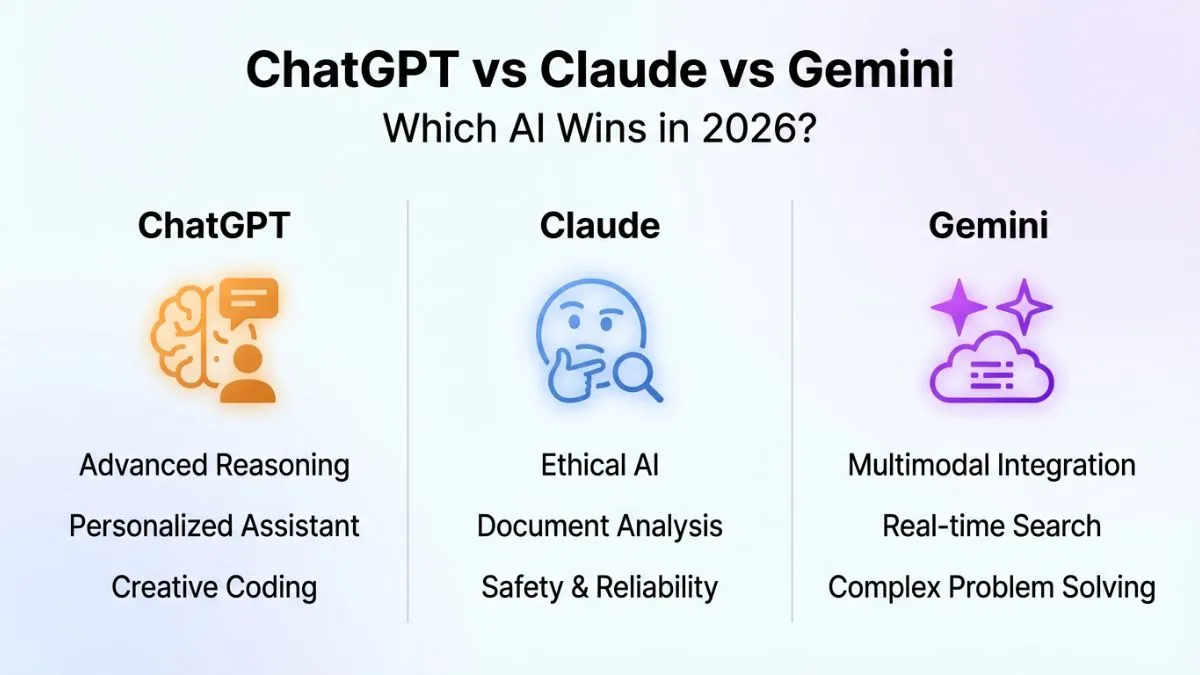
ChatGPT vs Claude vs Gemini: Which AI Wins in 2026?

Introduction: The AI Race Has Never Been More Competitive
In 2026, artificial intelligence is no longer a novelty — it is a daily utility for millions of professionals, students, marketers, developers, and business owners. The three titans dominating this space are ChatGPT by OpenAI, Claude by Anthropic, and Gemini by Google DeepMind. Each has evolved dramatically over the past 12 months, and picking the wrong one for your workflow could cost you time, money, and competitive edge.
This definitive guide breaks down ChatGPT vs Claude vs Gemini across every major dimension: raw intelligence, speed, coding ability, SEO performance, content creation, safety, pricing, and real-world use cases. Whether you are a digital marketer trying to scale content production, a developer building AI-powered apps, or a business owner looking to automate workflows, this article gives you everything you need to make the right call.
Understanding how AI is changing SEO is increasingly important as all three of these models are reshaping how content ranks on Google — and knowing which tool does it best is a genuine competitive advantage.
A Quick Overview of Each AI in 2026
ChatGPT (OpenAI)
OpenAI's ChatGPT remains the most recognized AI brand in the world. Powered by the GPT-4o and the newer GPT-4.5 architecture in 2026, it features multimodal input (text, image, audio, video), an expansive plugin ecosystem, and deep integration with Microsoft 365 products. ChatGPT Plus costs $20/month with access to advanced reasoning modes and real-time web browsing.
Claude (Anthropic)
Anthropic's Claude, now in its Claude 4 generation, has made enormous strides in long-context reasoning, nuanced writing, and safety-first behavior. Claude's 200,000-token context window means it can process entire books, legal contracts, or massive codebases in a single conversation. Anthropic positions Claude as a trustworthy AI that prioritizes honesty, and it has become the favorite for enterprise content operations and technical writing.
Gemini (Google DeepMind)
Google's Gemini Ultra 2.0 is the most deeply integrated AI assistant on the planet, embedded across Google Search, Gmail, Docs, Sheets, YouTube, and Android. In 2026, Gemini benefits from native real-time web access, direct integration with Google's entire product ecosystem, and a powerful multimodal engine that handles images, audio, and video natively. Gemini Advanced is available via Google One at $19.99/month.
Head-to-Head Comparison: The Detailed Breakdown
1. Natural Language Understanding & Conversational Intelligence
All three models are excellent at natural language, but they differ in style and depth.
ChatGPT is conversational, flexible, and creative. It handles ambiguous queries well and does an excellent job adapting its tone — from casual to formal, technical to poetic. Its weakness is occasional overconfidence, producing plausible-sounding but inaccurate responses without always flagging uncertainty.
Claude leads in nuanced reasoning and long-form coherence. Ask Claude to analyze a 50-page PDF, maintain consistent voice across a 5,000-word article, or reason through an ethically complex scenario, and it delivers results that are measurably more careful and detailed. Anthropic's Constitutional AI methodology means Claude is less prone to making things up and more likely to say "I'm not sure" when appropriate.
Gemini excels at factual, real-time queries because of its live Google Search integration. When you need up-to-the-minute information, stock data, news summaries, or product comparisons, Gemini has a built-in edge that neither ChatGPT nor Claude can fully match without third-party plugins.
Winner: Claude for depth of reasoning; Gemini for real-time factual accuracy.
2. Content Creation & SEO Writing
For digital marketers and SEO professionals, the content creation capabilities of each model are probably the most commercially important comparison.
ChatGPT produces highly readable, engaging content quickly. It is excellent for social media copy, email campaigns, product descriptions, and short-form blog posts. However, for long-form SEO content, it can become repetitive and sometimes loses the thread of an argument past the 2,000-word mark without strong prompting.
Claude is the clear winner for long-form SEO articles. Its ability to maintain structural coherence, vary sentence rhythm naturally, and integrate keyword strategy without keyword stuffing makes it the preferred choice for serious content teams. If you want content that genuinely helps improve your website's SEO score, Claude's output tends to need less editing before publishing.
Gemini has improved dramatically for content in 2026 but still feels more like a research assistant than a creative writer. It is superb for generating outlines, summarizing competitor content, and drafting factual explainers, but its prose can feel functional rather than engaging.
For anyone building an SEO strategy for their website, understanding the strengths of each AI for content production is essential. Claude's contextual depth and natural writing flow give it a meaningful edge for long-form organic content.
Winner: Claude for SEO content; ChatGPT for short-form creative copy.
3. Coding & Developer Use Cases
This is where the gap between the three models is arguably smallest, but the nuances matter enormously for professional developers.
ChatGPT with GPT-4.5 remains a dominant coding assistant. It supports over 40 programming languages, handles complex debugging sessions, writes efficient SQL, and can generate entire backend systems with reasonable scaffolding. The OpenAI Codex API integration and Microsoft Copilot synergy make it a formidable enterprise coding tool.
Claude has emerged as a genuinely competitive coder in 2026, particularly for Python and JavaScript. Its longer context window means it can review an entire codebase, understand dependencies between files, and suggest systemic refactors that shorter-context models miss. If you are looking for the best AI tools for Python developers, Claude deserves serious consideration.
Gemini integrated deeply with Google's IDX (Integrated Development Experience) cloud IDE, and its code completion in Android Studio and Google Cloud environments is excellent. For developers in the Google ecosystem, Gemini is a natural fit.
Winner: Tied between ChatGPT and Claude, with ChatGPT edging ahead for rapid prototyping and Claude winning for large-codebase comprehension.
4. Multimodal Capabilities: Images, Audio, and Video
Multimodal AI — the ability to understand and generate content across text, images, audio, and video — is one of the most important battlegrounds in 2026.
ChatGPT handles image analysis, DALL-E 3 image generation, voice conversations, and basic video analysis through GPT-4o. It is the most mature multimodal consumer product currently available, with years of refinement.
Gemini is the most advanced multimodal model of the three. Its native architecture was built from the ground up to handle multiple modalities simultaneously, meaning it processes image-plus-text or video-plus-audio queries more fluidly than models that added multimodality as a feature layer. For tasks like analyzing product images for SEO alt text or extracting data from video content, Gemini leads.
Claude has solid image understanding capabilities through Claude's vision features but does not offer native image generation and its audio capabilities are more limited. For text-plus-image tasks it performs strongly; for broader multimodal work, it lags behind the other two.
Winner: Gemini, with ChatGPT as a close second.
5. Accuracy, Hallucinations & Trustworthiness
Hallucination — when an AI confidently generates false information — remains one of the most serious practical problems for any production use of these models.
ChatGPT has improved significantly in hallucination reduction through GPT-4.5 and its updated reinforcement learning from human feedback (RLHF) processes. However, it still exhibits overconfidence in domains where its training data may be outdated or sparse.
Claude has the most robust approach to accuracy among the three. Anthropic's Constitutional AI framework and its model's tendency toward epistemic humility — admitting uncertainty rather than fabricating — make it the most trustworthy for high-stakes content, legal drafting, medical research, or financial analysis. Independent AI safety research from organizations like METR consistently rates Claude as performing well on alignment benchmarks.
Gemini's live web access actually helps reduce hallucinations for factual queries because it can verify against current sources. However, its synthesis of complex multi-source information can occasionally introduce subtle errors when sources conflict.
Winner: Claude for overall trustworthiness; Gemini for real-time fact-checking.
6. Context Window & Memory
The context window is how much text an AI can "hold in mind" during a single conversation. This matters enormously for tasks like reviewing long documents, maintaining consistency in large writing projects, or debugging extensive codebases.
ChatGPT offers a 128,000-token context window in its most advanced tier, which handles most professional use cases comfortably.
Claude provides a 200,000-token context window — the largest among consumer-facing AI models in 2026. This makes it uniquely powerful for tasks like auditing an entire website's content for SEO issues, reviewing a full legal contract, or writing a book-length document in one session.
Gemini Ultra matches Claude with a 1 million token context window in its experimental Gemini 1.5 features, a genuinely staggering figure that can process entire video files or massive data repositories.
Winner: Gemini (experimental 1M tokens); Claude for reliable, production-ready long-context tasks.
7. Speed & Performance
For high-volume workflows, generation speed matters.
ChatGPT delivers fast response times for standard queries, though complex reasoning tasks with the "o3" thinking model can take 15–60 seconds for deep analysis.
Claude has optimized considerably in 2026, with Claude Haiku and Claude Sonnet tiers offering near-instantaneous responses for most tasks, while Claude Opus takes longer for complex reasoning chains.
Gemini leverages Google's TPU infrastructure for exceptional speed, particularly on short to medium-length tasks. Its integration into Google Workspace means response times feel near-instant in context.
Winner: Gemini for most tasks; all three are competitive for standard queries.
8. Pricing Comparison (2026)
| Feature | ChatGPT Plus | Claude Pro | Gemini Advanced |
|---|---|---|---|
| Monthly Price | $20/month | $20/month | $19.99/month |
| Context Window | 128K tokens | 200K tokens | 1M tokens (exp.) |
| Image Generation | Yes (DALL-E 3) | No | Yes (Imagen 3) |
| Real-time Web | Yes | Limited | Yes (native) |
| API Access | Yes (separate) | Yes (separate) | Yes (separate) |
| Enterprise Plan | ChatGPT Team/Enterprise | Claude for Work | Google Workspace AI |
For API pricing, all three charge per million tokens, with pricing varying by model tier. Anthropic's Claude API, OpenAI's GPT-4 API, and Google's Gemini API each offer free tiers for developers. If you are building an AI-powered SEO tool or e-commerce application, factoring in API costs at scale is critical for your budget.
9. Privacy & Data Security
For businesses handling sensitive client data, privacy policies are non-negotiable.
Anthropic (Claude) does not use conversations to train models by default on paid plans. Its enterprise tier includes comprehensive data handling agreements and SOC 2 compliance.
OpenAI (ChatGPT) has improved privacy controls significantly since 2023, offering enterprise data opt-outs and dedicated instances for enterprise customers.
Google (Gemini) benefits from Google's mature enterprise security infrastructure, GDPR compliance, and strong data governance policies through Google Cloud and Workspace agreements — though Google's ad-based business model creates inherent tension around data usage transparency.
Winner: Claude for enterprise data privacy; Google for compliance infrastructure.
10. Integrations & Ecosystem
ChatGPT's custom GPT marketplace now hosts over 4 million custom AI assistants and integrates with hundreds of third-party tools including Zapier, Notion, Slack, and HubSpot.
Gemini wins the integration battle by sheer depth of embedding in Google's ecosystem — Docs, Sheets, Gmail, Meet, Drive, Search, Maps, Android, and Chrome. For businesses already on Google Workspace, Gemini is everywhere, all the time.
Claude integrates through the Anthropic API and appears natively in tools like Notion AI, Slack, and various enterprise platforms, but its consumer-facing integration ecosystem is narrower than the other two.
Winner: Gemini for Google ecosystem users; ChatGPT for third-party integrations.
Use Case Recommendations: Who Should Use What?
For SEO Professionals & Content Marketers
Claude is the top pick. Its long-form coherence, keyword integration, and ability to process entire site audits make it ideal for serious content operations. Pair it with tools from BrightSEOTools' keyword research suite for a complete workflow. Understanding on-page SEO techniques that actually work alongside AI assistance is the most powerful combination available in 2026.
For Developers & Engineers
ChatGPT and Claude are both excellent. ChatGPT has a richer ecosystem of coding plugins and deep Microsoft Visual Studio integration; Claude wins for large-context code reviews. Check out the best AI tools for coding for an expanded comparison of AI coding tools.
For Students & Researchers
Claude leads for research tasks requiring careful reasoning and long document analysis. For students looking for an accessible entry point, the top free AI tools for students is a great starting resource.
For E-commerce & Shopify Sellers
ChatGPT's plugin ecosystem and product description capabilities make it strong for e-commerce. See the best AI tools for Shopify and best AI tools for Amazon sellers for platform-specific guidance.
For Google Workspace Users
Gemini is the obvious choice. Its native embedding in Google's product suite reduces friction and maximizes workflow efficiency for teams already living inside Google's ecosystem.
For General Productivity
All three perform well. For a comprehensive overview across use cases, the best AI tools complete guide covers dozens of tools including these three in granular detail.
Technical SEO Implications: Can AI Tools Help Your Rankings?
Using AI for SEO is not just about writing articles — it encompasses technical auditing, structured data generation, internal linking strategy, and more. Here is how each AI performs on the technical SEO front:
ChatGPT can generate schema markup, write robots.txt files, audit meta descriptions at scale, and help build XML sitemaps. It is a practical tool for day-to-day technical SEO tasks.
Claude excels at SEO auditing when given large amounts of data. Feed it an entire crawl report and it can identify patterns, prioritize fixes, and draft recommendations in a structured format. This is invaluable for anyone working through a website audit checklist.
Gemini has an edge for SEO professionals working in Google Search Console and Google Analytics, as it can interpret and analyze these native Google tools with deep contextual awareness.
For deeper technical SEO work, understanding how to audit your technical SEO and what technical SEO is and why you need it are foundational skills that AI tools can dramatically accelerate.
Real-World Test Results: Side-by-Side Prompts
To give this comparison practical grounding, here are results from running identical prompts across all three models in early 2026:
Prompt 1: "Write a 1,000-word blog post about Core Web Vitals for a beginner audience."
- ChatGPT: Fast, readable, good structure, slightly generic.
- Claude: Excellent structure, natural tone, accurate technical detail, strong readability.
- Gemini: Well-researched with up-to-date Google documentation references, slightly dry prose.
Prompt 2: "Debug this 300-line Python script for a web scraper."
- ChatGPT: Identified 3 of 4 bugs quickly, missed one edge case.
- Claude: Identified all 4 bugs and explained why each would cause issues in production.
- Gemini: Identified 2 bugs quickly but required follow-up prompts for the others.
Prompt 3: "What is the current Google algorithm update status?"
- ChatGPT: Provided information up to its training cutoff, noted limitation.
- Claude: Similar response with appropriate uncertainty markers.
- Gemini: Retrieved current information from Google Search, provided accurate up-to-date answer.
These tests reflect common workflows and illustrate why no single model wins across every scenario.
The Verdict: Which AI Wins in 2026?
There is no single "best" AI — only the best AI for your specific context. Here is the final scorecard:
| Category | Winner |
|---|---|
| Long-form Content & SEO Writing | Claude |
| Real-time Information & Research | Gemini |
| Coding & Development | ChatGPT / Claude (tie) |
| Multimodal Tasks | Gemini |
| Accuracy & Trustworthiness | Claude |
| Speed | Gemini |
| Ecosystem & Integrations | Gemini |
| Context Window | Gemini (experimental) / Claude (reliable) |
| Privacy & Enterprise | Claude |
| Pricing Value | Tied |
Overall Recommendation:
- Choose Claude if you are a content creator, SEO professional, researcher, or enterprise user prioritizing accuracy and long-form quality.
- Choose ChatGPT if you rely on third-party integrations, value its mature ecosystem, or primarily work with Microsoft products.
- Choose Gemini if you live in Google's ecosystem, need real-time web access, or work heavily with multimodal content.
The most sophisticated professionals in 2026 are not picking just one — they are using all three strategically, routing different task types to the model that handles them best. For SEO and content specifically, learning how to use AI tools effectively for your SEO strategy gives you a systematic framework for deploying each model where it creates the most value.
Frequently Asked Questions (FAQs)
1. Which AI is most accurate in 2026 — ChatGPT, Claude, or Gemini?
Claude (Anthropic) is generally considered the most accurate and trustworthy for complex reasoning tasks due to its Constitutional AI training methodology and tendency toward epistemic humility. Gemini has an edge for real-time factual accuracy due to its native Google Search integration. ChatGPT sits in the middle, performing well but occasionally exhibiting overconfidence.
2. Is Claude better than ChatGPT for SEO content?
Yes, for most SEO content workflows Claude outperforms ChatGPT — particularly for long-form articles (1,500+ words) where maintaining coherence, varying sentence structure naturally, and integrating keywords without stuffing is critical. Claude's larger context window also means it can incorporate SEO briefs, competitor analysis, and brand guidelines simultaneously.
3. Does Gemini use real-time internet data?
Yes. Gemini has native Google Search integration that allows it to retrieve and cite current information. This is a significant practical advantage over models that rely solely on training data, especially for news-sensitive topics, market updates, or rapidly evolving technical fields.
4. Which AI is best for coding in 2026?
ChatGPT (with GPT-4.5) and Claude are the strongest coding assistants for most developers. ChatGPT has a broader plugin ecosystem and stronger Microsoft/Visual Studio integration. Claude wins for large-context code review — analyzing entire repositories and identifying architectural issues. Gemini is excellent specifically within Google's developer tools ecosystem.
5. Are these AI tools safe for enterprise use?
All three offer enterprise-grade security tiers. Claude and ChatGPT Enterprise offer the strongest data privacy guarantees, with options to ensure conversations are never used for model training. Google Workspace AI (Gemini) offers robust compliance infrastructure including GDPR and SOC 2 compliance.
6. How do ChatGPT, Claude, and Gemini compare on pricing?
All three flagship consumer products are priced at approximately $20/month. The key differentiator is value per dollar for your specific use case. For API usage at scale, pricing varies significantly by model tier and token volume — developers should benchmark each against their specific usage patterns before committing.
7. Can I use these AI tools to improve my website's SEO score?
Absolutely. All three can help generate optimized content, write meta descriptions, create schema markup, identify technical SEO issues, and improve internal linking strategies. For a practical starting point, you can use the free website SEO score checker at BrightSEOTools and then use your AI of choice to act on the recommendations.
8. Which AI handles the longest documents or context?
Gemini has an experimental 1 million token context window (Gemini 1.5), which is the largest available. Claude offers a reliable 200,000-token context window for production tasks. ChatGPT supports 128,000 tokens. For most practical tasks, Claude's context window is more than sufficient, and its production reliability gives it an advantage over Gemini's experimental long-context capabilities.
9. Is Gemini better than ChatGPT for Google Workspace users?
Yes, significantly. Gemini is natively embedded in Google Docs, Gmail, Sheets, Drive, Meet, and other Google Workspace applications. For teams that work primarily within Google's ecosystem, Gemini provides a seamless, deeply integrated experience that ChatGPT cannot match through plugins alone.
10. Will one AI replace the others in the near future?
Unlikely. The AI market is increasingly structured around complementary strengths rather than one-size-fits-all dominance. OpenAI, Anthropic, and Google each have distinct strategic moats — proprietary model architectures, ecosystem integrations, and research directions — that make sustained competition more probable than outright winner-takes-all outcomes. Professionals who learn to leverage all three will have a lasting advantage over those committed to just one platform.
Final Thoughts
The ChatGPT vs Claude vs Gemini debate in 2026 does not have a single clean answer — and that is actually good news. It means the market has produced three genuinely excellent tools, each optimized for different strengths. The winning strategy is knowing when to deploy each one.
For SEO and content professionals specifically, Claude is the most powerful writing and analysis engine available today. For real-time research and Google ecosystem workflows, Gemini is indispensable. For rapid prototyping, third-party integrations, and ecosystem breadth, ChatGPT remains the benchmark.
Start by identifying your top three to five use cases, test all three models against real tasks from your workflow, and build a multi-model system rather than a single-model dependency. That approach will serve you far better in the long run.
To get the most from your AI-assisted SEO strategy, explore the full suite of free SEO tools at BrightSEOTools — from keyword research and backlink checking to site speed audits and meta tag analysis. Pairing powerful AI with robust SEO tooling is the combination that drives sustainable, long-term organic growth.