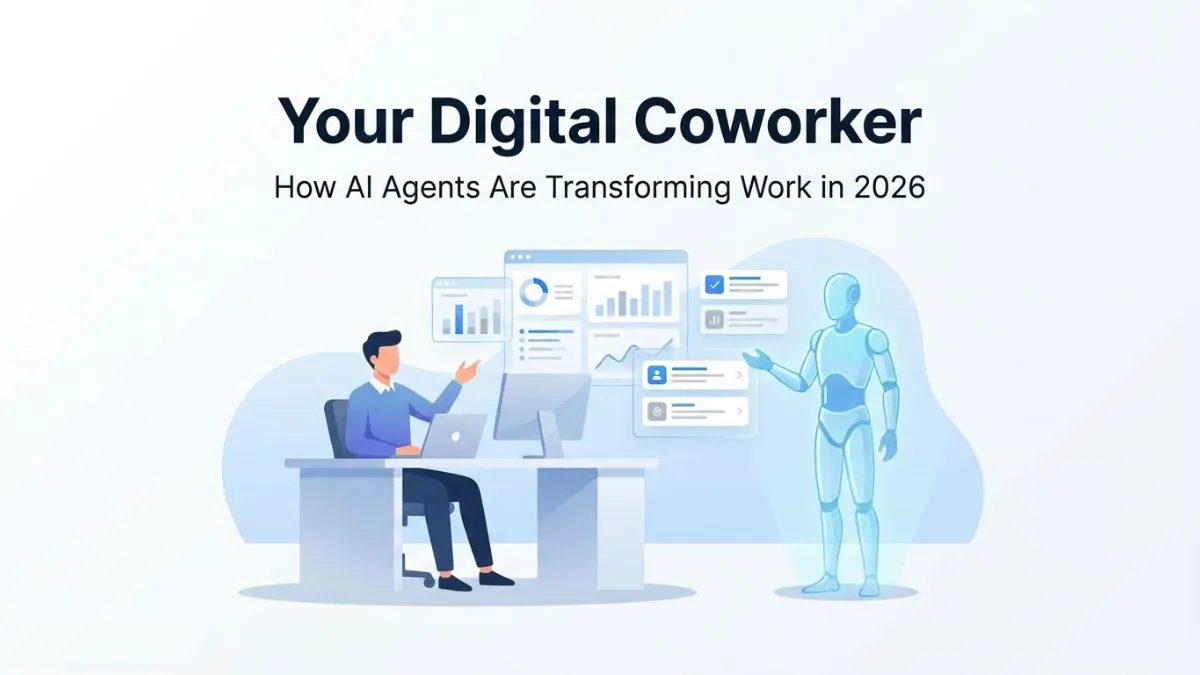
How AI Agents Are Becoming Your Digital Coworkers in 2026

1. Introduction: The Rise of the AI Coworker
The modern office looked very different just five years ago. You had human employees answering emails, writing reports, running keyword research, monitoring website analytics, and scheduling meetings — all manually, all slowly. Then came a seismic shift. AI agents arrived not just as tools but as autonomous team members capable of thinking, deciding, and acting — all without a human pressing a button every five minutes.
By 2026, the term "digital coworker" is not a metaphor. It is a job description. Organizations around the world are integrating AI agents into their daily operations at a pace that is rewriting every assumption about productivity, workforce structure, and the future of human labor. According to McKinsey's Global AI Research, generative AI could add between $2.6 trillion and $4.4 trillion annually in value to the global economy — and a significant portion of that comes directly from autonomous AI agent applications inside businesses.
This guide is your definitive, deeply researched look at how AI agents are becoming digital coworkers in 2026, what they actually do on the job, which industries are being transformed first, and — critically — how you can start leveraging them for your business, your SEO strategy, and your professional career today.
Key Stats at a Glance
| Metric | Figure |
|---|---|
| Enterprises using AI in at least one function (McKinsey, 2025) | 77% |
| Potential annual economic impact of generative AI | $4.4 Trillion |
| Working hours impacted by AI automation by 2030 | 40% |
| Productivity multiplier reported by early AI agent adopters | 3.5x |
2. What Exactly Are AI Agents?
Before we dive into how AI agents are reshaping the workplace, it is critical to define exactly what we mean by the term. Most people think of a chatbot when they hear "AI" — something you type a question into and get an answer from. AI agents are fundamentally different, and the distinction matters enormously.
An AI agent is an autonomous software system that perceives its environment, makes decisions, and takes actions toward a defined goal — all without continuous human input. Where a traditional chatbot responds, an AI agent acts. Where a basic AI tool waits for instructions, an AI agent pursues objectives, plans sequences of steps, uses tools, browses the web, writes and executes code, sends emails, and iterates on results — all on its own.
The Key Properties of a True AI Agent
- 🧠 Autonomy — Operates independently without needing a human to validate each micro-decision or trigger each next step.
- 🎯 Goal-Oriented — Works toward high-level objectives and self-determines the best sequence of actions to achieve them.
- 🔧 Tool Use — Can use external tools — search engines, code interpreters, APIs, databases — to gather and act on information.
- 🔁 Iterative Learning — Evaluates its own outputs, recognizes errors, and revises its approach in real time based on feedback.
- 🤝 Multi-Agent Collaboration — Can communicate and delegate tasks to other specialized AI agents in a coordinated swarm.
- 🧩 Context Retention — Maintains memory of prior interactions, user preferences, and task history across extended sessions.
Modern AI agents in 2026 are built on top of powerful large language models (LLMs) like GPT-5, Claude 3 Opus, Gemini Ultra, and Llama 4 — but they are enhanced with agentic frameworks, long-context memory systems, and robust tool-calling architectures. Frameworks like LangChain, AutoGen by Microsoft, and CrewAI have made it dramatically easier to deploy production-grade AI agents for business use.
3. How AI Agents Work in 2026
Understanding the technical mechanics of AI agents helps you appreciate both their power and their limitations. While you do not need to be a machine learning engineer to deploy an AI agent for your business, knowing how they function will help you design better workflows and set realistic expectations.
The Agent Loop: Plan → Act → Observe → Revise
Every AI agent operates on a core loop. First, it receives a high-level goal from a human operator (e.g., "Research the top 20 competitors in our niche, analyze their backlink profiles, and prepare a weekly SEO report"). Then the agent enters its autonomous loop:
- Plan: The agent breaks down the goal into sub-tasks and decides which tools to invoke in what order.
- Act: It executes each sub-task — browsing URLs, querying APIs, writing content, running calculations.
- Observe: It reviews the outputs of each action and checks whether they meet quality expectations.
- Revise: If outputs are insufficient or an action fails, it adjusts strategy and tries alternative approaches.
This loop repeats until the goal is achieved or until the agent determines it needs human clarification. This ability to self-correct and iterate is what truly separates agentic AI from simple automation scripts.
Multi-Agent Architectures: The Digital Dream Team
The most sophisticated AI deployments in 2026 use multi-agent systems — orchestrated networks where different specialized agents collaborate. Imagine a digital marketing team staffed entirely by AI:
- A Research Agent gathers market trends and competitor data.
- A Content Agent writes long-form blog posts and social media copy.
- An SEO Agent optimizes every piece of content for on-page signals and checks technical issues.
- A Publishing Agent pushes finalized content to your CMS and schedules it.
- An Analytics Agent monitors performance after publishing and suggests improvements.
This kind of AI-driven SEO workflow is no longer experimental — it is being deployed by forward-thinking businesses right now, and the results in terms of content output speed and quality are staggering.
💡 Pro Insight: The most effective human-AI collaboration models in 2026 are not about replacing human judgment — they are about amplifying it. Humans set strategy, verify outputs, and handle edge cases. AI agents handle the high-volume, repetitive execution layer that used to consume 60–70% of a knowledge worker's day.
4. Key Roles AI Agents Are Filling in the Workplace
The adoption of AI agents is not uniform across departments — it is moving fastest wherever there is a high volume of structured, repeatable knowledge work. Here are the most impactful roles AI agents are occupying in organizations in 2026.
4.1 The AI Research Analyst
Research that used to take a junior analyst three days now takes an AI agent three hours. AI research agents can scan hundreds of papers, reports, and web pages, synthesize key findings, identify conflicting evidence, and produce a polished briefing document — complete with source citations — faster than any human team. This is transformative for consulting firms, investment banks, pharmaceutical companies, and any organization that relies on competitive intelligence.
4.2 The AI Customer Support Agent
Modern AI customer service agents go far beyond FAQ bots. In 2026, they can access CRM databases, process refund requests, escalate to the right human department when emotional tone indicates frustration, personalize responses based on purchase history, and follow complex decision trees — all in natural language, across 50+ languages simultaneously. Companies using advanced AI support agents report 40-60% reductions in support ticket resolution time.
4.3 The AI Content Creator & SEO Strategist
Perhaps no workplace role has been transformed more visibly than content creation and SEO. AI agents today can perform complete website SEO audits, conduct in-depth keyword research, write and optimize blog posts, generate meta descriptions, build internal linking structures, and monitor ranking fluctuations — all autonomously. The human SEO strategist's role has shifted from execution to oversight and creative direction.
4.4 The AI Software Developer
AI coding agents like GitHub Copilot Workspace, Devin, and Claude Code can now take a natural language feature request and produce functional, tested, documented code across an entire codebase. They understand project context, follow coding conventions, write unit tests, identify security vulnerabilities, and submit pull requests — acting as a tireless junior developer who never sleeps and never needs onboarding.
4.5 The AI Data Scientist
Data analysis agents can clean messy datasets, run statistical analyses, generate visualizations, identify anomalies, build predictive models, and narrate their findings in plain English. For small businesses that cannot afford a dedicated data science team, this is an equalizing superpower. For large enterprises, it accelerates the time-to-insight from weeks to hours.
4.6 The AI Project Manager
Emerging AI project management agents track task completion, flag blockers, redistribute workloads when team members fall behind, draft status updates, and ensure deadlines are met — all by integrating with tools like Jira, Asana, Slack, and Google Workspace. They function as a constant, impartial project overseer who can see every signal at once.
5. AI Agents Transforming SEO & Digital Marketing
For digital marketers and SEO professionals, the rise of AI agents is not a distant concern — it is the most significant shift in your industry since Google's Panda and Penguin algorithm updates. Let's explore exactly how AI agents are rewriting the SEO playbook in 2026.
5.1 Automated Technical SEO Audits
AI agents connected to crawling infrastructure can perform comprehensive technical SEO audits on a continuous basis — not just monthly. They can detect and categorize crawl errors, identify 404 errors and broken links, flag duplicate content issues, review robots.txt and sitemap configurations, analyze Core Web Vitals performance, check mobile-friendliness, and generate prioritized fix lists — all automatically.
5.2 AI-Powered Keyword Research and Content Mapping
Traditional keyword research is a time-intensive process. AI agents now handle the entire research-to-strategy pipeline: they identify high-opportunity keyword clusters, analyze keyword gaps against competitors, map keywords to content silos, calculate search intent, estimate traffic potential, and build full content calendars. What used to take an SEO team a full sprint now takes minutes.
5.3 Intelligent Link Building at Scale
Link building has historically been one of the most labor-intensive aspects of SEO. AI agents in 2026 are changing this by autonomously identifying high-authority link opportunities, drafting personalized outreach emails, following up on non-responses, tracking link acquisition status, and flagging toxic links before they damage your domain authority.
5.4 Dynamic On-Page Optimization
AI agents can analyze your existing content portfolio and make data-driven on-page improvements automatically. They can update title tags and meta descriptions based on current best practices, suggest improvements to heading structure, add schema markup, build intelligent internal linking, and even A/B test page variants — all without requiring a developer to manually push code.
5.5 Real-Time SERP Monitoring and Competitive Intelligence
AI agents can track your SERP positions in real time, alert you to ranking drops before they become crises, identify which competitors just published a piece targeting your keywords, and suggest counter-content strategies.
⚡ Did You Know? According to Gartner's research, more than 80% of enterprises will have used generative AI in some capacity by 2026. Among SEO and digital marketing teams, AI-assisted workflows are already the default, not the exception.
6. AI Agents and the Productivity Revolution
The productivity gains from AI agents are not incremental — they are exponential. This is because agents do not just help humans work faster; they multiply the effective output of each human team member by handling entire categories of tasks that previously demanded human attention.
The 10X Knowledge Worker
Consider a content marketing manager who, in 2023, could realistically produce 4-6 high-quality blog posts per month with SEO optimization included. With a properly configured AI agent stack in 2026, that same manager can oversee the production of 40-60 posts per month — with AI agents handling research, drafting, optimization, and publishing, while the human focuses on strategy, tone, brand alignment, and quality control. That is a genuine 10X productivity multiplier.
Research from Stanford and MIT economists studying AI's impact on professional workers found that access to AI tools increased the productivity of customer service agents by an average of 14%, with the gains concentrated among lower-skilled workers (who saw up to 34% improvement). More recent 2025 studies on agentic AI show even larger effects because agents handle more complete workflows, not just assistance on individual tasks.
Asynchronous and 24/7 Operation
Perhaps the most operationally valuable aspect of AI agents as digital coworkers is that they operate continuously. Your AI-powered productivity stack doesn't take vacations, doesn't get sick, doesn't experience Monday morning drag, and doesn't stop working at 5pm. For global businesses operating across time zones, this 24/7 capability means that tasks assigned at end of business in New York are completed and ready for review when teams in London start their morning.
7. Challenges & Ethical Considerations
The excitement around AI agents is justified — but it must be tempered with a clear-eyed understanding of the very real challenges, risks, and ethical questions that accompany this technological shift.
7.1 The Hallucination Problem
AI agents can and do make things up. LLMs at their core are probabilistic text generators, not truth engines. An AI research agent might cite a study that does not exist, produce a financial projection using flawed logic, or write SEO content containing factual errors. In 2026, this problem has been significantly reduced through better grounding techniques, retrieval-augmented generation (RAG), and multi-agent fact-checking — but it has not been eliminated. Human oversight at the output stage remains essential.
7.2 Security and Data Privacy
Giving an AI agent access to your email, CRM, codebase, and internal documents creates significant security surface area. If an agent is compromised or manipulated through prompt injection attacks, the consequences could be severe. Organizations must implement strict permission boundaries, audit agent actions, and ensure that sensitive data is never unnecessarily exposed to external AI services.
7.3 Job Displacement Anxieties
The human dimension of the AI agent revolution cannot be sidestepped with optimistic talking points. Real displacement is occurring in roles centered on routine knowledge tasks — data entry, basic content writing, first-level customer support, and administrative coordination. The World Economic Forum's Future of Jobs Report estimates that AI will displace 85 million jobs by 2025 while creating 97 million new ones — but the transitional pain for workers in disrupted roles is real and should be taken seriously.
7.4 Quality Control at Scale
When AI agents are producing 10X the output, quality control becomes proportionally harder. A single error in an AI agent's prompt configuration can propagate across thousands of outputs before it is caught. Building robust review checkpoints, output sampling protocols, and human escalation triggers into agentic workflows is not optional — it is a critical part of responsible deployment.
7.5 Regulatory and Compliance Landscape
The EU AI Act, which came into full effect in 2026, creates new compliance requirements for organizations using AI systems in high-risk decision-making contexts. In the US, sector-specific AI guidance from the FTC, SEC, and FDA is shaping how AI agents can be used in financial services, healthcare, and advertising.
8. Industry-by-Industry Breakdown
| Industry | Primary AI Agent Use Case | Impact Level | Adoption Stage |
|---|---|---|---|
| Digital Marketing & SEO | Content creation, keyword research, technical audits, link building | 🔴 Very High | Mainstream |
| Software Development | Code generation, debugging, code review, documentation | 🔴 Very High | Mainstream |
| E-Commerce | Product descriptions, inventory forecasting, customer service, pricing optimization | 🔴 Very High | Mainstream |
| Financial Services | Risk analysis, fraud detection, report generation, compliance monitoring | 🟠 High | Expanding |
| Healthcare | Clinical note summarization, diagnostic support, drug interaction checks | 🟠 High | Early Majority |
| Legal | Contract review, due diligence, legal research, document drafting | 🟠 High | Early Majority |
| Education | Personalized tutoring, curriculum generation, student assessment | 🟡 Medium-High | Growing |
| Manufacturing | Predictive maintenance, supply chain optimization, quality control | 🟡 Medium-High | Growing |
| Real Estate | Market analysis, lead qualification, property descriptions, virtual tours | 🟡 Medium | Early Adopters |
E-Commerce: A Deep Dive
The e-commerce sector offers one of the clearest examples of AI agents delivering measurable ROI. For Shopify store owners, AI agents are handling product description generation at scale, managing dynamic pricing algorithms, optimizing ad creative in real time, flagging fraudulent orders, and personalizing the shopping experience at the individual user level. Check out our guides on best AI tools for e-commerce and best AI tools for Amazon sellers for a practical starting point.
9. How to Start Working With AI Agents Today
You do not need a team of ML engineers, a massive budget, or enterprise-grade infrastructure to start working with AI agents. Here is a practical roadmap for businesses at every level.
Step 1: Audit Your Repetitive Tasks
Start by listing every task your team performs more than three times per week that involves structured information. Writing reports, answering similar emails, pulling data from dashboards, writing product descriptions, updating spreadsheets — these are your best candidates for AI agent automation.
Step 2: Start With Specialized AI Tools Before Building Agents
Rather than jumping straight into custom agent development, begin with specialized AI tools that already have agentic workflows built in. For SEO, tools available at BrightSEOTools provide a strong foundation — the website SEO score checker and keyword research tool are excellent starting points. Our guide on best AI tools with pros and cons is a great resource for choosing the right tools.
Step 3: Implement a No-Code Agent Using Existing Platforms
Platforms like Zapier AI, Make (Integromat), and n8n allow you to build multi-step agentic workflows without writing code. You can create a workflow that monitors your search rankings, pulls data into a spreadsheet, drafts a weekly email summary, and sends it to your team — all automated.
Step 4: Define Clear Agent Boundaries and Human Checkpoints
Every AI agent deployment should have:
- Clearly defined scope — what the agent can and cannot do
- Resource limits — what APIs and data it can access
- Output review triggers — when a human must approve before an action is executed
- Escalation protocols — what happens when the agent encounters something outside its training
Step 5: Measure, Iterate, and Scale
Track the time saved, output quality, error rates, and business impact of each AI agent you deploy. Use this data to refine prompts, adjust workflows, and identify the next highest-value automation opportunity. For deeper guidance on measuring what matters, explore our article on how to measure SEO success and the top SEO checker tools.
10. The Future: What Comes After AI Coworkers?
We are still in the early innings of the AI agent era. The capabilities we see in 2026 represent perhaps 10-15% of what this technology will be capable of by 2030. Here is a look at the near-term trajectory.
10.1 Persistent Agents with Long-Term Memory
Current AI agents have limited memory across sessions. The next generation will maintain persistent, structured memory of every interaction, every decision made, every piece of feedback received — creating agents that genuinely learn and improve over months and years of working with your organization.
10.2 Embodied AI Agents
Physical robotics companies are rapidly converging with AI agent frameworks. By 2028-2030, the term "AI coworker" may be literal — humanoid robots powered by the same LLM architectures driving digital agents will be operating in warehouses, hospitals, laboratories, and eventually offices. Companies like Figure, Agility Robotics, and Tesla's Optimus division are investing billions in this convergence.
10.3 Regulatory Frameworks Will Mature
As AI agents take on more consequential roles, legal and regulatory frameworks will necessarily mature. We will see clearer standards for AI agent accountability, mandatory audit trails for agentic decisions, and likely new categories of liability for organizations deploying autonomous AI in high-stakes contexts.
10.4 New Human Roles: The Agent Orchestrator
A new professional category is emerging — the AI Agent Orchestrator. These are the people who design, configure, supervise, and improve multi-agent workflows. They combine deep domain expertise with an understanding of AI capabilities and a talent for translating business objectives into agent-ready specifications. This role will be one of the highest-demand, highest-paid positions in the knowledge economy within three years.
The organizations that win in this environment will be those that embrace AI-driven strategies proactively, invest in training their teams to collaborate with agents effectively, and build the kind of feedback-loop culture that extracts maximum value from every AI deployment.
FAQs
1. What is the difference between an AI agent and a chatbot?
A chatbot responds to questions in a conversational interface — it waits for user input and generates a reply. An AI agent is fundamentally different: it is autonomous, goal-oriented, and proactive. Rather than waiting for each instruction, an AI agent takes a high-level objective, plans a series of steps to achieve it, uses external tools and data sources, executes actions (like browsing the web, writing code, or sending emails), reviews its own output, and iterates — all without constant human involvement. Think of a chatbot as a knowledgeable assistant you have to guide step-by-step; an AI agent is more like a capable employee you can assign a project to and expect a completed result from.
2. Are AI agents replacing human workers in 2026?
The accurate answer is nuanced. AI agents are displacing specific categories of tasks rather than entire human roles wholesale — at least in 2026. Roles built primarily around routine, structured, high-volume knowledge work are seeing significant task displacement. However, roles requiring creativity, strategic judgment, interpersonal relationship management, and ethical reasoning are actually being elevated. Net job creation is expected to exceed net job displacement by 2030, but the transition period involves real disruption for workers in automatable roles.
3. How are AI agents changing SEO in 2026?
AI agents are transforming SEO from a labor-intensive discipline into a largely automated, continuously optimized function. They can now perform technical audits, conduct keyword research, write and optimize content, build internal linking structures, monitor rankings, detect algorithm changes, and trigger competitive responses — all autonomously. Human SEO professionals are shifting from doing execution work to directing strategy, reviewing AI outputs, and managing the creative and brand dimensions of content that AI cannot fully replicate.
4. What tools can I use to deploy AI agents for my business today?
There are excellent options across every budget level. For no-code deployments, Zapier AI, Make (Integromat), and n8n allow you to build automated multi-step workflows without programming. For more sophisticated deployments, AutoGen (Microsoft), CrewAI, and LangGraph offer programmable multi-agent architectures. For SEO, BrightSEOTools offers a comprehensive suite of AI-powered tools. Starting with specialized tools before building custom agents is generally the wisest approach for most businesses.
5. How do I ensure AI agent outputs are accurate and reliable?
Key strategies include: using retrieval-augmented generation (RAG) to ground agents in verified data sources; implementing multi-agent cross-checking where one agent verifies the output of another; building human review checkpoints at critical output stages; maintaining structured audit logs of agent actions; using output evaluation frameworks; and establishing clear escalation protocols for edge cases. The more consequential the output domain (medical, legal, financial), the more rigorous your oversight framework must be.
6. What is a multi-agent system and when should I use one?
A multi-agent system is an orchestrated network of specialized AI agents that collaborate to accomplish complex, multi-step goals. Rather than one general-purpose agent handling every aspect of a task, different agents handle different domains — each optimized for its specific function. Consider a multi-agent approach when your workflow involves multiple distinct domains of expertise, when quality control requires one agent to verify another's output, or when different parts of a workflow would benefit from running in parallel. For most small businesses, single-agent workflows are sufficient to start.
7. How much does it cost to implement AI agents for a small business?
Costs vary dramatically based on implementation approach. Using no-code automation platforms with AI capabilities starts at $20-100/month. Using AI APIs directly typically costs $0.01-0.10 per 1,000 tokens — amounting to roughly $50-500/month for most small businesses. More sophisticated custom agent deployments can run $2,000-20,000+/month for enterprise implementations. The best approach for most small businesses is to start with purpose-built AI tools, then scale to custom agent development only once specific use cases justify the investment.
8. Will AI agents work for my industry if it's highly regulated?
Yes, but with important caveats. In regulated industries (healthcare, finance, legal), AI agents are most appropriately used for non-regulated supportive tasks — document summarization, research assistance, administrative automation — rather than for regulated decision-making. Working closely with legal and compliance teams from the outset is non-negotiable. Even within regulated industries, the administrative and research functions that can be safely automated represent enormous efficiency opportunities.
9. What skills should I develop to work effectively alongside AI agents?
The most valuable skills fall into four categories:
- Prompt engineering and agent configuration — clearly articulating goals, constraints, and success criteria to AI systems.
- Critical output evaluation — quickly identifying errors, biases, and quality issues in AI-generated work.
- Workflow design — decomposing complex tasks into agent-executable steps and building effective human-AI handoff points.
- Domain expertise — your deep field knowledge allows you to direct AI agents intelligently and catch errors a generalist agent would miss.
10. How do AI agents impact SEO content quality — does Google penalize AI-generated content?
Google's official position is that they reward helpful, high-quality content regardless of how it was produced — and penalize low-quality, spammy, or manipulative content regardless of whether a human or AI wrote it. AI-generated content that is well-researched, accurate, genuinely helpful, and properly structured can rank exceptionally well. The risk is not AI generation per se — it is the temptation to produce high volumes of low-effort, generic content purely for search manipulation. AI agents used to scale authentic, expert-level content creation are a competitive advantage; AI agents used to flood the web with thin, keyword-stuffed pages will trigger penalties. Quality and user value remain the north star.
Final Thoughts: Embracing the AI Coworker Revolution
The shift from AI as a tool to AI as a digital coworker is the defining technological transition of this decade. In 2026, organizations that embrace AI agents thoughtfully — with clear governance, rigorous quality standards, and a genuine commitment to human-AI collaboration — are achieving levels of productivity, scale, and competitive advantage that were simply not possible before.
For SEO professionals, digital marketers, developers, and business owners, the entry points are accessible right now. Start with AI-powered SEO auditing, explore intelligent keyword research, and deepen your understanding through resources on AI tools that are game-changers for SEO and the top 100 AI tools shaping the industry.
The question is no longer whether AI agents will transform your workplace. They already are. The question is whether you will be the one directing them — or being replaced by the team that is.