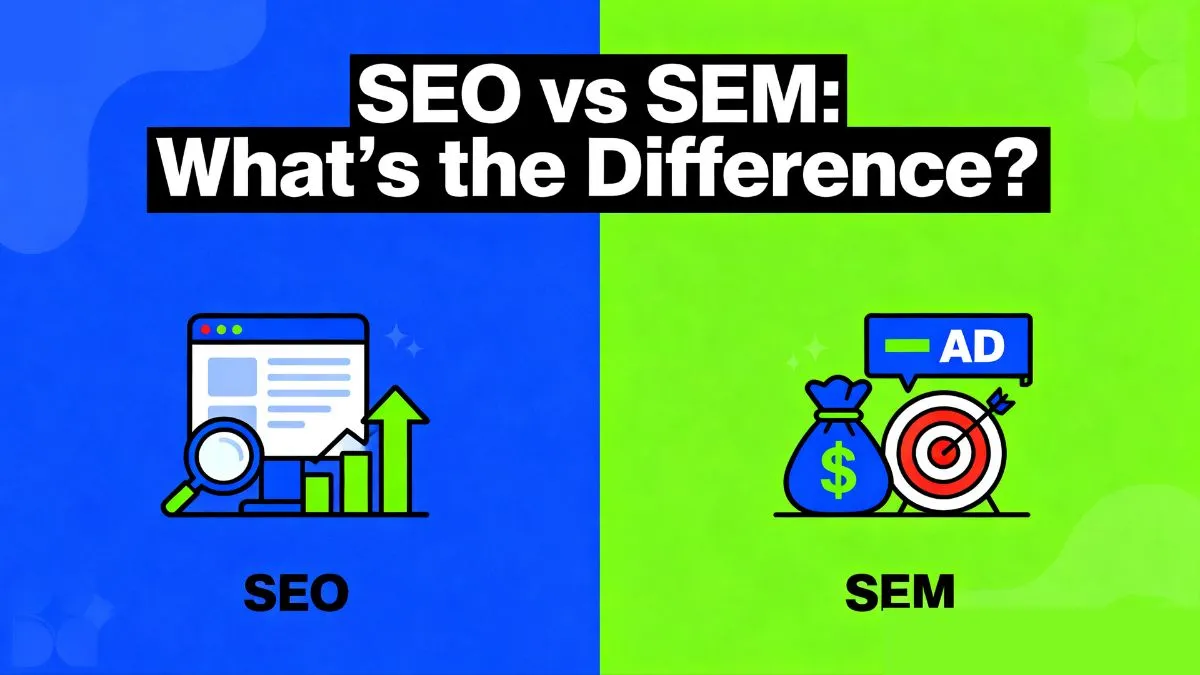
SEO vs SEM: What's the Difference? Complete Guide 2025

If you're trying to grow your online presence, you've probably heard the terms SEO and SEM thrown around. But what exactly do they mean, and more importantly, which one should you focus on? In this comprehensive guide, we'll break down everything you need to know about SEO vs SEM, helping you make informed decisions for your digital marketing strategy.
Understanding the Basics: What Are SEO and SEM?
Before diving into the differences, let's establish clear definitions of both terms.
What is SEO (Search Engine Optimization)?
SEO stands for Search Engine Optimization. It's the practice of optimizing your website to rank higher in organic (unpaid) search engine results. When someone searches for a keyword related to your business on Google, Bing, or other search engines, SEO helps ensure your website appears prominently in those results.
SEO encompasses various strategies including on-page optimization, technical SEO, content creation, and link building. The goal is to increase both the quantity and quality of traffic to your website through organic search engine results.
What is SEM (Search Engine Marketing)?
SEM stands for Search Engine Marketing. It's a broader digital marketing strategy that includes both paid and organic tactics to increase visibility in search engines. However, in modern marketing terminology, SEM typically refers specifically to paid search advertising, such as Google Ads or Microsoft Advertising.
With SEM, you pay to have your ads displayed at the top of search results for specific keywords. You're essentially buying visits to your site rather than earning them organically.
The Key Differences Between SEO and SEM
Understanding the distinctions between these two strategies is crucial for developing an effective digital marketing plan.
1. Cost Structure
SEO: SEO is often called "free traffic," but that's somewhat misleading. While you don't pay per click, SEO requires investment in content creation, technical optimization, and often professional services. The costs are upfront and ongoing, but once you rank well, the traffic itself doesn't cost you per visitor. You can use tools like our Website SEO Score Checker to evaluate your current optimization level.
SEM: SEM operates on a pay-per-click (PPC) model. You bid on keywords, and every time someone clicks your ad, you pay a fee. Costs can range from a few cents to hundreds of dollars per click, depending on competition and industry. According to WordStream's PPC statistics, the average cost per click across all industries is around $2.69 for search.
2. Time to Results
SEO: SEO is a long-term strategy. It typically takes 3-6 months to see significant results, and sometimes longer for competitive keywords. Search Engine Journal reports that most SEO campaigns need at least 4-6 months before showing meaningful traffic increases. However, once you achieve good rankings, they can be sustained with ongoing maintenance.
SEM: SEM provides almost instant visibility. Once your campaign is approved and live, your ads can appear within hours. This makes SEM ideal for time-sensitive promotions, product launches, or when you need immediate traffic.
3. Sustainability
SEO: Rankings achieved through SEO can be relatively stable over time. Even if you pause your SEO efforts, your rankings won't disappear overnight. Quality content and strong backlinks continue to provide value long after they're created. Check out our guide on 10 Proven SEO Tips to Skyrocket Traffic for sustainable strategies.
SEM: The moment you stop paying for ads, your visibility disappears. There's no residual effect once you turn off your campaigns. This makes SEM less sustainable as a standalone strategy.
4. Click-Through Rates (CTR)
SEO: Organic search results generally receive higher click-through rates than paid ads. According to BrightEdge research, organic search drives 53% of all website traffic, while paid search accounts for only 15%.
SEM: While SEM ads appear at the top of search results, many users skip past them to click on organic results. Search Engine Land notes that the top organic result gets clicked 10 times more often than the top paid result.
5. Targeting Capabilities
SEO: SEO targeting is primarily keyword-focused. You optimize your content for specific search terms and topics, but you have limited control over who sees your results. Your content appears to anyone searching for relevant terms.
SEM: SEM offers sophisticated targeting options including geographic location, demographics, time of day, device type, and even audience remarketing. Google Ads targeting options allow you to reach very specific audience segments.
6. Testing and Optimization
SEO: SEO changes take time to implement and even longer to show results. A/B testing is possible but requires patience, as you need significant time between changes to accurately measure impact. Use our Meta Tag Generator to optimize your on-page elements efficiently.
SEM: SEM allows for rapid testing and optimization. You can test different ad copy, landing pages, and targeting options simultaneously, seeing results within days or even hours. This makes it ideal for refining your messaging and conversion strategy.
Technical SEO: The Foundation of Organic Success
Technical SEO forms the backbone of any successful organic search strategy. Without proper technical optimization, even the best content won't rank well.
Core Technical SEO Elements
Site Speed: Page speed is a critical ranking factor. Google's Core Web Vitals emphasize loading performance, interactivity, and visual stability. Research from Portent shows that site conversion rates drop by an average of 4.42% with each additional second of load time. Improve your site's performance with insights from our article on 7 Proven Ways to Improve Core Web Vitals.
Mobile Optimization: With mobile searches accounting for over 60% of all searches according to Statista, mobile-friendliness is non-negotiable. Test your site with our Mobile Friendly Test tool.
Site Architecture: A well-structured website helps both users and search engines navigate your content. Logical hierarchies, clean URL structures, and proper internal linking all contribute to better rankings. Learn more about this in our guide on 9 Site Architecture Tweaks That Work.
SSL Certificate: HTTPS is a ranking signal. Google has confirmed that secure sites receive a ranking boost. Verify your security with our SSL Checker.
Crawlability: Search engines need to crawl and index your pages effectively. Use our Find DNS Record tool and check your robots.txt configuration with guidance from 8 Key Tips for Robots.txt Perfection.
Content Strategy: The Heart of SEO
Content remains king in the world of SEO. HubSpot research indicates that companies that blog receive 55% more website visitors than those that don't.
Creating SEO-Optimized Content
Keyword Research: Start with comprehensive keyword research. Use tools like Ahrefs' Keywords Explorer or our own Keyword Research Tool to identify opportunities. Find related terms with our Related Keywords Finder.
Search Intent: Understanding search intent is crucial. Moz explains that there are four main types of search intent: informational, navigational, commercial, and transactional. Your content must match the intent behind your target keywords.
Content Depth: According to Backlinko's research, the average first-page result on Google contains 1,447 words. Comprehensive, in-depth content tends to rank better than thin, superficial pages.
Content Freshness: Regular updates signal to search engines that your site is active and relevant. SEMrush found that content freshness correlates with higher rankings for certain query types.
Multimedia Elements: Incorporating images, videos, and infographics enhances user experience and engagement. Optimize your images with our Image Compressor to maintain fast loading times.
Link Building: Building Authority and Trust
Backlinks remain one of the most important ranking factors. Ahrefs' study of 1 billion pages found a clear correlation between the number of referring domains and organic search traffic.
Effective Link Building Strategies
Quality Over Quantity: Google's John Mueller has stated that a few high-quality links are far more valuable than many low-quality ones. Focus on earning links from authoritative, relevant sites.
Content-Driven Link Acquisition: Create linkable assets like original research, comprehensive guides, or useful tools. BuzzSumo's analysis shows that in-depth guides and research-backed content earn significantly more backlinks.
Guest Posting: Contributing to reputable sites in your industry builds both links and authority. However, Google's guidelines emphasize that guest posts should provide value, not just serve as link building schemes.
Broken Link Building: This strategy involves finding broken links on other websites and suggesting your content as a replacement. It's a win-win approach that provides value to both parties.
Monitor Your Backlinks: Use our Best Free Backlink Checker Tools to track your link profile and identify new opportunities.
SEM Campaign Structure: Maximizing Paid Search ROI
Successful SEM campaigns require careful planning and optimization. Let's explore the key components.
Campaign Architecture
Account Structure: Organize your Google Ads account into campaigns by product line, service type, or geographic target. Within each campaign, create tightly themed ad groups. Google's best practices recommend no more than 20 ad groups per campaign.
Keyword Match Types: Understanding match types is crucial. Broad match reaches the widest audience but may trigger irrelevant searches. Phrase match offers more control, while exact match provides the highest relevance but lowest reach. WordStream's guide explains each type in detail.
Negative Keywords: Adding negative keywords prevents your ads from showing for irrelevant searches, saving budget and improving ROI. Regular negative keyword refinement is essential for campaign efficiency.
Ad Extensions: Extensions increase your ad's visibility and click-through rate. Google reports that extensions typically improve CTR by several percentage points. Use sitelinks, callouts, structured snippets, and call extensions when applicable.
Ad Copy That Converts
Compelling Headlines: Your headline is the first thing users see. Include your target keyword and a clear value proposition. Google's RSA best practices recommend providing 8-10 unique headlines for responsive search ads.
Clear Call-to-Action: Tell users exactly what you want them to do: "Shop Now," "Get a Free Quote," "Start Your Trial," etc. Specificity increases conversion rates.
Ad Relevance: Ensure your ad copy closely matches both the search query and the landing page content. Quality Score, Google's rating of ad quality, directly impacts your ad position and cost per click.
A/B Testing: Continuously test different versions of your ads. Even small changes in wording can significantly impact performance. Test one variable at a time for clear results.
Landing Page Optimization: Where SEO and SEM Converge
Both SEO and SEM traffic ultimately land on your website, making landing page optimization crucial for both strategies.
Essential Landing Page Elements
Relevance: Your landing page must deliver on the promise made in the search result or ad. Misalignment leads to high bounce rates and poor conversion rates. Learn how to address this in our post on 8 Proven Tips to Reduce Bounce Rate.
Load Speed: According to Google's research, 53% of mobile users abandon sites that take longer than 3 seconds to load. Optimize with tips from 10 Speed Hacks for Lightning Fast Sites.
Clear Value Proposition: Within seconds, visitors should understand what you're offering and why it matters to them. Use clear headlines and concise copy.
Strong CTAs: Your call-to-action should be prominent, action-oriented, and create a sense of urgency or value. HubSpot's research shows that personalized CTAs perform 202% better than generic ones.
Trust Signals: Include testimonials, reviews, security badges, and social proof. Nielsen Norman Group research confirms that social proof significantly influences purchasing decisions.
Mobile Responsiveness: With mobile traffic dominating, your landing pages must work flawlessly on all devices. Check your mobile optimization with 7 Smart Ways to Improve Mobile SEO.
Local SEO vs Local SEM: Capturing Nearby Customers
For businesses serving local markets, both strategies have location-specific considerations.
Local SEO Tactics
Google Business Profile: A fully optimized Google Business Profile is essential. According to BrightLocal's survey, 87% of consumers read online reviews for local businesses.
Local Citations: Consistent NAP (Name, Address, Phone) information across directories like Yelp, Yellow Pages, and industry-specific directories helps establish local relevance.
Local Content: Create content targeting local keywords and addressing local topics. Blog about community events, local news, and area-specific solutions.
Reviews and Ratings: Actively encourage and respond to customer reviews. Moz's local search ranking factors study identifies reviews as a top-ranking signal for local searches.
Local SEM Strategies
Location Targeting: Use radius targeting or specific geographic areas to show ads only to relevant local audiences. Google's location targeting options allow precise geographic control.
Location Extensions: These show your business address, phone number, and a map marker with your ads. They significantly improve CTR for local businesses.
Call Extensions: Many local searches have immediate intent. Call extensions allow users to contact you directly from the search results.
Local Keywords: Bid on keywords that include location modifiers like "near me," city names, or neighborhood names.
Measuring Success: KPIs for SEO and SEM
You can't improve what you don't measure. Here are the key metrics for each strategy.
SEO Metrics to Track
Organic Traffic: Monitor total organic sessions using Google Analytics 4. Track trends over time and segment by landing page, device, and location.
Keyword Rankings: Track your positions for target keywords using tools like Google Search Console, SEMrush, or Ahrefs. Check your SERP positions with our SERP Checker.
Click-Through Rate: Found in Google Search Console, CTR shows how often people click your listing when it appears in search results. Low CTR may indicate poor titles or meta descriptions.
Backlink Profile: Monitor the quantity and quality of backlinks pointing to your site. Track new links, lost links, and referring domain diversity.
Domain Authority: While not a Google metric, Domain Authority (DA) from Moz provides a useful benchmark for comparing your site's strength to competitors.
Page Speed: Use Google PageSpeed Insights and our tools to monitor loading times and Core Web Vitals metrics.
Conversions from Organic: Ultimately, traffic means nothing without conversions. Track organic-attributed conversions in Google Analytics.
SEM Metrics to Track
Cost Per Click (CPC): How much you're paying per click. Compare to industry benchmarks and optimize to reduce costs.
Click-Through Rate (CTR): The percentage of impressions that result in clicks. Higher CTR generally indicates better ad relevance and lower costs.
Quality Score: Google's rating of your keywords, ads, and landing pages. Higher Quality Scores lead to better ad positions and lower costs.
Conversion Rate: The percentage of clicks that result in desired actions. Track this both in Google Ads and Google Analytics for complete insight.
Cost Per Acquisition (CPA): Total ad spend divided by conversions. This shows how much you're paying to acquire a customer.
Return on Ad Spend (ROAS): Revenue generated divided by ad spend. A ROAS of 4:1 means you earn $4 for every $1 spent on ads.
Impression Share: The percentage of impressions you receive compared to the total available. Lost impression share indicates missed opportunities.
Common SEO Mistakes to Avoid
Even experienced marketers make mistakes. Here are critical pitfalls to avoid.
Technical Errors
Ignoring Mobile Optimization: With mobile-first indexing, Google primarily uses mobile versions of content for ranking and indexing.
Slow Page Speed: Site speed affects both rankings and user experience. According to Section.io, page load time has a direct correlation with bounce rate.
Broken Links: These create poor user experiences and waste crawl budget. Regularly check and fix broken links with guidance from 10 Smart Ways to Fix Broken Links.
Duplicate Content: Avoid creating multiple pages with identical or very similar content. Use canonical tags appropriately to indicate preferred versions.
Poor Site Architecture: Confusing navigation and excessive click depth make it difficult for both users and search engines to find content.
Content Mistakes
Keyword Stuffing: Overusing keywords makes content read unnaturally and can trigger Google penalties.
Thin Content: Pages with little substantive content provide poor user experience and rarely rank well.
Ignoring Search Intent: Creating content that doesn't match what users actually want when they search for a keyword leads to high bounce rates and poor rankings.
Neglecting Content Updates: Old, outdated content loses relevance over time. Regularly refresh and update your most important pages.
For more mistakes to avoid, check out 5 SEO Mistakes Killing Your Rankings and 6 Deadly SEO Habits to Break Now.
Common SEM Mistakes to Avoid
Paid search campaigns can quickly drain budgets if not managed carefully.
Campaign Structure Errors
Poor Account Organization: Mixing unrelated keywords in single ad groups leads to poor ad relevance and lower Quality Scores.
Ignoring Negative Keywords: Without regular negative keyword additions, you'll waste budget on irrelevant searches.
Set-and-Forget Campaigns: SEM requires ongoing optimization. Campaigns left unattended quickly become inefficient.
Bidding and Budget Mistakes
Bidding on Brand Terms Only: While brand terms convert well, they don't drive new customer acquisition. Balance brand and non-brand keywords.
Inadequate Budget: Spreading too little budget across too many campaigns prevents any from achieving meaningful volume.
Manual Bidding Without Strategy: Manual bidding requires constant attention and expertise. Consider automated bidding strategies like Target CPA or Maximize Conversions for better results.
Targeting Errors
Too Broad Targeting: Reaching the wrong audience wastes money. Use demographic, geographic, and audience targeting to reach qualified users.
Ignoring Device Performance: Mobile, desktop, and tablet users often perform differently. Analyze by device and adjust bids accordingly.
Poor Landing Page Experience: Sending traffic to your homepage or irrelevant pages kills conversion rates and increases costs.
Integrating SEO and SEM: The Synergistic Approach
The most successful digital marketing strategies don't treat SEO and SEM as competing tactics but as complementary approaches.
How SEO and SEM Work Together
Keyword Research Sharing: Use SEM data to identify high-converting keywords for SEO targeting. Conversely, use SEO keyword research to inform SEM campaigns. Search Engine Land explains how integrated keyword strategies improve overall performance.
SERP Domination: Appearing in both organic and paid results increases total visibility and clicks. Google research shows that paid and organic listings work together, not against each other.
Testing Ground: Use SEM's rapid testing capabilities to test messaging, offers, and landing pages. Apply winning variations to your SEO strategy.
Brand Protection: Bid on your brand terms to prevent competitors from capturing your brand traffic through ads.
Short-Term and Long-Term Balance: Use SEM for immediate visibility while building long-term organic presence through SEO.
Remarketing to Organic Visitors: Create remarketing campaigns targeting users who found you through organic search but didn't convert. This keeps your brand top-of-mind.
Budget Allocation Between SEO and SEM
The ideal budget split depends on several factors:
Business Stage: New businesses may need more SEM for immediate visibility, while established businesses can invest more heavily in long-term SEO.
Industry Competition: Highly competitive industries with expensive CPCs may justify greater SEO investment for better long-term ROI.
Product/Service Type: Complex, high-consideration purchases often benefit more from SEO content that educates and nurtures. Simple, transactional products may convert well through SEM.
Seasonal Considerations: Some businesses use SEM heavily during peak seasons and maintain SEO presence year-round.
A common approach is the 70/30 split: 70% to SEO for sustainable long-term growth, 30% to SEM for immediate results and testing. However, adjust based on your specific situation and goals.
Industry-Specific Considerations
Different industries require different SEO and SEM strategies.
E-commerce
SEO Focus: Product pages, category optimization, user-generated reviews, and blog content targeting buying-related keywords. Use our Best AI Tools for E-commerce Stores guide for additional insights.
SEM Strategy: Shopping campaigns, dynamic remarketing, and seasonal promotions. According to Shopify's research, Shopping ads have higher CTRs and better ROI than text ads for e-commerce.
Local Services (Plumbers, Lawyers, Dentists)
SEO Focus: Google Business Profile optimization, local content, and review generation. BrightLocal reports that 93% of consumers use the internet to find local businesses.
SEM Strategy: Tight geographic targeting, call extensions, and location extensions. Focus on high-intent keywords with local modifiers.
B2B SaaS
SEO Focus: Educational content, comparison pages, and solution-focused keywords. Gartner research indicates that 77% of B2B buyers conduct extensive research before contacting sales.
SEM Strategy: Target bottom-of-funnel keywords, competitor comparison terms, and use audience targeting for account-based marketing.
Content Publishers
SEO Focus: Comprehensive keyword research, trending topics, and rapid content production. Technical SEO and site speed are especially critical for ad revenue maximization.
SEM Strategy: Generally limited use except for subscription promotions or premium content. Most publishers rely heavily on SEO for sustainable traffic.
The Future of SEO and SEM
Search marketing constantly evolves. Here are key trends shaping the future.
AI and Machine Learning
AI-Generated Content: Tools like ChatGPT and Claude are changing content creation, but Google's guidelines emphasize quality and user value over creation method. Explore Top 100 Best AI Tools for productivity enhancements.
Search Algorithms: Google's algorithms increasingly use AI to understand context, intent, and content quality. BERT and MUM represent major advances in understanding natural language.
Automated Bidding: SEM is moving toward more automation. Google's Smart Bidding uses machine learning to optimize bids in real-time.
Voice Search
Voice-activated searches are growing rapidly. Juniper Research predicts continued growth in voice assistant usage. This requires optimizing for natural language queries and featured snippets.
Visual Search
Image-based searches are becoming more sophisticated. Pinterest Lens and Google Lens allow users to search using images rather than text. Optimize images with proper file names, alt text, and structured data.
Zero-Click Searches
Featured snippets and knowledge panels increasingly provide answers directly in search results. SparkToro's research shows that a significant percentage of searches end without a click to any website. Focus on brand building and capturing featured snippet positions.
Privacy and Cookie Deprecation
Third-party cookie elimination affects remarketing and audience targeting in SEM. Google's Privacy Sandbox aims to provide privacy-preserving alternatives. First-party data collection becomes increasingly important.
Stay updated with trends by reading 11 Hot SEO Trends Dominating 2025 and implementing strategies from 7 Killer SEO Hacks for 2025 Success.
Essential Tools for SEO and SEM Success
Having the right tools makes the difference between mediocrity and excellence.
SEO Tools
Technical SEO:
- Google Search Console - Free, essential for monitoring search performance
- Screaming Frog SEO Spider - Technical site auditing
- Our Website SEO Score Checker - Quick SEO health assessment
- Check GZIP Compression - Verify compression
- Htaccess Redirect Checker - Validate redirects
Keyword Research:
- Ahrefs - Comprehensive keyword and backlink analysis
- SEMrush - All-in-one SEO suite
- Our Keyword Research Tool - Find opportunities
Content Optimization:
- Clearscope - Content optimization based on top-ranking pages
- Surfer SEO - On-page optimization recommendations
- Our Meta Tag Generator - Create optimized meta tags
- Meta Tag Analyzer - Audit existing tags
Backlink Analysis:
- Ahrefs Backlink Checker - Comprehensive link analysis
- Moz Link Explorer - Domain authority and link metrics
- See our Best Free Backlink Checker Tools comparison
Site Speed:
- Google PageSpeed Insights - Performance analysis with recommendations
- GTmetrix - Detailed performance reporting
- Implement fixes from 12 Speed Tactics Every Site Needs
Technical Tools:
- XML Sitemap Generator - Create sitemaps
- Robots.txt Checker - Validate crawl instructions
- Domain Age Checker - Check domain history
- Find DNS Record - DNS analysis
SEM Tools
Campaign Management:
- Google Ads Editor - Bulk campaign management
- Microsoft Advertising Editor - Manage Bing campaigns offline
Keyword Research:
- Google Keyword Planner - Keyword ideas and forecasts
- SpyFu - Competitor keyword analysis
- SEMrush PPC Toolkit - Competitive intelligence
Analytics and Tracking:
- Google Analytics 4 - Comprehensive website analytics
- Google Tag Manager - Tag management without code changes
- Hotjar - Heatmaps and user behavior tracking
- Crazy Egg - Visitor recording and A/B testing
Ad Copy and Landing Page Tools:
- Unbounce - Landing page builder with A/B testing
- Optimizely - Experimentation platform
- VWO - Conversion rate optimization suite
Competitor Analysis:
- iSpionage - Competitor PPC intelligence
- Adbeat - Display advertising competitive analysis
- SimilarWeb - Traffic and marketing intelligence
Building Your SEO Strategy: A Step-by-Step Roadmap
Let's break down how to build an effective SEO strategy from scratch.
Phase 1: Foundation and Audit (Weeks 1-2)
Website Audit: Start with a comprehensive technical audit. Use our Website SEO Score Checker to identify immediate issues. Look for problems like broken links, slow page speed, mobile usability issues, and crawl errors.
According to Ahrefs' site audit guide, the average website has numerous technical SEO issues. Address critical problems first: site speed, mobile-friendliness, HTTPS implementation, and XML sitemap presence.
Competitor Analysis: Identify 3-5 main competitors and analyze their SEO strategies. Use Ahrefs' Site Explorer or SEMrush's Domain Overview to understand their top-performing content, backlink profiles, and ranking keywords.
Baseline Metrics: Establish current performance metrics. Connect Google Search Console and Google Analytics 4 to your site. Document current organic traffic, rankings for target keywords, and conversion rates. Review our comprehensive Website Audit Checklist 2025 for thoroughness.
Phase 2: Keyword Research and Strategy (Weeks 3-4)
Keyword Discovery: Use multiple tools for comprehensive research. Our Keyword Research Tool combined with Google Keyword Planner, Ahrefs Keywords Explorer, and Answer the Public provides diverse keyword opportunities.
Keyword Categorization: Organize keywords by search intent: informational (blog content), commercial (comparison pages), and transactional (product/service pages). Moz's keyword research guide emphasizes the importance of intent-based categorization.
Content Gap Analysis: Identify topics your competitors rank for but you don't. Ahrefs' Content Gap tool makes this process straightforward. These represent immediate opportunities.
Prioritization: Score keywords based on search volume, competition, and relevance. Target a mix of high-volume competitive terms (long-term goals) and low-competition long-tail keywords (quick wins). Learn more from How to Do Keyword Research Without Paying for Expensive Tools.
Phase 3: Technical Optimization (Weeks 5-6)
Site Speed Optimization: Implement improvements from Google PageSpeed Insights recommendations. Common fixes include image compression using our Image Compressor, enabling GZIP compression (verify with our Check GZIP Compression tool), minifying CSS/JavaScript with our CSS Minifier and Javascript Minifier, and implementing browser caching.
Google's research shows that as page load time increases from 1 to 10 seconds, the probability of mobile user bounce increases by 123%. Follow our guide on 10 Quick Fixes to Optimize Page Load.
Mobile Optimization: Ensure responsive design across all devices. Test with our Mobile Friendly Test and Screen Resolution Simulator. With mobile-first indexing, Google primarily uses mobile content for ranking.
Site Architecture: Create logical site structure with clear hierarchies. Implement breadcrumb navigation, optimize internal linking, and ensure important pages are within 3 clicks of the homepage. Review 9 Site Architecture Tweaks That Work for specific tactics.
Technical Elements:
- Create and submit XML sitemap using our XML Sitemap Generator
- Optimize robots.txt following 8 Key Tips for Robots.txt Perfection
- Implement schema markup for rich snippets (Schema.org provides complete documentation)
- Fix broken links using strategies from 10 Smart Ways to Fix Broken Links
- Resolve crawl errors following 7 Powerful Fixes for Crawl Errors
Phase 4: Content Creation (Ongoing)
Content Calendar: Develop a 3-month content calendar addressing all target keywords. CoSchedule's research shows that consistent publishing schedules correlate with better organic performance.
High-Quality Content Creation: Write comprehensive, valuable content targeting specific keywords. Backlinko's analysis found that longer content tends to rank higher, with the average first-page result containing 1,447 words.
Content should include:
- Clear, compelling headlines with target keywords
- Comprehensive coverage of the topic
- Original research, data, or unique insights
- Multimedia elements (images, videos, infographics)
- Internal links to related content
- Natural keyword integration without stuffing
Content Optimization: Use our Meta Tag Generator to create optimized title tags and meta descriptions. Implement proper heading hierarchy (H1, H2, H3). Add alt text to all images using our Image to Text Converter to extract text from images when needed.
Content Refresh: Regularly update existing content. HubSpot found that updating and republishing old blog posts can increase organic traffic by up to 106%.
Phase 5: Link Building (Ongoing)
Natural Link Acquisition: Create genuinely linkable content that attracts backlinks naturally. According to BuzzSumo's content research, research-backed posts and comprehensive guides earn the most links.
Outreach Campaigns: Identify relevant websites in your industry. Use Hunter.io or Voila Norbert to find contact information. Craft personalized outreach emails highlighting how your content provides value to their audience.
Guest Posting: Contribute high-quality articles to authoritative sites in your niche. Focus on sites with strong domain authority and engaged audiences. Remember Google's quality guidelines emphasize providing value, not manipulative link schemes.
Broken Link Building: Find broken links on relevant sites using Ahrefs' Broken Link Checker or Check My Links Chrome extension. Reach out to site owners suggesting your content as a replacement.
Monitor and Maintain: Track your backlink profile using tools from our Best Free Backlink Checker Tools guide. Disavow toxic links through Google's Disavow Tool if necessary.
Phase 6: Monitoring and Optimization (Ongoing)
Performance Tracking: Monitor key metrics weekly:
- Organic traffic trends in Google Analytics 4
- Keyword rankings using Google Search Console or rank trackers
- Click-through rates for target keywords
- Conversion rates from organic traffic
- Core Web Vitals metrics
Regular Audits: Conduct comprehensive audits quarterly using our 9 SEO Checker Tools You Must Use. Follow the 10 Audit Tips to Fix SEO Issues Fast for efficient problem-solving.
Algorithm Updates: Stay informed about Google algorithm updates and adjust strategy accordingly. Major updates can significantly impact rankings.
Continuous Improvement: SEO is never "finished." Search Engine Journal reports that Google makes thousands of algorithm changes annually. Continuous optimization is essential for maintaining and improving rankings.
Building Your SEM Strategy: A Step-by-Step Roadmap
Now let's explore how to build an effective SEM strategy that delivers ROI.
Phase 1: Campaign Planning and Setup (Week 1)
Define Clear Objectives: Establish specific, measurable goals. Are you focused on:
- Lead generation (conversions)
- E-commerce sales (ROAS)
- Brand awareness (impressions, reach)
- Traffic generation (clicks)
Google's campaign planning guide emphasizes that clear objectives inform all subsequent decisions about bidding, targeting, and optimization.
Budget Determination: Calculate realistic budgets based on industry CPC benchmarks from WordStream's industry benchmarks. Start conservatively, test, then scale what works.
Account Structure: Set up campaigns logically:
- Campaign level: Product categories, service types, or geographic regions
- Ad group level: Tightly themed keyword groups (10-20 keywords maximum)
- Ad level: 2-3 responsive search ads per ad group minimum
Tracking Setup: Implement conversion tracking immediately. Install the Google Ads conversion tracking tag via Google Tag Manager. Track valuable actions like purchases, lead form submissions, phone calls, and email signups.
Phase 2: Keyword Research and Selection (Week 1-2)
Keyword Discovery: Use Google Keyword Planner to identify keywords with search volume and cost estimates. Supplement with our Keywords Rich Domains Suggestions tool.
Match Type Strategy: Implement a balanced approach:
- Exact match for high-intent, proven converters
- Phrase match for moderate control with expanded reach
- Broad match modified for discovery (use cautiously with negative keywords)
Google's match types guide explains how each match type determines when ads appear.
Negative Keyword List: Build a negative keyword list from day one. Common negatives include "free," "jobs," "DIY," "cheap," and any terms irrelevant to your offering. WordStream's negative keywords guide provides industry-specific suggestions.
Competitive Analysis: Use SpyFu or SEMrush's Advertising Research to see which keywords competitors bid on and what their ad copy looks like.
Phase 3: Ad Copy Creation (Week 2)
Responsive Search Ads: Create RSAs with 8-10 headlines and 3-4 descriptions. Google's RSA best practices recommend including:
- Keywords in at least 2 headlines
- Clear value propositions
- Calls-to-action
- Unique selling points
- Numbers and statistics where relevant
Ad Copy Principles:
- Relevance: Mirror the user's search query
- Clarity: Be specific about what you offer
- Urgency: Include time-sensitive offers when appropriate
- Trust Signals: Mention awards, certifications, guarantees
- CTA: Use action verbs like "Get," "Start," "Shop," "Try"
Google's ad copy guidelines outline requirements and best practices for compliant, effective ads.
Ad Extensions: Implement all relevant extensions:
- Sitelink extensions (link to specific pages)
- Callout extensions (highlight features/benefits)
- Structured snippet extensions (categories of products/services)
- Call extensions (phone number)
- Location extensions (business address)
- Price extensions (product/service pricing)
- Promotion extensions (sales and offers)
Google's extension documentation shows that extensions typically improve CTR by several percentage points.
Phase 4: Landing Page Optimization (Week 2-3)
Message Match: Ensure landing page headline and content directly address the ad's promise. Unbounce's research shows that message match dramatically improves conversion rates.
Single Focus: Each landing page should have one clear conversion goal. Remove navigation, limit links, and guide visitors toward the desired action.
Speed Optimization: Landing page speed critically impacts Quality Score and conversion rates. Use our 10 Speed Hacks for Lightning Fast Sites guide to optimize.
Clear Value Proposition: Within 5 seconds, visitors should understand:
- What you're offering
- Why it matters to them
- What action they should take
Trust Elements: Include:
- Customer testimonials and reviews
- Security badges for e-commerce
- Money-back guarantees
- Social proof (number of customers, case studies)
- Professional design and error-free copy
Strong CTA: Make your call-to-action button prominent with:
- Contrasting color that stands out
- Action-oriented text ("Get Started," not "Submit")
- Placement above the fold and at natural break points
- Size that's easily clickable on mobile
Mobile Optimization: Test landing pages on multiple devices. Google reports that 53% of mobile visits are abandoned if a page takes longer than 3 seconds to load.
Phase 5: Bidding and Budget Management (Week 3-4)
Initial Bidding Strategy: Start with manual CPC bidding to gather data and understand keyword performance. After collecting sufficient conversion data (typically 30+ conversions), transition to automated bidding.
Automated Bidding Options:
- Target CPA: Optimize for cost per acquisition
- Target ROAS: Maximize return on ad spend
- Maximize Conversions: Get the most conversions within budget
- Maximize Conversion Value: Prioritize high-value conversions
Google's Smart Bidding guide explains how each strategy uses machine learning to optimize performance.
Budget Pacing: Monitor daily budget consumption. If campaigns consistently hit daily budget limits before day's end, you're missing potential traffic. Google's budget recommendations help optimize spending.
Bid Adjustments: Apply bid modifiers based on performance:
- Device adjustments (mobile vs. desktop)
- Geographic adjustments (top-performing locations)
- Demographic adjustments (age, gender, household income)
- Time of day and day of week adjustments
Phase 6: Campaign Launch and Initial Optimization (Week 4-6)
Gradual Launch: Start with smaller budgets and limited targeting. This allows you to test and learn without significant risk. Scale what works, pause what doesn't.
Daily Monitoring: Check campaigns daily during the first two weeks:
- Search terms report (add negative keywords)
- Quality Score indicators
- Ad performance (pause low CTR ads)
- Conversion tracking functionality
A/B Testing: Test one variable at a time:
- Ad headlines
- CTAs
- Landing page layouts
- Offer positioning
- Visual elements
Optimizely's A/B testing guide provides statistical significance calculators and best practices.
Quality Score Optimization: Improve Quality Score to reduce costs and improve ad positions. Google's Quality Score guide identifies three components:
- Expected CTR (improve ad relevance to keywords)
- Ad relevance (ensure tight keyword-ad matching)
- Landing page experience (optimize for speed, relevance, usability)
Phase 7: Ongoing Optimization and Scaling (Ongoing)
Weekly Optimization Tasks:
- Review search terms, add negative keywords
- Adjust bids based on performance
- Test new ad variations
- Check for budget constraints limiting performance
- Monitor competitor activity and SERP changes
Monthly Strategic Reviews:
- Analyze conversion paths and attribution
- Assess campaign-level ROI
- Identify scaling opportunities
- Review and update audience targeting
- Refresh ad creative to combat ad fatigue
Quarterly Strategic Planning:
- Comprehensive competitive analysis
- Budget reallocation based on performance
- Testing new campaign types (Shopping, Display, Video)
- Landing page redesigns based on conversion data
- Expansion into new geographic markets or product lines
Advanced Strategies:
- Remarketing: Target users who previously visited but didn't convert. Google's remarketing guide shows remarketing campaigns typically have higher conversion rates and lower CPAs.
- Customer Match: Upload customer email lists to target existing customers or create lookalike audiences.
- In-Market Audiences: Reach users actively researching products/services like yours.
- RLSA (Remarketing Lists for Search Ads): Adjust bids and customize ads for previous visitors when they search.
SEO and SEM Synergy: Maximum Impact Strategies
The true power emerges when you strategically integrate SEO and SEM efforts.
Data Sharing for Better Performance
SEM Data Informs SEO: Paid search provides immediate performance data. Identify high-converting keywords in SEM campaigns, then target those keywords with SEO content. Search Engine Land explains how conversion data from paid search can prioritize organic content development.
SEO Data Informs SEM: Use organic search queries from Google Search Console to discover new keyword opportunities for paid campaigns. If certain keywords drive significant organic traffic, they're proven to have demand and relevance.
Landing Page Testing: Use SEM's rapid testing capabilities to optimize landing pages before implementing changes site-wide for SEO. Test headlines, CTAs, layouts, and content approaches with paid traffic, then apply winning variations to organic landing pages.
Occupying More Search Real Estate
SERP Domination: According to Google's research, appearing in both organic and paid results doesn't cannibalize clicks. Instead, total clicks increase when you appear in both positions.
Brand Protection: Bid on your brand terms even if you rank #1 organically. Competitors may bid on your brand, and having a paid ad above your organic listing prevents traffic loss. WordStream's analysis shows brand campaigns typically have excellent ROI.
Competitive Conquesting: Target competitor brand terms with SEM while building SEO content targeting "[Competitor] Alternative" keywords. This two-pronged approach captures users comparing options.
Strategic Budget Allocation
New vs. Established Content: Use SEM to drive traffic to new content while it builds organic authority. Once organic rankings improve, reduce SEM spend and reallocate to other keywords.
Seasonal Strategies: For seasonal businesses, ramp up SEM during peak seasons for immediate visibility while maintaining year-round SEO investment for sustained presence.
Competitive Landscape: In highly competitive verticals with expensive CPCs, allocate more resources to SEO for better long-term ROI. In less competitive spaces with affordable CPCs, balanced or SEM-heavy approaches may be optimal.
Audience Insights and Targeting
Remarketing to Organic Visitors: Create remarketing audiences of users who arrived via organic search but didn't convert. These visitors are already familiar with your brand and often convert at higher rates with remarketing ads.
Content Promotion: Use SEM to promote high-value organic content like comprehensive guides, tools, or research reports. This builds brand authority while capturing leads.
Customer Journey Mapping: Analyze how users interact with both paid and organic touchpoints. Google Analytics 4 provides cross-channel attribution reporting showing the complete customer journey.
Common Myths About SEO and SEM Debunked
Let's address widespread misconceptions that often lead to poor strategic decisions.
SEO Myths
Myth 1: "SEO is free." While you don't pay per click, SEO requires significant investment in content creation, technical optimization, tools, and often professional services. Forbes estimates that serious SEO campaigns cost $500-$5,000+ monthly depending on competitiveness.
Myth 2: "More keywords in content means better rankings." Keyword stuffing hurts rather than helps. Google's spam policies explicitly target this practice. Focus on natural, user-focused writing.
Myth 3: "Meta keywords tags affect rankings." Google officially stated in 2009 that meta keywords tags don't influence rankings. Don't waste time on them.
Myth 4: "More backlinks always equal better rankings." Quality trumps quantity. Google's link schemes documentation warns that manipulative link building can result in penalties. Focus on earning high-quality, relevant backlinks.
Myth 5: "SEO is a one-time project." SEO requires ongoing effort. Search Engine Journal reports that Google updates its algorithm thousands of times annually. Continuous optimization is essential.
Myth 6: "Social media directly impacts SEO rankings." While Google has confirmed social signals aren't direct ranking factors, social media drives traffic, brand awareness, and potential backlinks—all of which indirectly benefit SEO.
SEM Myths
Myth 1: "Paid ads improve organic rankings." Google explicitly states that paid advertising doesn't influence organic search rankings. The two systems are completely separate.
Myth 2: "Higher bids always mean better ad positions." Ad Rank, which determines position, considers both bid amount and Quality Score. Google's Ad Rank explanation shows that a lower bid with higher quality can outrank a higher bid with lower quality.
Myth 3: "Set up campaigns and let them run." SEM requires continuous optimization. WordStream's research shows that actively managed accounts perform significantly better than neglected ones.
Myth 4: "Broad match keywords waste money." When properly managed with strong negative keyword lists, broad match can discover valuable new search terms you hadn't considered.
Myth 5: "The more ad extensions, the better." Use only relevant extensions. Irrelevant extensions can dilute your message and confuse users.
Myth 6: "You need huge budgets to succeed with SEM." While larger budgets provide more data faster, even modest budgets can succeed with proper targeting, optimization, and focus on high-intent keywords.
Case Studies: Real-World SEO and SEM Success
Let's examine how real businesses successfully implemented these strategies.
Case Study 1: B2B SaaS Company - Integrated Approach
Challenge: A project management software company needed to compete against established players like Asana and Monday.com.
SEO Strategy:
- Created comprehensive comparison content targeting "[Competitor] alternative" keywords
- Published in-depth guides on project management methodologies
- Built backlinks through original industry research and data studies
- Optimized for featured snippets with structured FAQ content
SEM Strategy:
- Targeted competitor brand terms with ads highlighting unique features
- Used SEM to test messaging, then applied winners to SEO content
- Implemented aggressive remarketing to nurture leads
- Created dedicated landing pages for each competitor comparison
Results: Within 12 months, organic traffic increased 214%, while maintaining a 4:1 ROAS on paid campaigns. The integrated approach allowed rapid testing through SEM while building sustainable organic presence.
Case Study 2: Local Service Business - SEO Focus
Challenge: A plumbing company in Chicago competed against numerous local competitors with limited marketing budget.
Strategy:
- Optimized Google Business Profile with regular posts and photo updates
- Created location-specific service pages for all covered neighborhoods
- Earned citations on local directories using consistent NAP information
- Generated reviews through systematic customer follow-up
- Published helpful blog content addressing common plumbing questions
- Limited SEM spend to emergency keywords during off-hours
Results: Within 8 months, organic traffic increased 156%, phone calls from Google Business Profile increased 89%, and "near me" search visibility improved significantly. The business now ranks in the Local Pack for most target keywords, reducing reliance on expensive paid advertising.
Case Study 3: E-commerce Store - SEM Scaling
Challenge: An online retailer of outdoor gear needed rapid growth during peak season.
Strategy:
- Launched Google Shopping campaigns for all products
- Created brand awareness campaigns targeting outdoor enthusiast audiences
- Implemented dynamic remarketing showing viewed products
- Used customer match to create lookalike audiences
- Maintained basic SEO (product descriptions, technical optimization) but focused budget on paid channels
- Applied machine learning bidding strategies after gathering conversion data
Results: During peak season, the business achieved a 6:1 ROAS with Google Shopping, while remarketing campaigns achieved 12:1 ROAS. Annual revenue increased 340% year-over-year. This SEM-focused approach proved optimal for rapid scaling in a competitive e-commerce environment.
Making the Decision: Should You Focus on SEO or SEM?
The answer depends on multiple factors specific to your business situation.
Choose SEO-Focused Strategy When:
- You have time to build: If you can wait 3-6+ months for results
- Budget is limited but ongoing: You can invest consistently but can't afford high CPCs
- Long-term sustainability matters: You want traffic that doesn't disappear when spending stops
- Content marketing aligns with business: Your product/service benefits from educational content
- Low immediate need: You're not facing time-sensitive business needs
- High customer lifetime value: The long-term payoff justifies the upfront investment
Best for: B2B companies, content publishers, local services with recurring revenue, businesses with complex products requiring education.
Choose SEM-Focused Strategy When:
- You need immediate results: Product launches, seasonal promotions, or urgent business needs
- Budget allows for CPC costs: You can afford paid clicks in your industry
- Testing and data are priorities: You need rapid feedback on messaging and positioning
- High-converting transactional searches: Users search with clear purchase intent
- Competitive organic landscape: Ranking organically would take years against established competitors
- Retargeting opportunities: You have significant traffic to remarket to
Best for: E-commerce, time-sensitive offers, competitive markets, businesses with proven conversion funnels, product launches.
Choose Integrated Strategy When:
- Budget supports both: You have resources for complementary SEO and SEM efforts
- Maximum visibility needed: You want to dominate search results pages
- Data-driven optimization matters: You want SEM data to inform SEO and vice versa
- Comprehensive market coverage: You need both immediate and long-term results
- Competitive advantage through omnipresence: Appearing everywhere builds brand authority
Best for: Most established businesses with adequate budgets, companies in competitive industries, brands building market leadership.
Action Plan: Getting Started Today
Ready to implement these strategies? Here's your action plan.
If You're Starting with SEO:
Week 1:
- Run a comprehensive technical audit with our Website SEO Score Checker
- Set up Google Search Console and Google Analytics 4
- Conduct initial keyword research with our Keyword Research Tool
- Analyze top 3 competitors' SEO strategies
Week 2:
- Fix critical technical issues (speed, mobile, HTTPS)
- Generate and submit XML sitemap using our XML Sitemap Generator
- Optimize existing high-traffic pages (meta tags, content, internal links)
- Create content calendar for next 3 months
Week 3-4:
- Begin content creation targeting identified keywords
- Start basic link building outreach
- Implement schema markup on key pages
- Establish baseline metrics for tracking
Ongoing:
- Publish new optimized content weekly
- Build high-quality backlinks monthly
- Monitor rankings and traffic weekly
- Conduct comprehensive audits quarterly
If You're Starting with SEM:
Week 1:
- Set up Google Ads account with proper conversion tracking
- Conduct keyword research with Google Keyword Planner
- Analyze competitor ads with SpyFu or SEMrush
- Define clear campaign objectives and budget
Week 2:
- Create campaign and ad group structure
- Write responsive search ads for each ad group
- Build initial negative keyword list
- Set up ad extensions
Week 3:
- Create or optimize landing pages for each campaign
- Implement A/B testing framework
- Launch campaigns with conservative budgets
- Monitor daily for issues
Ongoing:
- Review and optimize campaigns daily (first 2 weeks)
- Add negative keywords weekly
- Test new ad variations weekly
- Conduct strategic reviews monthly
- Scale successful campaigns
If You're Implementing Both:
Start with the foundation that makes most sense for your timeline and budget, then add the complementary strategy as resources allow. Most businesses benefit from beginning with either:
- SEO foundation + targeted SEM: Build organic presence while using paid ads for immediate needs and high-value keywords
- SEM for quick wins + SEO buildout: Generate revenue and data through paid channels while building long-term organic assets
Advanced SEO Techniques for Competitive Markets
When competing in saturated markets, basic SEO isn't enough. Here are advanced strategies that separate leaders from followers.
Technical SEO Mastery
JavaScript SEO: Modern websites often rely heavily on JavaScript frameworks. Google's JavaScript SEO guide explains how Googlebot processes JavaScript. Ensure critical content renders server-side or use dynamic rendering for search engines.
International SEO: For global businesses, implement hreflang tags correctly. Google's international targeting guide explains how to signal geographic and language targeting. Use our Domain Hosting Checker to verify server locations.
Log File Analysis: Analyze server logs to understand how search engines actually crawl your site. Tools like Screaming Frog Log File Analyzer reveal crawl budget issues and opportunities. Learn more from 12 Crawl Budget Tips That Matter.
Structured Data Implementation: Go beyond basic schema. Implement Product Schema, FAQ Schema, Review Schema, and HowTo Schema to earn rich snippets. Google's structured data guide shows what's possible.
Core Web Vitals Optimization: With page experience as a ranking signal, optimizing Core Web Vitals is crucial. Focus on:
- LCP (Largest Contentful Paint): Load main content within 2.5 seconds
- FID (First Input Delay): Respond to user interactions within 100ms
- CLS (Cumulative Layout Shift): Maintain visual stability (score under 0.1)
Our comprehensive guide Core Web Vitals: 10 Key Fixes for Blazing SEO Success provides specific optimization tactics.
Advanced Content Strategies
Topic Clusters and Pillar Pages: Create comprehensive pillar pages covering broad topics, supported by cluster content addressing specific subtopics. HubSpot's topic cluster strategy shows this approach improves internal linking and topical authority.
Data-Driven Content: Original research earns significant backlinks. Conduct surveys, compile industry statistics, or analyze datasets to create unique data assets. Orbit Media's blogging survey demonstrates how data-driven content performs.
Search Intent Optimization: Map content to search intent stages:
- Awareness: What is X? How does X work?
- Consideration: Best X for Y, X vs Y comparisons
- Decision: X reviews, X pricing, X discount codes
Content Pruning: Remove or consolidate thin, low-performing content. Ahrefs' content decay study shows that outdated content can harm site quality signals. Sometimes less is more.
Featured Snippet Optimization: Structure content to capture position zero. Use:
- Concise paragraph answers (40-60 words)
- Numbered lists for processes
- Bulleted lists for options
- Tables for comparisons
- FAQ schema for question-based queries
SEMrush's featured snippets research reveals that 30% of search results include featured snippets.
Advanced Link Building Tactics
Digital PR and HARO: Respond to journalist queries through platforms like HARO (Help a Reporter Out), Qwoted, or SourceBottle. Earn high-authority links from major publications.
Unlinked Brand Mentions: Find mentions of your brand without links using Ahrefs Content Explorer or Google Alerts. Reach out requesting a link addition.
Resource Page Link Building: Identify resource pages in your industry using search operators like "intitle:resources" + "your keyword". Pitch your content for inclusion.
Scholarship Link Building: Create scholarships for students (even modest amounts). Educational institutions (.edu domains) often link to scholarship opportunities, providing high-authority backlinks.
Ego Bait Content: Create content featuring industry experts, then notify them. Many will share and link to content they're featured in.
Advanced SEM Strategies for Maximum ROI
Beyond basic campaigns, these advanced tactics drive superior performance.
Advanced Audience Targeting
Customer Match Audiences: Upload customer email lists to Google Ads Customer Match. Create campaigns specifically for existing customers (upsell/cross-sell) or lookalike audiences similar to your best customers.
Similar Audiences: Google automatically creates audiences similar to your remarketing lists or Customer Match audiences. These "cold" audiences perform better than standard prospecting.
In-Market Audiences: Target users actively researching products/services like yours. Google's in-market audiences identify users based on their recent search and browsing behavior.
Affinity Audiences: Reach users based on broader interests and habits. While less targeted than in-market audiences, affinity audiences help build brand awareness with relevant groups.
Life Event Targeting: Target users experiencing significant life changes (moving, graduating, getting married) when they're more likely to need certain products/services.
Advanced Bidding Strategies
Portfolio Bid Strategies: Manage multiple campaigns with a shared bidding strategy. This allows Google's machine learning to optimize across campaigns for better overall performance.
Seasonality Adjustments: Inform Smart Bidding about upcoming events affecting conversion rates (sales, product launches, holidays). This prevents the algorithm from misinterpreting temporary changes.
Target Impression Share: For brand awareness campaigns, bid to achieve a specific impression share. Useful for defending against competitor attacks on your brand terms.
Maximize Conversion Value: When conversions have different values (e.g., different products), this strategy prioritizes higher-value conversions rather than just conversion volume.
Value Rules: Assign different values to conversions based on additional signals like location, device, or audience. Google's value rules enable more sophisticated value optimization.
Advanced Ad Formats and Extensions
Responsive Display Ads: Upload images, logos, headlines, and descriptions. Google automatically generates hundreds of ad combinations, testing to find top performers. Google's responsive display ads guide explains implementation.
Discovery Ads: Reach users across Google's feeds (YouTube, Gmail, Discover) with visually rich ads. Discovery campaigns perform well for visual products and aspirational purchases.
Performance Max Campaigns: Google's newest campaign type uses automation to serve ads across all Google properties. Performance Max requires strong asset quality and conversion tracking.
Price Extensions: Display product/service prices directly in ads. Price extensions can pre-qualify clicks by setting price expectations.
Image Extensions: Add relevant images to search ads to increase visual appeal and CTR. Image extensions make ads more prominent in search results.
Advanced Campaign Types
Shopping Campaigns: Essential for e-commerce. Create product feeds, optimize titles/descriptions, and structure campaigns by priority and product category. Google Merchant Center powers Shopping ads.
Dynamic Search Ads: Google automatically generates ads based on your website content. Useful for large sites with many products. DSAs can discover new keyword opportunities.
YouTube Ads: Video advertising offers unique storytelling opportunities. YouTube ad formats include skippable in-stream, non-skippable, bumper ads, and more.
Gmail Sponsored Promotions: Appear in Gmail's Promotions tab. Gmail ads expand to full ad experiences when clicked.
App Campaigns: Promote mobile apps across Google properties. App campaigns drive installs and in-app actions.
Measuring ROI: The Complete Guide
Accurate measurement separates successful campaigns from expensive experiments.
Attribution Modeling
Last-Click Attribution: Credits the final touchpoint before conversion. Simple but ignores the customer journey. Most platforms default to this model.
First-Click Attribution: Credits the initial touchpoint. Useful for understanding awareness channels but ignores nurturing.
Linear Attribution: Distributes credit equally across all touchpoints. Provides a balanced view but doesn't weight critical moments.
Time-Decay Attribution: Gives more credit to touchpoints closer to conversion. Reflects that recent interactions often have greater influence.
Data-Driven Attribution: Google Analytics 4's data-driven attribution uses machine learning to assign credit based on actual conversion data. Requires sufficient conversion volume but provides the most accurate view.
Position-Based Attribution: Credits first and last touchpoints more heavily (typically 40% each), with remaining 20% distributed across middle touchpoints.
Key Performance Indicators by Business Model
E-commerce:
- Revenue and ROAS (minimum 4:1 typically viable)
- Average order value (AOV)
- Customer acquisition cost (CAC)
- Customer lifetime value (CLV)
- Cart abandonment rate
- Product page conversion rate
Lead Generation:
- Cost per lead (CPL)
- Lead-to-customer conversion rate
- Customer acquisition cost vs. CLV
- Lead quality scores
- Sales cycle length
- Marketing qualified leads (MQLs) vs. sales qualified leads (SQLs)
SaaS:
- Trial signup rate
- Trial-to-paid conversion rate
- Monthly recurring revenue (MRR)
- Customer acquisition cost payback period
- Churn rate
- Expansion revenue
Local Services:
- Phone calls from ads
- Form submissions
- Appointment bookings
- Service area expansion
- Review quantity and rating
- Local Pack rankings
Tools for Comprehensive Tracking
Google Analytics 4: The foundation of analytics. Set up GA4 with proper event tracking, conversion goals, and e-commerce tracking. Use Google Analytics 4 training resources to maximize utilization.
Google Tag Manager: Implement tracking without developer resources. GTM simplifies adding and managing tags, triggers, and variables.
Call Tracking: For businesses relying on phone calls, services like CallRail, CallTrackingMetrics, or Invoca provide detailed call attribution.
CRM Integration: Connect marketing data to sales outcomes. Integrate Google Ads with your CRM (Salesforce, HubSpot, Pipedrive) to track full customer journey.
Heatmapping and Session Recording: Tools like Hotjar, Crazy Egg, or Microsoft Clarity reveal how users actually interact with pages.
Industry-Specific Deep Dives
Different industries face unique search marketing challenges and opportunities.
Healthcare and Medical
Regulatory Compliance: Healthcare advertising faces strict regulations. Google's healthcare advertising policies prohibit certain claims and require careful compliance.
YMYL Considerations: Health content is "Your Money or Your Life" (YMYL) content. Google's Search Quality Guidelines emphasize E-A-T (Expertise, Authoritativeness, Trustworthiness) for medical content.
Local SEO Priority: Most healthcare searches have local intent. Optimize Google Business Profile, earn reviews, and create location-specific content.
Educational Content: Patients research symptoms and treatments extensively. Comprehensive, medically accurate content builds trust and authority.
Legal Services
Competitive Landscape: Legal keywords have some of the highest CPCs. "Personal injury lawyer" can exceed $100 per click in competitive markets.
Ethical Advertising: Attorney advertising is regulated. Review ABA Model Rules and state bar requirements before advertising.
Reputation Management: Legal clients heavily research attorneys. Proactively manage online reputation with review generation and content addressing common concerns.
Practice Area Specialization: Create separate campaigns and content for each practice area (family law, criminal defense, estate planning) rather than generic "lawyer" targeting.
Real Estate
Hyper-Local Targeting: Real estate is extremely location-specific. Create pages for every neighborhood, use geographic bid adjustments, and implement location extensions.
Visual Content Priority: Property listings require high-quality photos and virtual tours. Matterport 3D tours and drone photography differentiate listings.
Seasonal Patterns: Real estate has strong seasonal patterns. Adjust budgets and strategies for spring/summer buying seasons vs. winter slowdowns.
IDX Integration: Integrate MLS data feeds for automatically updated property listings that create SEO-friendly pages at scale.
Financial Services
Complex Compliance: Financial services face extensive regulation. Google's financial services policies restrict certain products and require certifications.
Trust Signals Critical: Financial decisions involve significant trust. Display credentials, certifications, security badges, and client testimonials prominently.
Educational Content Strategy: Financial products are complex. Create calculators, comparison tools, and educational content. Our Sales Tax Calculator, Percentage Calculator, and Simple Interest Calculator demonstrate useful tools.
Long Sales Cycles: Financial decisions take time. Implement robust remarketing and nurture campaigns that stay visible throughout consideration periods.
E-commerce and Retail
Product Feed Optimization: Shopping campaign success depends on feed quality. Optimize product titles, descriptions, images, and categories in Google Merchant Center.
Dynamic Remarketing: Show ads featuring exact products users viewed. Dynamic remarketing typically achieves 10x+ ROAS.
Reviews and Ratings: Product reviews influence both organic rankings and paid ad performance. Systematically collect reviews through follow-up emails.
Competitor Price Monitoring: Monitor competitor pricing and adjust bids/budgets accordingly. Tools like Prisync or Competera automate competitive pricing intelligence.
Seasonal Campaign Planning: E-commerce is highly seasonal. Plan campaigns months in advance for holidays, back-to-school, Black Friday/Cyber Monday, and industry-specific peaks.
For Shopify stores specifically, check our guide 15 Best AI Tools for Shopify: Step by Step Setup and for Amazon sellers, review Best AI Tools for Amazon Sellers.
Tools and Resources for Ongoing Learning
Search marketing evolves constantly. Stay current with these resources.
Industry Blogs and Publications
Essential Reading:
- Search Engine Journal - Daily news and strategy articles
- Search Engine Land - Breaking news and analysis
- Moz Blog - In-depth SEO guides and research
- Ahrefs Blog - Data-driven SEO insights
- Google Search Central Blog - Official Google announcements
- Google Ads Blog - Official paid search updates
Video Learning:
- Google Search Central YouTube - Official Google SEO guidance
- Google Ads YouTube - Official paid search tutorials
- Ahrefs YouTube - Comprehensive SEO training
- SEMrush YouTube - Marketing strategy insights
Certifications and Training
Google Certifications (Free):
- Google Analytics Individual Qualification
- Google Ads Search Certification
- Google Ads Display Certification
- Shopping Ads Certification
Industry Certifications:
- HubSpot SEO Certification (Free)
- SEMrush Academy Certifications (Free)
- Moz SEO Essentials Certification (Paid)
For comprehensive learning resources across topics, explore Udemy courses. Our guides Udemy Complete Guide: Free Courses, Paid Courses, Certificates, Business and Earnings and Udemy Free Digital Marketing Course Review & Complete Step by Step Guide provide detailed course recommendations.
Community and Networking
Forums and Communities:
- r/SEO on Reddit - Active SEO community
- r/PPC on Reddit - Paid search discussions
- WebmasterWorld - Veteran webmaster community
- Warrior Forum - Internet marketing discussions
Social Media:
- Follow John Mueller (Google Search Advocate)
- Follow Gary Illyes (Google Search Analyst)
- Follow Danny Sullivan (Google Search Liaison)
- Join LinkedIn groups for SEO and PPC professionals
Conferences:
Troubleshooting Common Problems
Even experienced marketers encounter challenges. Here's how to diagnose and fix common issues.
SEO Problems and Solutions
Problem: Rankings Dropped Suddenly
Diagnosis:
- Check Google Search Console for manual actions
- Review recent algorithm updates on Moz's algorithm change history
- Analyze if competitors strengthened their content or links
- Verify no technical issues occurred (robots.txt changes, accidental noindex tags)
Solutions:
- If manual action: Address the specific issue and submit reconsideration request
- If algorithm update: Assess if content meets updated quality standards
- If competitor-driven: Improve content quality and earn more authoritative backlinks
- If technical issue: Fix immediately and request re-crawling in Search Console
Problem: Traffic but No Conversions
Diagnosis:
- Review which keywords drive traffic - are they informational vs. transactional?
- Check bounce rate and time on page - is content relevant?
- Analyze user flow - where do visitors drop off?
- Test landing pages on multiple devices
Solutions:
- Refocus SEO on transactional, high-intent keywords
- Improve content relevance and user experience
- Optimize conversion paths and reduce friction
- Implement strategies from 8 Proven Tips to Reduce Bounce Rate
Problem: Slow Indexing
Diagnosis:
- Check crawl stats in Google Search Console
- Verify XML sitemap is accessible and updated
- Review robots.txt for blocking issues
- Check site speed and server response times
Solutions:
- Submit URLs directly through Search Console
- Improve crawl efficiency following 12 Crawl Budget Tips That Matter
- Fix site speed issues using 10 Quick Fixes to Optimize Page Load
- Build more high-quality backlinks to increase crawl priority
SEM Problems and Solutions
Problem: High CPC, Low Quality Score
Diagnosis:
- Review ad relevance to keywords
- Check landing page experience and load speed
- Analyze expected click-through rate
Solutions:
- Tighten ad group themes (max 10-20 related keywords per ad group)
- Rewrite ads to include target keywords in headlines
- Optimize landing pages for speed and relevance
- Add negative keywords to improve overall account quality
Problem: Low Click-Through Rate
Diagnosis:
- Compare CTR to WordStream's industry benchmarks
- Review ad copy - is it compelling and differentiated?
- Check ad position - are you appearing in bottom positions?
- Analyze competitor ads in search results
Solutions:
- Test new ad copy with stronger CTAs and unique value propositions
- Include pricing or promotions to pre-qualify clicks
- Add all relevant ad extensions
- Increase bids if consistently appearing in position 4+
Problem: Good Traffic, Poor Conversion Rate
Diagnosis:
- Review search terms report - are irrelevant queries triggering ads?
- Check landing page - does it match ad message?
- Analyze conversion funnel - where do users drop off?
- Verify conversion tracking is working correctly
Solutions:
- Add extensive negative keyword lists
- Create dedicated landing pages for each campaign/ad group
- Simplify conversion process and reduce required fields
- Implement remarketing to recapture abandoners
Problem: Budget Consumed Too Quickly
Diagnosis:
- Review which keywords/campaigns consume budget fastest
- Check if broad match keywords trigger excessive irrelevant traffic
- Analyze time-of-day and day-of-week performance
- Review geographic performance
Solutions:
- Shift budget from underperforming to high-performing campaigns
- Add negative keywords aggressively
- Implement dayparting (ad scheduling) to show ads only during high-conversion times
- Use location bid adjustments to reduce spend in low-performing areas
- Consider switching to Target CPA bidding to control costs
The Environmental and Ethical Considerations
Modern search marketing must consider broader impacts beyond immediate business results.
Sustainable Digital Marketing
Energy Efficiency: Website loading and ad serving consume energy. The Shift Project's research highlights digital technology's carbon footprint. Optimize site speed not just for SEO, but for environmental responsibility.
Reduce Digital Waste: Eliminate unused plugins, compress images, minify code. Our HTML Minifier helps reduce file sizes.
Sustainable Web Design: Consider implementing Sustainable Web Design principles throughout your site.
Ethical Advertising Practices
Transparency: Be honest in ad copy and landing pages. Don't bait-and-switch with misleading ads.
Privacy Respect: Implement privacy-first marketing as third-party cookies phase out.
Accessibility: Ensure websites are accessible to users with disabilities. Follow WCAG guidelines for inclusive design.
Data Protection: Comply with GDPR, CCPA, and other privacy regulations. Be transparent about data collection and usage.
Avoiding Dark Patterns
Don't use manipulative design or copy that tricks users into actions they don't intend. Dark patterns may boost short-term metrics but harm trust and violate platform policies.
Conclusion: The Future of Search Marketing
SEO and SEM continue evolving rapidly, driven by technological advances and changing user behavior.
Key Trends Shaping the Future
AI and Machine Learning Integration: Artificial intelligence increasingly powers both search algorithms and campaign optimization. Google's MUM (Multitask Unified Model) represents the next generation of search understanding. AI tools are also transforming content creation and optimization—explore Top 100 Best AI Tools and Best AI Tools for Productivity for practical applications.
Voice and Visual Search Growth: As voice assistants and visual search mature, optimize for conversational queries and image-based searches. ComScore predicts continued growth in voice-enabled devices.
Privacy-First Marketing: With third-party cookie deprecation and increased privacy regulations, first-party data and contextual targeting become paramount. Google's Privacy Sandbox offers privacy-preserving alternatives.
Zero-Click Searches: Featured snippets and knowledge panels increasingly answer queries directly in search results. Focus on brand building and securing featured snippet positions.
E-A-T and Content Quality: Google's emphasis on Expertise, Authoritativeness, and Trustworthiness intensifies, especially for YMYL content. Invest in genuinely authoritative content creation.
Local and Personalized Results: Search results become increasingly personalized based on location, search history, and context. Local SEO grows more critical even for non-local businesses.
Multimodal Search Experiences: Future search integrates text, voice, image, and video queries seamlessly. Optimize content for discovery across all formats.
Final Recommendations
Start with Strategy: Don't just execute tactics. Develop clear objectives, understand your audience, and create integrated strategies that align SEO and SEM efforts.
Invest in Learning: Search marketing evolves constantly. Dedicate time to ongoing education through blogs, courses, conferences, and experimentation.
Focus on User Value: Both Google's algorithms and user behavior reward content and experiences that genuinely help people. Optimization should enhance value delivery, not manipulate systems.
Measure What Matters: Vanity metrics like rankings and impressions matter less than business outcomes. Focus on conversions, revenue, and ROI.
Be Patient with SEO, Agile with SEM: SEO requires patience and consistency over months and years. SEM allows rapid testing and iteration. Use each strategy's strengths appropriately.
Integrate, Don't Isolate: SEO and SEM work best together. Share data, coordinate strategies, and maximize visibility through complementary approaches.
Stay Ethical: Short-term gains from black-hat tactics aren't worth long-term risks. Build sustainable presence through ethical practices.
Keep Users First: Every decision should prioritize user experience and value. Algorithms increasingly reward what users actually find helpful.
Your Next Steps
The difference between SEO and SEM is clear: one builds long-term organic presence while the other provides immediate paid visibility. But the real question isn't which to choose—it's how to leverage both strategically for your specific business goals.
Start with our free tools to assess your current state:
- Website SEO Score Checker - Evaluate your SEO foundation
- Keyword Research Tool - Find opportunities
- Mobile Friendly Test - Ensure mobile optimization
- SSL Checker - Verify security
Then implement the action plans outlined above, starting with whichever approach best fits your timeline and resources.
Remember: search marketing isn't a destination but a journey. Markets change, algorithms evolve, and user behavior shifts. The most successful businesses stay curious, keep learning, and continuously adapt their strategies.
Whether you focus on SEO, SEM, or an integrated approach, commit to excellence in execution, measurement, and optimization. The visibility, traffic, and revenue opportunities in search are enormous—but only for those who invest the effort to do it right.
For more insights on ranking without paid advertising, read Rank Your Website Without Spending on Ads. To avoid common pitfalls, review 5 SEO Mistakes Killing Your Rankings and 7 SEO Blunders That Crush Conversions.
Ready to dominate search results? The strategies, tools, and knowledge are at your fingertips. Now it's time to execute.
About BrightSEOTools: We provide free, powerful SEO tools and resources to help marketers, business owners, and developers optimize their online presence. From technical analysis to keyword research, content optimization to conversion tracking—our comprehensive toolkit supports every aspect of search marketing. Explore our complete collection of tools and join thousands of users improving their search performance daily.