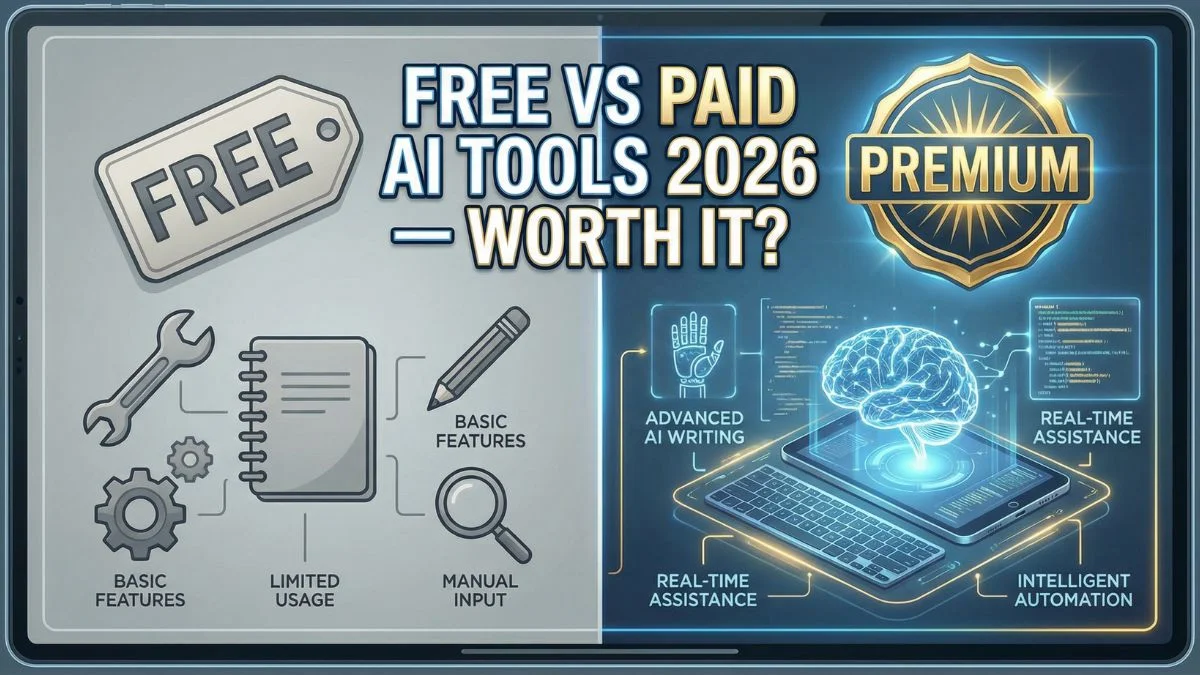
Free vs Paid AI Writing Tools: Is Upgrading Worth It

You've got a dozen free AI writing tools open in browser tabs, a half-finished blog post, and a growing suspicion that the $49/month "Pro" plan might actually change your life. Sound familiar?
In 2026, the AI writing tools market has exploded past $6.5 billion in annual revenue, with hundreds of platforms competing for your attention — and your subscription fee. The question isn't whether AI writing tools work anymore. They clearly do. The real question is: does paying for one actually get you more than the free tier offers?
This guide cuts through the marketing fluff with real comparisons, honest ROI analysis, and practical advice for freelancers, small businesses, content marketers, and enterprise teams alike.
1. The State of AI Writing Tools in 2026 {#state-of-ai-writing-tools-2026}
The AI writing landscape in 2026 looks radically different from just two years ago. In 2024, ChatGPT's free tier dominated. By mid-2026, the market has fragmented into a rich ecosystem of specialized tools — each optimized for different use cases, from long-form SEO content to technical documentation to social media copy.
Key market stats for 2026:
- The global AI content generation market is valued at $6.5 billion, projected to reach $13.8 billion by 2029 (Grand View Research, 2026)
- 78% of content marketers now use AI writing tools in some capacity (Content Marketing Institute, 2026 B2B Report)
- The average professional uses 2.4 AI tools simultaneously — mixing free and paid tiers
- 64% of freelancers report that AI writing tools have increased their output by at least 40%
- AI-assisted content now accounts for an estimated 30–35% of all published web content globally
The commoditization of AI has blurred the line between free and paid — but it hasn't erased it. Understanding exactly where that line sits is worth real money.
2. What Free AI Writing Tools Actually Offer {#what-free-ai-writing-tools-offer}
Free AI writing tools in 2026 are significantly more capable than their 2023 counterparts. The baseline has risen dramatically thanks to model improvements and competitive pressure.
What you typically get for free:
- Character or word limits per day — usually between 1,000 and 10,000 words
- Access to base language models (GPT-4o mini, Gemini Flash, or proprietary smaller models)
- Standard templates for blogs, emails, social posts, and product descriptions
- Basic tone and style controls
- Limited or no memory between sessions
- Watermarked output on some platforms
- Ads or usage tracking in exchange for free access
The hidden ceiling:
Free tiers are deliberately designed with friction. This isn't cynical — it's business. Platforms need to convert users, so they strategically limit the features that matter most to power users: output quality at scale, brand voice training, SEO integration, API access, and team collaboration.
For casual users producing under 5,000 words per week, free tools can genuinely be sufficient. The challenge starts when your content demands grow.
3. What Paid AI Writing Tools Add to the Mix {#what-paid-ai-writing-tools-add}
Premium AI writing subscriptions — typically ranging from $12/month to $125/month — unlock a meaningfully different experience.
Core upgrades in paid plans:
- Unlimited or high-volume word generation (often 100,000+ words/month)
- Access to premium models (GPT-4o, Claude Sonnet 4.6, Gemini 1.5 Pro, etc.)
- Brand voice customization — train the AI on your existing content
- SEO integration — built-in SERP analysis, keyword density suggestions, NLP optimization
- Long-form document modes — maintain context across 5,000–50,000 word documents
- Plagiarism checking included in-platform
- AI detection bypass features (increasingly standard in 2026)
- Team workspaces and collaboration with role-based permissions
- API access for workflow automation
- Priority support and faster generation speeds
The model quality difference:
This is perhaps the most significant factor most reviews underplay. In 2026, the gap between frontier models and budget models is substantial for professional writing. A premium model handles nuance, complex arguments, technical accuracy, and tonal variation in ways that smaller free-tier models simply cannot match consistently.
4. Head-to-Head Comparison: Free vs Paid {#head-to-head-comparison}
| Feature | Free Tier | Paid Tier ($20–$50/mo) | Paid Tier ($50–$125/mo) |
|---|---|---|---|
| Monthly word output | 1,000–10,000 | 50,000–Unlimited | Unlimited + API |
| Model quality | Base/Small models | Mid-tier frontier | Latest frontier models |
| SEO integration | None | Basic keyword tools | Full SERP + NLP analysis |
| Brand voice training | ❌ | Limited | ✅ Full custom |
| Long-form context | ❌ | Up to 10,000 tokens | 100,000+ tokens |
| Plagiarism checker | ❌ | ✅ | ✅ |
| AI detection score | ❌ | Sometimes | ✅ Built-in |
| Team collaboration | ❌ | 1–3 seats | 5+ seats |
| API access | ❌ | ❌ | ✅ |
| Customer support | Community/FAQ | Priority/Chat | |
| Templates | 20–50 basic | 100–200 | 500+ specialized |
| Integrations | None | Grammarly, Docs | CMS, HubSpot, Slack, etc. |
5. Top Free AI Writing Tools in 2026 {#top-free-ai-writing-tools-2026}
1. ChatGPT Free (OpenAI)
The free tier of ChatGPT still uses GPT-4o mini by default, with occasional access to GPT-4o during off-peak hours. Excellent for general writing tasks, brainstorming, and short-form content. The 40-message-per-3-hour limit on the free tier is the primary constraint for heavy users.
Best for: Brainstorming, short social copy, quick rewrites
2. Google Gemini Free
Gemini's free tier, powered by Gemini 1.5 Flash, offers solid multilingual support and Google Search integration — a key differentiator. The 1,500 requests/day limit makes it viable for moderate use.
Best for: Research-assisted writing, multilingual content, Google Workspace users
3. Claude.ai Free (Anthropic)
Anthropic's free tier offers access to Claude Sonnet-level outputs with daily usage caps. Widely praised for nuanced, human-sounding prose with low AI detection scores.
Best for: Long-form drafts, tone-sensitive writing, academic content
4. Rytr Free Plan
Rytr's free forever plan allows 10,000 characters/month with access to 40+ use cases and 30 languages. A practical choice for small business owners who need occasional social or email copy.
Best for: Small business owners, occasional social media copy
5. Copy.ai Free Tier
Copy.ai's free plan offers 2,000 words/month and one user seat. The template library is extensive even on the free tier — over 90 copywriting frameworks available.
Best for: Copywriters testing templates and frameworks
6. Top Paid AI Writing Tools in 2026 {#top-paid-ai-writing-tools-2026}
1. Jasper AI ($49–$125/month)
Jasper remains the market leader for enterprise content teams. In 2026, its Brand Voice 3.0 feature can analyze your existing content library and replicate tone with remarkable accuracy. The SEO Mode, powered by Surfer SEO integration, makes it a genuine all-in-one for content marketers.
Standout feature: Brand Voice 3.0 + Surfer SEO integration
Best for: Content marketing teams, agencies
2. Copy.ai Pro ($49/month)
The Pro plan unlocks unlimited words, team workflows, and the new GTM (Go-to-Market) AI suite — tools built specifically around sales and marketing copy pipelines. A strong choice for growth-focused startups.
Standout feature: GTM AI workflow automation
Best for: Sales teams, growth marketers
3. Writesonic Pro ($16–$99/month)
Writesonic's tiered pricing is one of the most accessible entry points for professional AI writing. The Chatsonic feature adds real-time web access, making it useful for time-sensitive content. The SEO-focused "Article Writer 6.0" consistently produces high-quality long-form drafts.
Standout feature: Real-time web access + Article Writer 6.0
Best for: Bloggers, SEO content writers, solopreneurs
4. Surfer AI ($29–$99/month)
Surfer AI is unique in that it's built SEO-first. Every article it generates is optimized around NLP scoring, semantic keyword coverage, and real-time SERP analysis. Not a general-purpose writer — but for ranking content, it's best-in-class.
Standout feature: Real-time SERP-driven content scoring
Best for: SEO specialists, affiliate marketers
5. Notion AI ($10/month add-on)
For teams already living in Notion, the AI add-on integrates seamlessly into existing workflows. It won't replace a dedicated writing tool, but for summarization, editing, meeting notes, and internal docs, it's exceptional value.
Standout feature: Native Notion workspace integration
Best for: Remote teams, project managers, ops professionals
Related reading: Explore our complete breakdown of the Best AI Tools Complete Guide with Pros & Cons and our curated Top 100 Best AI Tools list.
7. Who Should Stick with Free Tools {#who-should-stick-with-free-tools}
Free AI writing tools are genuinely the right choice for a meaningful segment of users. Don't let the marketing pressure you into an upgrade you don't need.
You should stay on free tools if:
- ✅ You produce fewer than 5,000 words of AI-assisted content per week
- ✅ Your content doesn't require consistent brand voice or tone accuracy
- ✅ You're in exploration mode — testing whether AI fits your workflow
- ✅ You're a student or hobbyist without commercial content demands
- ✅ Your primary use case is personal emails, casual blogs, or social posts
- ✅ You have strong editing skills and see AI as a starting point, not a final output
- ✅ Your budget genuinely doesn't allow for subscriptions
The free tools available in 2026 — especially Claude, Gemini, and ChatGPT's free tiers — are remarkably capable for these use cases. Don't pay for what you won't use.
8. Who Should Upgrade to Paid {#who-should-upgrade-to-paid}
The ROI math shifts decisively toward paid plans for users with professional content needs.
You should upgrade if:
- ✅ You're a freelancer billing clients for content — even one extra article per month covers most subscription costs
- ✅ You run an SEO-driven content strategy where ranking quality matters
- ✅ Your team includes multiple content creators who need shared workspaces
- ✅ You need consistent brand voice across hundreds of pieces of content
- ✅ You're in e-commerce and need high-volume product descriptions
- ✅ You produce long-form content (3,000+ words) regularly
- ✅ You need API access to integrate AI writing into custom workflows
- ✅ Your content strategy requires real-time data or web-sourced writing
- ✅ AI detection scores matter for your use case (academic, journalism, etc.)
For e-commerce specifically, see our deep dive: Best AI Tools for E-commerce Stores
9. The Real Cost of "Free" {#the-real-cost-of-free}
The most overlooked factor in the free vs paid debate is time cost. Free tools introduce friction — and friction costs money.
Where free tools quietly drain your time:
Rate limits and wait times. Hitting a daily limit mid-project forces workarounds: switching tools, waiting for resets, or splitting workflows. An experienced content marketer estimates this costs 30–60 minutes per week in disrupted flow state.
Quality editing overhead. Base-model output typically requires 30–40% more editing time than premium model output. For a writer billing $75–$150/hour, this gap pays for an entire subscription in a single week.
Context loss. Free tools with limited memory force you to re-explain your brief, brand guidelines, and tone on every new session. This is particularly punishing for complex projects.
Missing integrations. Without CMS plugins, Grammarly sync, or SEO tool integration, you're copy-pasting between tabs — a small friction that compounds into significant time loss across months.
The real math:
| Scenario | Free Tool Cost | Paid Tool ($49/mo) |
|---|---|---|
| 20 articles/month at $100 each | Free upfront | $49 subscription |
| Extra editing time (40% more) | ~6 hrs at $75/hr = $450 | ~1.5 hrs extra = $112 |
| Rate limit workarounds | ~4 hrs/month = $300 | 0 hrs |
| Total effective cost | $750 | $161 |
The "free" option isn't free. It's just invoiced in time instead of dollars.
10. ROI Calculator: Is a Paid Plan Worth It for You? {#roi-calculator}
Use this quick framework to calculate your personal ROI on a paid AI writing subscription.
Step 1: Estimate your monthly content output
- Articles, blog posts, product pages, email sequences, social content — count the pieces and assign them a rough word count.
Step 2: Calculate your time cost
- How many hours do you spend writing and editing per month?
- Multiply by your hourly rate (or opportunity cost if you're a business owner).
Step 3: Estimate AI efficiency gain
- Most paid AI tools reduce writing + editing time by 30–60% for regular users
- Conservative estimate: 30% time savings
Step 4: Run the numbers
Monthly writing hours x Hourly rate x 30% = Monthly time savings in dollars
Subtract subscription cost = Net monthly ROI
Example:
- 20 hours writing/month × $60/hr = $1,200/month in time cost
- 30% savings = $360/month in recovered time
- Minus $49 subscription = $311 net positive ROI per month
Even at conservative estimates, paid AI tools pay for themselves quickly for anyone producing content professionally.
Also explore: Best Free AI Tools to Use Daily for maximizing value while minimizing spend.
11. Expert Tips for Getting the Most Out of Any AI Writing Tool {#expert-tips}
Whether you're on a free or paid plan, these strategies dramatically improve output quality.
🏆 Tip 1: Master Prompt Engineering First
The most expensive AI tool with a poor prompt will underperform a free tool with an excellent one. Invest time in prompt crafting before upgrading. Specify: audience, tone, format, word count, and key points to cover.
🏆 Tip 2: Use a "Content Brief" System
Before any AI session — paid or free — create a structured brief:
- Target keyword and search intent
- Audience persona and knowledge level
- Key arguments or sections required
- Competitor content to differentiate from
- Brand voice notes
🏆 Tip 3: Layer Free + Paid Tools Strategically
Many power users combine free and paid tools by task:
- Research & ideation: ChatGPT free or Gemini free
- First draft generation: Paid tool with SEO features (Jasper, Writesonic)
- Editing & grammar: Grammarly free or paid
- AI detection scoring: GPTZero or Originality.ai
- SEO optimization: Surfer SEO or BrightSEOTools SEO checker
🏆 Tip 4: Train Your Brand Voice Before Scaling
If you invest in a paid tool with brand voice training, spend the first two weeks feeding it 10–20 pieces of your best existing content. This upfront investment pays dividends across every future piece.
🏆 Tip 5: Use AI for the Ugly Parts, Not the Whole Job
The highest-quality AI-assisted content in 2026 uses AI for: outlines, first drafts, section expansions, FAQ generation, and metadata — while human writers handle: narrative voice, unique data, expert quotes, and strategic positioning.
🏆 Tip 6: Monitor AI Detection Scores Regularly
With Google's Helpful Content guidelines and platform policies evolving rapidly, keeping AI detection scores in check matters for long-term SEO health. Paid tools increasingly include this natively; free users should incorporate a standalone checker.
For SEO-specific content optimization, visit our guide on Essential Content Optimization Practices Every Marketer Should Know.
12. Pros and Cons Summary {#pros-and-cons-summary}
Free AI Writing Tools
Pros:
- ✅ Zero financial commitment — ideal for testing and exploration
- ✅ Sufficient for low-volume, low-stakes content needs
- ✅ Increasingly capable baseline models in 2026
- ✅ No contract lock-in risk
- ✅ Multiple free tools can be combined strategically
Cons:
- ❌ Usage limits disrupt productive workflows
- ❌ Base models produce lower quality at professional standards
- ❌ No brand voice training or style consistency tools
- ❌ Limited or no SEO integration
- ❌ Weak long-form context handling
- ❌ No team collaboration features
- ❌ Higher hidden time cost
Paid AI Writing Tools
Pros:
- ✅ Frontier model access produces noticeably better output
- ✅ SEO integration pays for itself in ranking improvements
- ✅ Brand voice training ensures consistency at scale
- ✅ Long-form context enables complex project continuity
- ✅ Team features scale with your organization
- ✅ API access enables powerful workflow automation
- ✅ Positive ROI for professional content producers
Cons:
- ❌ Monthly cost ($12–$125) is a real commitment
- ❌ Feature overlap between tools creates subscription sprawl
- ❌ Learning curve for advanced features
- ❌ Overreliance risk — teams may deprioritize writing skills
- ❌ Pricing tiers can feel nickel-and-dime for specific features
13. Conclusion {#conclusion}
The honest answer to "is upgrading worth it in 2026?" is: it depends on one thing — what your time is worth.
For casual users, hobbyists, students, and low-volume content producers, free AI writing tools in 2026 are genuinely good. They've never been better, and the free tier of ChatGPT, Claude, or Gemini can serve real writing needs without a subscription.
But for professionals, freelancers, content marketers, and business owners who rely on content to drive traffic, leads, or revenue — the ROI math is clear. A $49/month subscription that saves 3+ hours of editing time, produces more rankable content, and enables brand consistency at scale is not an expense. It's a productivity investment with measurable returns.
The smartest play in 2026? Start by deeply optimizing your use of free tools. Learn prompt engineering, build content briefs, and combine complementary free platforms. Then, when you hit the ceiling — and you will — upgrade to one paid tool that addresses your most expensive pain point. Not all five. One.
Your content strategy should be built on data, not FOMO. Use the ROI framework in this guide, test your free tools to their limit, then decide with confidence.
🔗 Related Resources from BrightSEOTools
- Does AI Generated Content Hurt Your SEO?
- Best Free AI Tools for Freelancers
- Best AI Tools for Content Creators
- How AI Is Changing SEO
- AI Tools: 7 Game Changers for Explosive SEO in 2025
- Free Website SEO Checker
FAQs {#faqs}
1. Are free AI writing tools good enough for professional use in 2026?
Free AI writing tools can handle professional tasks at low volumes, but have significant limitations for scale. For producing under 5,000 words per week on non-brand-specific content, free tools like ChatGPT or Claude's free tier are adequate. For consistent brand voice, SEO integration, or team collaboration at scale, paid tools deliver meaningfully better results and time efficiency.
2. What is the best free AI writing tool in 2026?
Claude's free tier and ChatGPT's free tier are the strongest general-purpose free AI writing tools in 2026. Claude excels at nuanced, human-sounding prose, while ChatGPT benefits from a broader template and plugin ecosystem. For SEO-assisted writing, Google Gemini's free tier with Search integration provides a unique advantage unavailable elsewhere at no cost.
3. How much do paid AI writing tools cost per month?
Paid AI writing tools range from $10 to $125 per month in 2026. Entry-level plans (Writesonic, Rytr, Notion AI) start at $10–$20/month. Mid-tier professional tools (Copy.ai Pro, Jasper Starter) run $49/month. Full enterprise plans with team features and API access typically cost $99–$125/month per user or seat.
4. Is Jasper AI worth the price in 2026?
Jasper AI is worth the investment for content marketing teams producing 30+ pieces of content monthly. Its Brand Voice 3.0 feature and Surfer SEO integration create a genuine competitive advantage for SEO-driven content strategies. For solo writers or low-volume users, the price-to-value ratio is less compelling compared to lighter alternatives.
5. Can AI-written content rank on Google in 2026?
Yes — AI-assisted content can rank well on Google in 2026 when it demonstrates genuine helpfulness, originality, and expert insight. Google's position remains focused on content quality, not production method. The key is ensuring AI content passes the Helpful Content threshold: it should provide unique value, accurate information, and be thoroughly reviewed by subject matter experts before publishing.
6. What features should I look for in a paid AI writing tool?
The most valuable features in a paid AI writing tool are: brand voice training, SEO integration, long-form context handling, and team collaboration. Secondary priorities include plagiarism detection, AI detection scoring, template variety, and API access for workflow automation. Prioritize based on your specific bottlenecks — don't pay for features you won't use within 90 days.
7. Do paid AI tools produce less detectable AI content?
Paid AI tools using frontier models (GPT-4o, Claude Sonnet 4.6, Gemini 1.5 Pro) generally produce more natural, harder-to-detect output than free-tier base models. Additionally, many paid platforms in 2026 include built-in AI detection scoring and humanization features. However, human editing remains the most reliable method for creating content that reads authentically.
8. Is it better to use one paid AI writing tool or combine multiple free tools?
For most users, one well-chosen paid tool outperforms a stack of free tools in efficiency and output quality. The multi-tool approach introduces workflow friction, context-switching costs, and inconsistent output quality. However, a strategic combination — such as a paid writing tool paired with a free grammar checker and free SEO audit tool — offers genuine cost-efficiency without significant performance sacrifice.
9. What's the best AI writing tool for SEO content in 2026?
Surfer AI and Jasper with Surfer SEO integration are the top AI writing tools for SEO-focused content in 2026. Both platforms build NLP optimization, semantic keyword coverage, and real-time SERP analysis directly into the writing workflow. For tighter budgets, Writesonic's Article Writer 6.0 offers strong SEO-assisted output at a lower price point. Pair any of these with a tool like the BrightSEOTools website SEO checker for post-publication auditing.
10. How do I decide between free and paid AI writing tools for my business?
Calculate your monthly writing hours, multiply by your hourly rate, then apply a 30% efficiency gain estimate — if the savings exceed the subscription cost, upgrade. Beyond the math, consider: do you need brand consistency at scale? Team collaboration? SEO integration? If any of these are true, a paid tool typically pays for itself within the first month for professional content producers. Start free, optimize your workflow, then upgrade when you hit a clear ceiling.