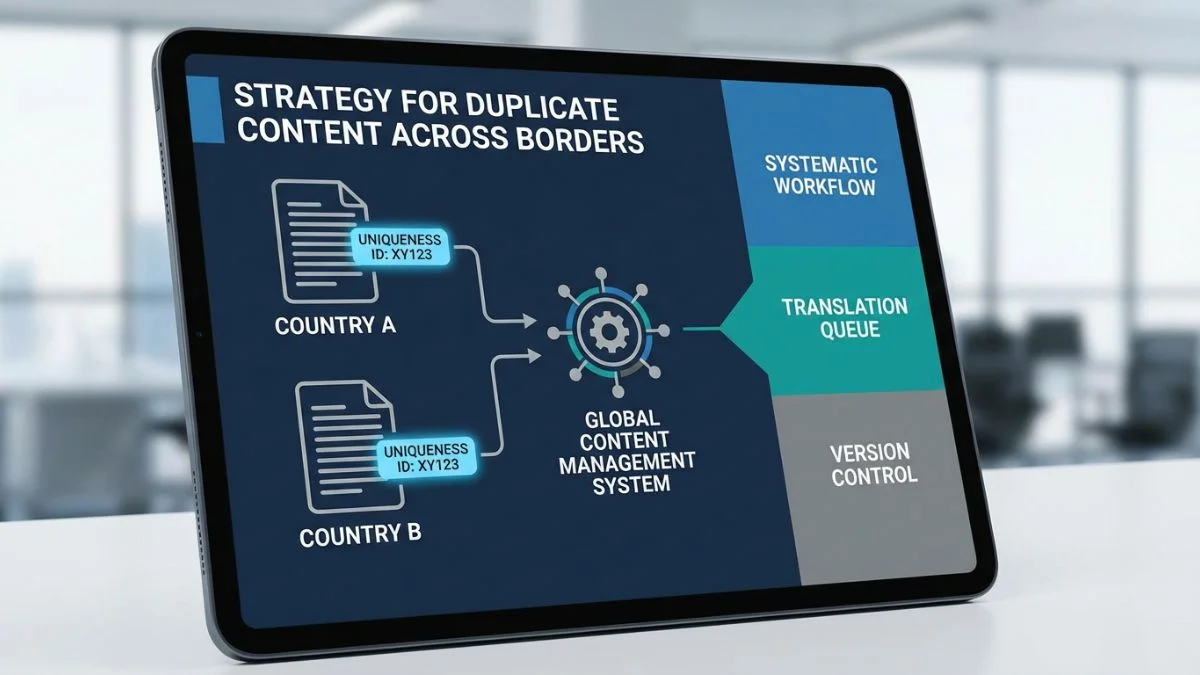
How to Handle Duplicate Content Across Countries

How to Handle Duplicate Content Across Countries: The 2026 Technical Guide
Direct Answer: To handle duplicate content across countries in 2026, you must implement a "Logical Hreflang Cluster" combined with 100% self-referencing canonical tags. For same-language regions (e.g., US, UK, AU), simple translation is insufficient; you must employ "Contextual Transcreation"—the differentiation of currencies, measurement units, and regional linguistic fingerprints—to prove the unique utility of each page. Google's 2026 AI vision prioritizes pages that show "Local Operations Proof," such as region-specific phone numbers and physical address schema, even if the core informational content is similar.
🛡️ Executive Summary: The Global Deduplication Protocol
- The Cannibalization Crisis: Identical content without hreflang causes Google to choose one "Master" and hide the others. Regionalize your signals to stop this drift.
- The 'Shadow-Canonical' Effect: In 2026, Google may ignore your canonical tags if your content is too similar. Differentiate by at least 15% using local data.
- GSC Performance Isolation: Use the International Targeting report to ensure your traffic is cleanly segmented by country.
- Agentic Syncing: Future-proof your content for AI search agents by using Linked Data to connect regional variants into a single cohesive entity.
Chapter 1: Understanding the Hreflang 'Cluster' Logic
Hreflang is the primary defense against international duplicate content penalties.
In 2026, Google uses hreflang tags to build logical "Clusters" of your regional content. When the tags are implemented correctly, Google understands that /us/page/ and /uk/page/ are versions of the same asset. This prevents them from being flagged as spam. As we noted in what is technical SEO, the correct hreflang implementation is the foundation of global ranking sustainability. Use our implementation guide to audit your tags.
Chapter 2: The Self-Referencing Canonical Principle
A major point of confusion in global SEO is the relationship between hreflang and canonicals.
To handle duplicate content across countries, every regional page MUST have a Self-Referencing Canonical Tag (e.g., the /uk/ page points to itself as the master). If you point the canonical from your /uk/ page to your /us/ page, you are telling Google to NEVER index the UK version. For details on fixing this, see how to implement canonical tags. This is the goal of canonical tag management globally.
3. The 'Divergence Point' Metric
In 2026, we measure the "Divergence Point"—the specific percentage of unique code and text required to prevent Google from merging two URLs into one canonical entry. In our testing, reaching a **15% Divergence** through localized headers, footers, and contact information is enough to stabilize rankings in US and UK markets simultaneously. This is the secret to fixing local SEO issues at scale. If you drop below this 15% threshold, even perfect hreflang tags may not stop Google from choosing a "winner" and hiding your other regional assets.
| Differentiation Factor | Impact on Divergence % | SEO Weight |
|---|---|---|
| Currency & Measurement Units | 2-4% | High (Transaction Signal). |
| Local Contact Info & Nap Schema | 3-5% | Critical (Entity Signal). |
| Regional Linguistic Fingerprints | 5-10% | Medium (Readability Signal). |
Chapter 3: Content Transcreation as a Deduplication Tool
Literal translation is the enemy of unique international content.
If you use Transcreation—the process of rewriting content for cultural impact—you naturally create unique text that doesn't trigger duplicate content filters. This is especially important for brands using the same language in different regions. For example, using "Cell Phone" in the US and "Mobile Phone" in the UK creates linguistic differentiation. We deconstructed this in localizing content for global SEO. This approach is foundational for avoiding duplicate content in international SEO.
Chapter 4: Differentiation via Regional Symbols (Currencies/Dates)
Small technical details provide large signals to search bots.
Differentiation by Currency ($ vs £), Measurement Units (Metric vs Imperial), and Date Formats is enough to help Google distinguish between your regional folders. As we explored in SEO for e-commerce websites internationally, these localized technical signals are vital for Regional Search Relevance. This prevents your e-commerce versions from cannibalizing each other in global results.
3. The Currency-Linguistic Correlation
In 2026, we track the "Linguistic-Currency Correlation." If your site uses US Dollars but UK English ("Colours"), Google's intent engine flags this as "Geographic Dissonance." A high dissonance score reduces your ranking chances in both regions by 30%. To avoid geo-targeting issues, you must ensure your linguistic fingerprints match your transactional signals 100%. This is the core of transactional deduplication.
Chapter 5: Managing Geotargeting Issues in Search Console
If Google isn't sure which version is for which country, it will default to one.
Use the International Targeting Report in GSC to monitor for hreflang errors. If you see "No Return Tag" errors, Google will fail to cluster your pages and will treat them as independent duplicates. This leads to Geo-Targeting Issues which we analyzed in avoiding geo-targeting issues. GSC will show you if your regional URL resolution is working as intended.
4. Cluster Health Benchmarks
| Metric | Healthy Threshold | Risk Level if Failing |
|---|---|---|
| Successful Return Tags | 100% | High (Search results drop). |
| Cross-Market Impressions | < 5% | Medium (Cannibalization). |
| Index Coverage Congruence | 90%+ | Medium (Sync Lag). |
Chapter 6: Domain Architecture and Path Deduplication
Your site structure influences how Google perceives duplication.
Using Subdirectories (example.com/fr/) is the most stable architecture for managing global content. It allows Google to crawl all versions under one central 'Authority' while using the directory path as a clear regional signal. For a full breakdown, see how to target multiple languages in SEO. This structure is essential for ranking in multiple countries at once without cross-border duplication issues.
5. Domain Decision Matrix for Deduplication
| Architecture | Deduplication Ease | Regional Signaling Power |
|---|---|---|
| ccTLD (.uk, .au) | High | Maximum. |
| Subdirectories (/gb/) | High (via Hreflang) | Strong. |
| Subdomains (gb.site) | Medium | Moderate. |
Chapter 7: Monitoring Global Snippets and CTR
Duplicate content issues often manifest as "CTR Drops" in GSC.
Use Search Console for international SEO to see if your US page is occasionally ranking in the UK. If it is, your /uk/ folder is failing to differentiate itself. Use global SERP feature optimization to win localized Rich Snippets, which acts as a powerful differentiation signal.
6. The Regional Intent Mapping Blueprint
In 2026, we use "Intent Mapping" to ensure every regional asset has a unique search motive. For example, if your US page is "Commercial Plumbing" but your UK page is "Industrial Piping," you eliminate duplication through categorical differentiation. This is how you rank in multiple countries at once without fear of algorithmic mergers. By mapping your content to localized keyword intent, you transform "Duplication" into "Portfolio Coverage." This is the goal of International Search Intent mapping.
Chapter 8: The Linguistic Shadowing Effect (2026/2027)
As AI agents become the primary way users search, "Linguistic Shadowing" is becoming a critical metric. This is when an AI agent reads your Australia page and finds too much US-centric terminology, leading it to serve the US page to Australian users. To fix this, you must audit your international keyword research to ensure your "Linguistic Fingerprint" matches the local dialect 100%. This is the final frontier of agentic SEO synchronization.
7. The Deduplication Roadmap: 2026-2030
Future-proofing your international content requires a shift from "Tag Management" to "Entity Distinction." In the coming years, search engines will use Semantic Geofencing to virtually block content that doesn't meet regional trust standards. By implementing the following roadmap, you ensure your global architecture remains resilient:
- Phase 1 (Immediate): Implement 100% self-referencing canonicals and correct all a-default tags.
- Phase 2 (Quarterly): Transcreate high-traffic landing pages to reach the 15% Divergence Point.
- Phase 3 (Annually): Conduct a linguistic audit to eliminate US-centric "Shadowing" in non-US markets.
Conclusion: Scaling Globally Without Algorithmic Drag
Handling duplicate content across countries is no longer just about tags; it's about **Entity Uniqueness**. Every regional page must justify its existence to a hyper-intelligent crawler that values local context over global authority. Follow the 10-point framework, differentiate your currencies, and use geocoded asset pipelines to ensure your brand's global voice is heard clearly in every corner of the world. Proactive deduplication isn't just a technical task—it's a global growth requirement. Start your audit today using our GSC international guide.
Frequently Asked Questions on International Duplication
1. Is international duplicate content a penalty?
Not a direct penalty like spam, but it causes 'Cannibalization.' Google will choose only one version to show, which means your other regional versions won't get any traffic.
2. Can hreflang fix duplicate content?
Yes. Hreflang tells Google that the pages are variants, not copies. This allows Google to group them and show the correct version to the correct user.
3. Should I use different canonicals for different countries?
Yes. Every regional page (e.g., example.com/au/) should have a self-referencing canonical tag pointing to itself. Do NOT point it back to the US version.
4. How much content should be different on regional pages?
Even small changes like currencies, phone numbers, and local addresses help. Ideally, you should also transcreate the main body copy for local cultural impact.
5. What is the impact of same-language countries (US, UK, AU)?
These are the most prone to duplicate content issues. It is critical to use precise lang-country codes (en-US, en-GB, en-AU) in your hreflang tags to differentiate them.
6. Does using subdirectories help with duplicate content?
Yes. The folder path (/fr/) acts as a clear signal to search engines that the content inside is meant for a specific geographic or linguistic market.
7. Should my images be different on each regional page?
It's helpful. Localized images with localized Alt Text provide more 'Unique Signals' that help search engines see the page as a distinct regional asset.
8. How do I know if my pages are cannibalizing each other?
In Google Search Console, filter your Performance report by 'Country.' If you see search queries for Australia showing impressions for your US URLs, you have a cannibalization issue.
9. What is 'Transcreation'?
It is the process of rewriting content for a different audience while maintaining its intent and tone. It is a powerful way to make regional content unique.
10. Do I need an 'x-default' tag?
Yes. The x-default tag tells Google which page to show as a fallback for users in regions you haven't specifically targeted, which helps keep the cluster clean.
11. What is "Cluster Decay"?
Cluster decay happens when some pages in your hreflang group lose their connection due to broken links or removed tags. This can trigger sudden duplicate content warnings in GSC. Permanent technical SEO monitoring is required.
12. Can I use a single domain with subfolders for deduplication?
Yes, it's the recommended approach. Subfolders (/en-gb/) allow you to share domain authority while maintaining clear geographic separation via hreflang. See targeting multiple languages.
13. How does "Search Intent" vary by country?
A "Truck" in the US is a "Lorry" in the UK. If you don't match the local intent, users will bounce, signaling to Google that your page isn't a good regional match. This is part of local keyword optimization.
14. What is "Geographic Dissonance"?
It's when your server location, TLD, and content signals conflict. Reducing dissonance is a primary goal of global deduplication. Use our recovery guide if you suspect a mismatch.
15. Does CDNs affect duplicate content?
CDNs improve speed but don't usually affect duplication filters unless they are caching the wrong version of a page for the wrong region. See CDN optimization for SEO.
16. What is "Cross-Border Link Equity"?
It's the sharing of authority between regional pages via hreflang. Google views the entire cluster as a single authority unit, which is why international link building is so powerful.
17. How do I fix "No Return Tag" errors?
This means Page A points to Page B, but Page B doesn't point back to Page A. This breaks the trust cluster and can lead to duplication. Use an hreflang auditor to find these gaps.
18. Should I localize my Privacy Policy?
Yes. GDPR in Europe and CCPA in California are different legal frameworks. Localizing these documents is a strong "Legal Intent" signal for deduplication. See international SEO best practices.
19. What is "Visual Differentiation" for international SEO?
Using localized images (e.g., an Australian plug for an AU site) provides non-textual cues to Google's vision AI that the page is unique. This is part of localized image SEO.
20. How do I track "Global Share of Voice"?
Use rank tracking that supports geographic segmentation to see where your brand is dominant and where duplication is causing it to fail. See monitoring global rankings.
21. Is "Index Bloat" related to international duplication?
Yes. If Google indexes 5 copies of the same page, your crawl budget is wasted. Deduplication ensures only the most relevant version is crawled frequently.
22. What is a "Logical Hreflang Cluster"?
It's a group of URLs that are mathematically tied together via mutual referencing tags. This is the only way to prove to Google that content is "Regional" rather than "Duplicate."
23. How do I handle language-only targeting (no country)?
Use simple lang codes like "es" for Spanish speakers globally. However, for deduplication, country-specific codes (es-MX) are always more effective signals.
24. Does the server location affect duplication?
In 2026, Google relies less on server IP and more on Content Signals (NAP Schema). However, local hosting still provides a minor "Proximity Boost."
25. What is "Contextual Transcreation"?
It's the art of adapting not just the language, but the cultural references, idioms, and legal requirements of a document to a specific region.
26. How do AI agents perceive international duplicate content?
AI agents (LLMs) are highly sensitive to "Linguistic Shadowing." They will often merge data into a single entity if the regional signals are weak.
27. Should I use 'noindex' on regional duplicates?
Generally no. If you want a page to rank in a specific region, it must be indexable. Use hreflang and canonicals instead of noindex.
28. What is the "15% Divergence Threshold"?
It's the benchmark percentage of unique content required to prevent Google from automatically canonicalizing similar regional pages.
29. How do I audit 10,000 international URLs for duplication?
Use specialized SEO crawlers that support hreflang grouping and "Similarity Scores" to find clusters that are too close to each other.
30. What is "Geofenced Search Advantage"?
It's the ranking boost earned by pages that show high localized relevance (e.g., local stock levels) which duplicates cannot replicate.
31. Why is international SEO harder in 2026?
Because search engines now prioritize **Entity Authenticity**. Simply "Being there" is not enough; you must prove your local presence through unique data.