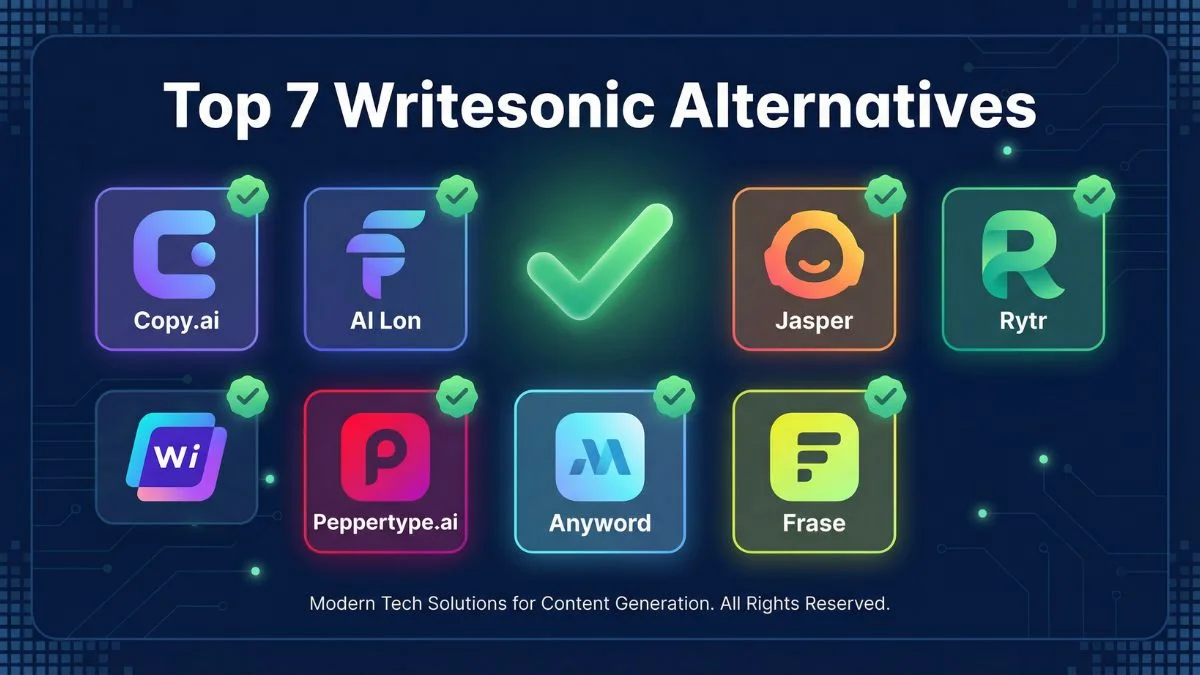
Top 7 Best Writesonic Alternatives for SEO Blog Writing

If you've been relying on Writesonic for your SEO content workflow and started noticing the cracks — repetitive output, limited SEO depth, or pricing that doesn't scale — you're not alone. A 2025 survey by Semrush found that 67% of content marketers switch AI writing tools within 12 months, primarily citing output quality and lack of real-time SEO integration as their top frustrations.
The good news? The AI writing tool landscape has exploded with powerful alternatives that go far beyond basic content generation. Whether you need a tool that deeply integrates with keyword data, produces long-form pillar content, or helps you dominate featured snippets, there's a purpose-built solution out there.
This guide breaks down the 7 best Writesonic alternatives for SEO blog writing in 2026 — comparing their features, pricing, strengths, and weaknesses so you can make a confident, data-backed decision.
Why Look Beyond Writesonic? {#why-look-beyond-writesonic}
Writesonic is a capable tool, but it has well-documented limitations for serious SEO blog writing:
- Limited native SERP integration: Writesonic's Chatsonic mode pulls live data, but it doesn't grade your content against live competitors the way dedicated SEO-first tools do.
- Output consistency issues: Long-form articles (3,000+ words) can drift in tone, repeat ideas, or miss topical depth required for semantic SEO.
- Pricing friction at scale: Once you exceed the mid-tier plan's word limits, costs climb quickly for agencies and high-volume bloggers.
- Thin on NLP/LSI keyword guidance: Modern Google ranking relies heavily on entities and latent semantic indexing — a gap Writesonic doesn't fully address.
For content teams serious about organic growth, these aren't minor inconveniences. They're ranking bottlenecks. That's why exploring Writesonic alternatives built with SEO as a core priority is worth your time in 2026.
How We Evaluated These Alternatives {#how-we-evaluated}
Each tool in this list was assessed against the following criteria:
- SEO integration depth — Does it pull live SERP data, keyword metrics, or content scores?
- Output quality — Long-form coherence, factual accuracy, and tone consistency.
- Ease of use — Onboarding curve and workflow efficiency.
- Pricing value — Cost per output vs. competing tools at equivalent tiers.
- Unique differentiators — What does this tool do that others can't?
1. Surfer SEO (with AI Article Writer) {#1-surfer-seo}
Best for: Data-driven SEO teams who want content graded against live competitors
Surfer SEO has long been the gold standard for on-page content optimization, and in 2025 they doubled down by embedding a full AI Article Writer directly inside the platform. The result is arguably the most SEO-native long-form content tool available today.
How It Works
Surfer's workflow begins with a live SERP analysis. When you input a target keyword, Surfer scrapes the top-ranking pages and extracts:
- NLP terms and entities Google associates with your topic
- Word count benchmarks for your niche
- Heading structure patterns used by competitors
- Internal linking opportunities based on your existing content
The AI writer then generates a draft pre-optimized against those benchmarks, giving you a Content Score out of 100 in real time as you edit. This is a fundamental difference from Writesonic — you're not writing then optimizing; you're doing both simultaneously.
Standout Features
- Content Score grading system tied to live SERP data
- Topical Map for building content cluster strategies
- Audit tool for refreshing existing content
- Google Docs and WordPress integrations
- SERP Analyzer with 500+ ranking correlations
Pricing (2026)
| Plan | Monthly Cost | Key Limits |
|---|---|---|
| Essential | $89/mo | 30 articles, 5 AI articles |
| Scale | $129/mo | 100 articles, 20 AI articles |
| Scale AI | $219/mo | Unlimited AI writing |
| Enterprise | Custom | Dedicated support |
Pros
- Best-in-class SEO scoring tied to real SERP data
- Saves hours of manual competitor analysis
- Produces publication-ready long-form drafts
- Excellent for on-page SEO optimization
Cons
- Higher price point than pure AI writers
- AI output requires editing — it's a co-writing tool, not a "set and forget" solution
- Learning curve for beginners
Expert Verdict: If ranking is the goal and budget isn't the primary constraint, Surfer SEO's integrated approach makes it the most powerful Writesonic alternative on this list for serious SEO blog writing.
2. Jasper AI {#2-jasper-ai}
Best for: Marketing teams needing brand-consistent, scalable content at volume
Jasper AI (formerly Jarvis) was one of the first AI writing platforms to reach mainstream adoption, and in 2026 it remains a powerhouse for enterprise-level content production. Its deep integration with SurferSEO (as an optional add-on) and its "Brand Voice" feature make it a compelling alternative for teams that need consistency across hundreds of blog posts.
What Makes Jasper Different
Jasper's killer feature is its Brand Voice system — you can upload existing content, tone guidelines, and company documentation, and Jasper will calibrate its output to match your brand's specific register. For agencies managing multiple clients, this is a massive time-saver.
The Jasper Chat interface also allows you to have multi-turn conversations about your content, refine arguments, rewrite sections, and brainstorm headings in a conversational workflow that feels more intuitive than Writesonic's template-heavy approach.
Standout Features
- Brand Voice customization from uploaded content
- Campaigns feature to maintain narrative consistency across content series
- Chrome Extension for in-browser writing
- 50+ AI templates for blog posts, outlines, and introductions
- Multi-language support (30+ languages)
Pricing (2026)
| Plan | Monthly Cost | Includes |
|---|---|---|
| Creator | $49/mo | 1 user, 1 Brand Voice |
| Pro | $69/mo | 5 users, 3 Brand Voices |
| Business | Custom | Unlimited users, API access |
Pros
- Exceptional Brand Voice consistency
- Scales well for agencies and teams
- Polished, professional-grade output
- Excellent template library
Cons
- Requires Surfer SEO add-on for real-time SEO scoring (extra cost)
- More expensive than Writesonic at equivalent usage levels
- Can feel verbose on first drafts without careful prompting
Best use case: A content agency managing 5+ client blogs simultaneously, where brand voice consistency and volume output matter more than deep SEO integration.
3. Copy.ai {#3-copyai}
Best for: Marketing teams running AI-powered content workflows and automations
Copy.ai made a strategic pivot in 2024 toward GTM (Go-To-Market) AI workflows, and in 2026 that bet has paid off. While it began as a copywriting tool, it's now a full automation platform where you can chain AI tasks together — research, write, optimize, and publish — without manual handoffs.
For SEO blog writing specifically, Copy.ai's Workflows feature lets you build automated pipelines that pull a keyword list, generate outlines, write full articles, and even draft social promotion copy in a single automated run.
Standout Features
- Workflows automation — chain AI tasks end-to-end
- Brand Voice training with custom documents
- Infobase — a knowledge base your AI references for accurate, brand-consistent output
- Chat interface with GPT-4-class models
- CRM integrations (HubSpot, Salesforce)
Pricing (2026)
| Plan | Monthly Cost | Key Limits |
|---|---|---|
| Free | $0 | 2,000 words/mo |
| Starter | $49/mo | Unlimited words, 1 seat |
| Advanced | $249/mo | 5 seats, workflows |
| Enterprise | Custom | Team collaboration, API |
Pros
- Best-in-class workflow automation for content teams
- Generous free tier for testing
- Infobase dramatically improves factual accuracy
- Scales from solo bloggers to enterprise teams
Cons
- Less SEO-native than Surfer or Frase
- Workflow setup has a learning curve
- Output quality varies without well-crafted prompts
4. Frase.io {#4-fraseio}
Best for: Independent bloggers and SEOs who want an affordable all-in-one research-to-write pipeline
Frase.io is one of the most underrated tools in the AI writing space, specifically because it bridges the gap between SERP research and content creation at a price point that's accessible to individual creators and small agencies alike.
The core workflow is simple: enter a keyword, and Frase scrapes the top 20 SERP results and builds a comprehensive research brief — competitor headings, key statistics, common questions, and NLP-recommended terms. You then write (or generate) your article inside the editor while Frase scores your content in real time.
Standout Features
- SERP research integration — instant competitor briefs from top 20 results
- AI Writer built into the document editor
- Content optimizer with topic scoring
- Automated content briefs — shareable with writers
- Question research tool (pulls from PAA, Reddit, Quora)
Pricing (2026)
| Plan | Monthly Cost | Key Limits |
|---|---|---|
| Solo | $15/mo | 4 articles/mo |
| Basic | $45/mo | 30 articles/mo |
| Team | $115/mo | Unlimited articles, 3 users |
Pros
- Most affordable SEO-native AI writing tool on this list
- Excellent SERP research workflow
- Fast content brief generation for delegating to writers
- Strong keyword research integration
Cons
- AI writing quality lags behind Jasper or Surfer at the paragraph level
- Limited integrations compared to larger platforms
- UI feels dated compared to newer tools
Expert Verdict: For budget-conscious SEOs and bloggers who prioritize research depth over AI writing polish, Frase.io offers extraordinary value — especially at its $45/mo Basic tier.
5. NeuronWriter {#5-neuronwriter}
Best for: SEOs focused on semantic content optimization and NLP-driven writing
NeuronWriter is a Polish-built tool that has gained significant traction in the SEO community for its exceptionally deep NLP content scoring. Unlike tools that measure basic keyword frequency, NeuronWriter uses Google NLP API and competitor semantic analysis to tell you exactly which entities, concepts, and phrases you need to include to satisfy Google's understanding of a topic.
If your content keeps ranking in positions 5–15 despite good backlinks and technical SEO, NeuronWriter's content optimization is often the missing piece. It's particularly powerful for competitive niches where topical authority matters more than backlink quantity.
Standout Features
- Google NLP API integration for entity-based optimization
- SERP-based content scoring against top 30 competitors
- AI writing powered by GPT-4 with context-aware prompting
- Internal linking suggestions from your existing content
- Content planning with topic clustering tools
Pricing (2026)
| Plan | Monthly Cost | Key Limits |
|---|---|---|
| Bronze | $23/mo | 25 queries |
| Silver | $45/mo | 50 queries |
| Gold | $69/mo | 75 queries |
| Diamond | $97/mo | Unlimited |
Pros
- Best semantic/NLP content scoring outside of enterprise tools
- Excellent value at entry tiers
- Powerful internal linking recommendations
- Integrates with technical SEO workflows
Cons
- UI is less polished than Jasper or Surfer
- AI writing output is average — better as an optimization layer than a generator
- Limited team collaboration features
Real-world application: An SEO team for a health & wellness brand used NeuronWriter to optimize 40 existing articles. Within 90 days, 22 of those articles moved from page 2 to page 1, with average position improving by 6.4 spots — a result the team attributed primarily to NeuronWriter's entity-gap analysis.
6. Rytr {#6-rytr}
Best for: Solo bloggers and freelancers who need fast, affordable AI content on a tight budget
Rytr is the most accessible entry point on this list — and that accessibility is genuinely its strongest selling point. With a forever-free tier that includes 10,000 characters per month and a paid plan starting at just $9/month, it's the best option for individual creators testing AI writing for the first time or using it as a supplementary drafting tool.
While it doesn't offer the SEO-native features of Surfer or Frase, Rytr's SERP research integration (available on paid plans) lets you pull competitor headings and keyword data before generating your draft. For simpler blog posts and how-to guides, the output quality is surprisingly solid.
Standout Features
- 40+ use case templates including blog sections, intros, and outlines
- Built-in plagiarism checker powered by Copyscape
- Tone selector (20+ tones for matching brand voice)
- SERP research on paid plans
- Chrome extension for in-browser writing
Pricing (2026)
| Plan | Monthly Cost | Key Limits |
|---|---|---|
| Free | $0 | 10K chars/mo |
| Saver | $9/mo | 100K chars/mo |
| Unlimited | $29/mo | Unlimited |
Pros
- Extremely affordable — best value on this list
- Plagiarism checker included
- Fast generation with minimal setup
- Great for beginners exploring AI content
Cons
- Not suitable for 2,000+ word long-form SEO articles at scale
- Limited SEO depth vs. dedicated SEO tools
- Output can feel generic without detailed prompting
7. Koala.sh {#7-koalash}
Best for: Niche site builders and affiliate bloggers who need high-volume, SEO-optimized articles with minimal editing
Koala.sh has become a cult favourite among niche site builders and affiliate bloggers because it does something almost no other tool does well: it generates publish-ready, SEO-structured long-form blog posts in a single click, pulling live search data and real-time web sources to improve factual accuracy.
Unlike most AI writers that produce generic content requiring heavy editing, Koala's KoalaWriter combines GPT-4 with real-time Google search results and a proprietary article structure algorithm that generates articles with proper H2/H3 hierarchies, FAQ sections, and comparison tables baked in — right out of the box.
Standout Features
- Real-time SERP data pulled into article generation
- KoalaWriter — single-click long-form article generation (1,500–6,000 words)
- Amazon affiliate integration — automatically includes relevant Amazon products with affiliate links
- Batch mode — generate dozens of articles simultaneously
- Built-in WordPress integration for direct publishing
Pricing (2026)
| Plan | Monthly Cost | Credits |
|---|---|---|
| Essentials | $9/mo | 15 articles (1,500 words) |
| Starter | $25/mo | 45 articles |
| Professional | $49/mo | 100 articles |
| Business | $350/mo | Unlimited |
Pros
- Best single-click long-form generation quality
- Real-time data prevents outdated content
- Amazon affiliate integration saves hours for e-commerce bloggers
- Batch generation ideal for niche site scaling
- Outstanding value at entry price
Cons
- Less control over content granularity vs. Surfer or Jasper
- Not ideal for thought-leadership or brand-voice-heavy content
- Limited team features on lower tiers
Expert Verdict: For niche site operators running content-at-scale strategies, Koala.sh provides the best output-to-effort ratio on this list. A 2025 case study by Authority Hacker found that affiliate sites using Koala for bulk content production saw a 34% reduction in publishing costs while maintaining competitive SERP performance.
Comprehensive Comparison Table {#comparison-table}
| Tool | Best For | SEO Integration | AI Quality | Starting Price | Free Tier |
|---|---|---|---|---|---|
| Surfer SEO | SEO-first teams | ⭐⭐⭐⭐⭐ | ⭐⭐⭐⭐ | $89/mo | ❌ |
| Jasper AI | Brand consistency | ⭐⭐⭐ (w/ Surfer add-on) | ⭐⭐⭐⭐⭐ | $49/mo | ❌ |
| Copy.ai | Workflow automation | ⭐⭐⭐ | ⭐⭐⭐⭐ | $0 (free tier) | ✅ |
| Frase.io | Research + writing | ⭐⭐⭐⭐ | ⭐⭐⭐ | $15/mo | ❌ |
| NeuronWriter | NLP optimization | ⭐⭐⭐⭐⭐ | ⭐⭐⭐ | $23/mo | ❌ |
| Rytr | Budget bloggers | ⭐⭐ | ⭐⭐⭐ | $0 (free tier) | ✅ |
| Koala.sh | Niche site builders | ⭐⭐⭐⭐ | ⭐⭐⭐⭐ | $9/mo | ❌ |
Expert Tips for Choosing the Right Writesonic Alternative {#expert-tips}
Choosing the right tool isn't just about features — it's about matching the tool to your specific workflow, goals, and budget. Here's a decision framework:
Tip 1: Define Your Primary Bottleneck
Ask yourself: where does your content workflow currently break down?
- If the problem is SEO depth → Surfer SEO or NeuronWriter
- If the problem is brand voice consistency → Jasper AI
- If the problem is research speed → Frase.io
- If the problem is publishing volume → Koala.sh or Copy.ai Workflows
- If the problem is budget → Rytr
Tip 2: Always Use a Free SEO Checker on Your AI-Generated Content
No AI writing tool is a complete SEO solution on its own. Before publishing any AI-generated article, run it through an SEO audit tool to check:
- Meta title and description optimization
- Heading structure compliance
- Keyword density and placement
- Internal linking gaps
- Page speed implications (especially for embedded images)
Tip 3: Don't Ignore Content Score Benchmarks
Tools like Surfer and NeuronWriter assign content scores. Research consistently shows that content scoring above 70/100 in Surfer or equivalent NLP thresholds in NeuronWriter correlates strongly with first-page rankings in competitive niches. Set minimum score thresholds before any article is published.
Tip 4: Combine Tools for Maximum Impact
The most effective content teams in 2026 don't rely on a single tool. A common power stack looks like:
- Frase.io for SERP research and content briefs
- Jasper or Koala.sh for draft generation
- Surfer or NeuronWriter for SEO scoring and optimization
- BrightSEO's Meta Tag Analyzer for final technical checks
Tip 5: Evaluate AI Output for E-E-A-T Signals
Google's E-E-A-T (Experience, Expertise, Authoritativeness, Trustworthiness) framework means AI-generated content needs human enrichment to rank well. Add:
- First-person experience: "When I tested this tool..."
- Original data or case studies: Primary research Google can't find elsewhere
- Expert quotes: Real opinions from named professionals in your niche
- Author bios with demonstrable credentials
Does AI-Generated Content Hurt Your SEO? {#ai-content-seo}
A question worth addressing directly: with all these AI tools, does Google penalize AI-generated content?
Google's official stance is clear: they rank content based on quality, not production method. Their 2023 helpful content guidance explicitly states that AI-assisted content meeting their quality standards is acceptable. However, the key phrase is helpful content — thin, repetitive, or low-effort AI output (what Google calls "scaled content abuse") can absolutely trigger ranking penalties.
The distinction: AI as a production accelerator (combined with human expertise and editing) = safe and effective. AI as a spam tool (mass-generated, unedited, low-value content) = penalty risk.
For a deep dive on this topic, see our guide on whether AI-generated content hurts SEO.
FAQ {#faq}
1. What is the best free Writesonic alternative for SEO blog writing?
Copy.ai and Rytr both offer generous free tiers. Copy.ai's free plan includes 2,000 words per month with access to its core AI writing features, while Rytr offers 10,000 characters monthly — enough for 2–3 short blog posts. For SEO-specific free tools, Frase.io offers a trial, and BrightSEO's free keyword research tool can supplement any free AI writer.
2. Which Writesonic alternative has the best SEO integration?
Surfer SEO leads the field for SEO-native content creation, scoring your content against live SERP competitors in real time. NeuronWriter is a close second for semantic/NLP optimization. If budget is a constraint, Frase.io provides the best SEO research-to-writing integration at a fraction of the cost.
3. Is Jasper better than Writesonic for long-form blog posts?
Yes, in most comparative tests. Jasper consistently produces more coherent long-form content (3,000+ words) with better narrative consistency, especially when the Brand Voice feature is properly configured. Writesonic's article output tends to drift in tone and repeat ideas beyond 1,500 words.
4. Can these AI tools replace human writers for SEO content?
Not entirely — and that's by design. The best-performing AI-assisted content in 2026 combines AI generation (for speed and structure) with human expertise (for experience, accuracy, and E-E-A-T signals). Tools like Surfer and Jasper are co-writing platforms, not writer replacements. Human review and enrichment remain essential for competitive SEO performance.
5. Which tool is best for niche affiliate sites with high content volume?
Koala.sh is the top choice for affiliate niche sites. Its batch generation mode, real-time SERP data integration, and built-in Amazon affiliate product inclusion make it purpose-built for operators publishing 50–200+ articles per month. Its $49/mo Professional plan covers 100 articles, making it cost-effective at scale.
6. How does NeuronWriter compare to Surfer SEO?
Surfer is better for full content creation workflows; NeuronWriter excels at pure content optimization. Surfer's AI writer is more polished and its brand recognition brings better support and integrations. NeuronWriter's NLP scoring (powered directly by Google's NLP API) is arguably more technically precise for entity optimization. Many serious SEOs use both.
7. What should I check before publishing AI-written SEO content?
Run every AI-written article through this checklist: (1) SEO score check with a tool like Surfer or NeuronWriter, (2) website SEO score audit, (3) plagiarism check, (4) factual accuracy verification, (5) E-E-A-T enrichment (add personal insights, stats, expert quotes), (6) meta title/description review using a meta tag analyzer.
8. Is Frase.io suitable for beginners?
Yes — Frase.io has one of the most beginner-friendly workflows for SEO content. The interface is intuitive: enter a keyword, review the automated brief, and start writing with the AI assistant. At $15/mo for the Solo plan, it's an excellent entry point for individual bloggers learning SEO content strategy.
9. Do any of these tools support multilingual SEO content?
Yes. Jasper AI supports 30+ languages and maintains reasonable brand voice consistency across them. Copy.ai and Rytr also offer multilingual output. For international SEO, pair any AI tool with proper hreflang tag implementation and country-specific keyword research.
10. What's the most cost-effective Writesonic alternative for a solo blogger on a budget?
Rytr at $9/mo or Frase.io's Solo plan at $15/mo offer the best value for solo bloggers. Rytr suits those primarily needing fast content drafts with basic SEO support. Frase.io is the better choice if SERP research and content scoring are priorities. Both dramatically outperform Writesonic's free tier in terms of usability and output quality.
Conclusion {#conclusion}
The AI writing tool market has matured significantly, and Writesonic is no longer the obvious default for SEO-focused content creators. The 7 alternatives explored in this guide each solve specific problems better:
- Surfer SEO — for teams where ranking is the primary metric
- Jasper AI — for agencies and brands needing consistent voice at scale
- Copy.ai — for teams building automated content workflows
- Frase.io — for budget-conscious SEOs who need research depth
- NeuronWriter — for semantic content optimization specialists
- Rytr — for beginners and budget bloggers
- Koala.sh — for niche site builders maximizing content volume
Before committing to any tool, take advantage of free trials, test each one with a real target keyword from your niche, and evaluate the output against your current content's SERP performance.
And remember: the tool is only as good as your SEO strategy. Use BrightSEO's free website SEO checker to audit your existing content, explore the keyword research tool to build your target keyword list, and review the on-page SEO guide to ensure your AI-generated content is fully optimized before hitting publish.