10 Best EthOS Alternatives in 2026 (Honest Comparison for Research Teams)

So you've been using EthOS for your qualitative research — or you're evaluating it — and you're wondering if there's something better out there.
Maybe it's the pricing. Maybe you need a feature EthOS doesn't offer. Or maybe you just want to know what else exists before committing.
You're in the right place.
This guide breaks down the 10 best EthOS alternatives for mobile ethnography, diary studies, and qualitative UX research in 2026. Each tool is reviewed with its real-world use case, pros and cons, pricing transparency, and who it's actually built for.
No fluff. No hype. Just the honest breakdown you need to make the right call.
What Is EthOS — and Why Look for Alternatives?
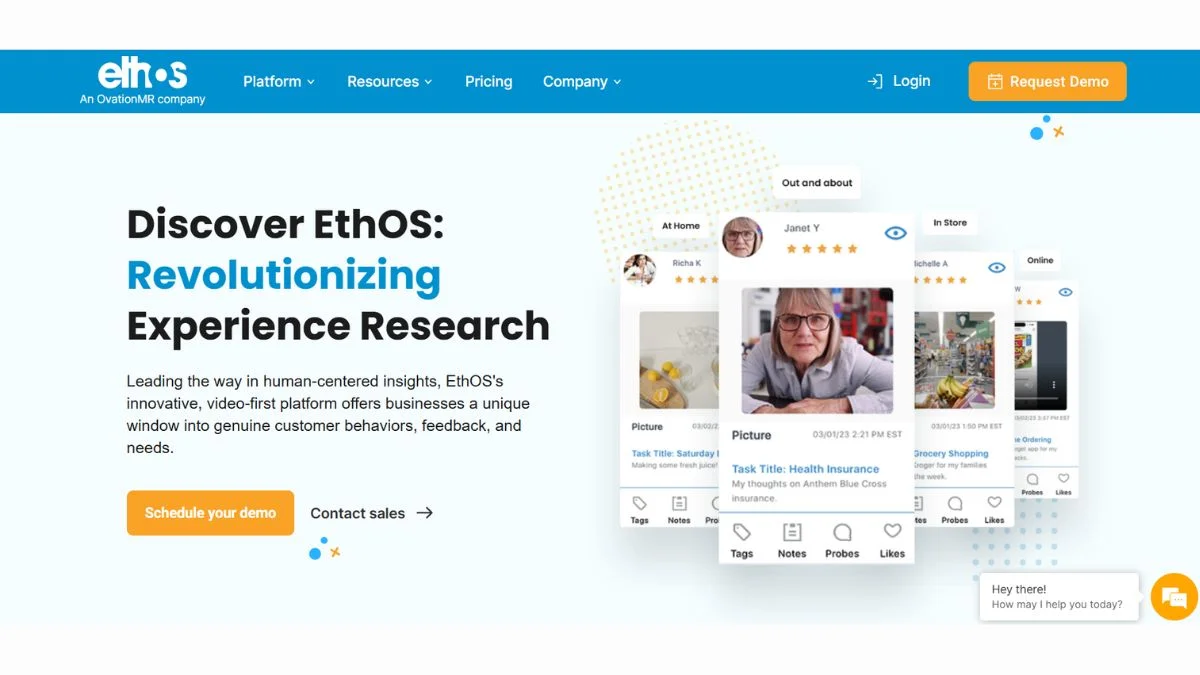
EthOS (ethosapp.com) is a qualitative research platform built for UX, CX, and market research teams. It lets you run mobile ethnography studies, digital diary studies, video surveys, usability tests, and in-depth interview analysis — all from one dashboard.
It's a solid tool. The interface feels like a familiar chat app (think WhatsApp or Messenger), which makes participant onboarding easy. It also has built-in AI analysis, automated transcription, sentiment analysis, and a panel of 3 million+ participants across 150+ countries.
So why would you look for alternatives?
A few honest reasons:
- Pricing — EthOS's enterprise pricing isn't for everyone, especially smaller agencies or early-stage teams.
- Specific methodology needs — Some tools are better for longitudinal studies, others for rapid video feedback, others for AI-moderated research at scale.
- Global reach — Certain platforms have stronger panels or better GDPR compliance for specific regions.
- Integration requirements — Your stack might need something that connects to tools EthOS doesn't support.
Let's get into the alternatives.
The 10 Best EthOS Alternatives in 2026
1. dscout — Best for In-the-Moment Mobile Research
What it is: dscout is one of the most recognized mobile research platforms in the US market. It's built around "missions" — tasks you send to participants who respond via their smartphones in real-time.
Best use case: Product research, shopping journey studies, and in-home usage tests where you need rich, video-based feedback from real environments.
Who should use it: Enterprise UX teams and consumer insights teams doing longitudinal or diary-style research in North America.
Key advantage: dscout has its own large, well-vetted participant panel. You can be up and running with real participants in hours, not days.
Pros:
- Intuitive mobile app for participants
- Strong video analysis tools
- Excellent panel quality and speed
- Built-in AI tagging and highlight reels
Cons:
- Enterprise pricing — not budget-friendly for small teams
- Less flexibility for non-video methodologies
- Primarily US-focused panel
2. Indeemo — Best for Social-Media-Style Ethnography (#2 is great for European teams)
What it is: Indeemo is a mobile qualitative research platform designed to feel like Instagram. Participants share moments, photos, and video diaries through a familiar, social media-style interface.
Best use case: Shopper journey mapping, lifestyle ethnography, customer experience research. Especially strong for European markets and GDPR-sensitive projects.
Who should use it: Mid-size agencies or in-house research teams working in the UK/EU who want high participant completion rates and real-time probing capability.
Key advantage: The social media UX dramatically increases participant engagement and response completion.
Pros:
- GDPR-compliant by design
- Real-time interaction with participants
- Supports diverse media types (video, photo, text, audio)
- Great for customer journey research
Cons:
- Less robust analysis/reporting tools than some competitors
- Not as strong outside Europe
- Learning curve for complex study setups
3. Recollective — Best for Community-Based Qualitative Research
What it is: Recollective is an enterprise qualitative research platform that merges online communities with longitudinal research. It's powered by AI and designed for researchers who need to run complex, multi-methodology studies under one roof.
Best use case: Brand tracking, community-based research, iterative concept testing over extended periods.
Who should use it: Large research agencies and enterprise insights teams who run multiple simultaneous studies and need advanced collaboration tools.
Key advantage: AI-powered analysis that works across community discussions, diary entries, and video responses — all in one place.
Pros:
- Flexible multi-methodology support
- Strong AI analysis tools
- Excellent moderation controls
- Good for longitudinal and community research
Cons:
- Overkill for simple one-off studies
- Premium pricing
- Steeper learning curve for new users
4. Forsta (formerly FocusVision) — Best All-in-One Research Suite (This one is a serious EthOS competitor)
What it is: Forsta is a comprehensive research platform that covers qualitative, quantitative, and mixed-method research. Their Digital Diaries & Communities module is the direct competitor to EthOS's ethnography tools.
Best use case: Teams that need to combine qual and quant in a single workflow — running surveys alongside ethnographies, for example.
Who should use it: Research agencies and enterprise companies that don't want to juggle multiple tools. If you need one platform to do everything, Forsta is worth a serious look.
Key advantage: The breadth of research methods available means you can handle any brief without switching platforms.
Pros:
- Covers virtually every research methodology
- Strong enterprise security and compliance
- In-the-moment diary capture via mobile
- Excellent panel access globally
Cons:
- Can feel overwhelming for focused use cases
- Pricing is enterprise-tier
- Some modules feel less polished than specialist tools
5. UserZoom (now part of UserTesting) — Best for UX-Focused Research
What it is: UserZoom is a UX research platform with robust tools for usability testing, journey mapping, and qualitative feedback. It merged with UserTesting to create one of the largest UX research ecosystems available.
Best use case: Digital product teams doing usability testing, concept validation, and behavioral research on websites and apps.
Who should use it: Product managers, UX designers, and researchers at tech companies who need fast, structured feedback on digital experiences.
Key advantage: The integration of video feedback, usability metrics, and a massive participant panel in a single platform is hard to beat for digital product research.
Pros:
- Industry-leading usability testing tools
- Huge, diverse participant panel
- Strong analytics and benchmarking
- Integrates with Figma, Jira, and Slack
Cons:
- Expensive at scale
- Not ideal for in-the-wild mobile ethnography
- Can be too digitally-focused for physical world research
6. Yazi — Best for Emerging Markets and AI-Moderated Research
What it is: Yazi is a WhatsApp-based qualitative research platform with AI moderation built in. It's particularly well-suited for reaching hard-to-engage demographics and markets where WhatsApp is the primary communication tool.
Best use case: Diary studies in emerging markets, AI-moderated depth interviews at scale, any project where participant completion rates are a primary concern.
Who should use it: Global brands and agencies doing research in Africa, Latin America, Southeast Asia, or anywhere WhatsApp penetration is high.
Key advantage: By running research through WhatsApp, Yazi dramatically reduces participant drop-off — people respond in apps they already use daily.
Pros:
- Near-zero participant learning curve (it's WhatsApp)
- AI moderation reduces researcher time
- Excellent for emerging markets
- Strong completion rates
Cons:
- Limited to WhatsApp-compatible methodologies
- Less suitable for video-heavy studies
- Reporting tools are less mature than established platforms
7. Voxpopme — Best for Video Feedback at Scale
What it is: Voxpopme is a video research platform designed to collect and analyze video responses at scale. It's known for its powerful AI analysis engine that can process hundreds of video responses quickly.
Best use case: Brand research, ad testing, concept evaluation — any scenario where you need human video responses analyzed quickly across a large sample.
Who should use it: Research teams that work with video feedback regularly and need to surface insights from large volumes of responses fast.
Key advantage: AI video analysis that auto-generates highlight reels, themes, and sentiment scoring from large video datasets.
Pros:
- Excellent at processing large volumes of video
- Fast time-to-insights
- Strong for brand and concept testing
- Good integration options
Cons:
- Video-first focus means limited support for other data types
- Less suited for longitudinal diary studies
- Enterprise pricing
8. Discuss.io — Best for Live Qualitative Research
What it is: Discuss.io is a qualitative research platform focused on live video interviews, focus groups, and longitudinal studies. It supports both moderated and unmoderated research and includes AI-powered analysis.
Best use case: In-depth interviews, online focus groups, concept testing with live moderator interaction.
Who should use it: Research teams that prefer live interaction with participants rather than asynchronous study designs.
Key advantage: The ability to run live focus groups and in-depth interviews with AI-assisted analysis in the same platform is a genuine differentiator.
Pros:
- Great for live and hybrid methodologies
- AI transcription and tagging
- Flexible study design options
- Strong for B2B and specialized audiences
Cons:
- Scheduling live sessions adds complexity
- Not the strongest for passive mobile ethnography
- Pricing scales with sessions, which can add up
9. Civicom ThoughtLight — Best for Offline and Hard-to-Reach Research
What it is: Civicom ThoughtLight is a mobile qualitative research tool that supports video, photo, audio, and text feedback — with a key differentiator: it works offline. Participants can capture responses without an internet connection.
Best use case: Research in locations with poor connectivity, in-store shopper studies, clinical research, or any study where participants may not always have data access.
Who should use it: Healthcare researchers, retail researchers, and global teams working in regions with inconsistent internet access.
Key advantage: Offline functionality combined with geo-fencing and geo-triggering makes this uniquely suited for physical world research.
Pros:
- Offline capability is a genuine differentiator
- Geo-fencing triggers responses at specific locations
- Supports diverse media input types
- Works across iOS and Android
Cons:
- Interface feels less modern than competitors
- Smaller participant panel
- Less AI-powered analysis than newer platforms
10. Contextmapp — Best for Co-Creation and Journey Mapping
What it is: Contextmapp is a mobile research and ethnography solution built specifically for customer journey mapping, co-creation projects, and mobile diaries. It's designed for researchers who want participants to be active collaborators, not just passive subjects.
Best use case: Service design projects, customer journey research, and co-creation workshops where participant collaboration is essential.
Who should use it: Service designers, UX researchers, and consultancies who use research to directly inform product or service design.
Key advantage: The co-creation focus means participants can actively map their own journeys, making the data richer and the findings more actionable.
Pros:
- Purpose-built for journey mapping
- Co-creation tools built in
- Clean, modern participant interface
- Good for longitudinal studies
Cons:
- Niche focus limits use for general research
- Smaller ecosystem than major platforms
- Less known outside Europe
Quick Comparison Table
| Tool | Best For | Pricing | Panel Included | AI Analysis | Offline Mode |
|---|---|---|---|---|---|
| EthOS | All-round mobile ethnography | Enterprise | ✅ 3M+ | ✅ | ❌ |
| dscout | US video-based studies | Enterprise | ✅ | ✅ | ❌ |
| Indeemo | European ethnography | Mid-range | ❌ | ✅ | ❌ |
| Recollective | Community research | Enterprise | ❌ | ✅ | ❌ |
| Forsta | All-in-one qual+quant | Enterprise | ✅ | ✅ | ❌ |
| UserZoom/UserTesting | UX/usability testing | Enterprise | ✅ | ✅ | ❌ |
| Yazi | Emerging markets | Mid-range | ✅ | ✅ | ❌ |
| Voxpopme | Video at scale | Enterprise | ✅ | ✅ | ❌ |
| Discuss.io | Live qual interviews | Mid-range | ✅ | ✅ | ❌ |
| Civicom ThoughtLight | Offline/physical research | Contact | ❌ | Limited | ✅ |
| Contextmapp | Journey mapping/co-creation | Mid-range | ❌ | Limited | ❌ |
How to Choose the Right EthOS Alternative
Before you pick a tool, ask yourself three honest questions:
1. What methodology are you running? Not all platforms support all methods equally. If you're running video-heavy in-the-moment research, dscout or Voxpopme are stronger. If you're doing community-based longitudinal research, Recollective is built for that.
2. Where are your participants? If you're researching in the US, dscout has the strongest native panel. For Europe, Indeemo and Recollective are well-established. For emerging markets, Yazi is in a class of its own.
3. What's your budget reality? Most of these tools sit at enterprise pricing tiers. If you're a smaller team or agency, platforms like Yazi or Indeemo tend to offer more accessible entry points. Always ask about pilot pricing — most will negotiate.
Pro Tips for Evaluating Qualitative Research Platforms
- Always run a pilot study before committing. Most platforms offer trials or demo studies. Use them to test participant experience, not just the researcher dashboard.
- Check AI quality on your data type. AI transcription and analysis quality varies enormously across platforms, especially for accented speech, technical vocabulary, or non-English languages.
- Ask about participant panel quality, not just size. A panel of 3 million low-quality profiles is worse than a curated panel of 500,000 verified participants.
- Consider the full workflow. The best platforms handle recruiting, data collection, analysis, and reporting in one place. Stitching multiple tools together adds complexity and time.
- GDPR and data residency matter more than ever. If you're running research in the EU, confirm where data is stored and processed before signing any contract.
Internal Resources Worth Reading
If you're researching this topic further, these articles from BrightSEOTools may be useful:
- Best AI Tools for Complete Guide with Pros & Cons
- Top 10 Free AI Tools for Beginners in 2025
- Best AI Tools for Productivity
- Top 100 Best AI Tools
- Free AI Tools That Replace Expensive Software
- Best Free AI Tools to Use Daily
- Best AI Tools for Students
- 25 Best AI Tools for Every Profession
- Best AI Tools for Content Creators
- Free AI Tools for Small Businesses
- Best AI Coding Assistants
- AI Summarizer Review
- What Are AI Agents? The Complete Beginners Guide
- How AI Agents Are Becoming Your Digital Coworkers
- Best AI Agent Platforms You Need to Know About Right Now
- ChatGPT vs Claude vs Gemini: Which AI Wins
- Free AI Productivity Tools for Teams
- Free AI Customer Service Tools
- 13 Free AI Tools for Content Creators
- 9 Best Free AI Data Analysis Tools
- 13 Best Free AI Tools for Freelancers
- 11 Free AI Client Management Tools
- Essential Content Optimization Practices Every Marketer Should Know
- How AI Is Changing SEO
- Best Free Grammar Checkers
- Free AI Marketing Tools for Startups That Actually Deliver Results
- 11 Free AI Fun Tools Social Media
- Free AI Tools Every Freelancer Needs
- 13 Free AI Tools to Automate Work
- 5 Free AI Brainstorming Tools
- 9 Free AI Idea Generators Projects
- 7 Free AI Document Readers Chat with File
- 13 Free AI Tools to Summarize PDFs
- 9 Free AI Meeting Notes Generators
- 11 Free AI Feedback Collection Tools
- 9 Free AI Quiz Survey Makers
- 7 Best Free AI Survey Generators 2026
- Google Forms Ultimate Guide
- SurveyMonkey Review
- Typeform Review
Frequently Asked Questions
What is EthOS used for?
EthOS is a mobile ethnography and qualitative research platform used by UX, CX, and market research teams to run diary studies, video surveys, usability tests, and in-depth interview analysis.
It's particularly useful when you need rich, in-the-moment insights from participants in their natural environments — not in a lab or focus group room. The platform supports data collection via video, photo, screen recording, and live chat, with built-in AI to help analyze results efficiently.
What is the best EthOS alternative for small teams?
For smaller teams, Yazi and Indeemo tend to offer more accessible pricing and simpler onboarding than enterprise-heavy platforms like Forsta or dscout.
Yazi is especially compelling for teams on a budget who need high completion rates — the WhatsApp-native approach removes friction for participants. Indeemo is a good mid-tier option with strong support for diary and journey research.
Is dscout better than EthOS?
It depends on your use case. dscout is generally stronger for US-based video ethnography studies with access to its own vetted participant panel. EthOS has broader methodology support and a larger global panel.
If your research is video-heavy and US-focused, dscout has an edge. If you need more methodology flexibility or global reach, EthOS or Forsta may serve you better. Both are enterprise tools — expect comparable pricing.
Can I run qualitative research on a budget?
Yes, though most dedicated mobile ethnography platforms sit at enterprise pricing. For budget-conscious teams, options like Yazi (WhatsApp-based) or basic diary study setups within platforms like Discuss.io can reduce cost significantly.
Another approach is to use general-purpose tools like Google Forms or SurveyMonkey for simpler feedback collection, though these don't support the rich media and in-the-moment capture that dedicated ethnography platforms offer.
What is mobile ethnography?
Mobile ethnography is a research method where participants use their smartphones to capture photos, videos, and diary entries in their real-world environments, giving researchers contextual insights that can't be replicated in a lab.
Unlike traditional focus groups, mobile ethnography captures behavior as it actually happens — in homes, stores, workplaces, or wherever the experience being studied occurs. Platforms like EthOS, dscout, and Indeemo are purpose-built to facilitate this methodology at scale.
Which EthOS alternative is best for GDPR compliance?
Indeemo is specifically built with GDPR compliance in mind, making it a strong choice for European research teams. Recollective and Forsta also offer strong data governance features for enterprise clients.
Always verify where participant data is stored and processed before signing a contract. EU-based research requires data residency in Europe under GDPR — not all platforms guarantee this by default.
The Bottom Line
EthOS is a capable platform and genuinely one of the better tools in the qualitative research space. But it's not the only game in town.
Here's a quick decision guide:
- Need the best US video panel? → dscout
- Running research in Europe or GDPR-sensitive markets? → Indeemo
- Need qual + quant in one platform? → Forsta
- Focused on digital UX and usability? → UserZoom/UserTesting
- Working in emerging markets? → Yazi
- Need offline capability? → Civicom ThoughtLight
- Running community-based longitudinal research? → Recollective
The right tool depends entirely on your methodology, geography, and budget — not on which name appears most in a Google search.
Take your time, run a pilot, and make the call based on real data.
If you found this guide useful, explore more tool comparisons and AI research on BrightSEOTools — particularly the resources on AI tools for every profession and free AI tools for small businesses.