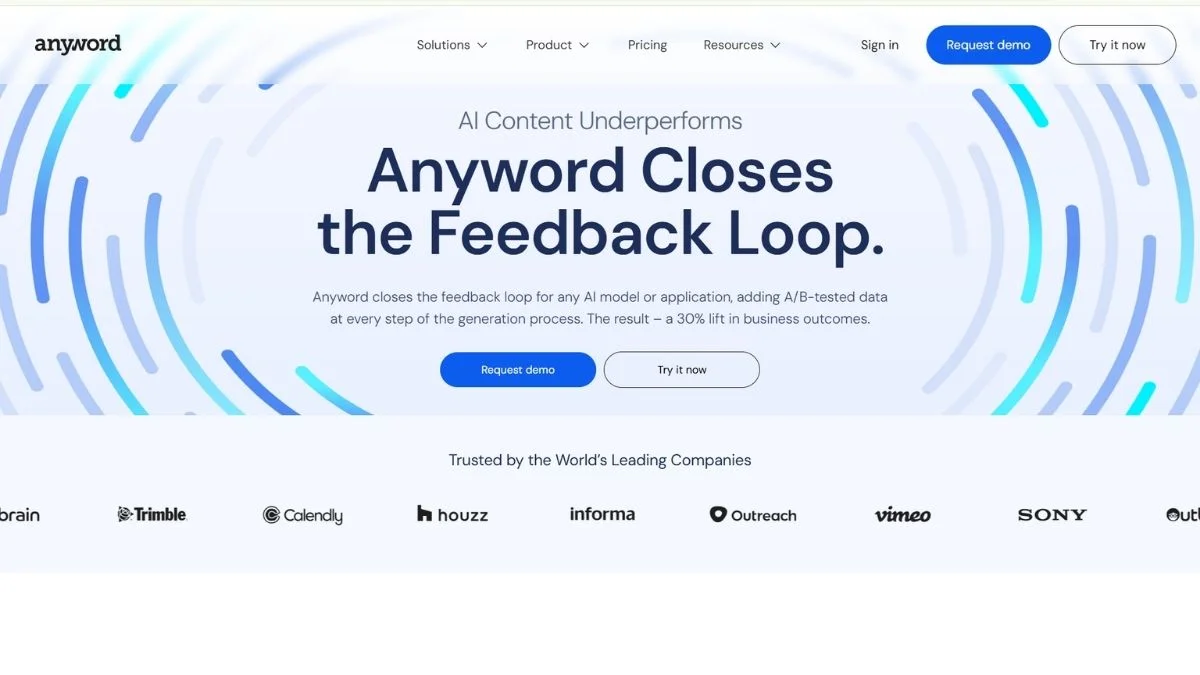
10 Best Anyword Alternatives in 2026 (Honest Comparison)

Anyword is a solid AI copywriting tool — no doubt about it. Its predictive performance scores and brand-voice features are genuinely useful. But it's also priced at a level that makes a lot of solo creators and small teams pause before subscribing.
Maybe you've hit the word limit. Maybe the interface isn't clicking for you. Or maybe you just want to explore what else is out there before committing.
Good news: the AI writing tool space has exploded in the last two years, and there are some seriously capable Anyword alternatives that might serve you better — at a lower cost, with more flexibility, or with features Anyword simply doesn't offer.
This guide breaks down 10 of the best Anyword alternatives for 2026, with honest pros and cons, real-world use cases, and a comparison table so you can make the right call without wasting money on trials.
What Makes a Good Anyword Alternative?
Before we dive in, let's be clear about what we're actually comparing. Anyword is primarily known for:
- Predictive performance scoring (estimating how well copy will convert)
- Brand voice training
- Marketing copy — ads, emails, landing pages
- Data-driven content optimization
So a good alternative needs to match at least some of these strengths — or offer something genuinely better in the areas you care about most.
Ask yourself: Are you replacing Anyword because of price, features, output quality, or all three? Your answer will determine which tool on this list is right for you.
10 Best Anyword Alternatives in 2026
1. Jasper AI — Best for Marketing Teams With Big Budgets
What it is: Jasper is one of the most well-known AI writing platforms on the market, built specifically for marketers, content teams, and agencies.
Best use case: Long-form content, ad copy, email campaigns, and brand voice consistency across large teams.
Who should use it: Marketing teams at mid-size to enterprise companies who need consistent output at scale and can justify the cost.
Key advantage: Jasper's Brand Voice feature lets you train the AI on your existing content so every piece sounds like you — not like a robot guessing your tone.
Pros:
- Excellent long-form content quality
- Strong templates library (50+ use cases)
- Native SEO integrations (Surfer SEO)
- Team collaboration features
- Solid brand voice training
Cons:
- Expensive — starts at $39/month
- Can still produce generic output without good prompts
- No native predictive performance scoring like Anyword
Practical insight: If you're a content manager juggling multiple campaigns and brands, Jasper's workflow features genuinely save time. But if you're a solo blogger or freelancer, the price-to-value ratio may not work in your favor.
👉 Learn more: Jasper.ai
2. Copy.ai — Best Free Anyword Alternative for Beginners
What it is: Copy.ai started as a simple copywriting tool and has evolved into a full AI content platform with workflows and automation features.
Best use case: Short-form copy — social posts, product descriptions, email subject lines, ad headlines.
Who should use it: Freelancers, small business owners, and beginners who want a capable free tier without a steep learning curve.
Key advantage: Copy.ai's free plan is genuinely usable — you get access to core templates and a decent monthly word allowance without needing a credit card.
Pros:
- Strong free tier
- Simple, clean interface
- Good template variety
- Workflow automation (for paid plans)
- Supports 25+ languages
Cons:
- Long-form quality can be inconsistent
- No predictive scoring
- Paid plans jump quickly in price
Practical insight: Copy.ai is where a lot of people start their AI writing journey, and for good reason. It's low-commitment and beginner-friendly. Just don't expect Jasper-level depth on the free plan.
👉 For a deeper look, check out our guide on best copy AI alternatives for generating sales copy.
3. Writesonic — Best for SEO-Focused Content (#3 Is a Sleeper Hit)
What it is: Writesonic is an AI writing platform with a heavy focus on SEO content, blog posts, and landing pages — powered by GPT-4 and its own fine-tuned models.
Best use case: Blog writing, SEO articles, product descriptions, and AI-powered website copy.
Who should use it: Bloggers, content marketers, and SEO professionals who need volume without sacrificing quality.
Key advantage: Writesonic's Chatsonic feature integrates real-time web search into its AI, which means it can write about current events — something most AI tools struggle with.
Pros:
- Real-time web access via Chatsonic
- Excellent blog post output quality
- Affordable pricing for individuals
- Built-in article rewriter and paraphraser
- Supports 25+ languages
Cons:
- Interface can feel cluttered
- Output occasionally needs heavy editing
- Brand voice features less refined than Anyword or Jasper
Practical insight: If your main job is producing SEO blog content at scale, Writesonic delivers strong value for money. The Chatsonic integration is especially useful when you need articles about recent events or trending topics.
👉 See also: top best Writesonic alternatives for SEO blog writing
4. QuillBot — Best for Rewriting and Paraphrasing
What it is: QuillBot is less of a content generator and more of a content improver — it excels at paraphrasing, summarizing, and rewriting existing text.
Best use case: Academic writing, rewriting drafts, improving clarity, and reducing plagiarism risk in content.
Who should use it: Students, academics, researchers, and writers who have rough drafts they need to polish quickly.
Key advantage: QuillBot's paraphrasing modes (Standard, Fluency, Formal, Creative, etc.) give you fine-grained control over how your rewritten content sounds.
Pros:
- Best-in-class paraphrasing
- Free plan covers most basic needs
- Grammar checker and summarizer built in
- Chrome extension available
- Easy to use — no learning curve
Cons:
- Not a content generator (can't write from scratch)
- Long documents can be slow to process
- Advanced modes locked behind paywall
Practical insight: QuillBot won't replace Anyword for writing ad copy from scratch. But if your workflow involves rewriting or polishing existing content, it fills that gap better than almost any other tool.
👉 Full breakdown: QuillBot Review & Complete Guide
5. Grammarly — Best for Polishing and Brand Consistency
What it is: Grammarly is the world's most widely used writing assistant — originally focused on grammar and spelling, now expanded into AI writing suggestions and tone adjustments.
Best use case: Editing, proofreading, tone adjustment, and improving written communication across any platform.
Who should use it: Anyone who writes professionally — marketers, executives, support teams, and content creators who need clean, professional output.
Key advantage: Grammarly's browser extension works everywhere — Gmail, Google Docs, LinkedIn, Slack — making it the most versatile editing tool on this list.
Pros:
- Works across virtually every platform
- Tone detection and suggestions
- Real-time grammar, clarity, and engagement feedback
- Free plan is genuinely useful
- Trusted by 30 million+ users
Cons:
- Not a copywriting tool — it edits, doesn't generate
- AI writing features (GrammarlyGO) are basic compared to Jasper or Writesonic
- Premium plan is pricier than comparable tools
Practical insight: Grammarly and Anyword serve different purposes. Grammarly is best used alongside a generator, not as a replacement. But if you're mainly using Anyword to polish copy rather than generate it, Grammarly might actually be all you need.
👉 See: Grammarly Review & Beginners Guide | Grammarly Alternatives
6. HIX.AI — Best All-in-One Anyword Alternative
What it is: HIX.AI is a newer but rapidly growing all-in-one AI writing suite that covers article writing, email drafting, SEO optimization, paraphrasing, and even grammar checking in a single platform.
Best use case: Creators and marketers who want one tool that does everything without needing to switch between Jasper, QuillBot, and Grammarly separately.
Who should use it: Agencies, content studios, and ambitious solo creators who want maximum output with minimum tool-switching.
Key advantage: HIX.AI bundles 120+ writing tools into one interface — including a long-form writer, browser extension, email writer, and SEO checker — at a price that undercuts most competitors.
Pros:
- Enormous feature set in one tool
- Strong long-form article quality
- Browser extension included
- Built-in SEO optimization suggestions
- Competitive pricing
Cons:
- Interface can feel overwhelming at first
- Newer platform — still ironing out bugs
- Brand voice training less mature than Anyword
Practical insight: If you've ever felt like you needed four different tools to cover all your writing needs, HIX.AI is worth a serious look. It's not perfect, but the feature density is impressive for the price.
👉 Related: best HIX AI alternatives for all-in-one AI writing
7. Wordtune — Best for Rewriting With Context (#7 Surprises Most People)
What it is: Wordtune is an AI writing companion focused on sentence-level rewriting — helping you say the same thing in a different, better, or more appropriate way.
Best use case: Email writing, professional communication, blog editing, and anyone who knows what they want to say but struggles with how to say it.
Who should use it: Non-native English speakers, business professionals, and writers who want to improve clarity without handing everything off to AI.
Key advantage: Wordtune keeps you in the driver's seat. Unlike tools that generate full articles, it offers smart rewrite suggestions you can accept, reject, or mix and match.
Pros:
- Highly intuitive rewriting experience
- Great for non-native English speakers
- Context-aware suggestions
- Chrome extension available
- Solid free tier
Cons:
- Not a content generator
- Limited template library
- Doesn't scale well for high-volume content production
Practical insight: Wordtune is genuinely underrated. If your writing process involves drafting your own ideas and then refining them, Wordtune makes that refinement loop dramatically faster.
👉 Compare: top best Wordtune alternatives for sentence rewriting
8. Notion AI — Best for Integrated Workflow Writing
What it is: Notion AI is the AI assistant built directly into Notion's popular productivity and note-taking platform.
Best use case: Teams already using Notion for project management who want AI writing assistance without switching apps.
Who should use it: Product teams, startup founders, and knowledge workers who live in Notion and want AI writing without disrupting their existing workflow.
Key advantage: Notion AI is embedded directly in your workspace — meaning you can draft, edit, summarize, and brainstorm without ever leaving the tool where your work already lives.
Pros:
- Seamlessly integrated into Notion
- Great for summarizing long documents
- Affordable add-on pricing
- Good at generating structured content (meeting notes, project briefs)
- No context-switching required
Cons:
- Only useful if you're already a Notion user
- Not built for high-volume marketing copy
- No predictive performance scoring
Practical insight: Notion AI isn't trying to be Anyword. It's trying to make your existing Notion workflow smarter. If you're on a content team that runs on Notion, it's a genuinely valuable addition.
👉 See: Notion AI vs ChatGPT – Which One Should You Actually Use
9. ChatGPT (Plus) — Most Flexible Anyword Alternative
What it is: ChatGPT is OpenAI's conversational AI model — the most widely used AI tool in the world, capable of writing, analysis, coding, research, and much more.
Best use case: Versatile writing tasks — ad copy, blog posts, email sequences, brainstorming, outlining, and anything that benefits from back-and-forth conversation.
Who should use it: Almost everyone. ChatGPT Plus ($20/month) offers GPT-4o, which delivers genuinely impressive writing quality across virtually every format.
Key advantage: The conversational interface means you can iterate, refine, and redirect the AI in real time — like having a writing partner who never gets tired.
Pros:
- Extremely versatile
- GPT-4o output quality is excellent
- Custom GPTs allow brand-voice training
- Affordable Plus plan at $20/month
- Massive community of prompt templates
Cons:
- No built-in performance scoring (unlike Anyword)
- Requires good prompt skills to get great output
- No specialized marketing templates
- Can hallucinate facts — always verify
Practical insight: For raw writing capability per dollar, ChatGPT Plus is almost unbeatable. Its weakness is that it lacks the structured marketing focus of Anyword — but if you're comfortable writing good prompts, that gap narrows considerably.
👉 See also: ChatGPT vs Claude vs Gemini – Which AI Wins | ChatGPT Alternatives
10. Semrush Writing Assistant — Best for SEO-Optimized Copy
What it is: Semrush's Writing Assistant is an AI-powered tool that evaluates your content against top-ranking competitors and gives you real-time SEO recommendations as you write.
Best use case: Writing and optimizing blog posts and landing pages that need to rank on Google — not just read well.
Who should use it: SEO professionals, content strategists, and digital marketers who care as much about search rankings as writing quality.
Key advantage: Real-time SEO scoring and competitor analysis while you write — which is the closest thing you'll find to Anyword's predictive performance scoring, but for organic search instead of paid ads.
Pros:
- Real-time SEO optimization
- Competitor benchmarking
- Tone of voice checker
- Plagiarism detection
- Integrates with Google Docs and WordPress
Cons:
- Requires a Semrush subscription
- More of an editor than a generator
- Focused on SEO content, not ad copy or emails
Practical insight: If you're switching from Anyword because you care more about organic traffic than conversion rate optimization, Semrush Writing Assistant is your best bet. It plugs the SEO gap that most pure copywriting tools ignore.
Quick Comparison Table
| Tool | Best For | Free Plan | Starting Price | Predictive Scoring | Long-Form |
|---|---|---|---|---|---|
| Anyword | Ad copy + performance scoring | ✅ Limited | $39/month | ✅ Yes | ✅ Yes |
| Jasper AI | Marketing teams | ❌ | $39/month | ❌ | ✅ Yes |
| Copy.ai | Beginners + short copy | ✅ | $36/month | ❌ | 🔶 Limited |
| Writesonic | SEO blogging | ✅ | $16/month | ❌ | ✅ Yes |
| QuillBot | Paraphrasing | ✅ | $4.17/month | ❌ | ❌ |
| Grammarly | Editing + polish | ✅ | $12/month | ❌ | ❌ |
| HIX.AI | All-in-one | ✅ | $19.99/month | ❌ | ✅ Yes |
| Wordtune | Rewriting | ✅ | $6.99/month | ❌ | ❌ |
| Notion AI | Workflow writing | ❌ | $8/month add-on | ❌ | 🔶 Limited |
| ChatGPT Plus | Versatile tasks | ✅ | $20/month | ❌ | ✅ Yes |
| Semrush WA | SEO content | ❌ | Included in Semrush | ✅ (SEO) | ✅ Yes |
How to Choose the Right Anyword Alternative
Still not sure which tool fits? Use this quick decision guide:
If you want the closest match to Anyword's predictive scoring: → Try Semrush Writing Assistant for organic content, or stick with a testing mindset using ChatGPT Plus with manual A/B testing.
If price is your main concern: → Copy.ai (free), QuillBot (free), or Writesonic ($16/month) offer serious value at lower price points.
If you need all-in-one functionality: → HIX.AI covers the widest feature range under one subscription.
If you're part of a larger marketing team: → Jasper AI has the best collaboration and brand-voice features for team environments.
If you care most about SEO rankings: → Writesonic or Semrush Writing Assistant are your strongest options.
Pro Tips: Getting the Most From Any AI Writing Tool
Switching tools is only half the battle. Here's what actually makes the difference:
1. Train it on your brand voice first. Most tools (Jasper, HIX.AI, even ChatGPT with Custom GPTs) let you feed in examples of your existing content. Do this before generating anything. The output quality improvement is dramatic.
2. Use frameworks, not blank prompts. Instead of "write a product description," try "write a product description using the AIDA framework for [product], targeting [audience], with a [tone] tone." Specific prompts produce specific results.
3. Always edit before publishing. No AI tool — not even Anyword — should be a set-and-forget solution. The best AI content is human-reviewed content. Use AI to produce the first 80%, then add your expertise and voice for the final 20%.
4. Test multiple outputs. Most tools let you generate multiple variations. Run them. The best option is rarely the first one produced.
5. Use AI tools for the hard parts — outlines, first drafts, and variations. AI excels at breaking writer's block and generating options. It struggles with deep expertise and nuanced takes. Play to its strengths.
Related Resources Worth Reading
If you're exploring AI writing and content tools more broadly, these guides from our blog will help:
- Best AI Tools Complete Guide with Pros & Cons
- Best Free AI Writing Tools No Word Limit
- Free AI Copywriting Tools for Marketing
- Jasper AI vs Copy.ai vs Writesonic – Best AI Copywriter
- Free vs Paid AI Writing Tools – Is Upgrading Worth It?
- Best AI Tools for Content Creators
- Best Free AI Tools to Use Daily
- Top 10 Best AI Tools You Must Try
- Free AI Content Generators for Bloggers
- Best AI Tools for Productivity
- 25 Best AI Tools for Every Profession
- Best Free ChatGPT Alternatives
- Free AI Assistants Better Than ChatGPT
- Does AI-Generated Content Hurt Your SEO?
- How AI Is Changing SEO
- Best Jasper AI Alternatives for Marketing Copy
- Top Free Jasper AI Alternatives for Small Businesses
- HIX AI vs Writesonic vs Copy.ai – Best All-in-One AI Writer
- QuillBot vs Wordtune vs Grammarly – Best AI Paraphrasing Tool
- Grammarly vs ProWritingAid vs Hemingway
- ChatGPT vs Jasper AI – Which Gives Better Marketing Copy?
- AI Tools – 7 Game Changers for Explosive SEO in 2025
- Free AI Marketing Tools for Startups
- Free AI Productivity Tools for Teams
- Best Free AI Tools for Small Business
- Free AI Tools for Entrepreneurs
- Free AI Tools Every Freelancer Needs
- Best Free Grammar Checkers
- SEO Tools – 10 Powerful Free Tools That Actually Work
- Free SEO Checker Online
Frequently Asked Questions
What is the best free alternative to Anyword?
Copy.ai and QuillBot are the top free Anyword alternatives. Copy.ai offers a genuinely capable free plan for short-form copy like ads and emails, while QuillBot excels at rewriting and paraphrasing existing content. For teams on a strict budget, both tools provide significant value without any upfront cost — though you'll hit limitations on volume and advanced features without upgrading.
Is Jasper AI better than Anyword?
Jasper is better for long-form content and team collaboration; Anyword wins on predictive performance scoring. Jasper produces higher-quality blog posts and has superior brand voice training tools. However, Anyword's ability to score copy by predicted conversion rate is a unique feature Jasper doesn't replicate. If your main use case is ad copy testing, Anyword has the edge. For content marketing at scale, Jasper is the stronger choice.
Can ChatGPT replace Anyword?
ChatGPT Plus can replace most of Anyword's writing functions, but not its predictive scoring. With good prompting, ChatGPT GPT-4o produces excellent marketing copy, emails, and landing page content. What it can't do is score your copy against predicted click-through or conversion rates. If you're willing to manually A/B test your output, ChatGPT is a cost-effective replacement. If you rely on Anyword's scoring data, ChatGPT alone won't fully substitute.
Which Anyword alternative is best for SEO content?
Writesonic and Semrush Writing Assistant are the best Anyword alternatives for SEO-focused content. Writesonic produces solid long-form blog content with real-time web access, making it great for topical authority building. Semrush Writing Assistant goes a step further by benchmarking your content against top-ranking competitors in real time. For serious SEO work, combining both tools is a strong strategy.
What's the cheapest Anyword alternative that still works well?
Writesonic at $16/month offers the best balance of price and quality. Its long-form writer, Chatsonic (real-time web access), and article rewriter make it a capable all-around tool at roughly half the cost of Anyword. For purely free options, Copy.ai's free tier covers basic copywriting needs without requiring a subscription.
Is Anyword worth it compared to these alternatives?
Anyword is worth it specifically if you rely on performance scoring for paid ad copy. Its ability to predict how well a piece of copy will perform before you run it is a genuinely differentiated feature — and for performance marketers running Google or Facebook ads, that data can pay for itself. For general content creation, SEO blogging, or email writing, most of the alternatives in this list match or exceed Anyword's output quality at a lower price.
Final Verdict
Anyword is a good tool — but it's not the only good tool, and it's definitely not the right tool for everyone.
Here's the quick summary:
- Best overall alternative: Jasper AI (teams) or Writesonic (individuals)
- Best free alternative: Copy.ai or QuillBot
- Best for SEO content: Semrush Writing Assistant
- Best all-in-one: HIX.AI
- Most flexible: ChatGPT Plus
- Best for editing and polish: Grammarly
- Best for rewriting: Wordtune or QuillBot
The honest truth? Most content creators will be well-served by ChatGPT Plus + Grammarly as a base stack, then adding a specialized tool (Writesonic for SEO, Jasper for brand work) as their needs grow.
Don't let tool paralysis stop you from creating. Pick one, learn it properly, and build your workflow around it.