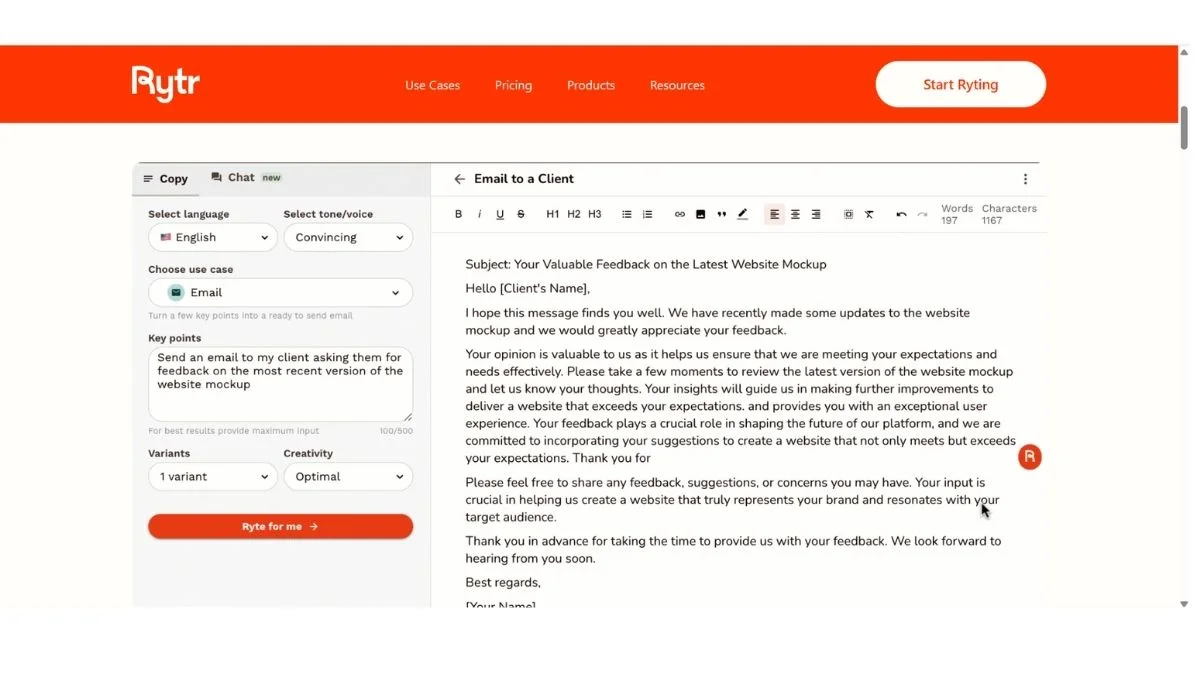
10 Best Rytr Alternatives in 2026 (Free & Paid)

Let's be honest — Rytr is a solid AI writing tool, but it's not for everyone.
Maybe you've hit the character limit one too many times. Maybe the output feels a bit generic. Or maybe you just want something with better SEO features, longer-form support, or a free plan that doesn't feel like a demo.
Whatever the reason, you're in the right place.
This guide breaks down the 10 best Rytr alternatives in 2026 — with honest pros and cons, who each tool is built for, and a clear recommendation at the end. No fluff, no filler.
Let's get into it.
Why Look for a Rytr Alternative?
Rytr works well for short-form content, quick social posts, and basic copywriting. But users often hit a wall when they need:
- Long-form blog posts (Rytr's output can feel choppy)
- Better SEO optimization built into the workflow
- More tone and style control
- Integrations with tools like WordPress, Surfer SEO, or Google Docs
- Higher word output without paying a premium
If any of those sound familiar, keep reading.
Quick Comparison Table
| Tool | Best For | Free Plan | Starting Price | Long-Form? |
|---|---|---|---|---|
| Jasper AI | Marketing teams | ❌ | ~$39/mo | ✅ |
| Copy.ai | Sales copy | ✅ | Free / $36/mo | ✅ |
| Writesonic | SEO blog writing | ✅ | Free / $16/mo | ✅ |
| Notion AI | Knowledge workers | ✅ (add-on) | $10/mo add-on | ✅ |
| QuillBot | Paraphrasing & editing | ✅ | $9.95/mo | ❌ |
| Wordtune | Sentence rewriting | ✅ | $13.99/mo | ❌ |
| Sudowrite | Fiction writers | ❌ | $22/mo | ✅ |
| Hypotenuse AI | E-commerce content | ❌ | $29/mo | ✅ |
| Simplified | Social media teams | ✅ | Free / $18/mo | ✅ |
| Anyword | Data-driven copy | ❌ | $39/mo | ✅ |
The 10 Best Rytr Alternatives in 2026
1. Jasper AI — Best for Marketing Teams and Brand Voice
What it is: Jasper (formerly Jarvis) is one of the most established AI writing platforms out there. It's designed for marketing teams that need consistent, on-brand content at scale.
Best use case: Long-form blog posts, ad copy, email campaigns, and brand voice consistency across a large team.
Key advantage: Jasper's "Brand Voice" feature lets you feed it your existing content and it learns to write in your style. That's huge for agencies or in-house teams.
Pros:
- Excellent long-form document editor
- Deep integration with Surfer SEO for on-page optimization
- Supports 30+ languages
- Strong template library (50+ frameworks)
- Team collaboration features
Cons:
- No free plan — trial only
- Can get expensive at scale
- Steeper learning curve than Rytr
Who should use it: Marketing managers, content agencies, and growing brands that need consistent AI output across multiple writers.
💡 Pro Tip: Jasper works best when you give it a detailed brief. The more context you feed it, the less editing you'll do afterward.
2. Copy.ai — Best Free Rytr Alternative for Sales Copy
What it is: Copy.ai started as a short-form copywriting tool and has since expanded into a full content workflow platform. It has one of the most generous free plans of any Rytr alternative.
Best use case: Sales emails, product descriptions, social captions, cold outreach, and marketing copy.
Key advantage: The free plan gives you access to over 90 templates with unlimited projects — something Rytr's free tier simply can't match.
Pros:
- Generous free plan (unlimited words on free tier)
- 90+ templates covering almost every content format
- Workflow automations (great for agencies)
- Clean, fast UI
Cons:
- Long-form blog posts can feel generic without heavy editing
- Not ideal for technical content
- Lacks built-in SEO scoring
Who should use it: Freelancers, startup founders, and solopreneurs who need solid copy without paying monthly.
Looking for more options in this space? Check out our best Copy.ai alternatives for generating sales copy.
3. Writesonic — Best for SEO Blog Writing
What it is: Writesonic is built with SEO writers in mind. It goes beyond basic AI generation by integrating directly with tools like Surfer SEO and offering an Article Writer that handles structure, headings, and keyword placement.
Best use case: Long-form SEO blog posts, landing pages, and product descriptions optimized for search.
Key advantage: Writesonic's Article Writer 6.0 can produce a full, structured blog post — including intro, sections, and conclusion — in one go. The quality is noticeably higher than Rytr's for long-form.
Pros:
- Built-in Surfer SEO integration
- Article Writer generates full posts in minutes
- Strong factual accuracy (pulls from the web in real-time)
- Affordable starter plans
- ChatSonic feature for AI chat with web browsing
Cons:
- Credit-based system can run out fast on lower plans
- Occasional factual errors on niche topics
- UI can feel overwhelming at first
Who should use it: SEO writers, bloggers, and content marketers who publish regularly and need Google-ready content.
For a deeper comparison, see our top Writesonic alternatives for SEO blog writing.
4. Notion AI — Best for Knowledge Workers and Note-Takers ⭐ This one surprises most people
What it is: Notion AI is an add-on built directly into Notion's workspace. If you already use Notion for notes, wikis, or project management, adding AI to that workflow is a game-changer.
Best use case: Drafting docs, summarizing meeting notes, rewriting sections, brainstorming inside your existing workspace.
Key advantage: It lives inside your workflow. No switching tabs, no copy-pasting. You write, highlight, and ask AI to improve it — all in the same place.
Pros:
- Seamlessly embedded in Notion
- Great for summarizing, rewriting, and drafting
- Affordable as an add-on ($10/mo)
- Works across all device types
- Perfect for teams already on Notion
Cons:
- Not a standalone tool — requires Notion
- Not designed for high-volume content production
- Limited template library compared to Jasper or Writesonic
Who should use it: Product managers, founders, students, researchers, and remote teams that live inside Notion.
Curious how it stacks up? Read our full Notion AI vs ChatGPT comparison to see which fits your workflow better.
5. QuillBot — Best for Paraphrasing and Editing
What it is: QuillBot isn't a content generator in the same way Rytr is — it's a paraphrasing and editing powerhouse. If you have existing content and want to make it better, cleaner, or more unique, QuillBot is hard to beat.
Best use case: Rewriting existing drafts, academic paraphrasing, grammar checking, and summarizing long documents.
Key advantage: QuillBot's paraphrasing modes (Standard, Fluency, Formal, Creative, etc.) give you real control over how your text is rewritten — something most AI writers don't offer.
Pros:
- Best-in-class paraphrasing with multiple modes
- Built-in grammar checker and summarizer
- Browser extension for writing anywhere
- Generous free plan
- Works great for academic writing
Cons:
- Not a content generator — doesn't write from scratch
- Free plan limits word count
- Less useful for bulk content creation
Who should use it: Students, academics, ESL writers, and anyone who edits more than they create from scratch.
See how it compares in our QuillBot vs Wordtune vs Grammarly breakdown.
6. Wordtune — Best for Sentence-Level Rewriting
What it is: Wordtune focuses on one thing and does it extremely well: making your sentences better. Think of it as an AI editor that sits on your shoulder while you write.
Best use case: Improving clarity, fixing awkward phrasing, adjusting tone, and polishing drafts in real time.
Key advantage: Wordtune's "Rewrite" suggestions appear inline as you type. You can see multiple versions of a sentence and pick the best one — without leaving your document.
Pros:
- Real-time inline suggestions
- Tone adjustment (casual, formal, etc.)
- Integrates with Google Docs and MS Word
- Free plan available
- Very intuitive UI
Cons:
- Not ideal for generating content from scratch
- Limited to sentence/paragraph-level edits
- Can feel repetitive on shorter text
Who should use it: Writers, bloggers, and business professionals who write their own content but want AI to help polish it.
7. Sudowrite — Best for Fiction Writers (#7 is a must-see for novelists)
What it is: Sudowrite is the AI writing tool built specifically for creative and fiction writers. While Rytr tries to cover everything, Sudowrite doubles down on storytelling.
Best use case: Novel writing, short stories, character development, plot brainstorming, and overcoming writer's block.
Key advantage: Features like "Story Engine," "Describe" (sensory detail generator), and "Brainstorm" are designed for narrative writing — not marketing copy. Nothing else in this list comes close for fiction.
Pros:
- Story Engine guides you through complete novel drafts
- Generates vivid descriptions and dialogue
- Beat sheets and plot outline tools
- Ideal for genre fiction (fantasy, romance, thriller)
- Active community and regular updates
Cons:
- Expensive relative to its niche
- No free plan
- Not useful for business or marketing content
Who should use it: Novelists, short story writers, screenwriters, and anyone pursuing creative writing projects.
Want more options for creative writing? See our top Sudowrite alternatives for fiction and novel writing.
8. Hypotenuse AI — Best for E-commerce Content
What it is: Hypotenuse AI is purpose-built for e-commerce businesses that need to generate product descriptions, category pages, and ad copy at scale — often from just a product name or SKU.
Best use case: Bulk product description generation, Amazon listings, Shopify copy, and category page content.
Key advantage: It can generate hundreds of unique product descriptions in one batch — something that would take a human team days to complete manually.
Pros:
- Bulk generation from spreadsheet/CSV uploads
- Amazon and Shopify optimized templates
- Maintains brand consistency across large catalogs
- Content passes most AI detectors
- HypoDoc for blog-length content
Cons:
- Not suited for non-e-commerce use cases
- No free plan
- Pricier than generalist tools
Who should use it: E-commerce store owners, Shopify merchants, Amazon sellers, and digital agencies managing product catalogs.
For more on this, check our guide on the best AI tools for e-commerce stores.
9. Simplified — Best for Social Media Teams
What it is: Simplified combines AI writing, graphic design, video editing, and social media scheduling into one platform. It's like Canva and Rytr had a very productive baby.
Best use case: Social media content creation, short-form captions, ad creatives, and team collaboration on content calendars.
Key advantage: You can write copy AND design the visual for a social post in the same tool. That kind of workflow efficiency is genuinely rare.
Pros:
- All-in-one: writing + design + scheduling
- Very generous free plan
- 50+ AI writing templates
- Team collaboration built in
- Great for Instagram, LinkedIn, Twitter/X content
Cons:
- Jack of all trades, master of none — writing quality lags behind dedicated tools
- Can feel cluttered with so many features
- Advanced features locked behind paid plans
Who should use it: Social media managers, content creators, small marketing teams, and freelancers managing multiple client accounts.
10. Anyword — Best for Data-Driven Copywriters
What it is: Anyword is the only AI writing tool on this list that predicts how well your copy will perform before you publish it. Every piece of content gets a "Predictive Performance Score" based on your target audience.
Best use case: Ad copy, landing pages, email subject lines, and any content where conversion rate matters.
Key advantage: The performance score isn't generic — it adjusts based on your industry, target demographic, and platform. A score for a Facebook ad targeting women 25-34 will differ from one targeting men 45-54. That's powerful.
Pros:
- Predictive performance scoring per audience segment
- Data-driven copy optimization
- Strong for paid ads (Facebook, Google, LinkedIn)
- Blog post wizard included
- Integrates with major ad platforms
Cons:
- No free plan
- Takes time to fully understand the scoring system
- Overkill for casual writers or bloggers
Who should use it: Performance marketers, paid media specialists, CRO professionals, and brands running regular ad campaigns.
Expert Tips: Getting the Most From Any AI Writing Tool
Before you pick a tool, here's what actually matters in practice:
1. Always write a detailed brief. The quality of AI output is directly proportional to the quality of your input. Vague prompts = vague content.
2. Use AI for the first draft, not the final. Every piece of AI-generated content needs a human edit before publishing — for accuracy, tone, and E-E-A-T compliance.
3. Don't trust AI for facts and statistics. Always verify numbers, quotes, and claims. AI models hallucinate, and a wrong stat in a published post can damage your credibility fast.
4. Test before committing. Almost all tools listed here have free trials. Use them. What works for one writer won't work for another.
5. Layer tools. Many pros use Writesonic for first drafts, Wordtune for polishing, and Grammarly for final checks. Mixing tools often yields better results than relying on one.
Which Rytr Alternative Should You Choose?
Still not sure? Here's the quick-decision breakdown:
- I need the best free option → Copy.ai
- I write SEO blog posts → Writesonic
- I'm a fiction writer → Sudowrite
- I run ads and care about conversions → Anyword
- I run an e-commerce store → Hypotenuse AI
- I already use Notion → Notion AI
- I want to improve existing content → QuillBot or Wordtune
- I manage social media → Simplified
- I lead a marketing team → Jasper AI
Want to explore more? Check out our full guide on the best AI writing tools with pros and cons and top free Jasper AI alternatives for small businesses.
Additional Resources from BrightSEOTools
If you're building your content stack, these guides will help:
- Best AI tools for content creators
- Free AI content generators for bloggers
- Best free AI writing tools with no word limit
- Jasper AI vs Copy.ai vs Writesonic — who wins?
- Free vs paid AI writing tools — is upgrading worth it?
- Best free grammar checkers
- Top 10 free AI tools for beginners in 2025
- Best AI tools for productivity
- 25 best AI tools for every profession
- Top 100 best AI tools
- Best free AI tools to use daily
- AI summarizer review
- Free AI tools every freelancer needs
- Free AI copywriting tools for marketing
- ChatGPT vs Jasper AI — which gives better marketing copy?
- Best HIX AI alternatives for all-in-one AI writing
- HIX AI vs Writesonic vs Copy.ai
- Top Wordtune alternatives for sentence rewriting
- Best Jenni AI alternatives for academic writing
- Free AI article writers — full length guide
- Free AI essay writers — no plagiarism
- Free AI productivity tools for teams
- Free AI marketing tools for startups
- Free AI tools for entrepreneurs
- Best free ChatGPT alternatives
- Free AI assistants better than ChatGPT
- How AI is changing SEO
- Does AI-generated content hurt your SEO?
- Essential content optimization practices every marketer should know
FAQ: Rytr Alternatives
What is the best free alternative to Rytr?
Copy.ai offers the strongest free plan among all Rytr alternatives, with unlimited words and 90+ templates. It doesn't cap your output the way Rytr's free tier does. For basic marketing copy, blog intros, and social captions, the free tier is genuinely enough for most individual users. Simplified is also worth considering if you need social media visuals alongside your writing.
Is Writesonic better than Rytr for SEO content?
Yes — Writesonic is significantly better than Rytr for SEO-focused content. Its Article Writer 6.0 produces structured, long-form posts with headers and keyword integration built in. The native Surfer SEO integration is a major differentiator for anyone serious about ranking on Google. Rytr doesn't have a comparable SEO workflow.
Which Rytr alternative is best for long-form blog posts?
Jasper AI and Writesonic are the top choices for long-form blog writing. Jasper excels at maintaining brand voice and tone across long content, while Writesonic is faster and more SEO-native. If budget is a concern, Writesonic's lower-tier plans make it accessible without sacrificing quality. Notion AI is also solid if you're already in that ecosystem.
Can AI writing tools fully replace human writers?
No — not reliably, especially for content that needs to rank on Google. AI tools are excellent at drafting, ideating, and structuring content, but they lack genuine expertise, personal experience, and the nuanced judgment that separates average content from content that actually ranks. Google's E-E-A-T guidelines specifically reward first-hand experience and expertise — things AI can't authentically provide. Use AI to accelerate your workflow, not replace your thinking.
Is Rytr good for beginners?
Rytr is decent for beginners due to its simple UI and low price point, but its output quality and feature depth are limited. Tools like Copy.ai or Simplified offer similarly beginner-friendly interfaces with more generous free plans and better content quality. If you're just starting out, test a few free options before committing.
What's the difference between Rytr and Jasper AI?
The main differences are output quality, feature depth, and price. Jasper produces noticeably higher-quality long-form content, offers brand voice training, and integrates with SEO tools like Surfer. Rytr is cheaper and simpler, making it a decent choice for basic short-form copy. For serious content marketing, Jasper is the step up most growing teams need.
Final Thoughts
Rytr is a fine starting point — but it's not the finish line.
If you've been using it and feel like something's missing, it's not you. The market has moved fast, and the alternatives in this list have caught up and, in many cases, lapped it.
Pick the tool that matches your actual workflow:
- SEO writing → Writesonic
- Marketing copy → Jasper AI or Anyword
- Budget-conscious → Copy.ai (free)
- Fiction → Sudowrite
- E-commerce → Hypotenuse AI
- Polish and editing → QuillBot
Still exploring your options? Browse our ultimate list of best AI tools for beginners or check top 10 AI tools you must try to keep building your AI toolkit.
The right tool won't just save you time — it'll make your content genuinely better.