10 Best SEO.ai Alternatives in 2026 (Free & Paid Options Compared)

Let's be honest — SEO.ai is a solid tool, but it's not for everyone.
Maybe the pricing feels steep for what you're getting. Maybe you hit a feature ceiling. Or maybe you just want to see what else is out there before committing. Whatever the reason, you're in the right place.
In this guide, I've tested and ranked the best SEO.ai alternatives you can use in 2026 — covering everything from AI writing assistants to full-blown SEO content suites. I'll show you what each tool does best, who it's for, and where it falls short, so you can pick the one that actually fits your workflow.
No fluff. No hype. Just real comparisons.
What Is SEO.ai and Why Look for Alternatives?
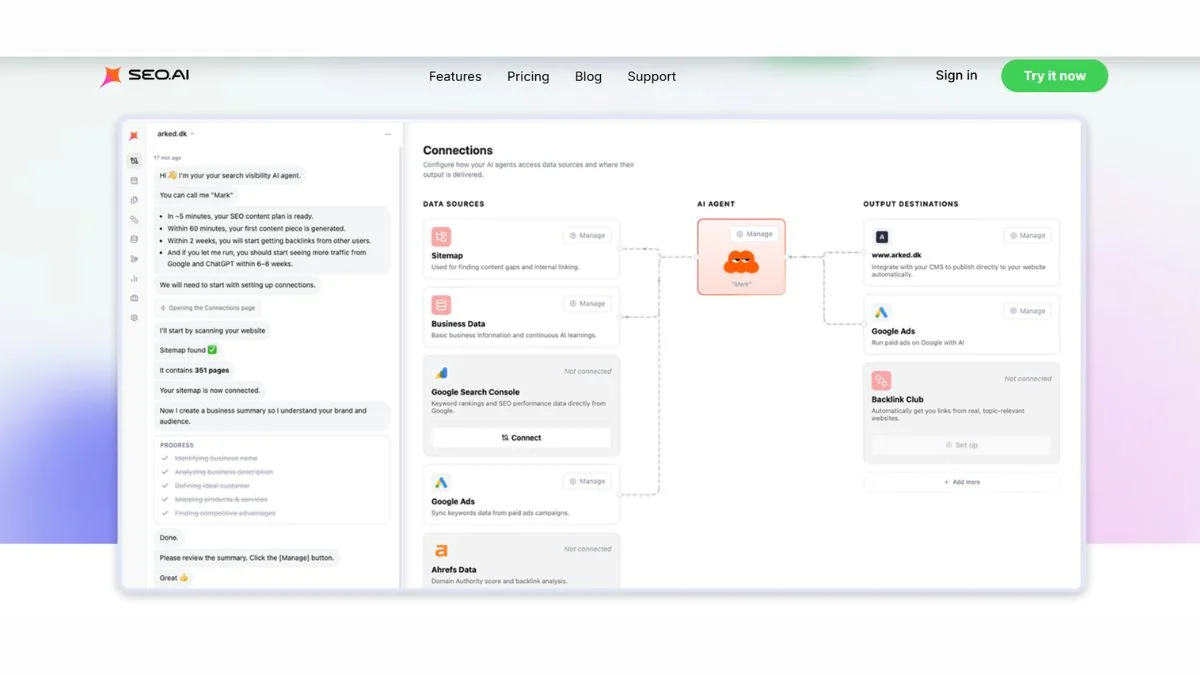
SEO.ai is an AI-powered content tool designed to help you write SEO-optimized articles faster. It uses real-time SERP data to guide your writing and suggest headings, keywords, and structure.
It's useful — but it has some real limitations:
- Pricing is on the higher end for solo creators and small teams
- Output quality can feel formulaic without heavy editing
- Limited integrations compared to more established platforms
- No free tier worth mentioning for regular use
If any of those pain points sound familiar, keep reading. There are some genuinely great alternatives available right now.
Quick Comparison Table
| Tool | Best For | Free Plan | Starting Price | AI Writing | SERP Analysis |
|---|---|---|---|---|---|
| Surfer SEO | On-page optimization | ❌ | ~$89/mo | ✅ | ✅ |
| Frase | Research + briefs | Limited | $45/mo | ✅ | ✅ |
| NeuronWriter | Budget-conscious SEOs | ❌ | ~$23/mo | ✅ | ✅ |
| Jasper AI | Long-form content | ❌ | $49/mo | ✅ | ❌ |
| Writesonic | Marketing copy | ✅ | $20/mo | ✅ | ❌ |
| Semrush Writing | Enterprise SEO | ❌ | $129/mo (Semrush) | ✅ | ✅ |
| RankIQ | Bloggers/niche sites | ❌ | $49/mo | ✅ | ✅ |
| MarketMuse | Topic authority | Limited | $149/mo | ✅ | ✅ |
| Scalenut | Full content workflow | ✅ | $39/mo | ✅ | ✅ |
| Outranking | SERP-focused writing | ❌ | $79/mo | ✅ | ✅ |
The 10 Best SEO.ai Alternatives
1. Surfer SEO — Best for On-Page Optimization
If you've spent any time in the SEO world, you've heard of Surfer SEO. And there's a reason it keeps coming up — it's one of the most data-driven content optimization tools available.
What it is: Surfer analyzes the top-ranking pages for your target keyword and gives you a content score, recommended word counts, heading structures, and NLP-based keyword suggestions — all in real time as you write.
Best use case: Optimizing existing content or creating new articles you want to rank for competitive keywords.
Pros:
- Content editor is genuinely excellent — clean, fast, actionable
- SERP Analyzer gives deep competitive insight
- Integrates with Google Docs and WordPress
- Topical Map feature helps plan content clusters
Cons:
- No meaningful free plan
- Can be expensive if you need multiple team seats
- AI Humanizer and some features cost extra
Who should use it: Content teams, SEO agencies, and bloggers targeting competitive keywords who need reliable data to back their content decisions.
Key advantage: The real-time content score as you write keeps you on track without constant back-and-forth with a separate analysis tool.
If you want to go deeper on how on-page optimization tools compare, check out our on-page SEO techniques that actually work guide.
2. Frase — Best for Research and Content Briefs
#2 deserves a closer look if you spend too much time on research before writing.
Frase cuts your research time dramatically by pulling together everything you need — competitor summaries, common questions, outline suggestions — before you type a single word.
What it is: Frase is an AI content tool that combines research, briefing, and writing into one streamlined workflow. It scrapes the top SERP results and summarizes them, so you know exactly what topics to cover.
Best use case: Creating detailed content briefs for writers, or doing your own pre-writing research in minutes instead of hours.
Pros:
- Excellent SERP research and summarization
- Question research pulls from Reddit, Quora, and Google's "People Also Ask"
- Affordable starting price for solo users
- Built-in AI writer handles first drafts well
Cons:
- AI writing quality requires editing — it's a starting point, not a finisher
- Limited integrations outside of Google Search Console
- Free plan is very restricted
Who should use it: Content managers, freelance writers, and in-house SEO teams who want to produce well-researched, comprehensive articles without the manual digging.
Key advantage: The research workflow is genuinely faster than any tool I've tested. You go from "blank page" to "structured outline with context" in about 10 minutes.
Want to understand how research ties into your broader SEO checklist? Our SEO checklist for beginners walks through every step.
3. NeuronWriter — Best Budget SEO Writing Tool
Here's the one that surprises most people: NeuronWriter gives you 80% of what Surfer SEO does at about a quarter of the price.
What it is: NeuronWriter is a content optimization platform that uses NLP and SERP data to help you write SEO-friendly content. It's popular among indie bloggers and small agencies who need results without the enterprise price tag.
Best use case: SEO writers and bloggers who want optimization guidance without paying $90+/month.
Pros:
- Very competitive pricing (often available via AppSumo lifetime deals)
- NLP-powered content scoring is accurate and helpful
- Supports multiple languages
- Includes internal linking suggestions
Cons:
- Interface isn't as polished as Surfer or Frase
- AI writing quality is average — better used for optimization than drafting
- Fewer integrations than major competitors
Who should use it: Budget-conscious bloggers, niche site builders, and freelance SEOs who want solid optimization features without breaking the bank.
Key advantage: The lifetime deal availability makes it one of the best value purchases in the SEO tools space right now.
4. Jasper AI — Best for Long-Form Content Creation
This one is a favorite among content marketers — and for good reason.
Jasper (formerly Jarvis) is one of the most capable AI writing tools available. It's not exclusively focused on SEO like SEO.ai, but it produces high-quality, readable content that you can then optimize manually or through an add-on like Surfer.
What it is: Jasper is an enterprise-grade AI writer with dozens of templates for blogs, emails, ads, social media, and more. The "Boss Mode" allows long-form content creation with excellent contextual awareness.
Best use case: High-volume content production where writing quality matters — especially for brands and marketing teams.
Pros:
- Output quality is consistently among the best AI tools available
- Large template library covers almost every content format
- Brand Voice feature keeps tone consistent across content
- Surfer SEO integration available
Cons:
- No built-in SEO analysis — you'll need a separate tool for that
- Pricing adds up quickly at scale
- Can generate factual errors — fact-checking is essential
Who should use it: Marketing teams, content agencies, and brands that publish frequently and need reliable, quality AI writing at scale.
Key advantage: The brand voice consistency is unmatched. Once trained, Jasper sounds like your brand, not a generic AI.
Our guide on best AI tools for content creators goes into more depth on Jasper vs. other writing-focused tools.
5. Writesonic — Best Freemium SEO Content Tool
If you're not ready to commit to a paid plan, Writesonic is the most generous free option on this list.
What it is: Writesonic is an AI content platform with a free tier that actually lets you produce meaningful content. It covers blog posts, product descriptions, ads, and landing pages — with an SEO mode that adds keyword guidance.
Best use case: Small businesses, solopreneurs, and beginner content marketers who want to try AI writing without upfront cost.
Pros:
- Generous free plan with monthly word credits
- Covers a wide range of content formats
- Chatsonic (ChatGPT-like feature) supports web browsing for current information
- Simple, beginner-friendly interface
Cons:
- SEO optimization features are basic compared to dedicated tools
- Output quality varies significantly by template
- Free tier limitations become frustrating quickly at scale
Who should use it: Beginners, freelancers testing the waters, and small teams producing occasional content who don't need deep SEO optimization.
Key advantage: You can produce real, usable content on the free plan — which is rare in this space.
For more free options, our best free AI writing tools with no word limit covers alternatives you can use without paying anything.
6. Semrush Content Marketing Toolkit — Best for Enterprise SEO Teams
Semrush is already the gold standard for SEO research. What fewer people know is that their Content Marketing Toolkit turns it into a full content production suite.
What it is: Built into the Semrush platform, the Content Marketing Toolkit includes an SEO Writing Assistant, Topic Research, Content Audit, and Brand Monitoring — all connected to Semrush's massive keyword and backlink database.
Best use case: Enterprise marketing teams or agencies already using Semrush who want their content workflow integrated with their SEO data.
Pros:
- Deep integration with Semrush's SERP and keyword data
- Content audit helps identify and fix underperforming pages
- Topic Research surfaces content gaps and trending angles
- Google Docs and WordPress integration via SEO Writing Assistant
Cons:
- Requires a Semrush subscription (expensive baseline)
- Not ideal if you only need content tools — too much overhead
- Content toolkit features feel secondary to Semrush's core product
Who should use it: Marketing teams already invested in the Semrush ecosystem who want content creation to flow naturally from their SEO research.
Key advantage: No data silos. Your keyword research, content creation, and performance tracking all live in one place.
You can explore how Semrush compares to other big names in our Semrush vs. Ahrefs deep dive.
7. RankIQ — Best for Bloggers and Niche Site Owners
If you run a blog or niche content site, this one might be the most practical pick on the list.
RankIQ was built specifically for bloggers. It identifies low-competition keywords your blog can realistically rank for, then guides your writing to match what Google wants to see.
What it is: RankIQ combines keyword research with content optimization, analyzing what top-ranked posts include and helping you write content that competes — without requiring a deep SEO background.
Best use case: Bloggers targeting informational keywords who want clear, actionable writing guidance without an overwhelming tool.
Pros:
- Curated keyword library with pre-analyzed low-competition opportunities
- Content optimizer is simple and focused
- Reports how long top-ranked posts are, which topics they cover, and what to include
- Excellent for beginners who don't know where to start
Cons:
- Limited to a niche audience (bloggers and content-heavy sites)
- Not suitable for e-commerce, technical SEO, or agency use cases
- Fewer features than Surfer or Frase at a similar price
Who should use it: Food bloggers, travel bloggers, hobby site owners, and niche content creators who want a focused, no-nonsense tool.
Key advantage: The pre-built keyword library saves enormous research time — RankIQ has already done the hard work of identifying which keywords have traffic potential and manageable competition.
8. MarketMuse — Best for Building Topical Authority
If ranking for one article at a time isn't enough — if you want to become the authority in your niche — MarketMuse operates at a different level.
What it is: MarketMuse analyzes your entire site's content portfolio and identifies topic gaps, opportunities, and the content you need to produce to build authority across a subject area.
Best use case: Publishers, large content sites, and brands that want a systematic approach to dominating a niche through topic coverage.
Pros:
- Topic modeling is genuinely sophisticated
- Content briefs are detailed and actionable
- Identifies internal linking opportunities across your site
- Shows competitive difficulty per topic with clarity
Cons:
- Expensive — pricing starts high and scales up
- Overkill for small blogs or new sites without existing content
- Learning curve is steeper than most tools on this list
Who should use it: Established content sites, SEO directors, and content strategists responsible for a large library of content.
Key advantage: MarketMuse doesn't just tell you what to write — it tells you what your entire site needs to look like to rank authoritatively.
For more on building topical authority, read our guide on how to use content silos for on-page SEO.
9. Scalenut — Best All-in-One Freemium Option
Looking for a free SEO.ai alternative that doesn't cut corners? Scalenut is worth a serious look.
Scalenut combines keyword research, content planning, AI writing, and optimization into one workflow — and they offer a free plan that's actually useful.
What it is: Scalenut is an AI-powered SEO and content platform with a "Cruise Mode" that takes you from keyword to finished draft in a structured, five-step process.
Best use case: Freelancers, small agencies, and content managers who want an end-to-end workflow without juggling multiple tools.
Pros:
- Free plan available with real (if limited) functionality
- Cruise Mode speeds up the writing process significantly
- Built-in content optimizer with NLP keyword suggestions
- Competitive pricing on paid plans
Cons:
- AI output requires editing — particularly for nuance and accuracy
- Free plan limits can be frustrating for regular use
- Doesn't go as deep on SERP analysis as Surfer or Frase
Who should use it: Content teams and freelancers who want an affordable, integrated workflow — especially those new to AI content tools.
Key advantage: The end-to-end workflow from keyword to optimized draft in a single platform reduces tool-switching fatigue significantly.
You can also explore our comparison of Writesonic alternatives for SEO blog writing for additional freemium options.
10. Outranking — Best for SERP-First Content Strategy
This one flips the script: instead of writing first and optimizing later, Outranking builds your content from the SERP data.
What it is: Outranking.io is an AI content tool that starts with deep SERP analysis — examining top-ranking pages, their outlines, questions they answer, and schema they use — then uses that data to generate content briefs and drafts.
Best use case: SEO professionals and content strategists who want every piece of content to be built on competitive SERP intelligence.
Pros:
- SERP analysis is comprehensive and practical
- Auto-generates content outlines based on top-ranked competitors
- Tracks content performance over time
- Includes schema markup guidance
Cons:
- Interface has a learning curve
- Can feel overwhelming for casual users
- Pricing is mid-range but adds up for large teams
Who should use it: SEO-first content teams, agency strategists, and experienced content marketers who want SERP data driving every content decision.
Key advantage: The automatic competitor outline analysis alone can save hours per article — and it significantly reduces the chance of missing topics your competitors are covering.
Pro Tips: Getting the Most From Any SEO Writing Tool
Before you pick a tool, keep these principles in mind. They apply regardless of which platform you choose:
Tip 1: Don't treat AI content as finished content. Every AI-generated draft needs human editing — for accuracy, tone, and originality. Google's helpful content guidance is clear on this.
Tip 2: Content scores are directional, not gospel. A score of 68 vs. 72 won't determine your rankings. Focus on whether your content actually answers the user's question better than what's currently ranking.
Tip 3: Combine tools smartly. Many top SEOs use Frase for research + Surfer for optimization + Claude or Jasper for writing. You don't have to go all-in on one platform.
Tip 4: Internal linking matters more than most AI tools suggest. After publishing, go back and link from older relevant posts to your new content. We cover this in depth in our internal linking for SEO guide.
Tip 5: Run a content audit before buying more tools. You might have underperforming content that needs updating more than you need new content. See our website audit checklist for a structured approach.
How to Choose the Right SEO.ai Alternative
Still not sure which one to pick? Here's a quick decision framework:
You're a solo blogger on a budget → Start with Scalenut (free plan) or NeuronWriter (affordable paid)
You're a freelance writer → Frase for research, Writesonic for drafts
You run an agency → Surfer SEO or Semrush Content Toolkit depending on your existing stack
You manage a large content site → MarketMuse for topic authority planning
You prioritize writing quality → Jasper AI with a Surfer integration
You're an SEO nerd who wants SERP-first content → Outranking
You run a niche blog → RankIQ — it was literally built for you
There's no single "best" option. The right tool is the one that fits your workflow, your budget, and your specific content goals.
Related Resources From BrightSEOTools
If you're building out your SEO strategy alongside choosing a content tool, these guides will help:
- Free website SEO checker — the definitive guide
- How to do keyword research without paying for expensive tools
- Top 10 free SEO tools for beginners in 2025
- 9 best free AI SEO tools to rank #1
- How to optimize blog posts for SEO
- How AI is changing SEO
- Does AI-generated content hurt your SEO?
- Best free Surfer SEO alternatives
- Best Scalenut alternatives
- How to write SEO-friendly meta descriptions
- How to optimize title tags for SEO
- How to improve content readability for SEO
- On-page SEO checklist — the complete guide
- How to update old content for SEO
- Essential content optimization practices every marketer should know
- How content marketing boosts SEO
- Best jasper AI alternatives for marketing copy
- Top free Jasper AI alternatives for small businesses
- Best Copy.ai alternatives for generating sales copy
- Best HIX AI alternatives for all-in-one AI writing
- Best Jenni AI alternatives for academic writing
- Jasper AI vs Copy.ai vs Writesonic — best AI copywriter
- Free vs. paid AI writing tools — is upgrading worth it?
- Best free AI tools to use daily
- Best AI tools complete guide with pros & cons
- Best Claude AI alternatives in 2026
- Best Google Gemini alternatives in 2026
- Ahrefs vs SEMrush — the ultimate SEO tool comparison
FAQ: SEO.ai Alternatives
What is the best free alternative to SEO.ai?
Scalenut and Writesonic offer the most usable free plans among SEO.ai alternatives. Both let you produce real content without paying upfront, though their free tiers have word limits. For pure SEO analysis without AI writing, Google Search Console combined with our free SEO checker tool covers the basics at no cost.
If you're primarily looking for keyword research, check our keyword research tool and related keywords finder — both free.
Is Surfer SEO better than SEO.ai?
Surfer SEO is generally considered stronger for content optimization, while SEO.ai focuses more on AI-driven drafting. Surfer's content scoring and NLP keyword analysis are more comprehensive, making it the preferred choice for SEOs who want data-driven content decisions. The trade-off is that Surfer is more expensive and has a steeper learning curve.
If budget allows and optimization is your priority, Surfer is worth it. If you primarily want AI to write drafts quickly, SEO.ai or Jasper may serve you better.
Can I use multiple SEO content tools together?
Absolutely — and many professional content teams do. A common stack looks like: Frase for research and briefing, Jasper or Claude for drafting, and Surfer SEO for final optimization before publishing. This approach leverages each tool's strengths while avoiding over-reliance on any single platform.
The key is keeping your workflow simple enough that the tools speed you up rather than add friction. Start with one tool, master it, then add a complementary one only if there's a clear gap.
How does AI content affect SEO rankings in 2026?
AI-generated content doesn't inherently hurt rankings — but low-quality, unedited AI content does. Google's 2023-2026 helpful content updates have made clear that the focus is on content quality and usefulness, not how it was produced. Well-researched, accurate, human-edited AI content ranks just fine.
The risk comes from publishing raw AI output without editing, fact-checking, or adding original insight. Always treat AI-generated drafts as a starting point, not a finished product. Our full breakdown at does AI-generated content hurt your SEO covers this in detail.
What should I look for in an SEO.ai alternative?
Look for: SERP-based content analysis, actionable keyword suggestions, quality AI writing, and integration with your existing tools. The exact priorities depend on your workflow — agencies need team features and integrations, bloggers need simplicity and good keyword guidance, and large publishers need topic modeling.
A few key questions to ask before committing:
- Does the tool analyze real SERP data, or just apply generic SEO rules?
- Can it integrate with Google Docs or WordPress?
- Is the AI writing output good enough that you're editing rather than rewriting?
Is there a genuinely free SEO content tool that works?
Yes — though you'll hit limits quickly. Writesonic's free plan includes word credits for article writing. Google's own tools (Search Console, Google Trends, Keyword Planner) cover keyword research and performance tracking at no cost. Combining free tools strategically can take you surprisingly far, especially early on.
For a full breakdown of what's available without paying, see our free SEO checker online — best Google & YouTube SEO tools guide.
Conclusion
SEO.ai isn't the only game in town — and depending on your needs, it might not even be the best one for you.
Here's the quick summary:
- Surfer SEO — best overall for optimization-focused teams
- Frase — best for research-first writers
- NeuronWriter — best value for budget-conscious users
- Jasper AI — best for high-volume, quality-focused content production
- Writesonic — best free starting point
- RankIQ — best specifically for bloggers
- MarketMuse — best for topical authority at scale
- Scalenut — best all-in-one freemium workflow
- Outranking — best for SERP-first content strategy
- Semrush Toolkit — best if you're already in the Semrush ecosystem
The smartest move? Pick one tool that fits your current stage, use it consistently for 30 days, and measure results before adding more complexity.
Ready to go deeper? Start with our 30-day SEO plan for new websites — it maps out exactly how content tools fit into a broader SEO strategy that actually builds rankings over time.
Have a favorite SEO.ai alternative we didn't cover? The SEO tool landscape moves fast — share your experience and help other readers find what works.