9 Best Bertha.ai Alternatives in 2026 (Tested & Ranked)

You opened Bertha.ai expecting magic — and what you got was... meh.
Maybe the output felt too generic. Maybe you hit the word limit too fast. Or maybe you just want to know if there's something better out there before committing to a subscription.
Good news: there absolutely is. And in this guide, I'm going to show you the 9 best Bertha.ai alternatives available right now — covering everything from budget-friendly free tools to powerhouse platforms used by marketing agencies and solo creators alike.
By the end of this post, you'll know exactly which tool fits your writing style, your niche, and your budget. Let's get into it.
What Is Bertha.ai — and Why Are People Looking for Alternatives?
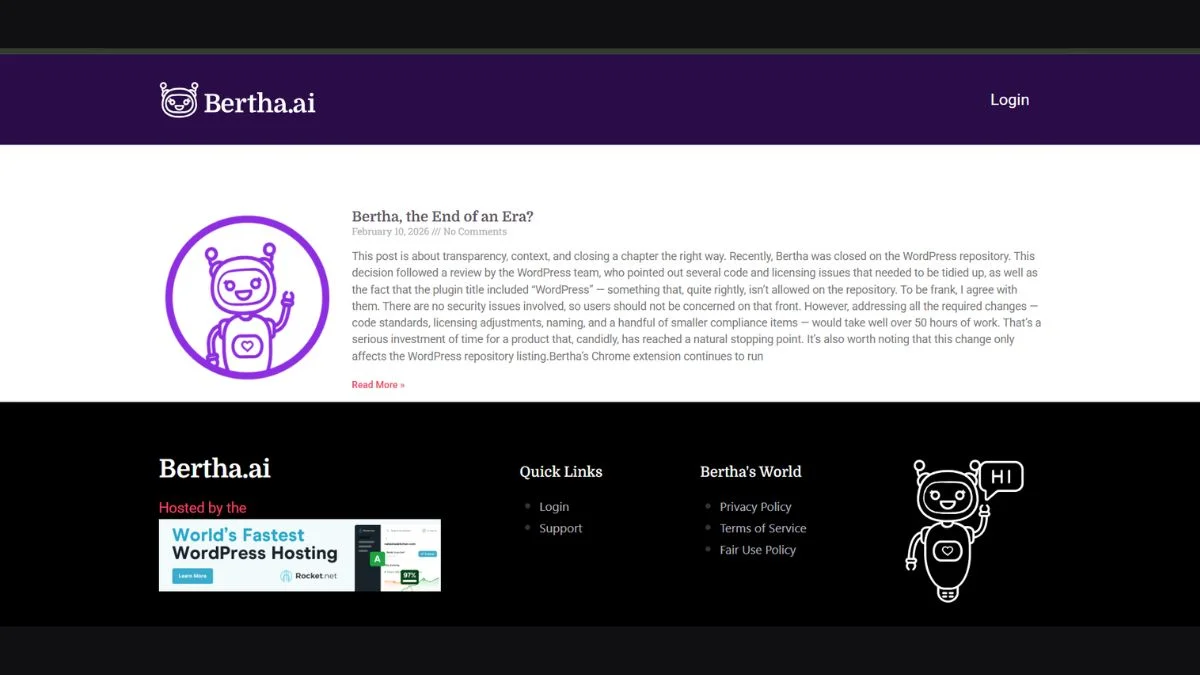
Bertha.ai is an AI content generator built primarily for WordPress users. It integrates directly into the WordPress editor and helps you generate blog posts, product descriptions, ad copy, and more.
It's decent. But "decent" doesn't cut it when you're trying to scale content, hit tight deadlines, or produce SEO-optimized material that actually ranks.
Common complaints from Bertha.ai users include:
- Output quality that needs heavy editing
- Limited word count on lower plans
- Narrow use case (mostly WordPress-focused)
- Fewer templates compared to competitors
- Weaker SEO optimization features
If any of those hit home, you're in the right place.
Quick Comparison Table: Bertha.ai vs Top Alternatives
| Tool | Best For | Free Plan | SEO Features | Starting Price |
|---|---|---|---|---|
| Jasper AI | Marketing teams & agencies | No (trial) | Strong | ~$49/mo |
| Copy.ai | Short-form & sales copy | Yes | Moderate | $49/mo |
| Writesonic | SEO blog writing | Yes (limited) | Strong | $16/mo |
| Rytr | Budget-conscious writers | Yes | Moderate | $9/mo |
| Surfer SEO + AI | SEO-first content | No | Excellent | $89/mo |
| Notion AI | Notes & documents | Limited | Basic | $10/mo add-on |
| Scalenut | Long-form SEO blogs | Yes (trial) | Strong | $39/mo |
| Anyword | Conversion-focused copy | Yes (limited) | Moderate | $49/mo |
| ChatGPT (GPT-4) | Versatile writing | Yes | Flexible | $20/mo |
Pro Tip: If you're using BrightSEO Tools' free AI writing resources, you can combine free tiers from multiple tools to cover almost every content need without spending a dime.
The 9 Best Bertha.ai Alternatives in 2026
1. Jasper AI — Best for Marketing Teams and Agencies
What it is: Jasper is one of the most recognized AI writing platforms on the market. It's a full-suite content tool used by brands, marketing agencies, and content teams who need consistent, high-quality output at scale.
Best use case: Long-form blog posts, email campaigns, ad copy, and social media content across multiple brands or clients.
Who should use it: Marketing agencies, content managers, and businesses running high-volume campaigns.
Key advantage: Jasper's "Brand Voice" feature lets you train the AI on your specific tone, style, and language — something Bertha.ai doesn't come close to offering.
Pros:
- Huge library of templates (50+)
- Integrates with Surfer SEO for optimized content
- Strong long-form content assistant ("Boss Mode")
- Multi-language support
Cons:
- No meaningful free plan (trial only)
- Can get expensive for solo creators
- Output still needs human review for accuracy
Honest verdict: Jasper is the premium choice. If you're serious about content marketing and have the budget, it's hard to beat. For freelancers watching spend, there are cheaper options below.
👉 Check our Best AI Tools for Content Creators guide for more picks like this.
2. Copy.ai — Best for Short-Form Sales Copy (#2 is surprisingly good for e-commerce)
What it is: Copy.ai is a fast, easy-to-use AI writing tool designed specifically around persuasive and conversion-driven copy. Think product descriptions, email subject lines, ad hooks, and landing page headlines.
Best use case: E-commerce product pages, Facebook/Google ad copy, cold email openers, and social media captions.
Who should use it: Entrepreneurs, e-commerce store owners, social media marketers, and freelance copywriters.
Key advantage: Copy.ai has one of the best free plans available — 2,000 words/month with no credit card required. It's also beginner-friendly enough that you can produce useful output in minutes.
Pros:
- Generous free tier
- Clean, intuitive interface
- Great for brainstorming and variations
- 90+ copywriting templates
Cons:
- Not ideal for long-form blog content
- SEO features are minimal
- Output can sound formulaic
Honest verdict: If you're an e-commerce seller or need quick marketing snippets, Copy.ai is a strong, accessible choice. It's especially good for AI tools for e-commerce stores.
3. Writesonic — Best for SEO-Optimized Blog Writing
What it is: Writesonic is a powerful AI content generator with a specific focus on SEO-friendly long-form writing. It comes packed with templates, integrates with search data, and produces structured content that's closer to publish-ready than most competitors.
Best use case: SEO blog posts, website landing pages, product descriptions, and AI-assisted articles that need to rank on Google.
Who should use it: Bloggers, SEO professionals, content agencies, and anyone focused on organic traffic growth.
Key advantage: Writesonic's "Article Writer 6.0" can generate a full SEO article with sources, headings, and real-time Google data in minutes. That alone puts it miles ahead of Bertha.ai for search-focused content.
Pros:
- Real-time web search integration
- Multiple article writing modes
- Affordable starter plans (~$16/mo)
- Chrome extension available
Cons:
- Output quality varies depending on prompt quality
- Higher word counts require paid plans
- Interface can feel busy for new users
Honest verdict: For SEO content creators, Writesonic punches above its weight class. It's one of our top picks in the top Writesonic alternatives for SEO blog writing roundup (yes, even the alternatives are strong here).
4. Rytr — Best Budget Pick for Freelancers (#4 saves serious money)
What it is: Rytr is a no-frills AI writing assistant that focuses on affordability without sacrificing too much quality. It's not flashy, but it gets the job done — especially for shorter pieces, social posts, and quick drafts.
Best use case: Blog intros, social media captions, email drafts, product descriptions, and content outlines.
Who should use it: Freelance writers on a budget, solo bloggers, virtual assistants, and students.
Key advantage: Rytr offers a completely free plan (10,000 characters/month) and a paid plan at just $9/month — making it one of the most accessible AI writing tools available.
Pros:
- Very affordable (cheapest on this list)
- Solid free plan
- 40+ use cases and templates
- 30+ language support
Cons:
- Output quality isn't competitive with Jasper or Writesonic
- Limited long-form content capabilities
- Fewer customization options
Honest verdict: Don't overlook Rytr just because it's cheap. For freelancers and early bloggers, it's a smart starting point. Learn more about free AI tools for freelancers to pair it with other free tools.
5. Surfer SEO + AI Editor — Best for Ranking on Google
What it is: Surfer SEO is primarily an SEO optimization platform, but it includes a powerful AI content editor that combines data-driven SEO recommendations with AI-generated writing. It's the most "SEO-science" approach on this list.
Best use case: Creating blog posts and landing pages that are specifically structured to compete for high-value keywords on Google.
Who should use it: SEO strategists, content managers, digital marketing agencies, and serious bloggers focused on organic rankings.
Key advantage: Surfer analyzes the top 20 ranking pages for any keyword and tells you exactly what topics, headings, word count, and LSI keywords your article needs. Then the AI helps you write it.
Pros:
- Best-in-class SEO content optimization
- SERP Analyzer + content editor combo
- Integrates with Jasper and Google Docs
- Detailed content scoring
Cons:
- Most expensive option here (~$89/mo)
- Steep learning curve for beginners
- AI writing is secondary to the SEO platform
Honest verdict: If SEO is your primary goal and budget isn't the constraint, Surfer is the gold standard. Pair it with insights from our website SEO score checker to supercharge your workflow.
6. Notion AI — Best for Writers Who Live in Notion
What it is: Notion AI is an add-on to the popular productivity and note-taking app Notion. It adds AI writing assistance directly into your workspace — perfect if you already use Notion for planning, drafting, and organizing content.
Best use case: Drafting, summarizing, editing, and organizing written content within a Notion workspace.
Who should use it: Freelance writers, content teams, and creators who already use Notion for project management.
Key advantage: The seamless integration with your existing Notion workspace means no context-switching. Write, plan, publish — all in one place.
Pros:
- Native integration with Notion
- Great for editing, summarizing, and rewriting
- Clean, distraction-free interface
- Affordable at ~$10/mo add-on
Cons:
- Not a standalone writing tool
- Limited SEO features
- Less powerful for long-form original content generation
Honest verdict: Notion AI is a quality-of-life upgrade, not a power tool. It's perfect for organizing and polishing — not for generating thousands of words from scratch. See also: Notion AI vs ChatGPT.
7. Scalenut — Best for Full-Content Marketing Workflows
What it is: Scalenut is an AI-powered SEO content research and writing tool built for content marketers who want to go from keyword to published article in a streamlined workflow. It combines keyword clustering, content planning, and AI writing in one platform.
Best use case: Building content clusters, planning pillar pages, writing SEO articles from scratch.
Who should use it: Content marketing managers, SEO specialists, and bloggers building topical authority.
Key advantage: Scalenut's "Cruise Mode" generates a full SEO article with outlines, SERP research, and NLP keywords in under 5 minutes. It's genuinely fast.
Pros:
- End-to-end content marketing workflow
- Strong SEO research and keyword clustering
- Cruise Mode for rapid article creation
- Decent free trial
Cons:
- Paid plans start at $39/mo
- UI can be overwhelming at first
- Some features still being refined
Honest verdict: Scalenut is the rising star on this list. If you're building a content strategy around topical authority (which you should be in 2026), this platform is built for exactly that. Check out how content marketing boosts SEO to understand why this matters.
8. Anyword — Best for Conversion-Focused Copy
What it is: Anyword is an AI writing tool that puts a unique twist on content generation: it predicts how well your copy will convert before you publish it. Each variation comes with a "Predictive Performance Score" based on data from millions of ads and campaigns.
Best use case: Landing pages, email campaigns, ad copy, and any content where conversion rate directly impacts revenue.
Who should use it: Performance marketers, SaaS companies, e-commerce brands, and direct response copywriters.
Key advantage: The performance scoring system is unlike anything else on this list. You're not just generating copy — you're generating data-backed copy with measurable expected outcomes.
Pros:
- Unique predictive performance scoring
- Strong ad copy and email generation
- Audience targeting within the tool
- Continuous learning from your brand data
Cons:
- Less focused on long-form blog content
- Interface can feel complex
- Pricier than some alternatives
Honest verdict: Anyword is a specialist, not a generalist. If your goal is conversions over content volume, it's worth the premium. Pair it with free AI marketing tools for startups for a well-rounded stack.
9. ChatGPT (GPT-4o) — Best All-Around Flexible Writing Tool
What it is: By now you've probably used ChatGPT. But in 2026, with GPT-4o and custom instructions, it's a genuinely powerful writing assistant — especially when you know how to prompt it effectively.
Best use case: Virtually anything: blog posts, scripts, emails, outlines, rewrites, social content, research summaries.
Who should use it: Everyone. Seriously — it's the Swiss Army knife of AI writing.
Key advantage: Flexibility. With the right prompts, ChatGPT can match almost any tone, format, style, or niche. And at $20/month, it's one of the best value options on this list.
Pros:
- Extremely versatile
- Supports web browsing (real-time data with ChatGPT Plus)
- Custom GPTs for specialized tasks
- Large community with prompt libraries
Cons:
- Requires good prompting to get great output
- No built-in SEO optimization
- Can hallucinate facts — always verify
Honest verdict: If you only pick one tool from this list, start with ChatGPT. Learn how to prompt well, and it'll do 80% of what the others do at a fraction of the complexity. Explore best free ChatGPT alternatives if cost is a concern.
Expert Tips: Getting the Most Out of Any AI Writing Tool
Switching tools won't fix bad prompts. Here's what actually makes the difference:
1. Be specific with context. Instead of "write a blog post about SEO," try: "Write a 1,500-word SEO blog post for a SaaS startup targeting 'on-page SEO tips for beginners' — conversational tone, numbered list format."
2. Use a two-pass approach. Generate a rough draft with AI, then rewrite the intro and conclusion yourself. This dramatically improves quality and makes the content feel human.
3. Always fact-check statistics. AI tools can invent convincing-sounding data. Cross-reference any numbers with authoritative sources before publishing.
4. Edit for your voice. The best AI content looks like you wrote it with AI assistance — not the other way around. Add personal examples, opinions, and specific details.
5. Use AI for the hard parts first. Outlines, meta descriptions, headlines, and section summaries are where AI saves the most time. Use it there before generating full drafts.
For deeper SEO optimization, always run your content through a free website SEO checker and review your on-page SEO checklist before publishing.
Which Tool Should You Actually Pick?
Here's a simplified decision tree:
- Tight budget + just starting out? → Rytr or ChatGPT (free tier)
- E-commerce or conversion copy? → Copy.ai or Anyword
- SEO blog content at scale? → Writesonic or Scalenut
- Premium quality + team workflows? → Jasper AI
- Already use Notion? → Notion AI
- Obsessed with Google rankings? → Surfer SEO
- Flexible, all-purpose writing? → ChatGPT (GPT-4o)
Still unsure? Check out our full comparison of Jasper AI vs Copy.ai vs Writesonic or dive into the best AI tools complete guide with pros and cons.
Related Guides You'll Find Useful
Before you go, here are some content and SEO resources from BrightSEO Tools that pair perfectly with your new AI writing setup:
- Free AI Copywriting Tools for Marketing
- Best Free AI Writing Tools with No Word Limit
- Best AI Tools for Productivity
- Top 10 Free AI Tools for Students
- Does AI-Generated Content Hurt Your SEO?
- Free AI Content Generators for Bloggers
- Best AI Coding Assistants (for developer-bloggers)
- ChatGPT vs Claude vs Gemini
- How to Use Keywords for SEO Effectively
- How to Write SEO-Friendly Meta Descriptions
- How to Optimize Blog Posts for SEO
- How to Improve Content Readability for SEO
- Free AI Article Writers Full Length
- Best Jasper AI Alternatives for Marketing Copy
- Top Free Jasper AI Alternatives for Small Businesses
- Best HIX AI Alternatives for All-in-One Writing
- Best Jenni AI Alternatives for Academic Writing
- Top Smodin Alternatives for AI Essay Writing
- Free vs Paid AI Writing Tools
- HIX AI vs Writesonic vs Copy.ai
- QuillBot Review & Complete Guide
- Grammarly Review & Beginners Guide
- Best Copy AI Alternatives
- Best QuillBot Alternatives
- Best Grammarly Alternatives
- How to Update Old Content for SEO
- How to Avoid Duplicate Content on Your Site
- SEO for Beginners: Ultimate Guide
- Top 100 Best AI Tools
- 25 Best AI Tools for Every Profession
Frequently Asked Questions
What is Bertha.ai used for?
Bertha.ai is an AI writing assistant built specifically for WordPress users. It integrates into the WordPress block editor and Elementor, helping users generate blog content, product descriptions, and ad copy directly inside their CMS. It's aimed at website owners who want to create content without leaving their WordPress dashboard.
That said, its functionality is narrow compared to tools like Jasper, Writesonic, or ChatGPT, which work across multiple platforms and use cases. If you work outside WordPress or need more versatile output, alternatives will serve you better.
Is there a free alternative to Bertha.ai?
Yes — several strong free alternatives exist. Rytr offers 10,000 characters/month free. Copy.ai provides 2,000 words/month on its free plan. ChatGPT (GPT-3.5) is completely free with no word limit, though GPT-4o requires a paid subscription.
If you're on a tight budget, combining Rytr's free plan for short-form copy with ChatGPT's free tier for longer drafts and research gives you a functional, zero-cost AI writing setup. See our full guide to best free AI writing tools with no word limit for more options.
Which Bertha.ai alternative is best for SEO content?
Writesonic and Scalenut are the top choices for SEO-focused content creation. Both tools integrate real-time search data, keyword optimization, and NLP-driven content scoring into their writing workflows. Surfer SEO (with its built-in AI editor) is the most technically advanced option if Google rankings are your primary goal.
For a complete SEO content workflow, combine an AI writing tool with a free website SEO score checker and review our on-page SEO checklist before publishing.
Can AI-generated content hurt my Google rankings?
Not if it's done correctly. Google's official stance (confirmed in their Helpful Content updates) is that it rewards helpful, original, people-first content — regardless of whether AI assisted in its creation. The problem arises when AI content is thin, inaccurate, or mass-produced without editorial oversight.
The key is to treat AI as a drafting tool, not a publish button. Always edit, fact-check, and add original insights before publishing. Read our deep dive: Does AI-Generated Content Hurt Your SEO?
Is Jasper AI better than Bertha.ai?
For most use cases, yes — Jasper is significantly more capable than Bertha.ai. Jasper offers more templates, better long-form writing assistance, brand voice training, SEO integration (via Surfer), and multi-language support. However, it's also considerably more expensive.
If your primary need is WordPress content specifically and you're on a budget, Bertha.ai's niche focus might still be relevant. But for anything beyond basic WordPress drafting, Jasper — or even Writesonic at a lower price point — will produce better results.
What's the best AI writing tool for small businesses in 2026?
Copy.ai or Writesonic are typically the best fit for small businesses. Both offer accessible pricing, strong template libraries, and output that covers the most common small business content needs: website copy, social media, product descriptions, and email marketing.
ChatGPT (with a $20/month Plus subscription) is also an excellent choice for small businesses that want maximum flexibility. Pair it with our free AI tools for small businesses guide to build a lean, effective content stack.
Final Thoughts
Bertha.ai isn't a bad tool — it's just a narrow one. If you're a WordPress user who only needs basic content generation inside your dashboard, it might still work for you.
But if you want more power, better SEO, more templates, or just smarter output — the alternatives above are ready and waiting.
Here's a quick recap:
- Best overall: Writesonic (value + SEO focus)
- Best premium: Jasper AI (quality + brand features)
- Best free option: ChatGPT or Rytr
- Best for conversions: Anyword
- Best for SEO rankings: Surfer SEO
Pick the one that fits your goal, give it two weeks, and compare your output quality against what you were producing before. You'll feel the difference.
And if you're working on building a full content and SEO strategy — not just finding a writing tool — bookmark BrightSEO Tools. Between the free SEO tools, AI content guides, and technical SEO resources, it's one of the most useful free hubs for content creators and marketers in 2026.
Now go write something great.