9 Best Wordplay.ai Alternatives in 2026 (Free & Paid)

So you've been using Wordplay.ai and something isn't clicking. Maybe the content quality feels flat, the pricing stings, or you just want to explore what else is out there.
You're not alone. A lot of content creators and SEO professionals are hunting for better AI writing tools — ones that actually sound human, rank on Google, and don't break the bank.
This guide cuts through the noise. You'll get 9 seriously good Wordplay.ai alternatives, each with honest pros and cons, who they're best for, and a clear answer to whether they're worth your time.
Quick answer: If you want the best all-around Wordplay.ai alternative, Koala AI and Writesonic top the list for SEO-focused content. For budget-conscious creators, Rytr and Copy.ai's free tier are hard to beat.
Let's get into it.
What Is Wordplay.ai — And Why Are People Looking for Alternatives?
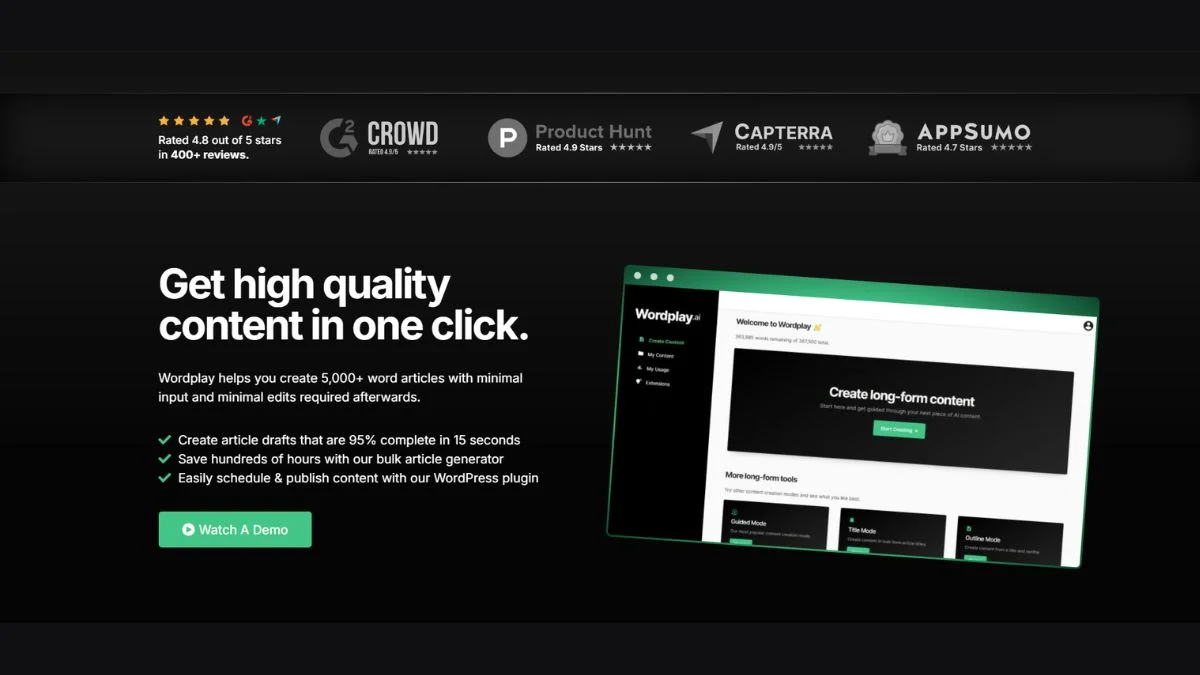
Wordplay.ai is an AI writing tool built around long-form content generation. It's known for producing SEO articles quickly with minimal input.
But it has real limitations:
- Content can feel templated — lacks personality and nuance
- Limited customization for tone and brand voice
- Pricing is steep compared to newer competitors
- No built-in keyword research or SEO scoring
- Weaker support for non-English content
If any of those hit home, keep reading. The tools below fix at least one (and usually several) of these issues.
Quick Comparison Table
| Tool | Best For | Free Plan | Starting Price | SEO Features |
|---|---|---|---|---|
| Koala AI | SEO blog posts | ✅ Limited | ~$9/mo | ✅ Strong |
| Writesonic | Long-form + short copy | ✅ Yes | $16/mo | ✅ Strong |
| Copy.ai | Marketing copy | ✅ Yes | $36/mo | ⚠️ Basic |
| Jasper AI | Enterprise teams | ❌ No | $49/mo | ✅ Strong |
| Rytr | Budget writers | ✅ Yes | $9/mo | ⚠️ Basic |
| Frase.io | SEO research + writing | ❌ No | $15/mo | ✅ Excellent |
| Surfer SEO | On-page optimization | ❌ No | $89/mo | ✅ Best-in-class |
| Scalenut | Content strategy | ✅ Trial | $39/mo | ✅ Strong |
| Neuronwriter | Semantic SEO | ❌ No | $19/mo | ✅ Very strong |
1. Koala AI — Best Overall Wordplay.ai Alternative
What it is: Koala AI (KoalaWriter) is one of the fastest-growing AI blog writing tools built specifically for SEO publishers. It pulls real-time data from the web and uses GPT-4 under the hood.
Best use case: Churning out SEO-optimized blog posts fast — especially for affiliate sites and niche content websites.
Who should use it: Bloggers, affiliate marketers, and content agencies that publish at scale.
Key advantage: Real-time web search integration means your content isn't stuck in a training data cutoff. It writes with current information baked in.
Pros:
- Very fast long-form generation (2,000–3,000 word posts in under 2 minutes)
- Pulls in SERP data to structure articles around what's already ranking
- Clean, readable output — less editing needed
- Affordable entry price
Cons:
- Free plan is limited (word count cap)
- Lacks deep brand voice customization
- Not ideal for highly technical or niche topics
If you're moving away from Wordplay.ai for content speed and quality, Koala AI is the first tool to try.
👉 Related: Best AI Tools for Content Creators
2. Writesonic — Best for Versatility
What it is: Writesonic is a full-stack AI writing platform covering everything from blog posts and landing pages to ad copy and product descriptions. It uses GPT-4 and has a built-in AI article writer called "Article Writer 6."
Best use case: Teams that need both long-form content AND short marketing copy from one tool.
Who should use it: Marketing teams, SaaS companies, and freelancers who write across multiple content formats.
Key advantage: Chatsonic (Writesonic's AI chatbot) has real-time Google search integration — unlike ChatGPT's base version.
Pros:
- Massive template library (100+ use cases)
- SEO mode with keyword integration
- Supports 25+ languages
- One of the better free tiers with 10,000 words/month
Cons:
- Article quality dips on technical subjects
- UI can feel cluttered for new users
- Higher tiers get expensive fast
👉 Related: Best AI Writing Tools: Complete Guide with Pros & Cons
3. Copy.ai — Best Free Option for Marketing Copy
What it is: Copy.ai started as a short-form copy tool and has evolved into a full content workflow platform. Its free plan is genuinely generous.
Best use case: Email marketing, social media captions, product descriptions, and ad copy.
Who should use it: Solo marketers, small business owners, and freelancers who need fast marketing content without spending much.
Key advantage: The free plan includes unlimited projects and a large template library — genuinely useful without paying a cent.
Pros:
- Very strong free tier
- Easy to use — minimal learning curve
- Good for short to medium-length copy
- Solid workflow automation in paid plans
Cons:
- Long-form blog posts aren't its strongest suit
- SEO optimization is surface-level
- No real-time web search
👉 Related: Free AI Copywriting Tools for Marketing — Ultimate Guide
4. Jasper AI — Best for Enterprise Teams (#4 is the enterprise powerhouse)
What it is: Jasper is one of the most established AI writing platforms on the market. It's used by major brands and has deep integration with Surfer SEO for optimized content.
Best use case: Large marketing teams with brand consistency requirements and compliance needs.
Who should use it: Enterprise marketers, content strategists, and agencies managing multiple client accounts.
Key advantage: Brand Voice feature — you can train Jasper on your brand's tone, style, and terminology so every output sounds like you.
Pros:
- Best-in-class brand voice training
- Deep Surfer SEO integration
- Solid collaboration and team features
- High output quality on marketing copy
Cons:
- No free plan
- Expensive starting price ($49/month)
- Overkill for solo writers or small blogs
- Some users report the quality has plateaued vs newer tools
If budget isn't an issue and brand consistency is critical, Jasper is worth it. For everyone else, it's hard to justify.
👉 Related: Jasper AI vs Copy.ai vs Writesonic — Best AI Copywriter
5. Rytr — Best Budget Alternative
What it is: Rytr is one of the most affordable AI writing assistants available, with a free plan that genuinely covers basic writing needs.
Best use case: Quick content drafts, email copy, social media posts, and short articles on a tight budget.
Who should use it: Freelancers, students, and solopreneurs who need an AI writing boost without subscription costs.
Key advantage: At $9/month for the Saver plan, it's the cheapest paid option that's still actually useful.
Pros:
- Generous free plan (10,000 characters/month)
- 40+ use cases and 20+ tones
- Simple, clean interface
- Fast output
Cons:
- Long-form content needs significant editing
- No SEO scoring or keyword tools
- Not suitable for high-volume publishing
👉 Related: Best Free AI Writing Tools — No Word Limit
6. Frase.io — Best for SEO Research + Writing Combined
What it is: Frase bridges the gap between SEO research and AI content creation. It analyzes the top-ranking pages for any keyword and helps you write content that competes directly with them.
Best use case: SEO-driven content creation where you need to understand competitors before writing.
Who should use it: SEO professionals, content strategists, and bloggers serious about ranking on Google.
Key advantage: The SERP analysis + AI writing combination in one tool is genuinely rare. You research, brief, and write without leaving the platform.
Pros:
- Brilliant for content briefs
- Shows competitor headings, word counts, and questions
- AI writer trained on your target SERP
- Relatively affordable for what it does
Cons:
- AI writing quality alone isn't exceptional — it shines when combined with research
- Interface has a learning curve
- Word generation limits on lower plans
This is the tool for writers who take SEO seriously. If you want content that ranks, not just content that reads well, Frase is a strong pick.
👉 Related: How to Do an SEO Audit for Your Website
👉 Related: 9 SEO Checker Tools You Must Use
7. Surfer SEO — Best Pure SEO Optimization Tool
What it is: Surfer SEO is less of a writing tool and more of a content optimization engine. You write (or paste in AI content), and Surfer tells you exactly what changes to make to outrank competitors.
Best use case: Optimizing existing or AI-generated content to meet on-page SEO requirements.
Who should use it: SEO specialists and content teams who want data-driven content scoring.
Key advantage: The Content Score feature is the clearest, most actionable SEO scoring system in the market. Hit 70+ and your chances of ranking improve dramatically.
Pros:
- Industry-leading content optimization
- NLP-based keyword suggestions
- Integrates with Google Docs and Jasper
- Keyword research built in
Cons:
- Expensive ($89/month starter)
- Not a standalone writing tool — you need to bring content to it
- Can lead to over-optimization if overused
👉 Related: What Is a Good SEO Score? Benchmarks by Industry
👉 Related: How SEO Score Is Calculated — The Complete Breakdown
👉 Related: On-Page SEO Techniques That Actually Work
8. Scalenut — Best for Full Content Strategy
What it is: Scalenut is an AI-powered content intelligence platform that combines keyword planning, content briefs, writing, and optimization in a single workflow.
Best use case: Running a full content strategy — from keyword research to published article — in one place.
Who should use it: Content managers, SEO agencies, and growing blogs that publish 10+ articles per month.
Key advantage: The Cruise Mode feature can take you from keyword to finished article in 5 minutes, with NLP terms integrated automatically.
Pros:
- End-to-end content workflow
- Strong NLP-based optimization
- Topic clusters and keyword planning tools
- Better value than Surfer + a separate AI writer combined
Cons:
- AI writing quality can be inconsistent
- Newer tool — still ironing out bugs
- Limited integrations compared to Jasper
👉 Related: How to Develop an Effective SEO Strategy — The Complete Guide
👉 Related: How Content Marketing Boosts SEO — The Complete Guide
9. Neuronwriter — Best for Semantic SEO (Hidden gem alert)
What it is: Neuronwriter is a content optimization tool with a strong emphasis on semantic SEO — making sure your content covers the full topical depth Google expects.
Best use case: Writers who want to dominate on semantic search signals and topical authority.
Who should use it: Advanced SEO practitioners, niche site builders, and anyone building topical authority in a specific domain.
Key advantage: At ~$19/month, it delivers Surfer-level SEO insights at a fraction of the cost. The SERP analysis and NLP term recommendations are genuinely excellent.
Pros:
- Excellent value for money
- Strong NLP term suggestions
- Internal linking recommendations built in
- Lifetime deal often available on AppSumo
Cons:
- AI writing quality is secondary to the optimization features
- Interface isn't as polished as Surfer
- Smaller community and fewer tutorials
If you're on a budget but still want real SEO optimization power, Neuronwriter is the most underrated tool on this list.
👉 Related: How to Use LSI Keywords in On-Page SEO
👉 Related: How to Add Schema Markup for On-Page SEO
Pro Tips: How to Choose the Right Wordplay.ai Alternative
Before you sign up for any tool, ask yourself these three questions:
1. What's your primary goal?
- Ranking on Google → Frase, Surfer SEO, or Neuronwriter
- Fast content at scale → Koala AI or Writesonic
- Budget-friendly drafts → Rytr or Copy.ai
2. How much editing are you willing to do? All AI tools produce drafts — not finished articles. The cheaper the tool, the more editing you'll need. Budget for editing time, not just subscription costs.
3. Do you need SEO baked in — or can you optimize separately? If SEO matters (and it should), go with a tool that has built-in optimization. Writing blind without SEO guidance wastes time.
Expert Tips:
- Combine tools for best results: Use Frase for research → Writesonic for first draft → Neuronwriter for optimization. Total cost can be under $50/month for a powerful stack.
- Don't skip the brief: The quality of your output is 70% about the quality of your prompt. Garbage in, garbage out.
- Test with real topics: Don't evaluate tools on generic prompts. Use your actual keywords and topics for a fair comparison.
👉 Related: Best Prompt Engineering Techniques for Developers
👉 Related: AI Tools: 7 Game Changers for Explosive SEO in 2025
👉 Related: Does AI-Generated Content Hurt Your SEO?
How AI Writing Tools Affect Your SEO in 2026
This is worth addressing directly because Google's stance has evolved.
Google's current position: AI-generated content is acceptable if it's helpful, original, and demonstrates E-E-A-T (Experience, Expertise, Authoritativeness, Trustworthiness).
What that means practically:
- Raw AI output without editing will struggle to rank
- Content that adds genuine insight, data, or personal experience performs better
- Thin AI content targeting the same keywords as thousands of other sites will get filtered out
The tools above are best used as accelerators, not replacements for human judgment. Use them to generate structure and first drafts — then add your expertise on top.
👉 Related: How AI Is Changing SEO
👉 Related: SEO Trends You Need to Know This Year
👉 Related: Essential Content Optimization Practices Every Marketer Should Know
Frequently Asked Questions
What is the best free alternative to Wordplay.ai?
Copy.ai and Rytr offer the most generous free plans among Wordplay.ai alternatives. Copy.ai's free tier includes unlimited projects with access to most templates. Rytr's free plan gives you 10,000 characters per month with 40+ use cases. Both are legitimate tools — not just limited demos — making them ideal starting points if you're not ready to spend.
Is Koala AI better than Wordplay.ai for SEO content?
For most users creating SEO-focused blog posts, yes — Koala AI produces more natural, current content. Koala AI's real-time web search integration means articles reference up-to-date information, which is a significant advantage for topical content. Wordplay.ai lacks this feature. That said, always review and edit AI output before publishing regardless of which tool you use.
Can I use multiple AI writing tools together?
Absolutely — and the best content marketers often do. A common workflow is: use Frase.io for keyword research and content briefs, Writesonic or Koala AI to generate the draft, and Surfer SEO or Neuronwriter for final optimization. Each tool handles what it does best. The combined cost is often less than a single enterprise subscription.
Do AI writing tools work for non-English content?
Most major alternatives support multiple languages, but quality varies significantly. Writesonic and Copy.ai both support 25+ languages. Jasper and Frase are strongest in English. For non-English SEO content, Writesonic is currently the most reliable option. Always have a native speaker review localized AI content before publishing.
How do I avoid Google penalties when using AI content tools?
The key is to add genuine value beyond what the AI generates. Google's helpful content system targets thin, templated content — not AI content specifically. To stay safe: add original research or data, include personal experience or perspective, ensure factual accuracy, update content regularly, and use proper E-E-A-T signals like author bios and cited sources.
👉 Related: How to Rank #1 on Google — Real Checklist
Is Jasper AI worth the price compared to cheaper alternatives?
Jasper is worth it specifically for enterprise teams with brand consistency needs — but not for individual bloggers. For solo creators and small teams, tools like Writesonic or Koala AI deliver 80% of Jasper's output quality at 20% of the price. Jasper's value is in team features, brand voice training, and integrations — not raw writing quality alone.
More Tools Worth Exploring
If none of the nine above quite fit your workflow, here are a few more worth checking out:
- ChatGPT — Still one of the most flexible writing tools when combined with good prompting
- Claude AI — Excellent for long-form, nuanced writing
- QuillBot — Best for paraphrasing and rewriting
- Grammarly — Not an AI writer but an essential editing layer
👉 Related: Top 10 AI Tools You Must Try
👉 Related: Best Free AI Tools to Use Daily
👉 Related: Free AI Tools That Replace Expensive Software
👉 Related: 25 Best AI Tools for Every Profession
Final Thoughts
Wordplay.ai isn't a bad tool — it's just that the AI writing space has exploded in 2025–2026, and the competition is fierce.
Here's a quick summary to help you decide:
- Best overall alternative: Koala AI
- Best for SEO research + writing: Frase.io
- Best for large teams: Jasper AI
- Best budget option: Rytr
- Best hidden gem: Neuronwriter
- Most versatile: Writesonic
- Best for pure SEO scoring: Surfer SEO
The right tool depends on your goals, budget, and how much you're willing to invest in the editing process.
Start with a free trial on two or three tools before committing. Most offer enough free usage to evaluate them with your actual topics and writing style.
Keep Exploring
If you found this guide useful, these resources will help you go further:
- SEO for Beginners — The Ultimate Step-by-Step Guide
- Free SEO Checker Online — 20 Best Google & YouTube SEO Tools
- How to Optimize Blog Posts for SEO
- Best AI Tools for Productivity
- Top 100 Best AI Tools
- Best AI Coding Assistants
- ChatGPT Alternatives
- Grammarly Alternatives
- QuillBot Alternatives
- Best Jasper AI Alternatives for Marketing Copy
- Top Free Jasper AI Alternatives for Small Businesses
- Best Copy.ai Alternatives for Generating Sales Copy
- Top Best Writesonic Alternatives for SEO Blog Writing
- Best HIX AI Alternatives for All-in-One AI Writing
- Free vs Paid AI Writing Tools — Is Upgrading Worth It?
- Website SEO Score Checker
- Keyword Research Tool