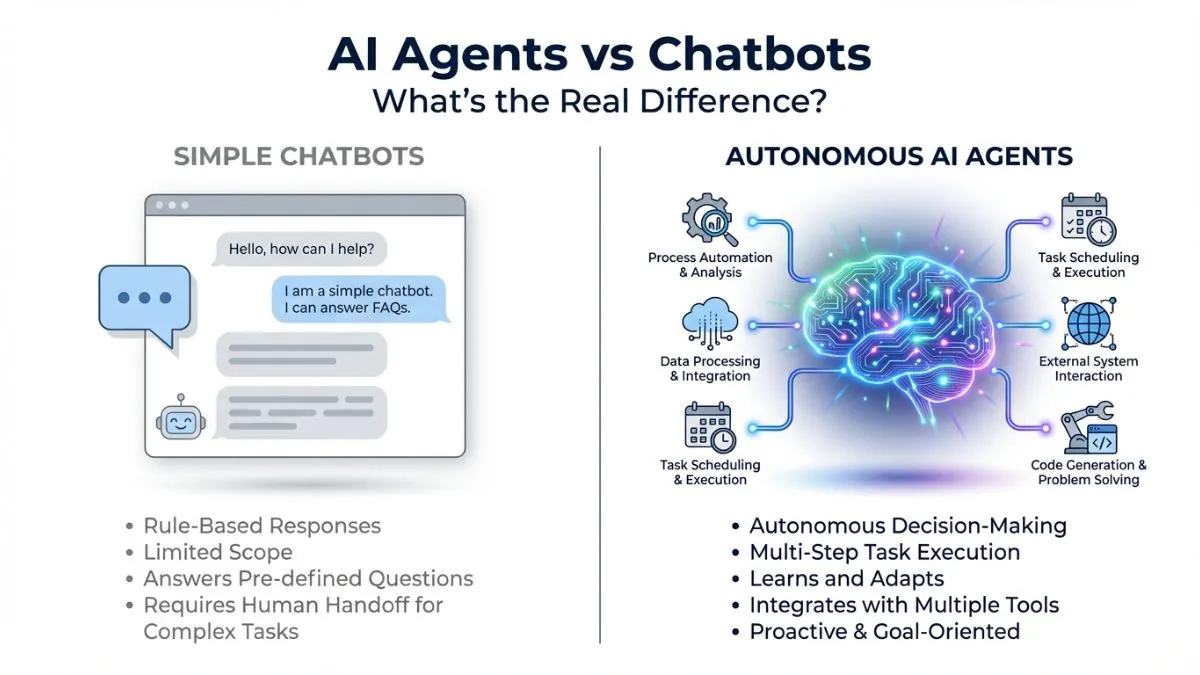
AI Agents vs Chatbots: What's the Real Difference? (Complete Guide)

Introduction: Why the Confusion Between AI Agents and Chatbots?
The terms "AI agent" and "chatbot" are being used almost interchangeably in tech conversations, marketing materials, and business boardrooms. But make no mistake — these two technologies are fundamentally different in purpose, capability, and the value they deliver.
If you have ever chatted with a customer support bot that gave you canned responses, that was a chatbot. If you have ever watched a system automatically research competitors, draft a strategy report, and send calendar invites without a single human click — that was an AI agent at work.
The distinction matters enormously, especially as businesses race to adopt AI tools for SEO automation, content production, customer support, and digital marketing. Understanding which tool you need — and when — can be the difference between a transformative ROI and a costly disappointment.
In this comprehensive guide, we break down the core differences between AI agents and chatbots, explore real-world use cases, compare technical architectures, and give you a clear framework for choosing the right technology for your needs.
What Is a Chatbot? A Clear Definition
A chatbot is a software program designed to simulate conversation with humans through text or voice interfaces. Chatbots follow a predefined set of rules, decision trees, or language models to respond to user input.
Chatbots can be divided into two main categories:
Rule-Based Chatbots operate on scripted workflows. They match keywords or user intent to pre-written responses. Think of interactive FAQ bots or simple customer service pop-ups. They work well for narrow, repetitive queries but fail the moment a user goes off-script.
AI-Powered Chatbots use natural language processing (NLP) and machine learning to understand context and intent more flexibly. Tools like early versions of virtual assistants fall into this category. They can handle more varied queries but are still fundamentally reactive — they wait for input and respond.
The key characteristic of any chatbot: it reacts, it does not act. A chatbot waits for you to say something, processes that input, and returns a response. That's the extent of its autonomy.
Popular chatbot platforms include Intercom, Drift, ManyChat, and tools built on platforms like Tawk.to and Crisp Chat, which are excellent for website engagement but are not autonomous agents.
What Is an AI Agent? A Clear Definition
An AI agent is a system that perceives its environment, makes decisions, takes sequences of actions, and pursues goals with a high degree of autonomy — often without requiring human input at every step.
Unlike chatbots, AI agents are goal-directed. You give an agent a high-level objective — "Research the top 10 competitors in my niche and summarize their keyword strategies" — and the agent independently determines the steps needed to accomplish it, executes those steps (browsing the web, using tools, writing code, sending requests), evaluates results, and iterates until the goal is achieved.
AI agents have four defining properties:
- Perception — They can take in information from their environment (text, web data, APIs, files).
- Reasoning — They apply a model of the world to evaluate options and plan next actions.
- Action — They can execute real tasks: browsing, coding, clicking, sending emails, calling APIs.
- Learning/Adaptation — Advanced agents can update their behavior based on feedback and outcomes.
Leading AI agent frameworks include AutoGPT, LangChain agents, Microsoft Copilot Studio, and platforms powered by large language models like Claude and GPT-4.
The Core Differences: AI Agents vs Chatbots at a Glance
| Feature | Chatbot | AI Agent |
|---|---|---|
| Behavior | Reactive (responds to input) | Proactive (pursues goals) |
| Autonomy | Low — follows scripts or NLP | High — plans and executes independently |
| Task Complexity | Single-turn, simple queries | Multi-step, complex workflows |
| Tool Use | Rarely uses external tools | Natively integrates tools, APIs, browsers |
| Memory | Limited session memory | Can retain long-term memory and context |
| Decision Making | Rule-based or narrow ML | Sophisticated reasoning over many steps |
| Scope | Conversational interface | Full workflow automation |
| Best Use Case | FAQs, customer support scripts | Research, coding, content pipelines, ops |
How Chatbots Work: The Technical Architecture
Understanding how chatbots work helps clarify their limitations. Most modern AI-powered chatbots are built on a stack that includes:
1. Natural Language Understanding (NLU): This layer interprets what the user is saying. Tools like Dialogflow, Rasa, or OpenAI's API process user input and classify it into intents (e.g., "I want to check my order status").
2. Dialogue Management: A decision engine determines the correct response based on the identified intent. For rule-based bots, this is a simple decision tree. For AI-powered bots, it may use a neural network.
3. Natural Language Generation (NLG): This generates a human-like response and delivers it back to the user.
4. Integration Layer: More sophisticated chatbots connect to back-end systems (CRMs, databases, order management systems) to fetch or update data in real time.
Even with all these layers, a chatbot's architecture is fundamentally session-bound and single-task-oriented. It processes one user input at a time and has no persistent drive toward an overarching goal.
For businesses using chatbots as part of their digital marketing strategy, chatbots shine in customer service automation, lead capture forms, and FAQ deflection — but they hit a hard ceiling in anything requiring multi-step reasoning.
How AI Agents Work: The Technical Architecture
AI agents operate on a fundamentally different paradigm known as the agent loop or ReAct loop (Reasoning + Acting):
1. Goal Intake: The agent receives a high-level objective from a user or system.
2. Planning: Using an LLM as its "brain," the agent breaks the goal into a sequence of sub-tasks and determines which tools to use for each.
3. Tool Execution: The agent calls external tools — web search, code executors, APIs, databases, file systems — to gather information or take actions.
4. Observation: The agent reviews the results of each tool call and updates its understanding.
5. Iteration: Based on observations, the agent re-plans if necessary and continues until the goal is complete.
6. Output Delivery: The agent delivers a final output (report, completed task, updated file, etc.) to the user.
This loop is what makes AI agents genuinely transformative. They are not just answering questions — they are doing work. According to McKinsey's research on AI automation, agentic AI systems are projected to automate up to 30% of knowledge work tasks by 2030, a figure that would have seemed implausible with chatbot technology alone.
For technical SEO professionals, AI agents can be particularly powerful for tasks like technical SEO audits, crawl error detection, and on-page optimization at scale.
Key Differences Explored in Depth
1. Autonomy and Initiative
This is the most fundamental difference. A chatbot is passive — it only acts when spoken to. An AI agent can be set to run on a schedule, monitor conditions, and trigger actions autonomously.
Imagine you run an e-commerce site. A chatbot can answer a customer's question about your return policy. An AI agent, however, can monitor your competitors' pricing every morning, detect when a rival drops prices by more than 10%, automatically update your pricing rules, draft a promotional email for your email list, and log the change in a report — all without a single human prompt.
2. Memory and Context
Chatbots typically have session memory only — they forget everything once the conversation ends (and sometimes within the conversation). Some advanced chatbot platforms have added persistent memory features, but they remain limited.
AI agents, especially those built on frameworks like LangChain or LlamaIndex, can maintain long-term memory across sessions. They can remember that you prefer formal writing, that your brand targets a specific demographic, or that a particular task failed last Tuesday and adjust accordingly.
3. Tool Use and Integration
Chatbots interact primarily through conversation. Their tool use is usually limited to fetching data from a connected CRM or knowledge base.
AI agents are built to use tools natively. A modern AI agent can:
- Browse live web pages
- Execute Python or JavaScript code
- Query databases directly
- Send API requests to third-party services
- Fill out forms and click through interfaces
- Generate and save files
This makes AI agents extraordinarily powerful for tasks like keyword research automation, backlink profile monitoring, and competitive analysis.
4. Reasoning and Decision-Making
Chatbots make decisions at the micro level: given this input, return this output. They do not reason about strategies, weigh trade-offs across many steps, or develop plans.
AI agents perform multi-hop reasoning — they can process a chain of logic across many steps, gather intermediate data, change course when results are unexpected, and arrive at conclusions that no single-step system could reach.
This is why AI agents are increasingly being deployed in complex workflows like content marketing pipelines, where producing a single piece of content may require keyword research, competitor analysis, outline creation, drafting, SEO scoring, and publishing coordination.
5. Task Scope
Chatbots excel at narrow, well-defined, high-volume tasks: answering FAQs, routing support tickets, collecting lead information.
AI agents excel at broad, ambiguous, multi-step goals: "Grow our organic traffic by 20% over the next quarter" is something you could theoretically hand to an agent — it would research your current rankings, identify quick-win opportunities, draft content briefs, and coordinate publishing, among many other sub-tasks.
Real-World Use Cases: When to Use a Chatbot
Despite the excitement around AI agents, chatbots remain highly valuable in specific scenarios:
Customer Support Automation: Chatbots handle tier-1 support queries 24/7 at a fraction of the cost of human agents. Tools like YesChat.ai enable businesses to deploy sophisticated conversational AI for support.
Lead Generation on Landing Pages: A well-designed chatbot on a SEO-friendly landing page can qualify visitors, capture emails, and book demos automatically.
E-commerce Product Discovery: Chatbots help users navigate large product catalogs, answer product questions, and reduce cart abandonment.
Internal HR and IT Helpdesks: Employees can query internal policy documents or submit IT tickets through a chatbot interface without human intermediaries.
Appointment Booking: Healthcare providers, salons, and service businesses use chatbots to streamline scheduling without staff involvement.
According to Salesforce's State of Service report, over 58% of customers have used a chatbot for customer service, and satisfaction rates are highest when chatbots stick to well-defined, transactional use cases.
Real-World Use Cases: When to Use an AI Agent
AI agents unlock an entirely different tier of automation:
SEO and Content Operations: An AI agent can run a complete website SEO audit, identify the most critical issues, prioritize fixes by impact, draft corrective content, update meta tags, and generate a monthly report — a workflow that would take a human team days.
Competitive Intelligence: Agents can monitor competitor websites, track pricing changes, analyze backlink growth, and surface actionable insights in real time.
Software Development: AI coding assistants and agents can write code, run tests, debug failures, and iterate on solutions autonomously — dramatically compressing development cycles.
Data Analysis and Reporting: Agents connected to analytics platforms can pull data, identify anomalies, visualize trends, and write executive summaries without human intervention.
Email and Outreach Campaigns: Agents can research prospects, personalize outreach messages, send emails, monitor responses, and follow up based on engagement — a complete off-page SEO link-building workflow can be partially automated.
Financial Research: Investment firms use AI agents to monitor news feeds, scan SEC filings, and flag trading signals far faster than human analysts.
The Role of Large Language Models (LLMs) in Both Technologies
Both chatbots and AI agents increasingly rely on large language models as their core intelligence layer. However, how they leverage LLMs differs significantly.
In a chatbot, the LLM is essentially a response generator. It receives a conversation turn and produces a reply. The LLM's power is applied to understanding and articulating — it makes the conversation feel natural and intelligent.
In an AI agent, the LLM serves as a reasoning engine and orchestrator. It does not just generate text — it generates plans, evaluates outcomes, decides which tools to invoke, interprets tool results, and loops back to achieve a goal. The LLM's reasoning capabilities are fully exploited.
This explains why the emergence of powerful LLMs like GPT-4, Claude, and Gemini has been far more transformative for agentic AI than for chatbots. An agent running on a capable LLM can perform tasks that were simply impossible for rule-based or even earlier NLP systems.
If you are exploring AI tools for your business, checking comprehensive guides to AI tools by profession can help you identify where agents and chatbots fit in your stack.
AI Agents vs Chatbots in the Context of SEO
Search engine optimization is one of the domains most profoundly impacted by the shift from chatbots to AI agents.
Traditional chatbot applications in SEO were limited: a chatbot might help a user navigate a website and reduce bounce rate, indirectly improving Core Web Vitals signals that Google uses for ranking.
AI agents in SEO are another matter entirely:
- They can run automated technical SEO audits on demand.
- They can identify and fix broken internal links across thousands of pages.
- They can generate and submit XML sitemaps automatically when new content is published.
- They can monitor keyword positions daily and alert you when rankings drop.
- They can draft SEO-optimized blog content at scale using keyword research tools.
- They can manage robots.txt optimization and canonical tag implementation without manual developer involvement.
For any business serious about how AI is changing SEO, transitioning from chatbot-only automation to an agent-augmented SEO stack is one of the most high-leverage investments available in 2025.
Limitations of Chatbots
Being realistic about chatbot limitations is critical for avoiding misaligned expectations:
1. Brittleness: Chatbots break when users go off-script. Even NLP-powered chatbots struggle with unusual phrasing, complex multi-part questions, or requests that sit outside their training data.
2. No Real Autonomy: Chatbots cannot initiate tasks, adapt to environmental changes, or pursue objectives without continuous human input.
3. Limited Integration: While chatbots can connect to databases, they are rarely designed to orchestrate complex multi-system workflows.
4. Context Loss: Most chatbots lose all context between sessions, forcing users to repeat themselves and degrading the experience over time.
5. Maintenance Overhead: Rule-based chatbots require constant updating as products, policies, and FAQs change. This creates a surprisingly high maintenance burden.
Limitations of AI Agents
AI agents are powerful but not without meaningful constraints:
1. Cost: Running complex agentic workflows consumes significant LLM tokens, which translates to real costs at scale. Careful prompt engineering and caching strategies are necessary to manage expenses.
2. Reliability and Hallucinations: Agents can make mistakes, take wrong turns in reasoning, or hallucinate facts — especially in high-stakes domains. Human oversight remains important.
3. Security and Trust: Giving an agent access to systems (email, databases, APIs) introduces security risks. Robust permission systems and audit logs are essential.
4. Complexity of Setup: Building a well-functioning AI agent is significantly more complex than deploying a chatbot. It requires careful design of the agent loop, tool integrations, and failure recovery mechanisms.
5. Latency: Multi-step agent workflows take longer than single-turn chatbot responses. For real-time user interactions, agents may not be the right choice.
According to a Stanford HAI report on foundation models, reliability and controllability remain the two most significant challenges facing AI agent deployment in enterprise environments.
The Emerging Middle Ground: Agentic Chatbots
The boundary between chatbots and agents is beginning to blur with the emergence of agentic chatbots — systems that maintain a conversational interface while adding genuine autonomous capability underneath.
Products like Monica.im represent this middle ground — conversational in interface, but capable of browsing the web, generating images, and executing multi-step tasks within a chat window. Similarly, DocsBot.ai blends chatbot-style interfaces with intelligent document retrieval workflows.
The trend points toward a future where the chatbot/agent distinction becomes less about interface and more about the depth of autonomy the system is permitted to exercise.
How to Choose Between a Chatbot and an AI Agent
Here is a simple decision framework:
Choose a chatbot when:
- Your use case is high-volume, repetitive, and well-defined.
- Users need immediate, real-time conversational responses.
- The task requires answering questions, not taking actions.
- You have a limited budget or technical resources.
- You are deflecting support tickets or capturing leads on landing pages.
Choose an AI agent when:
- The task involves multiple steps, decisions, and tool interactions.
- You need to automate a workflow, not just answer questions.
- Speed of response is less critical than depth and accuracy of output.
- The value is in proactive automation, not reactive conversation.
- You are looking to scale operations, research, or content production without proportional headcount growth.
Many enterprises will ultimately deploy both — chatbots at the user-facing conversational layer and agents in back-end workflows — creating a layered AI architecture that maximizes value at every touchpoint.
If you are just getting started with AI tools, the Ultimate List of Best AI Tools for Beginners is an excellent resource for understanding the full landscape.
The Future of AI Agents and Chatbots
The trajectory is clear: AI agents will become increasingly central to knowledge work, while chatbots will evolve into more natural, context-aware conversational interfaces — possibly powered by agent-level intelligence underneath.
Several macro trends are accelerating this shift:
Multi-Agent Systems: Rather than a single agent working alone, future systems will involve networks of specialized agents collaborating — one for research, one for writing, one for publishing, one for analytics — coordinated by an orchestrator agent.
Embodied Agents: AI agents are beginning to control physical systems — robots, vehicles, factory equipment — extending their reach beyond the digital world.
Personalized Agents: As memory and personalization improve, each user may have a dedicated personal AI agent that understands their goals, preferences, and context at a deep level — far beyond what any chatbot session could offer.
Regulatory Frameworks: As agents gain more autonomy and access to systems, governments and regulators are developing frameworks for accountability, transparency, and human oversight — factors that will shape agent design for years to come.
For professionals in SEO and digital marketing, keeping pace with these developments is not optional — it is a competitive necessity. Understanding how AI is reshaping search and SEO strategy will be one of the defining skills of the next decade.
Summary: AI Agents vs Chatbots
To recap the essential difference in one sentence: chatbots converse, AI agents act.
Chatbots are reactive conversational interfaces built for specific, narrow interactions. AI agents are autonomous, goal-directed systems capable of planning and executing complex, multi-step workflows across diverse tools and data sources.
Both technologies have their place. The smartest businesses in 2025 are not choosing one over the other — they are deploying chatbots where conversation and speed matter, and agents where depth, autonomy, and workflow automation create transformative value.
If your business is serious about scaling through AI — whether in SEO, content marketing, e-commerce, or operations — understanding the difference between these two technologies is no longer a nice-to-have. It is foundational.
10 Frequently Asked Questions (FAQs)
1. What is the simplest way to explain the difference between an AI agent and a chatbot?
A chatbot waits for you to ask a question and then answers it. An AI agent is given a goal and figures out — on its own — what steps to take to achieve it, using tools, making decisions, and acting autonomously. Chatbots react; agents act.
2. Can a chatbot become an AI agent?
Not inherently. A basic chatbot operates on scripts or reactive NLP models and lacks the planning, tool-use, and autonomous execution capabilities that define an agent. However, modern platforms are adding agentic capabilities to chatbot interfaces, blurring the line. A system that can browse the web, run code, and pursue multi-step goals through a conversational interface is functionally an agentic chatbot — closer to an agent than a traditional chatbot.
3. Are AI agents more expensive than chatbots?
Generally, yes. AI agents consume significantly more computational resources (LLM tokens, API calls, tool executions) per task than chatbots. A chatbot response might cost fractions of a cent in LLM tokens; an agent completing a complex research task could cost several dollars. However, when measured against the value delivered — hours of human work replaced — the ROI can be exceptional.
4. What are some examples of AI agents I can use today?
Several commercial AI agent products are available today, including AutoGPT, AgentGPT, Microsoft Copilot (in its agentic modes), Anthropic's Claude with tool use, OpenAI's GPT-4 with function calling, and specialized platforms like Monica.im and Skywork AI. The space is evolving rapidly, with new platforms launching regularly.
5. Do AI agents replace customer service chatbots?
Not in the near term for most use cases. Chatbots remain the right tool for high-volume, real-time customer service interactions where speed and predictability matter. AI agents are better suited for complex, back-end workflows. In customer service, agents might be used to handle escalated cases, generate detailed response drafts, or conduct account research — while the front-line interface remains a chatbot.
6. Can AI agents be used for SEO?
Absolutely, and this is one of the most promising application areas. AI agents can automate keyword research, run technical SEO audits, generate optimized content briefs, monitor backlink profiles, and track keyword rankings — dramatically increasing the scale at which SEO teams can operate.
7. Are AI agents safe to use in business workflows?
AI agents introduce real security and reliability risks that must be managed carefully. Giving an agent access to email, databases, or financial systems requires robust permission controls, audit logging, and human oversight for high-stakes decisions. Most enterprise deployments run agents in sandboxed environments with limited permissions and human-in-the-loop checkpoints for critical actions.
8. What is the difference between a virtual assistant and an AI agent?
Traditional virtual assistants (like Siri or Alexa) are sophisticated chatbots — they process voice input and return responses or trigger pre-defined actions. AI agents go much further: they can plan complex workflows, use external tools autonomously, maintain long-term memory, and pursue goals over extended periods without step-by-step human guidance. The term "AI agent" typically implies a much higher degree of autonomy and capability than a virtual assistant.
9. How do AI agents use tools?
AI agents use a mechanism called "tool calling" or "function calling." The agent's LLM is provided with a list of available tools (web search, code executor, API caller, file reader, etc.) along with descriptions of what each tool does. When the LLM determines that a tool is needed to progress toward its goal, it outputs a structured call to that tool, the tool executes, and the result is fed back into the LLM's context — enabling the agent to continue reasoning with new information.
10. What skills do I need to build an AI agent?
Building a basic AI agent requires familiarity with an LLM API (OpenAI, Anthropic, Google), an agent framework (LangChain, LlamaIndex, or Semantic Kernel), and basic Python programming. More complex agents require knowledge of API integrations, vector databases for memory, prompt engineering, and system design. For non-developers, low-code platforms like AutoGPT, AgentGPT, and AI tools for productivity are lowering the barrier to entry significantly.
Want to stay ahead of AI developments that impact your SEO and digital marketing? Explore the full suite of free SEO tools at BrightSEOTools.com to audit, optimize, and scale your website performance today.