10 Best Dashword Alternatives in 2026 (Ranked for Real Writers)

Let's be direct: Dashword is a decent content optimization tool, but it's not perfect for everyone. Maybe the pricing feels steep for what you get. Maybe you need deeper keyword insights, better AI writing features, or a tool that fits a specific workflow. Whatever the reason you're searching for Dashword alternatives, you're in the right place.
This guide covers the 10 best Dashword alternatives in 2026 — tools that help you create SEO-optimized content that actually ranks. For each tool, I've broken down what it does, who it's best for, real pros and cons, and what makes it stand out.
No fluff. No fake stats. Just honest, useful comparisons.
What Is Dashword (And Why Look for Alternatives)?
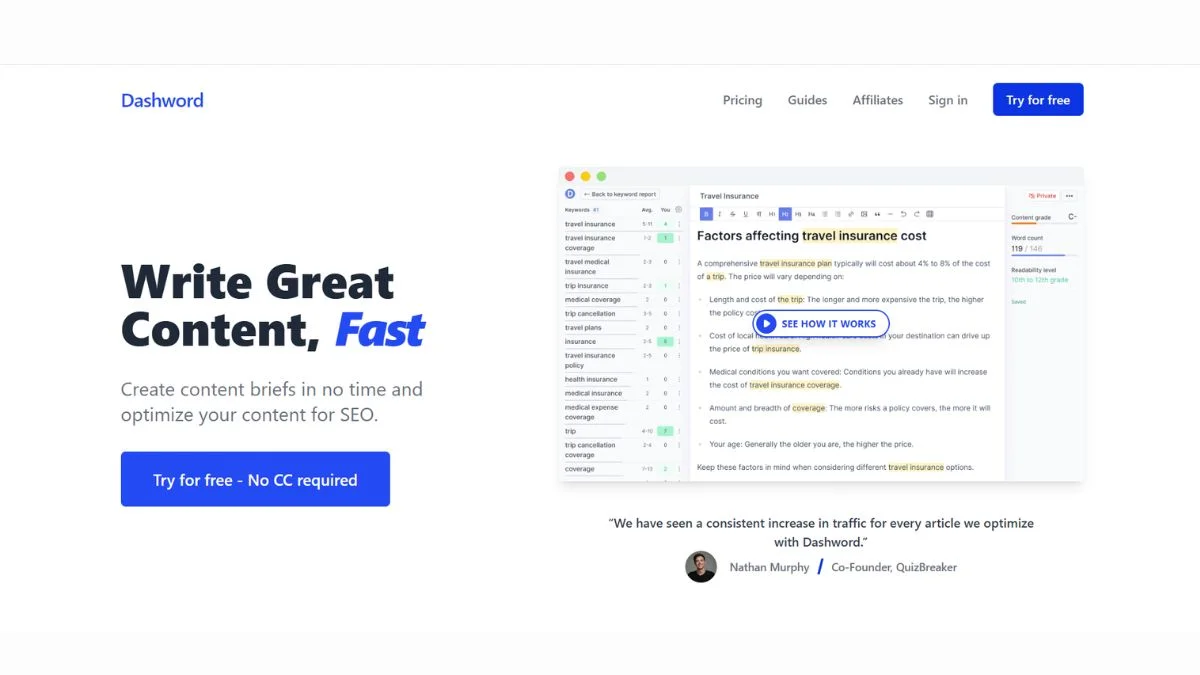
Dashword is an SEO content optimization platform that helps writers hit the right keyword frequency, analyze NLP terms, and benchmark content against top-ranking pages. It's clean, simple, and relatively affordable.
But it has gaps:
- Limited AI writing assistance compared to newer tools
- Fewer integrations with CMS platforms
- No built-in SERP analysis depth for competitive niches
- Basic content briefs that lack structural depth
If you need more power, more flexibility, or a better price-to-value ratio, these alternatives are worth your serious attention.
Quick Comparison Table
| Tool | Best For | AI Writing | Free Plan | Starting Price |
|---|---|---|---|---|
| Surfer SEO | On-page SEO scoring | ✅ Yes | ❌ No | ~$89/mo |
| Frase.io | Content briefs + AI | ✅ Yes | ✅ Limited | $45/mo |
| Clearscope | Enterprise content teams | ❌ Limited | ❌ No | $189/mo |
| MarketMuse | Topic authority building | ✅ Yes | ✅ Free tier | $149/mo |
| NeuronWriter | Budget-friendly optimization | ✅ Yes | ❌ No | $23/mo |
| SEOwind | AI article drafts + SEO | ✅ Yes | ✅ Trial | $49/mo |
| Writesonic | AI content at scale | ✅ Yes | ✅ Free | $16/mo |
| Scalenut | Full SEO workflow | ✅ Yes | ✅ Trial | $39/mo |
| Semrush SEO Writing | Existing Semrush users | ✅ Yes | ❌ (addon) | Included |
| PageOptimizer Pro | Technical on-page SEO | ❌ | ❌ No | $34/mo |
The 10 Best Dashword Alternatives in 2026
1. Surfer SEO — Best Overall for On-Page Optimization
If you've spent any time in the SEO content world, you already know Surfer. It's arguably the most popular content optimization tool on the market right now — and for good reason.
Surfer analyzes the top-ranking pages for your target keyword and gives you a real-time content score as you write. It checks word count, keyword usage, headings, NLP terms, and more.
What makes it different from Dashword? The depth of its SERP analysis and the quality of its Content Editor. Surfer's keyword density recommendations are based on actual top-ranking pages, not just generic NLP extraction.
Best use case: Writers and SEO teams who want a real-time editor that tells you exactly what your content needs to rank — while you're writing it.
Pros:
- Real-time content score with actionable suggestions
- Excellent SERP analyzer and competitor insights
- Integrates with Google Docs and WordPress
- Strong AI outline generator (Surfer AI)
Cons:
- Expensive for solo freelancers ($89/month starting)
- Can feel overwhelming for beginners
- AI writing quality is good but not exceptional
Who should use it: SEO agencies, content teams, and serious bloggers who want a proven, data-driven writing environment.
Key advantage: The live content score. You see your ranking potential improve in real time as you write.
📚 Want to compare Surfer with another top tool? Check out our guide on SEMrush vs Ahrefs: The Ultimate SEO Tool Comparison.
2. Frase.io — Best for AI-Powered Content Briefs
Frase sits in a sweet spot that Dashword misses: it's equally strong at research and writing. You get deep SERP analysis, automated content briefs, and a capable AI writer — all in one workflow.
The brief generation is especially impressive. Frase pulls top-ranking articles, extracts key topics and questions people ask, and builds a structured outline in minutes.
Best use case: Content strategists who need to produce detailed briefs quickly, or solo writers who want AI help from research through to the first draft.
Pros:
- Excellent "People Also Ask" and SERP question extraction
- AI writer is genuinely helpful for first drafts
- Affordable compared to enterprise alternatives
- Clean, easy-to-use interface
Cons:
- AI writing quality is average — still needs heavy editing
- Content scoring is less granular than Surfer
- Limited integrations outside of the platform
Who should use it: Freelance writers, content managers, and small agencies who want an all-in-one brief + writing tool without the Surfer price tag.
Key advantage: The SERP research and brief automation combo. It cuts research time dramatically.
🔗 Explore more writing tools in our Best AI Tools for Content Creators guide.
3. Clearscope — Best for Enterprise Content Teams
Clearscope is the Rolls-Royce of content optimization. It's premium, polished, and used by some of the biggest content teams in the world (think HubSpot, Condé Nast).
The core product is a grading system that evaluates how well your content covers a topic compared to top-ranking pages. The grades (A+, A, B, etc.) give writers a simple, clear target.
Best use case: Large content teams with editors and writers who need a streamlined, consistent optimization workflow across dozens of articles per month.
Pros:
- Industry-leading NLP-based keyword recommendations
- Simple, clean interface that writers actually enjoy
- Excellent for maintaining content quality at scale
- Google Docs and WordPress integrations
Cons:
- Very expensive ($189+/month) — not for individuals
- No built-in AI writing
- Limited SERP research depth compared to Frase or Surfer
Who should use it: Enterprise marketing teams and well-funded agencies where content quality is non-negotiable.
Key advantage: The simplicity of the grading system. Anyone on your team can use it without training.
4. MarketMuse — Best for Building Topical Authority (This one surprises most people)
Most content tools focus on a single article. MarketMuse thinks at the site level — and that's a game-changer.
Its AI analyzes your entire domain and tells you which topics you already have authority in, which gaps you have, and which content to create next to build topical clusters. That's a fundamentally different approach from Dashword.
Best use case: Sites trying to build topical authority in a niche — perfect for blogs, SaaS companies, and publishers who play a long-term SEO game.
Pros:
- Unique topic modeling and content gap analysis
- Shows your competitive position on a topic-by-topic basis
- Strong content briefs with question coverage
- Free tier available (limited)
Cons:
- Expensive at scale ($149+/month for full access)
- Steeper learning curve than simpler tools
- Overkill for a single-page or campaign-focused workflow
Who should use it: SEO strategists, site owners building content hubs, and anyone serious about topical authority.
Key advantage: Domain-level content strategy. No other tool on this list does this as well.
📖 Learn more about content strategy in our How Content Marketing Boosts SEO: The Complete Guide.
5. NeuronWriter — Best Budget-Friendly Dashword Alternative
If price is your primary concern, NeuronWriter is the answer. At around $23/month, it delivers features that rival tools charging 3–4x more.
NeuronWriter uses Google NLP and competitor analysis to build content recommendations. The editor is clean, the recommendations are solid, and the AI writing assistant handles basic drafts reasonably well.
Best use case: Budget-conscious bloggers, affiliate marketers, and freelancers who want serious optimization without serious pricing.
Pros:
- Extremely affordable (AppSumo lifetime deals available)
- Solid NLP recommendations
- Content planner and project management built in
- Regular feature updates
Cons:
- AI writing quality is below Jasper or Writesonic
- Interface feels less polished than Surfer or Clearscope
- Smaller community and support resources
Who should use it: Solo bloggers, affiliate site owners, and anyone who wants strong SEO content tools without enterprise pricing.
Key advantage: The price-to-feature ratio is unmatched in this space. Period.
6. SEOwind — Best for Full AI Article Generation with SEO Data
SEOwind is newer but moving fast. It combines real-time SERP data with AI writing to generate full, structured articles — not just outlines or suggestions.
You input a keyword, it researches the top pages, builds a brief, and then writes a full draft informed by actual ranking data. The output quality is noticeably better than tools that generate content without SEO context.
Best use case: Content teams or agencies that need to produce SEO-optimized first drafts at scale, with less manual research time.
Pros:
- AI drafts informed by real SERP data (not generic)
- Good content brief and outline quality
- Includes internal linking suggestions
- Supports team collaboration
Cons:
- Still maturing — some advanced features feel early-stage
- Output still requires thorough editing before publishing
- Less brand recognition than Surfer or Frase
Who should use it: Agencies and growing content operations who want to speed up first-draft production without sacrificing SEO quality.
Key advantage: The SERP-informed AI generation. It doesn't just write — it writes with context.
🤖 Curious about how AI is transforming content? Read How AI Is Changing SEO.
7. Writesonic — Best for AI Writing at Scale
Writesonic isn't a pure content optimization tool like Dashword — it's heavier on the AI writing side. But with its SEO mode and integrations, it's a legitimate alternative for writers who want AI-assisted creation with some optimization baked in.
The platform generates blog posts, landing pages, ad copy, and more. The SEO article writer uses real-time data to make content more competitive.
Best use case: Content marketers and copywriters who need high-volume output — not just SEO blog posts, but ads, emails, social copy, and more.
Pros:
- Extremely versatile — covers almost every content type
- Affordable free plan available
- Good integration with Surfer SEO for optimization
- Constant model improvements (powered by GPT-4)
Cons:
- Standalone optimization (without Surfer integration) is basic
- Output can be generic without detailed prompting
- Not ideal if pure SEO content analysis is the goal
Who should use it: Marketers, small businesses, and content creators who need an AI writing Swiss Army knife, not just an SEO optimizer.
Key advantage: Range. No other tool on this list covers as many content types.
✍️ See how Writesonic compares in our detailed Best AI Tools for Content Creators roundup.
8. Scalenut — Best End-to-End SEO Workflow
Scalenut wants to be your entire SEO content workflow — from keyword research and content planning to writing, optimization, and publishing. It's ambitious, and it mostly delivers.
The Cruise Mode feature is genuinely impressive: enter a keyword, answer a few questions, and Scalenut generates a full SEO article in minutes, using competitor data to guide the structure and keyword coverage.
Best use case: Growing content teams and agencies who want one platform to handle keyword research, briefs, writing, and optimization without switching tools.
Pros:
- Full workflow in one platform (research → write → optimize)
- Strong keyword clustering and content planning
- Good AI writing quality relative to price
- Free trial available
Cons:
- Can feel like it tries to do too much
- Some features are still being refined
- UI has a learning curve for new users
Who should use it: Marketing teams that are tired of juggling multiple tools and want a single, capable platform.
Key advantage: The end-to-end workflow. Research, write, and optimize without switching tabs.
9. Semrush SEO Writing Assistant — Best for Existing Semrush Users
If you're already paying for Semrush, you may be sleeping on its SEO Writing Assistant add-on. It integrates directly into Google Docs and gives you real-time readability, SEO, originality, and tone scores.
It's not as deep as Surfer or Clearscope for pure optimization, but for existing Semrush subscribers, it's a capable and cost-effective Dashword replacement.
Best use case: Writers and marketers already using Semrush who want content optimization without an additional subscription.
Pros:
- Seamless Google Docs and WordPress integration
- Readability and tone checks alongside SEO
- No extra cost if you already have Semrush
- Good for content optimization basics
Cons:
- Not as powerful as dedicated content optimization tools
- Requires a Semrush subscription to access
- Limited competitor content analysis
Who should use it: Semrush subscribers who write regularly and want a lightweight optimization layer in their existing workflow.
Key advantage: Zero extra cost for Semrush users. It's essentially a free upgrade.
📊 Compare top SEO platforms in our SEMrush vs Ahrefs: Which SEO Tool Wins guide.
10. PageOptimizer Pro (POP) — Best for Technical On-Page SEO
PageOptimizer Pro takes a different angle entirely. Rather than NLP-based keyword recommendations, it uses a factor-based scoring system grounded in detailed analysis of Google's ranking signals.
POP tells you exactly where to place keywords — in titles, H tags, body text, image alt text — based on what's working for the pages already ranking. It's arguably the most technically rigorous tool on this list.
Best use case: SEO professionals and technical writers who want precise, data-backed on-page instructions — not general keyword suggestions.
Pros:
- Highly precise, technical recommendations
- Factor-by-factor analysis of ranking signals
- More affordable than Surfer for similar depth
- Excellent for optimizing existing pages
Cons:
- Steeper learning curve — not beginner-friendly
- Less AI writing support
- Interface is functional but not beautiful
Who should use it: Technical SEOs, experienced bloggers, and anyone optimizing existing content rather than writing from scratch.
Key advantage: The technical precision. If you want to know exactly why a page isn't ranking, POP tells you.
🔧 Pair this with our How to Do an SEO Audit for Your Website guide for maximum impact.
Pro Tips: Getting the Most from Any Content Optimization Tool
Before you pick a tool, a few honest insights from real-world use:
1. Your content still needs to be good. No tool compensates for thin, unhelpful writing. Google's Helpful Content system rewards genuine expertise. Use these tools to enhance good writing, not replace it.
2. Don't chase the score blindly. A content score of 85 doesn't guarantee ranking. Focus on actually answering the reader's question better than competing pages.
3. Combine tools strategically. Many top content teams use Frase for research and briefs, Surfer for optimization, and a separate AI writer for drafts. You don't have to pick just one.
4. Optimize old content first. If you have existing pages sitting at positions 5–20, optimizing those with any of these tools will deliver faster results than creating new content.
5. Free trials are genuinely useful. Most tools on this list offer trials. Run the same article through 2–3 tools before committing — the experience will tell you more than any review.
📈 For a complete strategy, read our On-Page SEO Techniques That Actually Work and How to Update Old Content for SEO.
Which Dashword Alternative Should You Choose?
Still not sure? Here's a quick decision framework:
- Tight budget? → NeuronWriter
- Best overall value? → Surfer SEO or Frase.io
- Need full AI article generation? → Scalenut or SEOwind
- Already use Semrush? → SEO Writing Assistant
- Building topical authority? → MarketMuse
- Enterprise content team? → Clearscope
- Technical SEO focus? → PageOptimizer Pro
- Need AI for all content types? → Writesonic
There's no single "best" tool — only the best tool for your specific situation.
Related Reads You'll Find Useful
Building your SEO content strategy takes more than one good tool. Here are some resources worth bookmarking:
- Free Website SEO Checker: The Definitive Guide
- How to Do Keyword Research Without Paying for Expensive Tools
- Best Free Backlink Checker Tools
- SEO for Beginners: The Ultimate Step-by-Step Guide
- How to Write SEO-Friendly Meta Descriptions
- How to Optimize Title Tags for SEO
- What Is On-Page SEO: The Complete Beginner's Guide
- How to Improve CTR with SEO Titles
- How to Use LSI Keywords in On-Page SEO
- Best Practices for Internal Linking in SEO
- How Internal Linking Boosts SEO Score
- Image Optimization Tips for On-Page SEO
- URL Structure Best Practices for SEO
- How to Optimize Your Blog Posts for SEO
- How to Add Schema Markup for On-Page SEO
- How to Create SEO-Friendly Landing Pages
- How to Improve Content Readability for SEO
- How to Avoid Duplicate Content on Your Site
- On-Page SEO Checklist: The Complete Guide
- SEO Tools: 10 Powerful Free Tools That Actually Work
- Top 10 Free SEO Tools for Beginners in 2025
- 9 SEO Checker Tools You Must Use
- AI Tools: 7 Game-Changers for Explosive SEO in 2025
- Does AI-Generated Content Hurt Your SEO?
- How to Use Content Silos for On-Page SEO
- How to Optimize Blog Categories for SEO
- Essential Content Optimization Practices Every Marketer Should Know
- Best AI Coding Assistants (for devs building content tools)
- Best AI Tools Complete Guide with Pros & Cons
- Free SEO Checker Online: 20 Best Google & YouTube SEO Tools
FAQ: Dashword Alternatives
What is the best free alternative to Dashword?
The best free alternative to Dashword is Frase.io's limited free plan or the Semrush SEO Writing Assistant if you already have a Semrush account. NeuronWriter, while not free, is the most affordable paid option at around $23/month and delivers strong optimization features comparable to Dashword.
For writers on a strict budget, combining Google's free tools — Search Console, Keyword Planner, and People Also Ask research — with a basic grammar checker can cover the fundamentals without any cost.
Is Surfer SEO better than Dashword?
Yes, in most cases Surfer SEO is more powerful than Dashword — particularly for real-time content scoring, NLP keyword recommendations, and competitor analysis. However, Dashword is simpler and more affordable, making it reasonable for writers who just need basic guidance without Surfer's feature depth.
If budget allows, Surfer's data depth and live scoring make it the stronger long-term choice for anyone serious about ranking consistently.
Can I replace Dashword with a free AI writing tool?
Not completely. Free AI writing tools like ChatGPT can help you draft content, but they don't provide the SEO analysis, competitor benchmarking, or keyword optimization scoring that Dashword offers. You'd need to combine a free AI writer with a separate (even free-tier) SEO analysis tool to replicate Dashword's core functionality.
For serious SEO content work, a dedicated optimization tool is worth the investment.
Which Dashword alternative is best for beginners?
Frase.io is the most beginner-friendly Dashword alternative. Its interface is clean, its content briefs are intuitive, and the SERP question extraction feature teaches beginners what to write about, not just how to write it. NeuronWriter is a close second for budget-conscious beginners.
Avoid tools like MarketMuse or PageOptimizer Pro until you're comfortable with SEO fundamentals — they're powerful but have steeper learning curves.
What's the difference between Dashword and Clearscope?
The main differences are depth, price, and target audience. Clearscope uses more sophisticated NLP to grade content, has a simpler grading interface (A+ to F), and is designed for enterprise content teams. Dashword is more affordable and more accessible but delivers less granular analysis.
If you're running a high-volume content operation where consistency and quality control matter at scale, Clearscope justifies its premium price. For individual writers or small teams, Dashword or any of the mid-tier alternatives make more practical sense.
Does Google penalize AI-optimized content?
No — Google doesn't penalize content for being optimized. What Google penalizes is content that's unhelpful, thin, or clearly written for search engines rather than people. Using content optimization tools like Dashword or its alternatives is perfectly fine as long as your content genuinely helps readers.
Google's Helpful Content guidance is clear: quality and reader value come first. Optimization tools are just a way to make good content more discoverable.
Conclusion: Pick the Right Tool for Your Workflow
Dashword is a capable content optimization tool — but it's not the only option, and for many writers and teams, it's not even the best one.
Here's what to remember:
- For the best overall value: Surfer SEO or Frase.io
- For budget-conscious users: NeuronWriter
- For end-to-end workflow: Scalenut
- For enterprise teams: Clearscope
- For topic authority building: MarketMuse
- For technical precision: PageOptimizer Pro
The right tool depends on your goals, your budget, and how you work. Most offer free trials — don't commit until you've tested at least two options on a real article.
Ready to level up your content? Start with our SEO Checklist for Beginners or run your site through our free Website SEO Score Checker to see where your content stands today.