What Is On-Page SEO: The Complete Beginner's Guide

What Is On-Page SEO: The Complete Beginner's Guide
On-page SEO is the foundation of every successful digital marketing strategy. Whether you're launching a new website or trying to improve your existing rankings, understanding on-page optimization is absolutely critical. This comprehensive guide will walk you through everything you need to know about on-page SEO, from basic concepts to advanced techniques that drive real results.
What Is On-Page SEO?
On-page SEO (also called on-site SEO) refers to the practice of optimizing individual web pages to rank higher in search engines and earn more relevant traffic. Unlike off-page SEO, which focuses on external signals like backlinks, on-page SEO involves everything you can control directly on your website.
This includes optimizing your content, HTML source code, site architecture, and user experience elements. When done correctly, on-page SEO helps search engines understand your content better and provides a superior experience for your visitors.
According to Moz, on-page factors are among the most important ranking signals that search engines use to determine where your pages should appear in search results.
Why On-Page SEO Matters
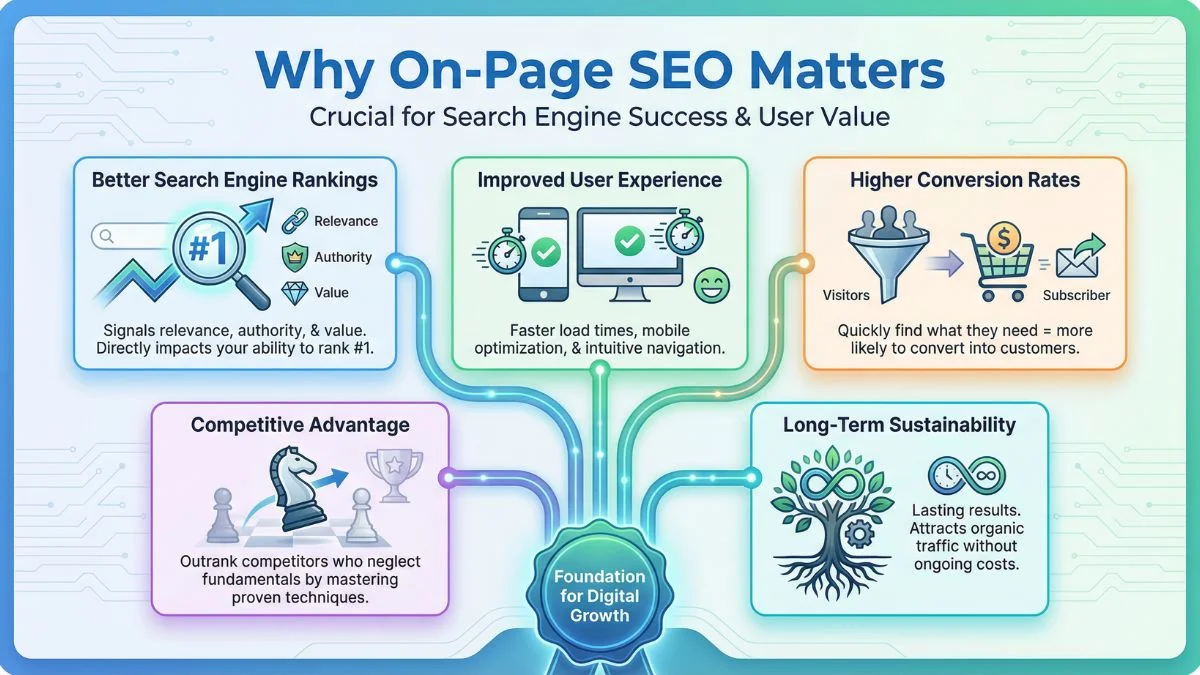
Search engines have evolved dramatically over the past decade. Google's algorithms now prioritize user experience, content quality, and technical excellence more than ever before. Here's why on-page SEO is crucial:
Better Search Engine Rankings: Proper on-page optimization signals to search engines that your content is relevant, authoritative, and valuable. This directly impacts your ability to rank #1 on Google.
Improved User Experience: On-page SEO isn't just about pleasing algorithms. It's about creating a better experience for your visitors through faster load times, mobile optimization, and intuitive navigation.
Higher Conversion Rates: When users find exactly what they're looking for quickly and easily, they're more likely to convert into customers or subscribers.
Competitive Advantage: Most websites still have significant on-page SEO issues. By mastering on-page SEO techniques that actually work, you can outrank competitors who neglect these fundamentals.
Long-Term Sustainability: Unlike paid advertising, on-page SEO provides lasting results. Once you've optimized your pages, they continue to attract organic traffic without ongoing costs.
Understanding Search Engine Ranking Factors
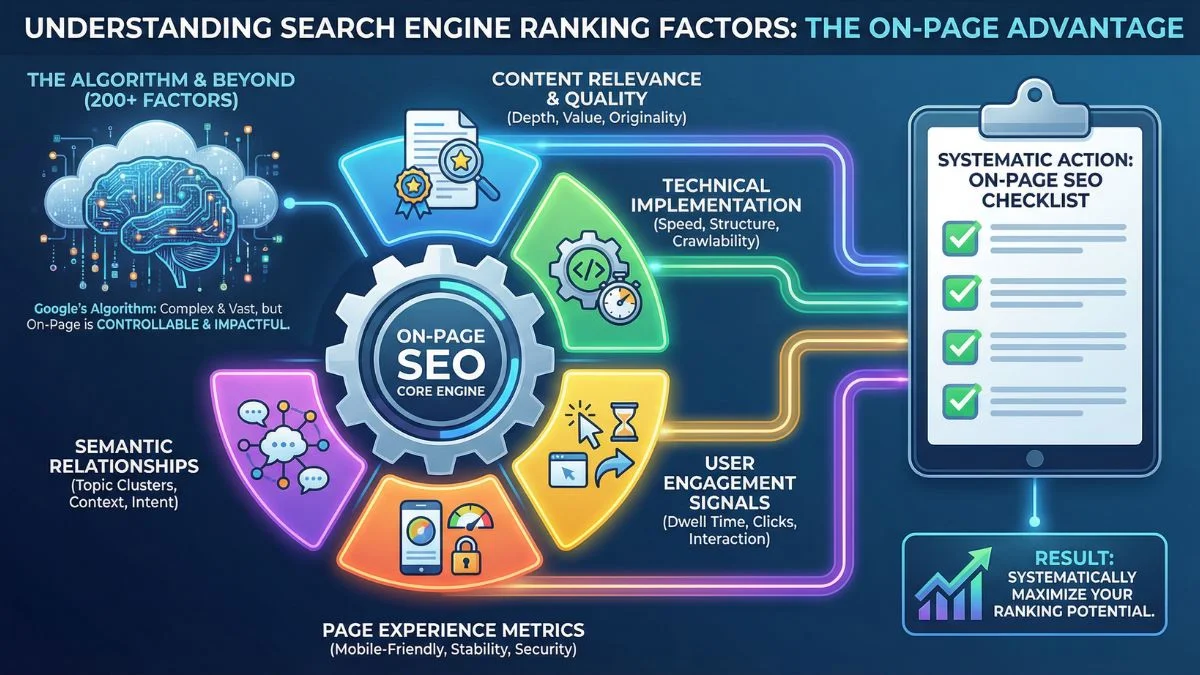
Before diving into specific tactics, it's important to understand how search engines rank websites. Google uses over 200 ranking factors in its algorithm, but on-page elements are among the most controllable and impactful.
Search engines evaluate:
- Content relevance and quality
- Technical implementation
- User engagement signals
- Page experience metrics
- Semantic relationships between topics
When you follow an on-page SEO checklist, you systematically address each of these factors to maximize your ranking potential.
Core Elements of On-Page SEO
1. Content Quality and Relevance
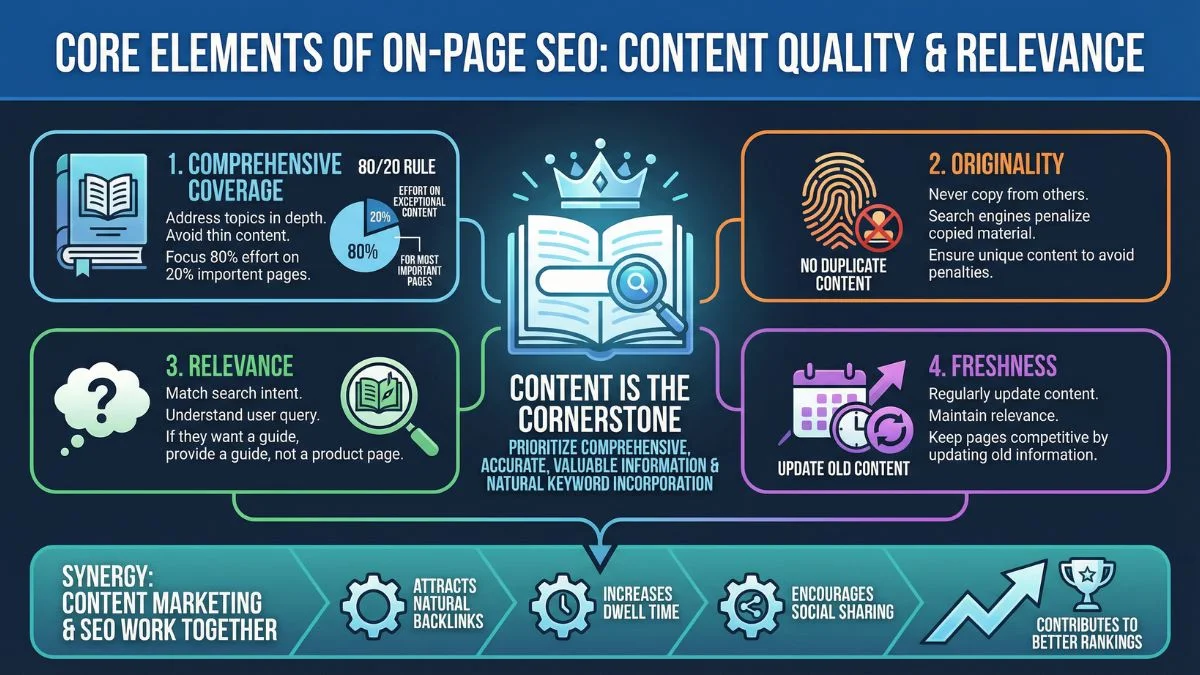
Content is the cornerstone of on-page SEO. Search engines prioritize pages that provide comprehensive, accurate, and valuable information to users. Your content should thoroughly answer user queries while naturally incorporating target keywords.
Key considerations for content optimization:
Comprehensive Coverage: Address topics in depth rather than creating thin content. Use the 80/20 rule where you focus 80% of your effort on creating exceptional content for 20% of your most important pages.
Originality: Never duplicate content from other sources. Search engines penalize sites with copied material, so learning how to avoid duplicate content on your site is essential.
Relevance: Ensure your content matches search intent. If users are looking for a guide, don't give them a product page. Understanding user intent is fundamental to SEO for beginners.
Freshness: Regularly update your content to maintain relevance. Learn how to update old content for SEO to keep your pages competitive.
Content marketing and SEO work together synergistically. High-quality content attracts natural backlinks, increases dwell time, and encourages social sharing—all of which contribute to better rankings.
2. Title Tag Optimization
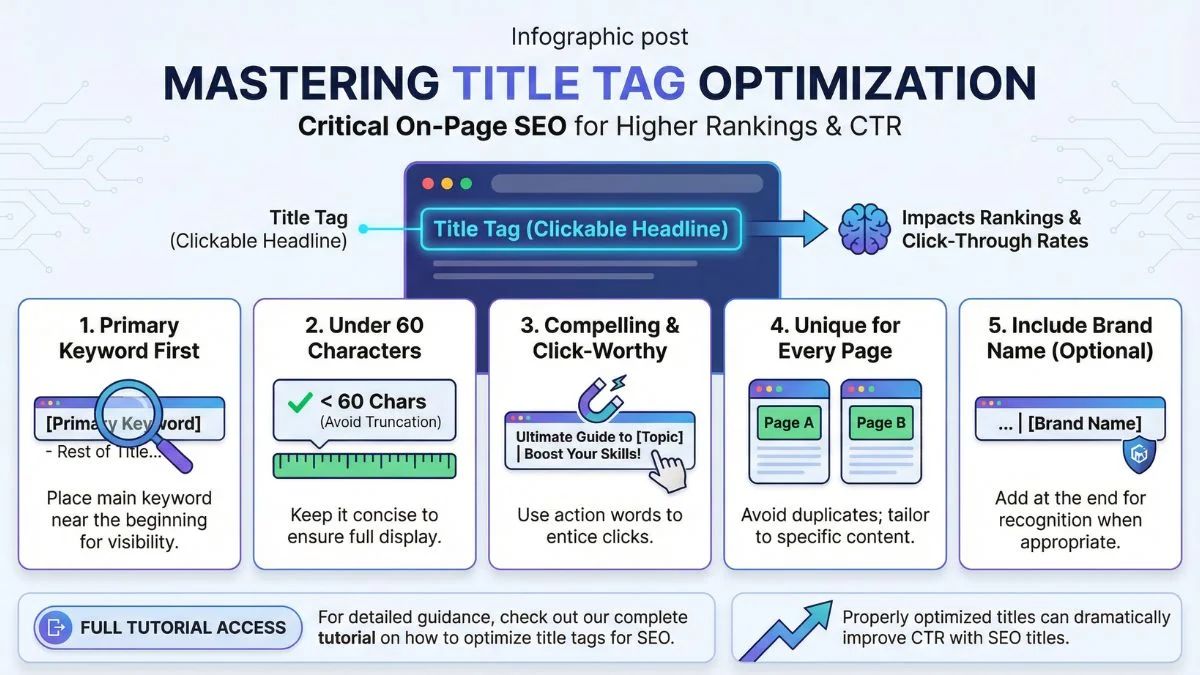
The title tag is one of the most critical on-page SEO elements. It appears in search results as the clickable headline and significantly impacts both rankings and click-through rates.
Best practices for title tags:
- Include your primary keyword near the beginning
- Keep titles under 60 characters to avoid truncation
- Make titles compelling and click-worthy
- Write unique titles for every page
- Include your brand name when appropriate
For detailed guidance, check out our complete tutorial on how to optimize title tags for SEO. Properly optimized titles can dramatically improve CTR with SEO titles.
3. Meta Description Optimization
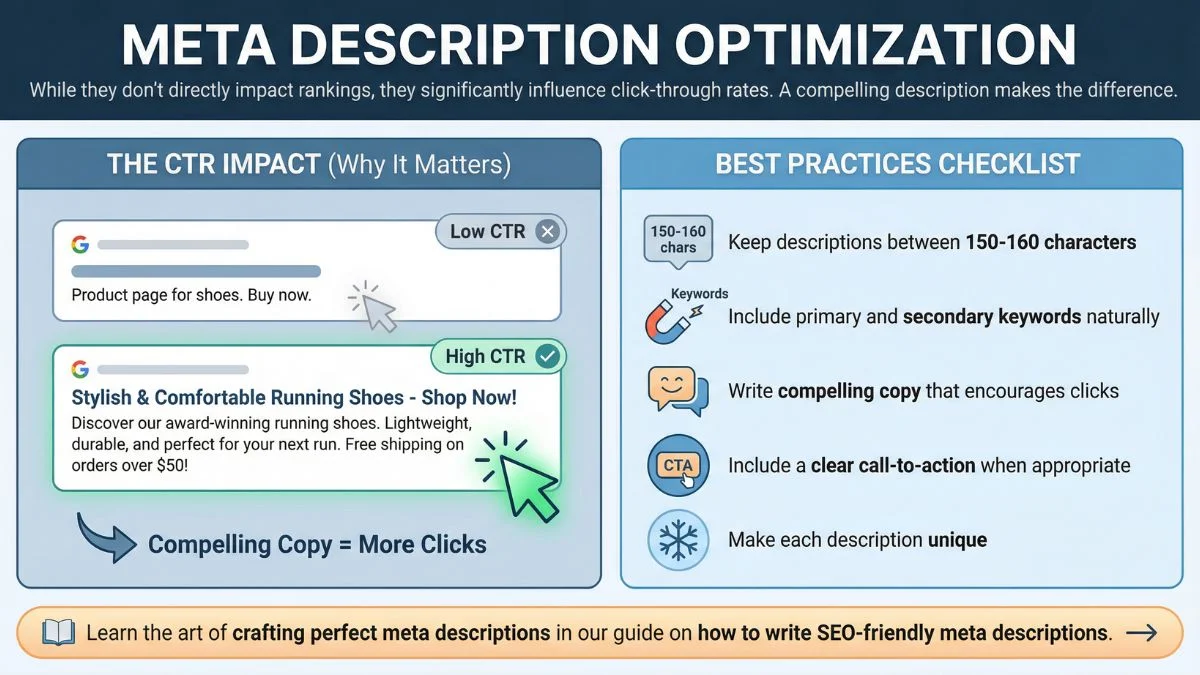
While meta descriptions don't directly impact rankings, they significantly influence click-through rates. A compelling meta description can make the difference between a user clicking your result or your competitor's.
Meta description best practices:
- Keep descriptions between 150-160 characters
- Include primary and secondary keywords naturally
- Write compelling copy that encourages clicks
- Include a clear call-to-action when appropriate
- Make each description unique
Learn the art of crafting perfect meta descriptions in our guide on how to write SEO-friendly meta descriptions.
4. Header Tags (H1-H6) Structure
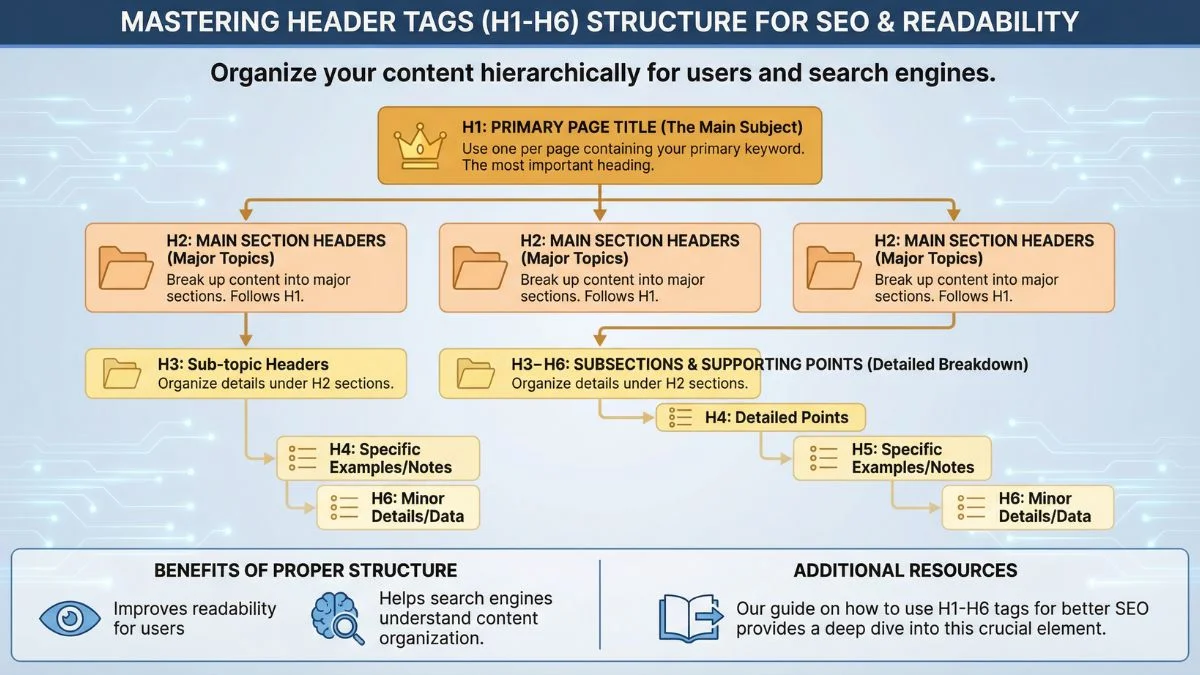
Header tags organize your content hierarchically, making it easier for both users and search engines to understand your page structure. They also provide valuable context about your content's topics and subtopics.
Header tag hierarchy:
- H1: Use one H1 per page containing your primary keyword
- H2: Main section headers that break up your content
- H3-H6: Subsections and supporting points
Proper header structure improves readability and helps search engines understand content organization. Our guide on how to use H1-H6 tags for better SEO provides a deep dive into this crucial element.
5. URL Structure Optimization
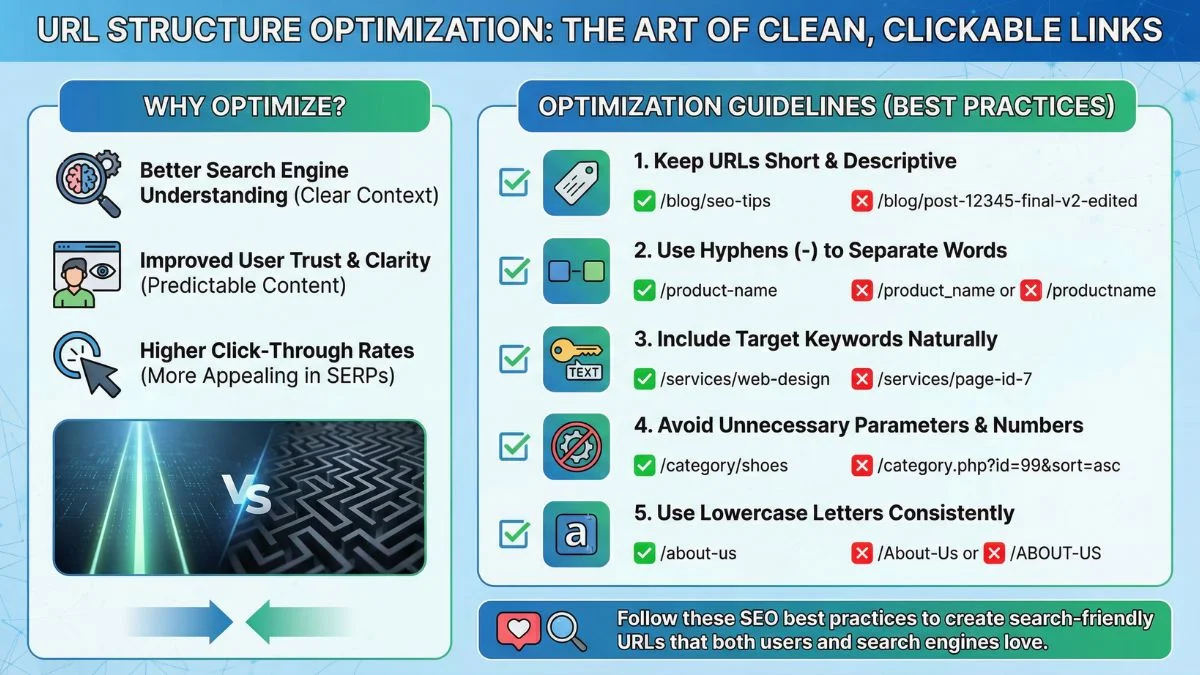
Clean, descriptive URLs help search engines and users understand what a page is about before even visiting it. Well-structured URLs also earn higher click-through rates in search results.
URL optimization guidelines:
- Keep URLs short and descriptive
- Use hyphens to separate words
- Include target keywords when natural
- Avoid unnecessary parameters and numbers
- Use lowercase letters consistently
Follow URL structure best practices for SEO to create search-friendly URLs that both users and search engines love.
6. Keyword Optimization and Placement
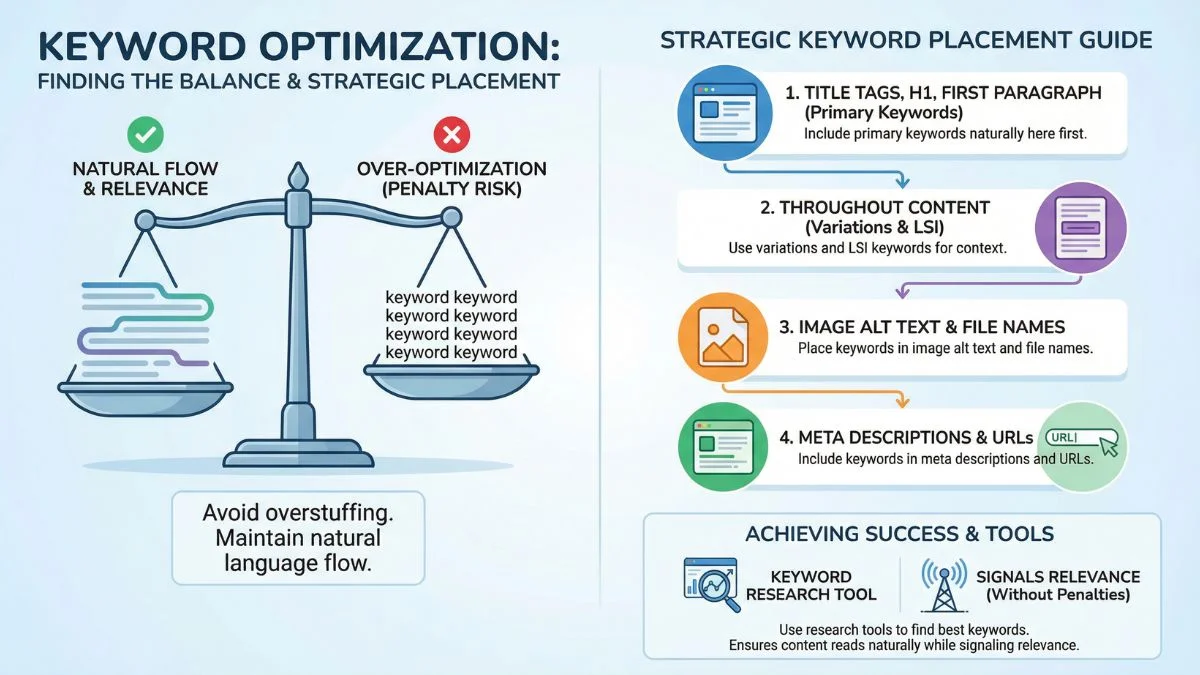
Effective keyword usage is about balance. You need to include keywords naturally while avoiding over-optimization that can trigger penalties.
Strategic keyword placement:
- Include primary keywords in title tags, H1, first paragraph
- Use variations and LSI keywords throughout content
- Place keywords in image alt text and file names
- Include keywords in meta descriptions and URLs
- Maintain natural language flow
Understanding how to use keywords for SEO effectively is essential for success. You can also use a keyword research tool to find the best keywords for your content.
Maintaining proper keyword density without overstuffing ensures your content reads naturally while still signaling relevance to search engines.
7. Internal Linking Strategy
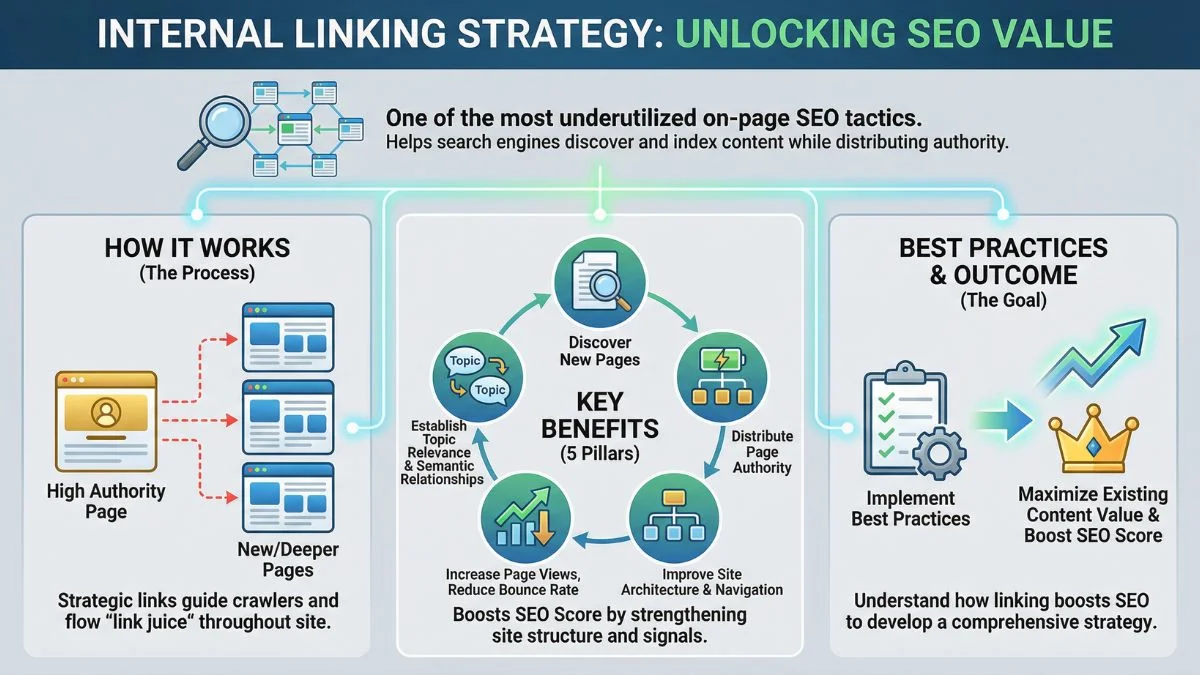
Internal linking is one of the most underutilized on-page SEO tactics. Strategic internal links help search engines discover and index your content while distributing page authority throughout your site.
Internal linking benefits:
- Helps search engines discover new pages
- Distributes page authority across your site
- Improves site architecture and navigation
- Increases page views and reduces bounce rate
- Establishes topic relevance and semantic relationships
Implement best practices for internal linking in SEO to maximize the value of your existing content. Understanding how internal linking boosts SEO score will help you develop a comprehensive linking strategy.
8. Image Optimization
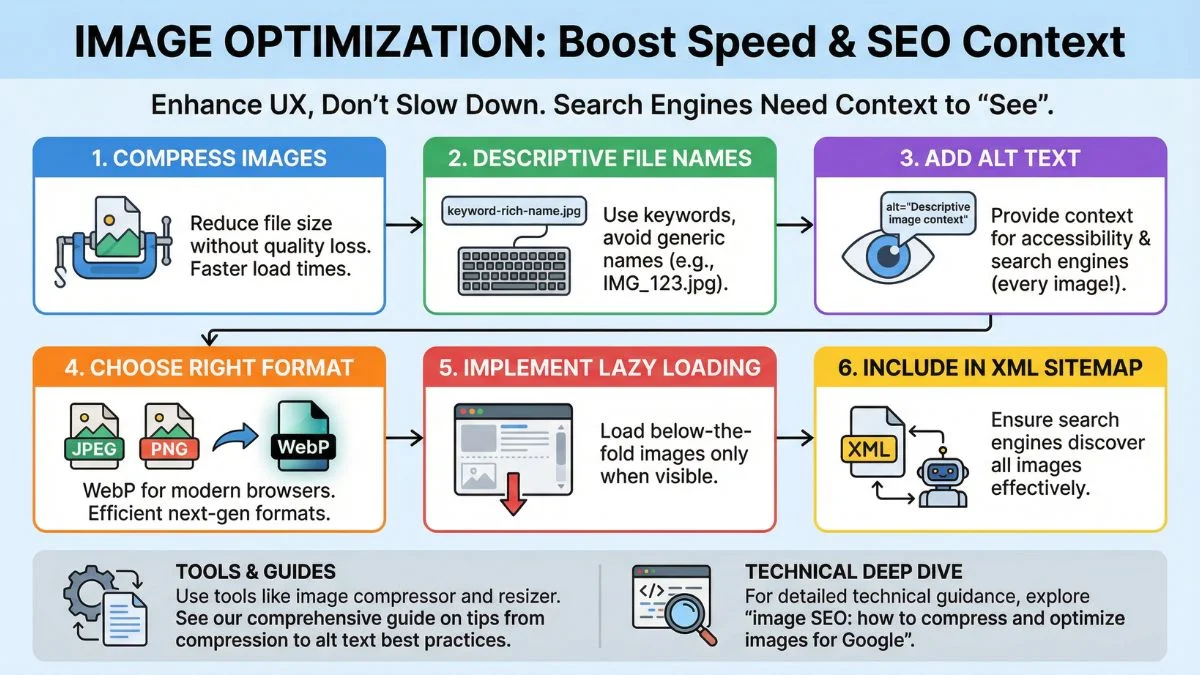
Images enhance user experience but can also slow down your site if not properly optimized. Search engines can't "see" images like humans do, so you must provide context through file names, alt text, and structured data.
Image optimization checklist:
- Compress images to reduce file size without quality loss
- Use descriptive, keyword-rich file names
- Add alt text to every image
- Choose the right file format (WebP for modern browsers)
- Implement lazy loading for below-the-fold images
- Include images in your XML sitemap
Our comprehensive guide on image optimization tips for on-page SEO covers everything from compression to alt text best practices. You can also use tools like image compressor and image resizer to optimize images quickly.
For detailed technical guidance, explore image SEO: how to compress and optimize images for Google.
9. Content Readability and User Experience
Search engines increasingly prioritize user experience signals. Content that's easy to read and navigate keeps visitors engaged longer, sending positive signals to search engines.
Readability optimization techniques:
- Use short paragraphs (2-3 sentences)
- Include bullet points and numbered lists
- Add relevant images and visual breaks
- Use clear, conversational language
- Break up text with descriptive subheadings
Learn how to improve content readability for SEO to keep visitors engaged and reduce bounce rates. This directly impacts how SEO helps improve user experience.
10. Schema Markup and Structured Data
Schema markup helps search engines understand your content's context and can enable rich snippets in search results. Rich snippets often achieve higher click-through rates and visibility.
Common schema types:
- Article schema for blog posts
- Product schema for e-commerce
- FAQ schema for question-based content
- Review schema for ratings and testimonials
- Local business schema for location-based businesses
Follow our tutorial on how to add schema markup for on-page SEO to implement structured data correctly.
11. Mobile Optimization
With mobile-first indexing, Google primarily uses your mobile site for ranking and indexing. If your site isn't mobile-friendly, you're at a severe disadvantage.
Mobile optimization essentials:
- Responsive design that adapts to all screen sizes
- Fast mobile load times
- Touch-friendly buttons and navigation
- Readable text without zooming
- Properly sized images
Use our mobile friendly test to check your site's mobile performance. For improvement strategies, read our guide on smart ways to improve mobile SEO.
Understanding why mobile SEO matters will motivate you to prioritize mobile optimization in your strategy.
12. Page Speed Optimization
Page speed is a confirmed ranking factor and critically impacts user experience. Slow pages frustrate users and lead to high bounce rates.
Speed optimization strategies:
- Minimize HTTP requests
- Enable compression (GZIP)
- Optimize and compress images
- Minify CSS, JavaScript, and HTML
- Leverage browser caching
- Use a Content Delivery Network (CDN)
Check your site's compression status with our GZIP compression checker. For code optimization, use our HTML minifier, CSS minifier, and JavaScript minifier.
Discover proven ways to improve Core Web Vitals and implement speed hacks for lightning-fast sites. Our article on site speed: killer tips to instantly boost UX provides actionable strategies.
Learn quick fixes to optimize page load and discover speed optimization tips for developers.
Advanced On-Page SEO Techniques
Content Silos and Topic Clusters
Content silos organize your website into thematic groups, establishing topical authority and improving internal linking structure. This architectural approach helps search engines understand your expertise.
A content silo consists of:
- Pillar pages covering broad topics
- Supporting content pages diving into subtopics
- Strategic internal links connecting related content
Implementing site architecture tweaks that work can significantly improve your site's crawlability and user navigation.
Featured Snippet Optimization
Featured snippets appear at the top of search results, earning position zero and capturing significant traffic. Optimizing for featured snippets requires specific formatting and content strategies.
Snippet optimization tactics:
- Answer questions concisely in 40-60 words
- Use lists, tables, and step-by-step formats
- Include question-based headings
- Provide clear, authoritative answers
- Structure content for easy extraction
Understanding zero-click SEO helps you optimize for all SERP features, not just traditional organic results.
Canonical Tags
Canonical tags tell search engines which version of a page is the primary one when you have duplicate or similar content. This prevents duplicate content penalties and consolidates ranking signals.
Meta Robots Tags
Meta robots tags control how search engines crawl and index your pages. Common directives include noindex, nofollow, noarchive, and nosnippet.
Blog Category Optimization
Don't overlook category pages. Learning how to optimize blog categories for SEO can turn these often-neglected pages into ranking powerhouses.
Page Layout and Design
Your page layout affects SEO more than you might think. Proper layout ensures important content is easily accessible, improves user engagement, and helps search engines understand content hierarchy.
Creating SEO-Friendly Landing Pages
Landing pages require special attention to on-page optimization. Learn how to create SEO-friendly landing pages that convert visitors while ranking well in search results.
Landing page optimization includes:
- Clear value propositions
- Focused keyword targeting
- Strong calls-to-action
- Trust signals and social proof
- Fast load times and mobile responsiveness
Optimizing Blog Posts for Maximum Impact
Optimizing blog posts for SEO requires a systematic approach that balances user value with technical optimization. Every blog post should target specific keywords, provide comprehensive information, and include strategic internal and external links.
Essential On-Page SEO Tools
Having the right tools makes on-page optimization efficient and effective. Here are essential tools for on-page SEO:
Analysis Tools:
- Website SEO Score Checker - Evaluate your overall SEO performance
- Meta Tag Analyzer - Check meta tag implementation
- SERP Checker - Analyze search engine rankings
Technical Tools:
- SSL Checker - Verify HTTPS implementation
- Find DNS Record - Check DNS configuration
- Spider Simulator - See your site as search engines do
Content Tools:
- Related Keywords Finder - Discover semantic keywords
- Case Converter - Format text correctly
- Online Text Editor - Create and edit content
Development Tools:
- XML Sitemap Generator - Create search engine sitemaps
- Robots.txt Checker - Verify crawl directives
- JSON Validator - Check structured data
For a comprehensive toolkit, explore our collection of free SEO tools.
Measuring On-Page SEO Success
You can't improve what you don't measure. Tracking the right SEO metrics helps you understand what's working and what needs adjustment.
Key performance indicators:
- Organic traffic growth
- Keyword rankings
- Click-through rates
- Bounce rate and dwell time
- Conversion rates
- Page load speed
- Mobile usability metrics
Learn how to track SEO performance with analytics and how to measure SEO success effectively.
Understanding what is a good SEO score and how SEO score is calculated helps you set realistic benchmarks. Many wonder "is 75 a good SEO score?" - our guide provides industry context.
Regularly check how SEO impacts your website traffic to understand ROI.
Common On-Page SEO Mistakes to Avoid
Even experienced marketers make on-page SEO mistakes. Avoid these common pitfalls:
1. Keyword Stuffing
Overusing keywords makes content unreadable and triggers Google penalties. Focus on natural language and user value.
2. Thin Content
Pages with minimal content rarely rank well. Provide comprehensive, valuable information that thoroughly addresses user needs.
3. Duplicate Content
Never copy content from other sources. Create original content or learn how to avoid duplicate content.
4. Neglecting Mobile Users
With mobile-first indexing, ignoring mobile optimization is a critical mistake. Ensure your site works flawlessly on all devices.
5. Slow Page Speed
Slow sites frustrate users and hurt rankings. Identify page speed killers slowing you down and fix them immediately.
6. Poor Internal Linking
Many sites fail to leverage internal linking effectively. Develop a strategic linking structure that distributes authority and helps users navigate.
7. Missing or Poor Meta Tags
Don't neglect title tags and meta descriptions. These elements significantly impact click-through rates.
8. Ignoring Technical SEO
On-page SEO includes technical elements. Learn about technical SEO secrets to ensure your site is technically sound.
For more guidance, review these articles on SEO mistakes killing your rankings, deadly SEO habits to break now, and SEO blunders that crush conversions.
Conducting a Comprehensive SEO Audit
Regular audits help identify and fix on-page issues before they impact rankings. Follow our website audit checklist 2025 and learn how to do an SEO audit for your website.
Use SEO checker tools you must use and discover audit tips to fix SEO issues fast.
Our free website SEO checker provides comprehensive analysis of your on-page elements.
Developing Your On-Page SEO Strategy
A systematic approach to on-page SEO yields better results than random optimization. Learn how to develop an effective SEO strategy that incorporates all on-page elements.
For new websites, follow this 30-day SEO plan to establish a strong foundation. SEO for startups requires special attention to resource allocation and priority setting.
Implement proven SEO tips to skyrocket traffic and discover easy SEO fixes that work like magic.
On-Page SEO vs. Off-Page SEO vs. Technical SEO
Understanding the differences helps you allocate resources effectively:
On-Page SEO: Elements you control on your pages (content, meta tags, internal links)
Off-Page SEO: External factors like backlinks, social signals, and brand mentions
Technical SEO: Site infrastructure, crawlability, indexation, and performance
All three work together. Understanding SEO vs SEM and SEO vs paid ads helps you make informed marketing decisions.
The Future of On-Page SEO
On-page SEO continues evolving. Stay ahead by understanding emerging trends:
AI and Machine Learning
How AI is changing SEO impacts how we create and optimize content. AI tools can enhance your workflow, but human oversight remains essential.
Voice Search Optimization
How voice search affects SEO strategy requires optimizing for conversational queries and question-based keywords.
Core Web Vitals
Google's Core Web Vitals measure user experience through specific performance metrics. Discover key fixes for blazing SEO success.
E-A-T (Expertise, Authoritativeness, Trustworthiness)
Google increasingly values content created by experts. Demonstrate your expertise through comprehensive content, author bios, and credible sources.
Stay current with hot SEO trends dominating the industry and understand why SEO is still relevant.
Advanced Technical Considerations
Crawl Budget Optimization
Large sites must optimize how search engines crawl their pages. Learn about crawl budget tips that matter to ensure important pages get indexed.
Fixing Crawl Errors
Powerful fixes for crawl errors help search engines access your content without issues.
Robots.txt Configuration
Key tips for robots.txt perfection ensure search engines crawl your site correctly.
Broken Links
Smart ways to fix broken links maintain your site's integrity and user experience.
Bounce Rate Reduction
High bounce rates signal poor user experience. Implement proven tips to reduce bounce rate and keep visitors engaged.
Practical Implementation Guide
Step 1: Conduct Keyword Research
Start with comprehensive keyword research using tools like our keyword research tool. Look for opportunities with good search volume and achievable competition.
Learn how to do keyword research without paying for expensive tools.
Step 2: Optimize Existing Content
Audit your current content and update pages with the highest potential. Focus on updating old content for SEO to breathe new life into existing assets.
Step 3: Create New Optimized Content
When creating new content, follow your on-page SEO checklist to ensure nothing is missed.
Step 4: Build Internal Link Architecture
Develop a strategic internal linking plan that connects related content and distributes authority throughout your site.
Step 5: Monitor and Refine
Continuously monitor performance and make data-driven adjustments. SEO is an ongoing process, not a one-time project.
Real-World Application Strategies
For E-commerce Sites
E-commerce sites have unique on-page requirements including product descriptions, category pages, and structured data. Each product page needs unique, compelling content that includes target keywords naturally.
For Local Businesses
Local businesses should optimize for location-based keywords, implement local business schema, and create location-specific landing pages.
For Blogs and Content Sites
Content sites should focus on comprehensive topic coverage, strategic internal linking between related posts, and regular content updates.
For SaaS Companies
SaaS sites need feature pages optimized for specific use cases, comparison pages targeting competitive keywords, and educational content addressing user pain points.
Getting Started: Your Action Plan
Ready to implement on-page SEO? Here's your action plan:
- Week 1: Conduct a comprehensive site audit using our website SEO score checker
- Week 2: Optimize title tags and meta descriptions across your top pages
- Week 3: Improve page speed and mobile usability
- Week 4: Enhance internal linking and content structure
Follow smart SEO rules every site must follow and implement expert SEO tricks Google loves.
For quick wins, try these powerful SEO moves for an instant boost and killer SEO hacks for 2025 success.
Understanding the Bigger Picture
On-page SEO doesn't exist in isolation. Understanding what is SEO and why it matters and how SEO helps grow your business online provides important context.
Learn about the 80/20 rule in SEO to focus your efforts on high-impact activities.
For those wondering about costs and ROI, discover how to rank your website without spending on ads.
Additional Resources and Learning
Continue your SEO education with these resources:
- Browse our complete SEO blog for the latest tips and strategies
- Check out top Backlinko SEO strategies for advanced tactics
- Use our comprehensive suite of free SEO tools for ongoing optimization
Frequently Asked Questions About On-Page SEO
1. What is the difference between on-page and off-page SEO?
On-page SEO refers to optimization techniques you control directly on your website, including content, HTML elements, site structure, and user experience. Off-page SEO involves external factors like backlinks, social signals, and brand mentions that occur outside your website. Both are essential for ranking success, but on-page SEO provides the foundation.
2. How long does it take to see results from on-page SEO?
Typically, you can start seeing results from on-page SEO within 3-6 months, though this varies based on competition, domain authority, and content quality. Quick wins like fixing technical errors might show results in weeks, while competitive keyword rankings may take 6-12 months. Consistent optimization and patience are key.
3. Can I do on-page SEO myself, or do I need to hire an expert?
You can definitely do on-page SEO yourself, especially with the comprehensive guides and tools available. Start with our SEO for beginners guide and use our free SEO tools. However, complex sites or competitive industries may benefit from expert consultation.
4. What's the most important on-page SEO factor?
While all factors matter, content quality is arguably the most important on-page SEO element. High-quality, comprehensive content that genuinely answers user queries forms the foundation. However, technical elements like page speed and mobile optimization are also critical in today's mobile-first world.
5. How often should I update my on-page SEO?
Conduct a comprehensive audit quarterly, but monitor your site monthly for issues. Update content when information becomes outdated, when competitors outrank you, or when search intent changes. Major algorithm updates may also necessitate adjustments to your on-page strategy.
6. Does social media affect on-page SEO?
Social media doesn't directly impact on-page SEO rankings, but it influences off-page signals. Social shares can increase content visibility, drive traffic, and potentially earn backlinks. Focus on creating shareable content, but don't rely solely on social media for SEO success.
7. How many keywords should I target per page?
Focus on one primary keyword and 2-4 secondary/related keywords per page. This allows you to create focused, comprehensive content without diluting your message. Use LSI keywords naturally throughout to provide context and depth.
8. Is there an ideal word count for SEO?
There's no magic number, but comprehensive content typically performs better. Aim for at least 1,000 words for standard pages and 2,000+ words for pillar content and competitive topics. However, quality always trumps quantity—don't add fluff just to hit a word count.
9. How do I optimize images without losing quality?
Use compression tools like our image compressor to reduce file size while maintaining visual quality. Convert images to modern formats like WebP, implement lazy loading, and always include descriptive alt text. Properly sized images dramatically improve page speed without sacrificing appearance.
10. What is keyword density, and does it still matter?
Keyword density is the percentage of times a keyword appears compared to total word count. While it once mattered significantly, modern SEO focuses on natural language and semantic relevance rather than exact percentages. Aim for natural inclusion rather than hitting a specific density target.
11. Should every page have unique content?
Absolutely. Every page should have unique, valuable content. Duplicate content confuses search engines and can result in penalties. If you must have similar content, use canonical tags to indicate the preferred version. Learn how to avoid duplicate content.
12. How important are meta descriptions for SEO?
Meta descriptions don't directly impact rankings but significantly affect click-through rates. A compelling meta description can dramatically increase clicks from search results, which indirectly improves SEO performance. Write unique, engaging descriptions for every important page.
13. What are Core Web Vitals, and why do they matter?
Core Web Vitals are Google's user experience metrics measuring loading performance (LCP), interactivity (FID), and visual stability (CLS). They're confirmed ranking factors affecting how users experience your site. Poor Core Web Vitals can hurt rankings regardless of content quality. Implement our Core Web Vitals fixes.
14. Can I use the same H1 tag as my title tag?
Yes, and it's often recommended. Your H1 should be similar to your title tag but can be slightly longer or more descriptive since it's not constrained by character limits. Both should include your primary keyword naturally.
15. How many internal links should each page have?
There's no strict limit, but aim for 2-5 contextually relevant internal links per 1,000 words of content. Quality matters more than quantity—link to genuinely relevant content that adds value for readers. Implement best practices for internal linking.
16. What's the difference between HTTP and HTTPS, and does it matter for SEO?
HTTPS is the secure version of HTTP, encrypting data between users and your server. Google confirmed HTTPS as a ranking factor, and Chrome marks HTTP sites as "not secure." Always use HTTPS—check your implementation with our SSL checker.
17. Should I optimize for voice search differently?
Yes. Voice search queries are typically longer and more conversational. Optimize for question-based keywords, use natural language, and structure content to directly answer common questions. Featured snippets are particularly important for voice search visibility.
18. How do I optimize for featured snippets?
Structure content with clear, concise answers to common questions. Use lists, tables, and step-by-step formats. Answer questions directly in 40-60 words, and use question-based headings. Our guide on optimizing featured snippets provides detailed strategies.
19. What's the best way to handle old, underperforming content?
You have three options: update and improve it, redirect it to more relevant content, or delete it if it serves no purpose. Usually, updating is best—refresh information, expand coverage, and improve optimization. Learn how to update old content for SEO.
20. How do I measure if my on-page SEO is working?
Track organic traffic, keyword rankings, click-through rates, bounce rates, conversion rates, and page speed metrics. Use Google Analytics and Search Console for comprehensive data. Regular monitoring helps you identify what's working and what needs adjustment. Learn how to measure SEO success.
Conclusion: Your On-Page SEO Journey Begins Now
On-page SEO is the foundation of your digital success. By mastering the elements covered in this guide—from content optimization and technical implementation to user experience and advanced strategies—you'll position your website for sustainable, long-term growth.
Remember that on-page SEO isn't a one-time task but an ongoing process of refinement and improvement. Start with the basics, measure your results, and continuously optimize based on data and user feedback.
The most important step is taking action. Begin with a comprehensive audit using our website SEO score checker, identify your biggest opportunities, and systematically address them.
Whether you're just starting out or looking to refine your existing strategy, the principles and techniques in this guide will help you achieve higher rankings, increased traffic, and better business results.
Need help along the way? Explore our complete collection of free SEO tools and comprehensive SEO blog resources to support your optimization journey.
Start optimizing today, and watch your search visibility soar. Your competitors are already implementing these strategies—don't let them get ahead. The best time to start your on-page SEO was yesterday. The second-best time is right now.
Ready to transform your website's performance? Begin your on-page SEO optimization journey today and unlock your site's full potential.
Advanced On-Page SEO Strategies for Maximum Impact
Understanding User Intent and Search Behavior
One of the most critical aspects of modern on-page SEO is understanding and matching user intent. Search engines have become sophisticated at determining what users really want when they type a query. There are four main types of search intent:
Informational Intent: Users seeking knowledge or answers (e.g., "what is on-page SEO") Navigational Intent: Users looking for a specific website or page Transactional Intent: Users ready to make a purchase or take action Commercial Investigation: Users researching before making a decision
Your content must align with the dominant intent for your target keywords. A mismatch between intent and content will result in high bounce rates and poor rankings, regardless of how well-optimized your technical elements are.
Content Depth and Topical Authority
Google increasingly rewards websites that demonstrate comprehensive expertise in specific topic areas. This means going beyond surface-level coverage and creating content that exhaustively addresses user needs.
Building topical authority requires:
- Creating comprehensive pillar content that covers topics thoroughly
- Supporting pillar content with detailed subtopic articles
- Maintaining consistent quality across all related content
- Regular updates to reflect industry changes and new information
- Demonstrating expertise through data, research, and unique insights
When you establish topical authority, Google begins to trust your site as a go-to resource, which can boost rankings across all related content.
The Psychology of SEO-Optimized Writing
Effective on-page SEO content must balance search engine requirements with human psychology. Your writing should:
Hook readers immediately: The first 100 words are critical. Address the user's problem or question directly and promise a solution.
Use the inverted pyramid structure: Put the most important information first, then provide supporting details and context.
Create information gaps: Tease valuable information to encourage readers to continue scrolling and reading.
Employ power words: Words like "proven," "ultimate," "essential," and "powerful" increase engagement and click-through rates.
Break the fourth wall: Address readers directly with "you" language to create connection and engagement.
Semantic SEO and Entity Optimization
Modern search engines understand concepts and entities, not just keywords. Google's Knowledge Graph connects entities (people, places, things, concepts) and understands their relationships.
Optimize for semantic SEO by:
- Including related concepts and entities naturally in your content
- Using varied vocabulary rather than repeating exact keywords
- Answering related questions users might have
- Linking to authoritative sources that define key concepts
- Implementing structured data to help search engines understand entities
This approach ensures your content ranks for variations and related terms, not just your exact target keyword.
Content Freshness and Historical Optimization
Search engines favor fresh, up-to-date content, especially for queries where recency matters. However, you don't need to constantly publish new content—updating existing content can be even more effective.
Content refresh strategies:
- Add current statistics and data
- Update outdated information and broken links
- Expand sections that underperform
- Add new sections covering emerging trends
- Refresh publication dates only when substantial updates are made
- Monitor competitor content for gaps you can fill
This strategy is often called "historical optimization" and can revive old content that has lost rankings.
Multi-Media Integration for Enhanced Engagement
Text-only content is no longer sufficient for competitive keywords. Integrating various media types improves engagement and signals content quality to search engines.
Effective multimedia elements include:
Videos: Embedded videos increase time on page significantly. Create original videos when possible, or embed relevant YouTube content.
Infographics: Visual representations of data and processes improve understanding and shareability. Use our text to image tool for quick graphics.
Interactive elements: Calculators, quizzes, and tools dramatically increase engagement. Use our various calculators as examples.
Diagrams and charts: Visual explanations help users grasp complex concepts quickly.
Screenshots and examples: Show, don't just tell. Real examples build trust and understanding.
Each multimedia element should serve a purpose—enhancing understanding, providing proof, or improving engagement—not just decorating your page.
Advanced Schema Markup Strategies
Beyond basic schema implementation, advanced structured data can unlock additional SERP features and visibility.
Advanced schema types to implement:
FAQ Schema: Displays your questions and answers directly in search results, capturing additional real estate.
HowTo Schema: Step-by-step instructions can appear as rich results with images.
Video Schema: Helps videos appear in video carousels and enhances standard results.
BreadcrumbList Schema: Shows navigation paths in search results, improving click-through rates.
Article Schema: Enhances news and blog post listings with publication details.
Organization Schema: Establishes your brand identity and can trigger knowledge panels.
Properly implemented schema markup doesn't just help rankings—it transforms how your listings appear, often increasing CTR by 20-40%.
Conversion Rate Optimization and SEO Synergy
On-page SEO and conversion rate optimization (CRO) work hand-in-hand. High traffic means nothing without conversions.
Optimize for conversions without hurting SEO:
- Place calls-to-action strategically without disrupting content flow
- Use exit-intent popups sparingly to avoid annoying users
- A/B test landing page elements while maintaining SEO integrity
- Ensure conversion forms don't block important content
- Balance persuasive copywriting with informational content
The best approach treats SEO and CRO as complementary disciplines. Content that ranks well and converts efficiently maximizes ROI from your SEO investment.
Accessibility and Inclusive Design
Web accessibility isn't just ethical—it's good SEO. Many accessibility best practices overlap with SEO requirements.
Accessibility improvements that boost SEO:
- Alt text for images (helps both visually impaired users and search engines)
- Proper heading hierarchy (aids screen readers and search engine understanding)
- Descriptive link text (benefits users with disabilities and provides keyword context)
- Sufficient color contrast (improves readability for all users)
- Keyboard navigation (ensures all users can access your content)
- Transcripts for audio/video (provides additional indexable content)
Making your site accessible expands your audience while simultaneously improving SEO signals. Learn more about web accessibility from W3C.
International and Multi-Language SEO
If you target multiple countries or languages, on-page optimization requires additional considerations.
International SEO best practices:
- Use hreflang tags to indicate language and regional targeting
- Create unique, natively-written content for each language (never rely on automated translation)
- Consider cultural differences in keyword research and content creation
- Use country-specific domains or subdirectories appropriately
- Localize all elements, including currency, dates, and measurements
International SEO is complex, but proper implementation can unlock massive growth opportunities in new markets.
Content Pruning and Site Architecture Refinement
Sometimes improving SEO means removing or consolidating content, not adding more. Content pruning eliminates low-quality pages that dilute your site's overall quality.
When to prune content:
- Pages with no traffic or engagement over 12+ months
- Thin content that doesn't serve user needs
- Outdated information that's no longer relevant
- Duplicate or near-duplicate content across multiple pages
- Pages with high bounce rates and no conversion value
Before deleting, consider whether content can be improved, merged with related pages, or redirected. Implement proper 301 redirects for any deleted pages with backlinks or historical value.
E-Commerce On-Page SEO Specifics
E-commerce sites face unique on-page challenges requiring specialized strategies.
E-commerce optimization priorities:
Product Descriptions: Write unique, detailed descriptions for each product. Never use manufacturer descriptions verbatim, as this creates duplicate content across thousands of retailer sites.
Category Pages: Optimize category pages as landing pages with unique content, not just product listings. These pages often have higher ranking potential than individual product pages.
User-Generated Content: Reviews and Q&A sections provide fresh, unique content while building trust. Moderate but don't overly filter user content.
Faceted Navigation: Implement canonical tags and parameter handling to prevent duplicate content from filter combinations.
Product Schema: Include detailed product schema with pricing, availability, reviews, and specifications to enable rich results.
Image Optimization: E-commerce sites often have hundreds or thousands of images. Compress aggressively and implement lazy loading.
Local Business On-Page SEO
Local businesses need specific on-page optimizations to rank in local search and Google Maps.
Local SEO on-page essentials:
- Include NAP (Name, Address, Phone) consistently on every page
- Embed Google Maps on your contact page
- Create location-specific landing pages for multi-location businesses
- Include local keywords naturally (city, neighborhood, region)
- Add local business schema markup with complete information
- Feature local testimonials and reviews prominently
- Create locally-relevant content (local events, news, community involvement)
Local SEO combines on-page optimization with Google Business Profile management for maximum visibility.
Mobile-First Optimization Deep Dive
With Google's mobile-first indexing, your mobile experience is your primary experience from a ranking perspective.
Mobile optimization beyond responsiveness:
Thumb-Friendly Design: Place important elements within easy reach of thumbs on smartphones.
Simplified Navigation: Mobile users need even clearer, more streamlined navigation than desktop users.
Accelerated Mobile Pages (AMP): While not required, AMP can provide speed advantages for content-heavy sites.
Mobile-Specific Content: Consider showing slightly different content on mobile if it improves user experience (while maintaining parity for SEO).
Touch Target Sizing: Ensure buttons and links are large enough to tap accurately (minimum 48x48 pixels).
Test your site extensively on real devices, not just browser emulators. Real-world mobile experience often differs from desktop simulations.
Security and Trust Signals
Security and trust directly impact both rankings and conversion rates.
Essential trust elements:
- HTTPS across your entire site (check with our SSL checker)
- Privacy policy and terms of service pages
- Clear contact information
- Professional design and error-free content
- Trust badges and security certifications
- Company information and about pages
- Author bios for content creators
- Social proof (testimonials, case studies, client logos)
These elements may seem peripheral to traditional SEO, but they significantly impact how both users and search engines perceive your site's credibility.
Continuous Testing and Optimization
On-page SEO is never "done." The most successful sites continuously test and refine their optimization strategies.
Establish a testing framework:
A/B Testing: Test title tag variations, content structures, and CTA placements to identify what performs best.
User Testing: Watch real users interact with your site to identify friction points and confusion.
Heat Mapping: Use tools like Hotjar to see where users click, scroll, and spend time.
Analytics Review: Regularly analyze performance data to identify optimization opportunities.
Competitor Analysis: Monitor what competitors are doing and identify gaps in your strategy.
Search Console Monitoring: Watch for crawl errors, indexing issues, and performance changes.
Document what you test, the results, and the actions taken. This creates institutional knowledge and prevents repeating failed experiments.
Building Your On-Page SEO Workflow
Successful on-page SEO requires systematic processes, not ad-hoc efforts.
Create a standardized workflow:
Content Planning Phase:
- Keyword research and intent analysis
- Competitive content gap analysis
- Content outline development
- Internal linking opportunity identification
Content Creation Phase:
- Write with SEO fundamentals in mind
- Optimize all on-page elements (title, meta, headers, URLs)
- Add relevant internal and external links
- Include optimized images and multimedia
- Implement appropriate schema markup
Quality Assurance Phase:
- Proofread for errors and readability
- Check mobile responsiveness
- Test page speed and Core Web Vitals
- Verify all links work correctly
- Ensure proper schema implementation
Publication and Monitoring Phase:
- Submit URL to Google Search Console
- Monitor initial performance
- Make data-driven refinements
- Schedule content refresh reviews
This workflow ensures consistency and quality across all content, regardless of who creates it.
The Future of On-Page SEO: What's Coming Next
Staying ahead requires understanding where on-page SEO is heading, not just where it is today.
AI-Generated Content and Detection
AI writing tools are proliferating, but search engines are simultaneously developing detection methods. The key is using AI as an assistant, not a replacement for human expertise and creativity. Always add unique insights, expertise, and value that AI alone cannot provide.
Enhanced Visual Search
Visual search is growing rapidly. Optimize images not just for traditional SEO, but for visual search engines. This includes detailed alt text, contextual image descriptions, and structured data that helps search engines understand image content. Use tools like our reverse image search to understand how images are being used.
Passage Ranking
Google now ranks specific passages within pages, not just entire pages. This means creating comprehensive content with clearly delineated sections addressing specific sub-questions. Each section should be able to stand alone as an answer to a particular query.
Core Web Vitals Evolution
Google continues refining Core Web Vitals metrics. Stay updated on new metrics and thresholds. What constitutes "good" performance today may be "poor" tomorrow as user expectations and technology capabilities evolve.
Zero-Click Searches
More searches are resolved directly in search results without clicks. While this seems problematic, it actually creates opportunities. Optimize for featured snippets, knowledge panels, and other SERP features to maintain visibility even in zero-click scenarios.
Predictive and Proactive Search
Search engines are moving toward anticipating needs before users search. This requires understanding user journeys and creating content that addresses questions users don't yet know they have.
Essential Resources for Ongoing On-Page SEO Success
Your on-page SEO education doesn't end with this guide. Continue learning and improving with these resources:
Regular Reading:
- Google Search Central Blog for official updates
- Search Engine Journal for industry news and strategies
- Our own SEO blog for actionable tips and guides
Community Engagement:
- Join SEO communities on Reddit, Twitter, and LinkedIn
- Attend SEO conferences and webinars
- Participate in local SEO meetups
Tool Arsenal:
- Bookmark our free SEO tools for daily optimization tasks
- Use Google Search Console for performance monitoring
- Implement Google Analytics for traffic analysis
Structured Learning:
- Follow systematic approaches like our SEO checklist for beginners
- Study successful competitors in your niche
- Document your learnings and results
Final Thoughts: The On-Page SEO Mindset
Success in on-page SEO requires adopting the right mindset. It's not about gaming search engines or finding shortcuts—it's about creating genuinely valuable experiences that deserve to rank.
The successful on-page SEO mindset includes:
User-First Thinking: Always prioritize user value over search engine manipulation. When you create content that genuinely helps users, rankings follow naturally.
Long-Term Perspective: On-page SEO is a marathon, not a sprint. Sustainable success requires consistent effort over time, not quick fixes.
Data-Driven Decision Making: Base optimization decisions on data, not assumptions. Test, measure, and refine continuously.
Competitive Awareness: Know what competitors are doing, but don't just copy them. Find opportunities they've missed and create unique value propositions.
Technical Excellence: Balance creativity with technical implementation. Beautiful content means nothing if search engines can't crawl, index, and understand it.
Continuous Learning: SEO evolves constantly. Commit to ongoing education and adaptation. What worked last year may not work today.
Holistic Integration: On-page SEO doesn't exist in isolation. It works best when integrated with content marketing, technical SEO, user experience design, and business strategy.
The websites that consistently rank at the top aren't just well-optimized—they're genuinely better resources than their competitors. They load faster, provide more comprehensive information, create better user experiences, and demonstrate clear expertise.
Your goal shouldn't be to "do SEO"—it should be to create the best possible resource in your niche, with SEO ensuring that resource gets the visibility it deserves.
Take Action Now
You now have a comprehensive understanding of on-page SEO from fundamentals to advanced strategies. Knowledge without action is worthless.
Your next steps:
- Audit your current site using our website SEO score checker
- Identify your biggest opportunities based on the audit results
- Create an action plan prioritizing high-impact, achievable improvements
- Implement systematically rather than trying to fix everything at once
- Monitor results using analytics and search console data
- Refine and repeat based on what you learn
Remember: your competitors are optimizing their sites right now. Every day you delay is a day they're gaining ground.
The difference between websites that succeed and those that struggle often comes down to consistent implementation of on-page SEO fundamentals. You now have the knowledge—success depends on your execution.
Start today. Optimize one page. Fix one technical issue. Improve one piece of content. Small, consistent actions compound into significant results over time.
Your website's success story begins with the first optimization. Make that optimization today.