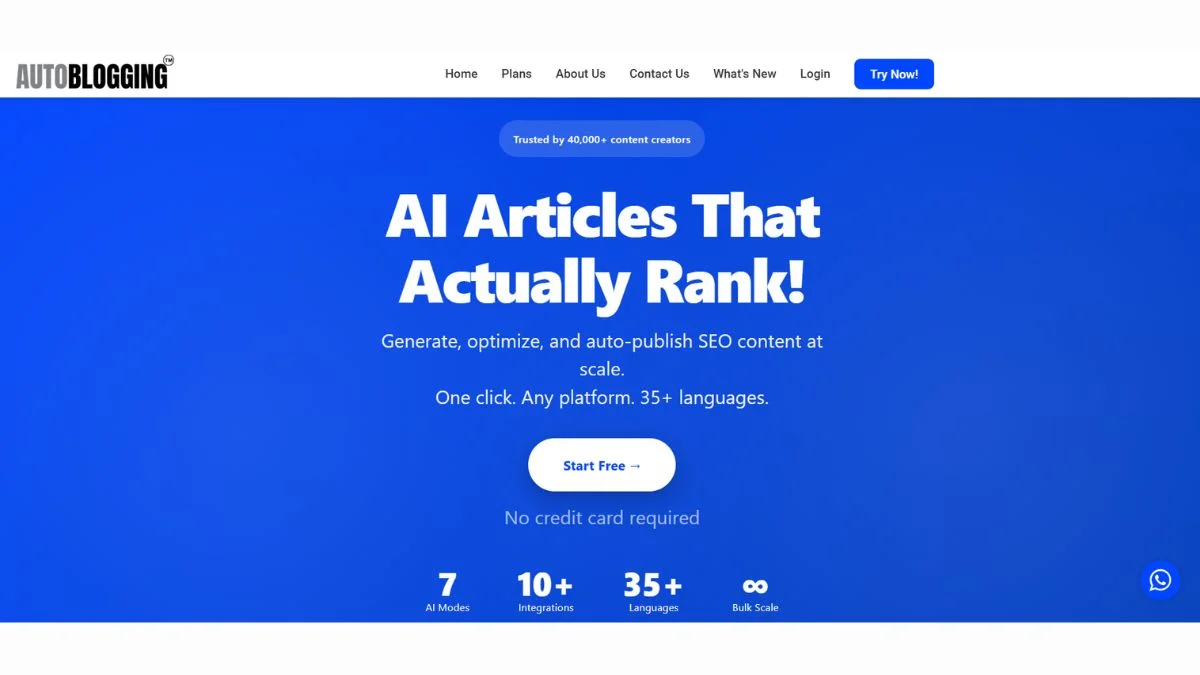
Best Autoblogging.ai Alternatives in 2026 (Honest, No-Hype Guide)

Let's be real — Autoblogging.ai is a decent tool, but it's not perfect for everyone. Maybe the output quality has frustrated you, the pricing doesn't justify the results, or you simply need something that fits your workflow better.
Whatever your reason, you're in the right place.
This guide covers the 10 best Autoblogging.ai alternatives in 2026 — tools that are actually worth your time. For each one, I'll tell you what it is, who it's for, and whether it's genuinely worth switching to. No fluff, no paid placements.
Quick answer: If you want the best overall Autoblogging.ai alternative, Writesonic or Koala AI will serve most bloggers well. But keep reading — #4 surprised even seasoned SEO pros.
What Is Autoblogging.ai and Why Look for Alternatives?
Autoblogging.ai is an AI writing platform designed to generate blog posts automatically — often with one click. It pulls from AI models to produce long-form content, typically targeted at bloggers and affiliate marketers who want to publish at scale.
It sounds great in theory. But here's what users commonly run into:
- Generic, repetitive content that needs heavy editing before publishing
- Limited customization over tone, structure, and style
- Pricing concerns as the output volume grows
- SEO gaps — the articles often lack proper keyword integration and internal linking strategy
Sound familiar? Then one of these alternatives might be exactly what you need.
How I Evaluated These Tools
Before diving in, here's what I used to judge each alternative:
- Output quality — Does it actually sound human?
- SEO capabilities — Does it support keyword optimization, meta tags, headings?
- Customization — Can you control tone, structure, and brand voice?
- Pricing fairness — Is there a free plan? Does the paid tier deliver value?
- Use case fit — Is it built for bloggers, agencies, or developers?
Now, let's get into it.
10 Best Autoblogging.ai Alternatives in 2026
1. Koala AI — Best for One-Click SEO Blog Posts
What it is: Koala AI is one of the fastest-rising AI writing tools built specifically for bloggers and affiliate marketers. It generates full-length, SEO-optimized articles from a keyword in seconds.
Best use case: Niche bloggers and affiliate sites that need to publish high volumes of articles quickly without sacrificing basic SEO structure.
Key advantage: It pulls real-time search results and integrates SERP data directly into articles — which means your content is fresher and more relevant than most AI tools can produce.
Pros:
- Real-time web data integration
- Amazon affiliate link support built in
- Clean, readable output that needs minimal editing
- Competitive pricing (starts around $9/month)
Cons:
- Limited brand voice customization
- Not ideal for complex, expert-level content
- Fewer content formats compared to broader tools
Who should use it: Affiliate bloggers, niche site builders, and content marketers who want fast, SEO-ready drafts.
If you're interested in understanding how AI tools are changing SEO, Koala AI is a great practical example of that shift.
2. Writesonic — Best All-Around AI Writing Platform
What it is: Writesonic is a comprehensive AI writing suite that covers everything from blog posts to ad copy, landing pages, product descriptions, and more. It's powered by GPT-4 and trained on high-converting content.
Best use case: Marketers and content teams who need versatility — not just bulk articles but quality content across multiple formats.
Key advantage: The Chatsonic feature gives you a ChatGPT-like assistant with real-time web access, which most article generators lack.
Pros:
- Massive variety of content templates
- Real-time Google data via Chatsonic
- SEO mode with keyword targeting
- Strong free plan (10,000 words/month)
Cons:
- Output can vary in quality across templates
- Advanced features locked behind higher tiers
- Can feel overwhelming for beginners
Who should use it: Content agencies, digital marketers, and bloggers who need more than just article generation.
For a deeper look at how Writesonic compares with other top tools, check out this breakdown of best Writesonic alternatives for SEO blog writing.
3. Jasper AI — Best for Brand Voice and Long-Form Content
What it is: Jasper (formerly Jarvis) is one of the most established AI writing platforms on the market. It focuses heavily on brand consistency and high-quality long-form content.
Best use case: Marketing teams and content agencies that need consistent brand voice across all their content.
Key advantage: Jasper's Brand Voice feature lets you train the AI on your existing content so every piece sounds uniquely yours — not generic.
Pros:
- Excellent brand voice training
- Deep integration with Surfer SEO
- Plagiarism checker included
- Strong community and templates library
Cons:
- One of the more expensive options (~$49/month for starter)
- Overkill for solo bloggers on a tight budget
- Output quality still needs editing for technical topics
Who should use it: Growing content teams, marketing agencies, and brands that publish regularly and need consistency.
Want to see how Jasper stacks up against other big names? Read: Jasper AI vs Copy AI vs Writesonic — Best AI Copywriter and Best Jasper Alternatives in 2026.
4. Frase.io — The SEO Researcher's Secret Weapon (This One Surprised Us)
What it is: Frase is an AI content tool built around SEO research first, writing second. It analyzes your competitors' top-ranking pages and helps you build content that directly competes for featured snippets and top SERP positions.
Best use case: SEO professionals and content strategists who want data-driven content briefs and optimized drafts.
Key advantage: The content scoring system shows you exactly how your article compares to top-ranking competitors — and what topics you need to cover to outrank them.
Pros:
- Deep SERP research built into the editor
- Content briefs generated in seconds
- Question research for FAQ and featured snippets
- Strong integration with Google Search Console
Cons:
- Writing output is good but not as fluent as Jasper or Writesonic
- Pricing can be confusing with add-ons
- Best results require an SEO background to fully leverage
Who should use it: SEO consultants, content strategists, and anyone serious about ranking — not just publishing.
This pairs perfectly with understanding how to optimize for featured snippets — Frase is practically built for this.
Also worth reading: Best Frase Alternatives if you want to compare before committing.
5. Copy.ai — Best Free Plan for Beginners
What it is: Copy.ai is an AI writing tool known for its generous free plan and beginner-friendly interface. It covers short-form copy, blog posts, social media captions, emails, and more.
Best use case: Freelancers, small business owners, and beginners who need solid AI writing support without a monthly bill.
Key advantage: The free plan offers unlimited words — which is genuinely rare in this space and makes it the ideal starting point before committing to paid tools.
Pros:
- Unlimited words on the free plan (with some limitations)
- Easy to use with no learning curve
- Wide variety of templates
- Good for short-form content like social posts and email subject lines
Cons:
- Long-form content quality is inconsistent
- Fewer SEO-specific features compared to Frase or Surfer
- Brand voice features are limited on lower tiers
Who should use it: Solopreneurs, new bloggers, and anyone testing AI writing tools for the first time.
Explore more options in: Best Copy.ai Alternatives in 2026 and Top Best Copy AI Alternatives for Generating Sales Copy.
6. Rytr — Best Budget-Friendly Option
What it is: Rytr is a lightweight, affordable AI writing assistant that punches above its price point. It supports 40+ use cases and 30+ languages.
Best use case: Budget-conscious writers, students, and small businesses that need solid drafts at minimal cost.
Key advantage: At just $9/month (or a free plan with 10k characters), Rytr offers surprising value — especially for those who just need a push to get past blank page syndrome.
Pros:
- Very affordable with a usable free tier
- Supports multiple languages
- Simple, clutter-free interface
- Good for short and medium-length content
Cons:
- Not suitable for publishing directly without editing
- Limited SEO features
- Outputs can feel formulaic on longer pieces
Who should use it: Students, non-native English writers, and small businesses needing regular content on a tight budget.
Compare options: Best Rytr Alternatives in 2026.
7. Scalenut — Best for Full SEO Content Workflows
What it is: Scalenut is an AI-powered SEO and content marketing platform that combines keyword research, content briefs, article generation, and content optimization in one tool.
Best use case: Content marketers and SEO teams looking to manage the entire content lifecycle from keyword to published post — without switching between five different tools.
Key advantage: The Cruise Mode lets you go from keyword to complete, SEO-optimized article in under 5 minutes — and the output is structured with proper heading hierarchies and NLP terms.
Pros:
- End-to-end content workflow
- Built-in keyword research and topic clustering
- NLP-based content optimization
- Competitive SERP analysis
Cons:
- Steeper learning curve than simpler tools
- Some features feel underdeveloped compared to Frase
- Can get expensive for large teams
Who should use it: Bloggers who are serious about SEO and want an all-in-one content platform rather than multiple subscriptions.
Check out: Scalenut Alternatives and Best AI Tools for Content Creators.
8. Anyword — Best for Data-Driven Copywriting
What it is: Anyword is an AI writing platform that goes beyond just generating content — it predicts how well your copy will perform before you publish it, using a proprietary performance score.
Best use case: E-commerce brands, performance marketers, and landing page writers who need copy that converts, not just copy that reads well.
Key advantage: The Predictive Performance Score is genuinely unique — it tells you which headline or hook is most likely to engage your target audience based on real data.
Pros:
- Predictive performance scoring
- Strong for ads, email, and landing pages
- Audience-specific tone customization
- A/B variation generation built in
Cons:
- Less focused on long-form blog content
- Pricing on the higher end
- Not the right fit for pure bloggers
Who should use it: Performance marketers, DTC brands, and anyone investing in paid media who wants to optimize copy before spending on ads.
More info: Best Anyword Alternatives in 2026.
9. HIX.ai — Best All-in-One AI Writing Suite
What it is: HIX.ai is a comprehensive AI writing platform that offers 120+ writing tools, a Chrome extension, an AI email writer, a document editor, and more — all under one roof.
Best use case: Content creators and teams who want maximum versatility from a single subscription.
Key advantage: The HIX Editor combines long-form writing with AI commands inline — similar to Notion AI — which makes the writing workflow feel natural rather than copy-paste heavy.
Pros:
- 120+ templates and tools
- Browser extension for writing anywhere
- Long-form editor with inline AI assistance
- Supports 50+ languages
Cons:
- Can feel feature-overwhelming for casual users
- SEO depth doesn't match Frase or Scalenut
- Quality varies across tool types
Who should use it: Prolific content creators, multilingual writers, and teams that need broad coverage without multiple subscriptions.
Compare: Best HIX AI Alternatives for All-in-One AI Writing and HIX AI vs Writesonic vs Copy AI.
10. Sudowrite — Best for Fiction and Creative Writers
What it is: Sudowrite is an AI writing tool specifically designed for fiction writers, novelists, and creative storytellers. It's built to help you write better stories — not just faster ones.
Best use case: Fiction writers, novelists, screenwriters, and creative writing students who want an AI collaborator that understands narrative structure.
Key advantage: Features like Describe, Brainstorm, and Story Engine are unlike anything in standard AI writing tools — they help you develop plot, character, and world-building in genuinely creative ways.
Pros:
- Purpose-built for creative fiction
- Story development tools (not just writing)
- Supports experimental and literary styles
- No template-based restrictions
Cons:
- Not useful at all for SEO or marketing content
- Higher price than general-purpose tools
- Niche audience
Who should use it: Novelists, fiction bloggers, creative writing students, and screenwriters.
Also see: Best Sudowrite Alternatives in 2026 and Top Best Sudowrite Alternatives for Fiction and Novel Writing.
Comparison Table: Autoblogging.ai Alternatives at a Glance
| Tool | Best For | Starting Price | Free Plan | SEO Features | Ease of Use |
|---|---|---|---|---|---|
| Koala AI | Affiliate bloggers | ~$9/mo | No | ✅ Strong | ⭐⭐⭐⭐⭐ |
| Writesonic | All-round content | Free / $16/mo | ✅ Yes | ✅ Strong | ⭐⭐⭐⭐ |
| Jasper AI | Brand voice, agencies | $49/mo | No | ✅ With Surfer | ⭐⭐⭐ |
| Frase.io | SEO-first content | $15/mo | No | ✅ Excellent | ⭐⭐⭐ |
| Copy.ai | Beginners, short-form | Free | ✅ Yes | ⚠️ Limited | ⭐⭐⭐⭐⭐ |
| Rytr | Budget writers | Free / $9/mo | ✅ Yes | ⚠️ Basic | ⭐⭐⭐⭐⭐ |
| Scalenut | Full SEO workflow | $39/mo | No | ✅ Excellent | ⭐⭐⭐ |
| Anyword | Conversion copy | $49/mo | No | ⚠️ Limited | ⭐⭐⭐⭐ |
| HIX.ai | Versatile teams | Free / $19.99/mo | ✅ Yes | ✅ Moderate | ⭐⭐⭐⭐ |
| Sudowrite | Fiction writers | $19/mo | No | ❌ None | ⭐⭐⭐⭐ |
Expert Tips: Getting the Most From Any AI Writing Tool
Switching tools is only half the battle. Here's what separates people who get great results from those who don't:
1. Always provide a detailed prompt. The more context you give the AI (target keyword, audience, tone, angle), the better the output. Treat it like briefing a junior writer.
2. Use AI for drafts, not final copies. The best content creators use AI to eliminate blank-page paralysis, then heavily edit the output for personality and accuracy.
3. Add your own insights and data. AI-generated content ranks better when it includes original observations, expert quotes, or real examples. Google's Helpful Content system rewards first-hand experience.
4. Always run an SEO audit after writing. Use a free tool to check your on-page elements. Learn how to write SEO-friendly meta descriptions and how to optimize title tags for SEO before hitting publish.
5. Don't skip internal linking. AI tools rarely handle internal linking well — that's on you. It's one of the highest-impact on-page SEO tactics. Learn more about how internal linking boosts SEO score.
6. Monitor performance. After publishing, track rankings and engagement. If a post isn't performing after 3 months, revisit it. Here's how to track SEO performance with analytics.
Does AI-Generated Content Hurt SEO in 2026?
This is the most common concern, and the honest answer is: it depends entirely on quality.
Google doesn't penalize AI content. It penalizes low-quality, unhelpful content — regardless of who or what wrote it. Well-edited, accurate, user-first content generated with AI tools ranks just fine.
Want a deeper dive? Read: Does AI-Generated Content Hurt Your SEO? What Google Says and How to Fix It.
Which Tool Should You Actually Choose?
Here's a simple decision framework:
- Starting out with no budget? → Copy.ai (unlimited free plan) or Rytr
- Running an affiliate or niche site? → Koala AI
- Need SEO-first content with competitor research? → Frase.io or Scalenut
- Managing a content team or agency? → Jasper AI or Writesonic
- Writing conversion-focused copy? → Anyword
- Writing fiction? → Sudowrite
- Want one tool for everything? → HIX.ai or Writesonic
And if you want to understand how these stack up against AI assistants more broadly, check out ChatGPT vs Claude vs Gemini — Which AI Wins and Best Free ChatGPT Alternatives.
For Bloggers Specifically: Pair Your AI Tool With Good SEO Habits
Using any of these tools effectively means understanding the SEO fundamentals underneath. A few resources to strengthen your foundation:
- What Is On-Page SEO? The Complete Beginner's Guide
- On-Page SEO Checklist — The Complete Guide
- How to Optimize Blog Posts for SEO
- How to Do Keyword Research Without Paying for Expensive Tools
- URL Structure Best Practices for SEO
- How to Update Old Content for SEO
- Image Optimization Tips for On-Page SEO
- How to Improve Content Readability for SEO
- How to Use H1–H6 Tags for Better SEO
- Best Practices for Internal Linking in SEO
- How to Avoid Duplicate Content on Your Site
- How to Use LSI Keywords in On-Page SEO
And for broader strategy, these will help you connect your content work to real traffic growth:
- SEO for Beginners: The Ultimate Step-by-Step Guide
- How to Develop an Effective SEO Strategy
- How Content Marketing Boosts SEO
- 10 Proven SEO Tips to Skyrocket Traffic
- SEO Checklist for Beginners
- How to Do an SEO Audit for Your Website
- The 10 Most Important SEO Metrics
- 30-Day SEO Plan for New Websites
- How SEO Helps Grow Your Business Online
For content writers also exploring AI-powered tools, here are some additional resources to bookmark:
- Best AI Tools for Content Creators
- Free AI Content Generators for Bloggers
- Best Free AI Writing Tools — No Word Limit
- Free AI Article Writers — Full Length Guide
- Free AI Copywriting Tools for Marketing
- Top 100 Best AI Tools
- Best Free AI Tools to Use Daily
- 25 Best AI Tools for Every Profession
More Alternatives Worth Knowing
The AI writing space moves fast. Here are a few more tools to keep on your radar:
- Wordtune — Excellent for rewriting and improving existing content. See Best Wordtune Alternatives in 2026.
- ProWritingAid — Great grammar and style checker beyond Grammarly. See Best ProWritingAid Alternatives.
- Hemingway Editor — Simplicity-focused writing clarity tool. See Best Hemingway Alternatives 2026.
- Quillbot — Strong paraphrasing tool. See QuillBot Review & Complete Guide and Best Quillbot Alternatives.
- Grammarly — Still the best grammar layer to add on top of any AI tool. See Grammarly Review & Beginner's Guide.
- Jenni AI — Specialized for academic and research writing. See Best Jenni AI Alternatives for Academic Writing.
- Smodin — Good for essay and article generation. See Top Smodin Alternatives.
- Writer.com — Enterprise-grade AI writing for teams. See Best Writer.com Alternatives.
Frequently Asked Questions
What is the best free Autoblogging.ai alternative?
Copy.ai and Rytr are the top free alternatives to Autoblogging.ai. Copy.ai offers unlimited words on its free plan (with some usage restrictions), while Rytr provides 10,000 characters per month at no cost. Both are solid starting points for bloggers testing AI writing tools before committing to a paid subscription. Neither matches the SEO depth of Frase or Scalenut, but for getting started without spending money, they're hard to beat.
Is Koala AI better than Autoblogging.ai?
For most bloggers and affiliate marketers, yes — Koala AI produces more current and SEO-relevant content. Koala pulls real-time SERP data and web results into its articles, which means you're not getting purely AI-hallucinated facts. Autoblogging.ai is fast, but Koala's output typically requires less post-editing and ranks better because it's structured around what's already working in search results.
Can AI-generated blog posts rank on Google in 2026?
Yes, AI-generated content can rank — but only if it's genuinely helpful, accurate, and well-edited. Google's algorithm evaluates content quality, expertise, and user experience — not the method of creation. Thin, templated AI content that adds no real value will not rank. But thoroughly edited, expert-informed AI content that answers user intent clearly can absolutely compete. The key is treating AI as a drafting tool, not a publishing machine.
Read more: Does AI-Generated Content Hurt Your SEO?
Which Autoblogging.ai alternative is best for SEO agencies?
Jasper AI and Scalenut are the strongest options for agencies. Jasper excels at brand voice consistency across multiple clients, while Scalenut provides end-to-end SEO workflows with keyword research, briefs, and optimization scoring built in. For agencies managing many client sites simultaneously, both tools support multi-project workflows better than most alternatives. Frase is also worth serious consideration for SEO-intensive agency work.
What's the difference between AI writing tools and autoblogging tools?
AI writing tools assist in creating content; autoblogging tools are designed to publish content automatically with minimal human involvement. Most AI writing tools (Jasper, Writesonic, Frase) still require human editorial oversight — they generate drafts. True autoblogging tools are designed to pull content, spin it, and publish automatically, which often produces low-quality output that Google actively devalues. In 2026, a hybrid approach — AI-assisted + human-edited — consistently outperforms fully automated content.
Is there a free trial for Jasper AI or Frase?
Both Jasper and Frase offer limited free trials. Jasper typically offers a 7-day free trial with access to core features. Frase offers a $1 trial for the first 5 days, which is a good way to test whether its SEO research features match your workflow before committing to a full subscription. Always check the current pricing on their official sites, as trial terms change frequently.
Conclusion
There's no single "best" Autoblogging.ai alternative — the right pick depends entirely on what you're trying to accomplish.
Here's the quick summary:
- For SEO content at scale: Koala AI or Scalenut
- For versatility and team use: Writesonic or Jasper
- For conversion copy: Anyword
- For pure SEO research + content: Frase.io
- For tight budgets: Copy.ai or Rytr
- For fiction and creative writing: Sudowrite
Whatever tool you choose, remember that the best content is still the content that genuinely helps people. AI is an accelerator — not a replacement for knowledge, experience, and editorial judgment.
Ready to take your content strategy further? Start with the SEO for Beginners: The Ultimate Step-by-Step Guide and explore our free SEO tools to audit your current site performance.