9 Best StoryLab.ai Alternatives That Actually Deliver Results (2026)

You opened StoryLab.ai, stared at the output, and thought — "There has to be something better."
You're not alone. While StoryLab.ai is a decent tool for generating marketing stories and content hooks, it has real limitations: thin outputs, restricted free plans, and a narrow focus that doesn't serve writers, developers, or marketers who need more depth.
The good news? The AI writing space has exploded in 2026, and there are genuinely great alternatives — some free, some affordable, and a few that will completely change how you create content.
In this guide, you'll find 9 hand-picked StoryLab.ai alternatives with honest pros and cons, who each tool is best for, and a clear comparison table to help you decide fast.
Quick answer: If you want the best all-around StoryLab.ai alternative, Jasper AI leads for marketing teams, QuillBot wins for rewriting and paraphrasing, and Copy.ai is the top free pick for solo creators.
What Is StoryLab.ai and Why Are People Looking for Alternatives?
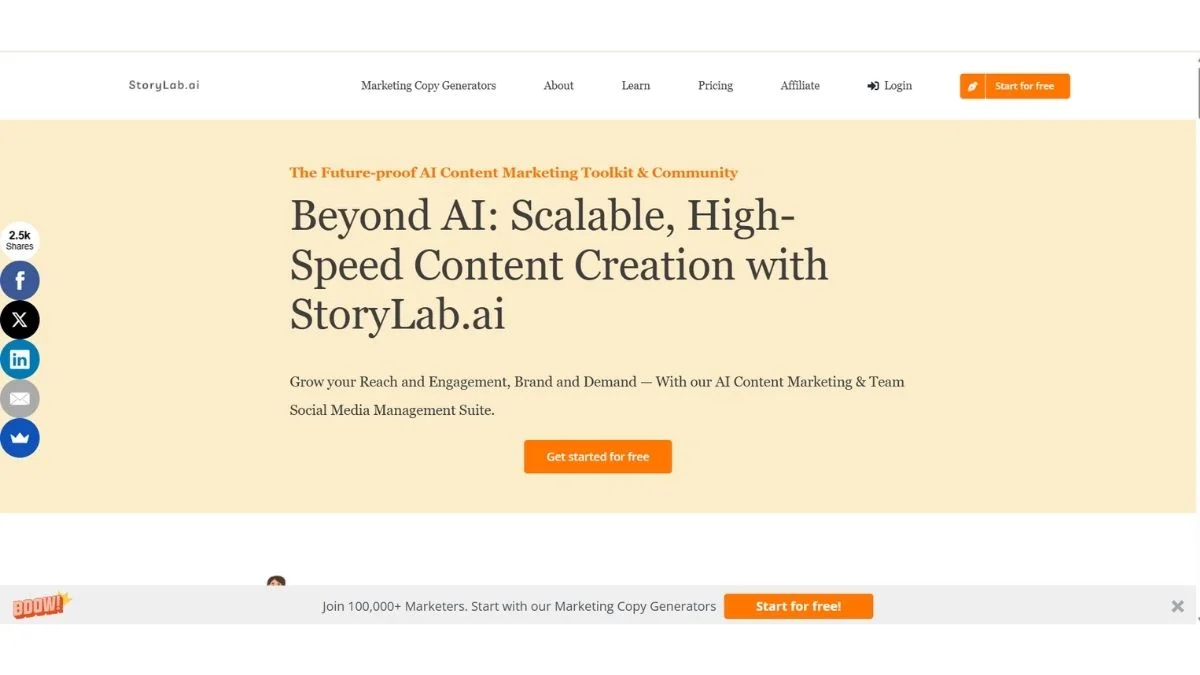
StoryLab.ai is an AI-powered content creation tool focused on storytelling frameworks — social media captions, ad copy, brand stories, and content hooks. It uses GPT-based models to help marketers and small business owners draft content quickly.
Common complaints that drive users to look elsewhere:
- Limited output quality on longer-form content
- Free plan is too restrictive for daily use
- No real document editor or workflow integration
- Lacks SEO-specific features
- Template library feels repetitive over time
If any of these hit close to home, the alternatives below will feel like an upgrade.
How We Selected These Alternatives
Every tool in this list was evaluated against these criteria:
- Output quality — Does it produce usable content, not just word salad?
- Use case fit — Marketing copy, long-form, SEO, or storytelling?
- Free plan generosity — Can you actually test it without a credit card?
- Ease of use — Beginner-friendly or requires a learning curve?
- Value for money — Is the paid plan worth it?
Only tools that passed all five checks made it here.
9 Best StoryLab.ai Alternatives in 2026
1. Jasper AI — Best for Marketing Teams and Brand Voice
What it is: Jasper is one of the most mature AI writing platforms available. Built specifically for marketers, it supports long-form blog posts, ad copy, email sequences, landing pages, and social content — all within one workspace.
Best use case: Teams that need consistent brand voice across multiple content types and channels.
Key advantage: Jasper's "Brand Voice" feature learns your tone and writing style, then applies it across every piece of content. No other tool does this as reliably.
Pros:
- Excellent long-form content quality
- 50+ templates covering every marketing need
- Supports team collaboration and workflows
- Integrates with Surfer SEO for on-page optimization
- Chrome extension works inside Google Docs
Cons:
- Pricing starts at $39/month — not beginner-friendly
- Can feel overwhelming for solo bloggers
- Outputs occasionally need fact-checking
Who should use it: Marketing managers, content agencies, and growth teams producing high volumes of content. If you're serious about content ROI, Jasper pays for itself.
If you want to understand the broader AI writing landscape first, check out this guide on Best AI Tools Complete Guide with Pros & Cons.
2. Copy.ai — Best Free Alternative for Solo Creators
What it is: Copy.ai started as a short-form copy generator and has grown into a full content workflow platform. Its free plan is genuinely generous — 2,000 words per month with access to 90+ templates.
Best use case: Freelancers, solopreneurs, and small business owners who need fast marketing copy without a budget.
Key advantage: The "Workflows" feature lets you automate multi-step content tasks — like generating a blog outline, expanding it into sections, and writing meta descriptions in one flow.
Pros:
- Generous free tier (no credit card required)
- Workflow automation saves hours
- Excellent for product descriptions and ad copy
- Clean, intuitive interface
- Supports 25+ languages
Cons:
- Long-form blog posts can feel disjointed
- Free plan lacks workflow automation
- Customer support is slow on free tier
Who should use it: Anyone testing the waters of AI writing. Also great for e-commerce sellers writing product descriptions at scale.
Explore more tools in the same category: Best Free ChatGPT Alternatives and Best AI Tools for Content Creators.
3. QuillBot — Best for Rewriting and Paraphrasing (#3 Is a Game-Changer for Editors)
What it is: QuillBot is the gold standard for AI-powered paraphrasing. Unlike StoryLab.ai, which generates from scratch, QuillBot specializes in transforming existing text — making it cleaner, shorter, more formal, or more creative.
Best use case: Editors, students, ESL writers, and anyone refining drafts rather than starting from zero.
Key advantage: Seven distinct paraphrasing modes (Standard, Fluency, Formal, Academic, Simple, Creative, Expand, Shorten) give you total control over how your content is rewritten.
Pros:
- Exceptional paraphrasing quality
- Chrome extension integrates with any website
- Summarizer tool extracts key points from long texts
- Free plan covers basic needs well
- Grammar checker included
Cons:
- Not designed for generating original content from scratch
- Word limit on free plan (125 words per paraphrase)
- Doesn't replace a full AI writer
Who should use it: Blog editors refining AI drafts, students improving essays, and content marketers polishing copy before publishing.
For a deeper breakdown, read the full QuillBot Review & Complete Guide and explore QuillBot Alternatives if you want to compare.
4. Writesonic — Best for SEO Blog Writing (#4 Consistently Beats StoryLab for Long-Form)
What it is: Writesonic is a full-stack AI writing tool with a strong focus on SEO-optimized content. It integrates with Google Search Console data and offers a dedicated AI Article Writer that produces publish-ready blog posts.
Best use case: Bloggers and content marketers who need Google-friendly long-form articles without spending hours writing them.
Key advantage: The "Article Writer 6.0" pulls real-time data from the web and generates fact-informed articles — not just templated filler.
Pros:
- Real-time data integration for up-to-date content
- Strong SEO article generation
- Chatsonic (ChatGPT alternative) included
- Affordable entry-level pricing
- Landing page builder included
Cons:
- Quality varies between templates
- Article Writer needs editing before publishing
- Interface can feel cluttered
Who should use it: SEO content managers, affiliate bloggers, and agencies who publish at high volume and need consistent quality. If SEO is your priority, also explore 9 Best Free AI SEO Tools to Rank #1 and read about How Content Marketing Boosts SEO.
Check out our comparison: Top Best Writesonic Alternatives for SEO Blog Writing.
5. Rytr — Best Budget Alternative Under $10/Month
What it is: Rytr is the most affordable AI writing tool on this list with a real paid plan starting at just $7.50/month. Despite the price, it punches well above its weight for short-form content.
Best use case: Bootstrapped founders, budget-conscious bloggers, and small teams that need reliable AI copy without a hefty subscription.
Key advantage: Rytr's tone selector lets you match your brand voice precisely — choosing from 20+ tones like Convincing, Enthusiastic, Formal, or Inspirational.
Pros:
- Cheapest legitimate AI writer available
- 40+ use cases covered
- Built-in plagiarism checker
- SEO analyzer included
- Clean and simple UI
Cons:
- Not ideal for long-form (1,500+ word) articles
- Output quality plateaus compared to Jasper or Writesonic
- Limited workflow automation
Who should use it: Startups on a shoestring budget, social media managers, and anyone who needs short marketing copy fast. Also pairs well with Free AI Copywriting Tools for Marketing.
6. Notion AI — Best for Writers Who Already Live in Notion
What it is: Notion AI is embedded directly inside Notion workspaces, turning the popular productivity tool into an AI-powered writing environment. No switching tabs, no copy-pasting — just write and let AI assist inline.
Best use case: Writers, project managers, and teams who already use Notion for planning and want AI writing baked into their existing workflow.
Key advantage: Ask AI to summarize a meeting note, draft a section from a bullet list, or turn a rough outline into a full draft — all without leaving your workspace.
Pros:
- Seamlessly integrated into Notion
- Excellent for summarizing, drafting, and editing
- No learning curve if you already use Notion
- Supports databases, wikis, and project docs
- Good value when bundled with Notion plans
Cons:
- Not a standalone writing tool
- Less specialized than Jasper or Copy.ai for marketing copy
- Requires a Notion subscription
Who should use it: Remote teams, content strategists, and solo creators who run their entire workflow in Notion. See how it compares: Notion AI vs ChatGPT — Which One Should You Actually Use? and explore Notion Alternatives if you're open to switching platforms.
7. HIX.ai — Best All-in-One Alternative (Blog + SEO + Chat)
What it is: HIX.ai is one of the most comprehensive AI writing platforms available in 2026. It combines a long-form article writer, SEO optimizer, browser extension, email writer, and AI chat — all under one roof.
Best use case: Content marketers who want one tool to replace multiple subscriptions.
Key advantage: HIX ArticleGPT generates articles with real-time web data and citations, reducing the need for manual research and fact-checking.
Pros:
- Covers virtually every writing use case
- Real-time web data for factual articles
- 120+ writing tools included
- Browser extension works anywhere
- Strong multilingual support
Cons:
- Free plan is limited to basic features
- Premium pricing can be high for individuals
- Some tools are more polished than others
Who should use it: Digital marketing agencies and content teams that want a single platform replacing 3–5 separate tools. Compare it with similar tools: HIX AI vs Writesonic vs Copy.ai — Best All-in-One AI Writer and Best HIX AI Alternatives for All-in-One AI Writing.
8. Grammarly — Best for Polishing and Refining Any Draft
What it is: Grammarly is the world's most widely used writing assistant. In 2026, it goes well beyond grammar — with a full generative AI layer that rewrites sentences, adjusts tone, sets goals, and suggests structural improvements.
Best use case: Anyone who writes professionally and needs their content to sound polished, confident, and error-free before publishing.
Key advantage: Grammarly's tone detection and adjustment feature is unmatched. It tells you exactly how your writing will land emotionally — and offers fixes.
Pros:
- Best-in-class grammar and clarity editing
- AI rewriting and tone adjustment
- Plagiarism checker on premium plan
- Works inside Gmail, Docs, LinkedIn, Slack, and more
- Trusted by millions — battle-tested reliability
Cons:
- Not a content generator — requires you to have a draft first
- Premium plan ($12/month) required for full AI features
- Can over-suggest in creative writing contexts
Who should use it: Every professional writer should use Grammarly at minimum for editing. It's not a StoryLab replacement for generation, but it's the best finishing layer you can add.
Read the full breakdown: Grammarly Review & Beginner's Guide. Also compare: QuillBot vs Wordtune vs Grammarly — Best AI Paraphrasing Tool and Grammarly Alternatives.
9. ChatGPT (GPT-4o) — Best for Flexibility and Power Users
What it is: ChatGPT by OpenAI is the most versatile AI tool available. It doesn't specialize in any single content format — instead, it adapts to whatever you throw at it: stories, blog posts, scripts, code, strategy, analysis, and more.
Best use case: Power users, developers, and writers who know how to prompt effectively and want maximum flexibility.
Key advantage: GPT-4o understands context brilliantly across long conversations, making it ideal for iterative writing projects where you refine content across multiple rounds.
Pros:
- Unmatched flexibility for all content types
- Handles complex, long-form tasks with ease
- Image generation (DALL·E) included in Plus
- Code interpreter for data analysis
- Free plan available (with limitations)
Cons:
- Requires strong prompting skills to get best results
- No built-in templates or marketing frameworks
- Can hallucinate facts — always verify output
Who should use it: Experienced content creators, developers, and anyone who wants raw AI power they can shape themselves. See also: ChatGPT vs Claude vs Gemini — Which AI Wins? and ChatGPT Alternatives.
For free options, check Best Free ChatGPT Alternatives and Free AI Chatbots With Unlimited Messages.
Quick Comparison Table
| Tool | Best For | Free Plan | Starting Price | Long-Form | SEO Features |
|---|---|---|---|---|---|
| Jasper AI | Marketing teams | ❌ Trial only | $39/month | ✅ Excellent | ✅ With Surfer |
| Copy.ai | Freelancers / Solo | ✅ 2,000 words | $36/month | ⚠️ Decent | ⚠️ Limited |
| QuillBot | Editing / Rewriting | ✅ 125 words | $4.17/month | ❌ Not designed | ❌ No |
| Writesonic | SEO Blog Writing | ✅ Limited | $12/month | ✅ Good | ✅ Strong |
| Rytr | Budget users | ✅ 10,000 chars | $7.50/month | ⚠️ Moderate | ⚠️ Basic |
| Notion AI | Notion users | ❌ Add-on | $8/member/mo | ✅ Good | ❌ No |
| HIX.ai | All-in-one teams | ✅ Limited | $19.99/month | ✅ Strong | ✅ Strong |
| Grammarly | Editing / Polishing | ✅ Basic | $12/month | ❌ Editor only | ❌ No |
| ChatGPT | Power users | ✅ GPT-4o mini | $20/month | ✅ Excellent | ⚠️ Manual |
Which StoryLab.ai Alternative Should You Choose?
Here's a quick decision framework:
- You run a content agency or marketing team → Go with Jasper AI
- You're a freelancer or solopreneur on a budget → Start with Copy.ai (free) or Rytr
- You rewrite and edit more than you generate → QuillBot is your tool
- SEO content is your primary goal → Writesonic or HIX.ai
- You already live in Notion → Notion AI is a no-brainer
- You want maximum power and flexibility → ChatGPT Plus
- You want one tool for everything → HIX.ai
Still unsure? Start with Copy.ai's free plan — you'll know within 20 minutes whether AI writing tools fit your workflow before spending a dollar.
Pro Tips for Getting More From Any AI Writing Tool
Here's what separates good AI content from great AI content — and it's not the tool, it's how you use it.
1. Give context, not just commands. Instead of "Write a blog intro about SEO," try "Write a blog intro for a small business owner who has never done SEO before. Keep it conversational and under 100 words." The more specific the input, the better the output.
2. Use AI for structure, your voice for depth. AI is brilliant at outlines and frameworks. Use it to organize your thoughts, then add your personal examples, data, and opinions. That's what makes content rank and resonate.
3. Edit before you publish — always. No AI tool is publish-ready out of the box. Run everything through Grammarly or read it aloud. You'll catch robotic phrasing that would hurt your credibility.
4. Chain tools together. Generate a draft with Writesonic → refine tone with QuillBot → polish grammar with Grammarly. Using tools in sequence gives you better results than relying on one platform for everything.
5. Match the tool to the task. Short ad copy? Copy.ai. 2,000-word SEO blog? Writesonic. Editing a human-written draft? QuillBot. Using the wrong tool for the wrong job is the most common mistake beginners make.
For more insights, explore Best Prompt Engineering Techniques for Developers and How to Improve Content Readability for SEO.
How AI Writing Affects Your SEO in 2026
This is worth addressing directly because a lot of creators are confused about it.
Google's current stance is clear: it doesn't penalize AI-generated content as long as it is helpful, accurate, and created with the user's intent in mind. What it penalizes is thin, repetitive, or manipulative content — whether AI wrote it or a human did.
The key is EEAT — Experience, Expertise, Authoritativeness, and Trustworthiness. AI can help you scale content production, but your unique insights, real examples, and editorial standards determine whether that content ranks.
Useful reads on this topic:
- Does AI-Generated Content Hurt Your SEO? What Google Says and How to Fix It
- How AI Is Changing SEO
- How to Optimize Blog Posts for SEO
- On-Page SEO Techniques That Actually Work
- Essential Content Optimization Practices Every Marketer Should Know
Bonus: Free AI Writing Tools Worth Bookmarking
If you're not ready to pay for any tool yet, here are genuinely useful free resources:
- Best Free AI Writing Tools No Word Limit
- Free AI Content Generators for Bloggers
- Free AI Article Writers Full Length
- Free AI Tools Every Freelancer Needs
- Free AI Productivity Tools for Teams
- Free AI Marketing Tools for Startups
- Best Free AI Tools to Use Daily
Frequently Asked Questions
What is the best free alternative to StoryLab.ai?
Copy.ai offers the best free alternative to StoryLab.ai. Its free plan includes 2,000 words per month, 90+ templates, and access to workflow automation — making it significantly more useful than most free tiers in the market.
Copy.ai's free plan doesn't require a credit card and gives you enough functionality to produce real marketing content: social captions, ad copy, product descriptions, and email subject lines. If you need more volume, upgrading to Rytr at $7.50/month is one of the most cost-effective moves you can make.
Is StoryLab.ai good for long-form blog writing?
No — StoryLab.ai is primarily designed for short-form marketing content like hooks, story frameworks, and social captions. For long-form blog writing, Writesonic, Jasper AI, or HIX.ai are significantly better options.
Long-form content requires tools that can maintain context across thousands of words, integrate SEO signals, and structure content logically. StoryLab.ai's core strength lies in narrative frameworks, not comprehensive article writing.
Can AI writing tools replace human writers?
No — AI writing tools are productivity multipliers, not replacements for human writers. They excel at structure, speed, and volume, but they lack genuine experience, original opinions, and the ability to build authentic audience trust on their own.
The best content in 2026 combines AI efficiency with human judgment. Use AI to draft and structure, then inject your unique insights, real examples, and editorial voice. That combination is what ranks on Google and converts readers into customers.
Which AI writing tool is best for SEO content specifically?
Writesonic and HIX.ai are the strongest choices for SEO content creation. Both integrate real-time web data, support long-form article generation, and offer built-in SEO optimization features that StoryLab.ai simply doesn't provide.
For a complete SEO workflow, pair either tool with a dedicated SEO checker. You can start with the free Website SEO Score Checker to audit your pages, and read the SEO Checklist for Beginners to make sure your content hits every ranking signal.
How much do AI writing tools typically cost per month?
AI writing tools range from free (Copy.ai, QuillBot basic) to $7.50/month (Rytr) up to $39–$99/month (Jasper AI for teams). Most serious creators land in the $12–$25/month range for a tool that covers their daily writing needs.
The right price depends on your volume. If you're writing 5–10 pieces per month, Rytr or Copy.ai Pro is more than enough. If you're running a content agency producing 50+ pieces monthly, Jasper's investment returns quickly. Always start with the free plan before committing.
Are these tools suitable for non-native English speakers?
Yes — most of these alternatives, especially QuillBot, Writesonic, and HIX.ai, offer strong multilingual support and are regularly used by non-native English speakers to produce professional-quality content.
QuillBot is particularly popular among ESL writers because its Fluency and Formal modes clean up grammatical errors while preserving the original meaning. Grammarly also has a tone detector that helps non-native writers match native-level professionalism.
For multilingual content strategies, also check out How to Target Multiple Languages in SEO and International SEO Complete Beginner's Guide.
Final Thoughts
StoryLab.ai is a fine starting point — but it's rarely where serious content creators end up.
The alternatives on this list cover every use case, budget, and skill level. Whether you want the raw power of ChatGPT, the SEO muscle of Writesonic, the editing precision of QuillBot, or the all-in-one convenience of HIX.ai, there's a clear upgrade path from where StoryLab.ai leaves off.
Here's the move: Start with Copy.ai's free plan today. Within a week, you'll know exactly what you need — and that clarity is worth more than any tool recommendation.
Keep Exploring
- Jasper AI vs Copy.ai vs Writesonic — Best AI Copywriter Compared
- Free vs Paid AI Writing Tools — Is Upgrading Worth It?
- Best AI Tools for Productivity
- Top 100 Best AI Tools
- Best AI Tools for Small Businesses
- 25 Best AI Tools for Every Profession
- How AI Agents Are Becoming Your Digital Coworkers
- What Are AI Agents? The Complete Beginner's Guide