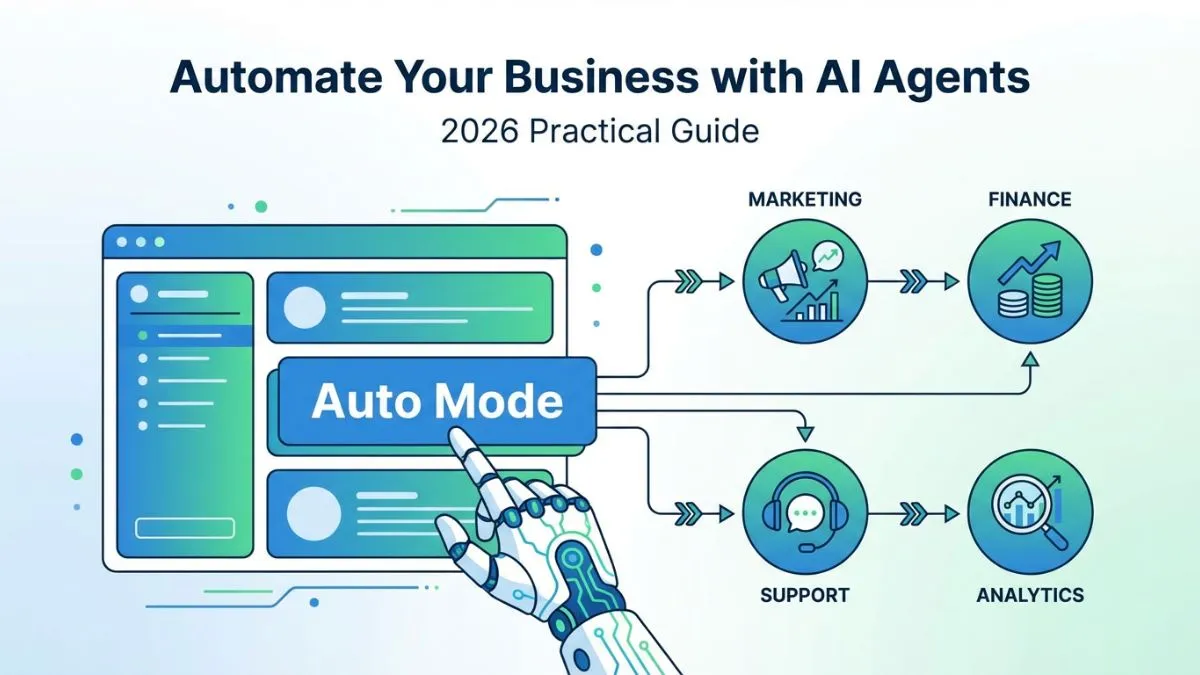
How to Use AI Agents to Automate Your Business in 2026: The Complete Expert Guide

The bottom line: AI agents have moved far beyond simple chatbots. In 2026, they reason, plan, execute tasks across multiple platforms, and operate autonomously — making them the most powerful lever for business automation that has ever existed. This guide shows you exactly how to deploy them, step by step.
1. What Are AI Agents? (2026 Definition)
An AI agent is a software system that perceives its environment, makes decisions based on goals, takes actions using tools, and iterates on those actions until a task is complete — all with minimal human intervention. Unlike a simple AI model that answers a single prompt, an AI agent operates in a loop: observe → plan → act → reflect → repeat.
In 2026, AI agents are powered by large language models (LLMs) as their reasoning core but are connected to external tools — web browsers, APIs, databases, code interpreters, email clients, CRMs — giving them the ability to actually do things in the real world, not just describe them.
A useful mental model: if a traditional chatbot is like a very smart reference book, an AI agent is like a highly capable employee who reads the reference book, writes the email, books the meeting, and reports back to you.
📊 📊 Market Reality: According to Gartner research, by 2026 over 40% of large enterprises are expected to have deployed agentic AI in at least one business-critical process — up from under 5% in 2023. The AI agent market is projected to surpass $47 billion globally by 2027.
The defining capabilities of modern AI agents include multi-step reasoning, tool use (calling APIs, running code, browsing the web), memory (short-term and long-term context), and multi-agent collaboration where specialized agents hand off tasks to each other. To understand more about how this technology is reshaping digital visibility, read our guide on how AI is changing SEO.
2. Why 2026 Is the Tipping Point for Business Automation
The convergence of four forces has made 2026 uniquely positioned as the year that AI-driven business automation becomes accessible to companies of every size — not just Silicon Valley giants.
Force 1: Model Capability Leap. The latest frontier models from OpenAI, Anthropic, Google DeepMind, and Meta have crossed critical thresholds in reasoning, instruction-following, and multi-step planning. Tasks that would have taken dozens of prompt engineering iterations in 2023 are now handled reliably in a single agent run.
Force 2: Standardized Agent Frameworks. Platforms like LangChain, CrewAI, AutoGen, and OpenAI's Assistants API have matured significantly. Developers and even non-technical operators can now build production-grade agent pipelines without starting from scratch.
Force 3: Falling Infrastructure Costs. The cost of running LLM-powered agents has dropped by over 90% since 2022. What cost $500/month in compute to automate a single business workflow now costs less than $20/month — putting it within reach of SMBs and solopreneurs.
Force 4: Ecosystem Integration. Major SaaS platforms — HubSpot, Shopify, Salesforce, Notion, Slack, Google Workspace — now offer native AI agent hooks or well-documented APIs that agents can call. The integration barrier has collapsed.
Understanding this shift matters because businesses that move now will compound advantages — better data, better-trained agents, lower costs, and entrenched workflows — that will be very difficult for late movers to close. This is analogous to the SEO landscape: early movers who built backlink authority and content depth in the early 2010s still dominate SERPs today. For a full strategic parallel, see our guide on SEO for startups — the compounding logic is identical.
3. Types of AI Agents and What They Do
Not all AI agents are the same. Understanding the taxonomy helps you match the right agent architecture to your business problem.
Reactive Agents
These agents respond to a stimulus in a predefined way without memory of past interactions. Think of a customer service bot that answers FAQs — useful for high-volume, predictable queries but limited in scope. They are the simplest to deploy and the most constrained.
Goal-Oriented Agents
Goal-oriented agents are given an objective — "research and draft a 1,500-word competitor analysis report" — and use reasoning to plan and execute the steps required. They can adapt their plan if an intermediate step fails. These are the workhorses of business automation in 2026.
Learning Agents
Learning agents improve their performance over time by incorporating feedback into their behavior. A sales outreach agent that tracks which email subject lines generate opens and iterates its future copy accordingly is a learning agent. These are more complex to set up but deliver compounding returns.
Multi-Agent Systems (MAS)
Multi-agent systems deploy networks of specialized agents — a researcher agent, a writer agent, a fact-checker agent, a publisher agent — each focused on one task and passing outputs to the next. This mirrors how high-functioning human teams operate and is particularly powerful for content pipelines, software development, and market research workflows.
| Agent Type | Best For | Complexity | Example Platform
| Reactive | FAQ bots, simple routing | Low | Tawk.to, Crisp Chat
| Goal-Oriented | Research, content, reporting | Medium | AutoGen, LangGraph
| Learning | Sales optimization, ad targeting | High | Custom LLM + RLHF loop
| Multi-Agent | Complex workflows, pipelines | High | CrewAI, MetaGPT
4. Top Business Use Cases for AI Agents in 2026
The real question is: where should you actually deploy AI agents in your business? The answer depends on where your biggest time drains, bottlenecks, and revenue opportunities lie. Below are the highest-ROI use cases observed across industries in 2026.
Content Creation and SEO
AI agents can conduct keyword research, analyze competitor content, draft long-form articles, optimize meta tags, interlink content, and publish — all within a single automated pipeline. An agent using a tool like our keyword research tool can identify high-opportunity terms, and a downstream writing agent can produce fully optimized drafts ready for human review.
For a strategic foundation, our comprehensive post on AI tools for explosive SEO covers the platforms making this possible. Pair that with an understanding of how content marketing boosts SEO to build a durable organic traffic engine.
Lead Generation and CRM Management
AI agents can prospect leads from LinkedIn, company databases, and news feeds; enrich contact data; score leads based on behavioral signals; draft personalized outreach emails; and update your CRM — reducing a task that used to take a sales team days to mere hours.
Customer Support Automation
Beyond reactive FAQ bots, agentic customer support systems can handle complex, multi-turn queries, access live order data, process refunds, escalate edge cases to human agents with full context, and learn from resolution patterns. Platforms like Tawk.to and Crisp Chat are increasingly integrating agentic layers into their offerings.
Financial Reporting and Analytics
An AI agent connected to your accounting software, ad platforms, and web analytics can generate weekly business intelligence reports, flag anomalies, model revenue scenarios, and deliver them in a pre-formatted slide deck — without a human analyst touching the process. Tools like our ROI calculator and compound interest calculator can be integrated into agent-driven financial dashboards.
E-Commerce Operations
Agents can monitor inventory levels, automate reorder triggers, adjust dynamic pricing based on competitor data, personalize product recommendations, generate product descriptions at scale, and manage seller dashboards. See our dedicated section on e-commerce automation below for detailed workflows.
HR and Recruitment
AI agents are transforming recruitment: scraping job boards for candidates, scoring résumés against job descriptions, scheduling initial screening calls, drafting offer letters, and onboarding new hires through automated document workflows — all while maintaining GDPR and local compliance frameworks.
Code Review and Software Development
Agentic coding assistants now operate as near-autonomous junior developers. They can interpret a GitHub issue, write code, run unit tests, fix failing tests, and open a pull request — with a human developer only needing to review and merge. Our overview of the best AI coding assistants and best AI tools for coding covers the leading platforms in this space.
5. Best AI Agent Tools & Platforms in 2026
Choosing the right platform is the most consequential decision in your AI automation journey. Here is a curated breakdown of the leading tools across different categories.
General-Purpose Agent Frameworks
LangGraph (LangChain) remains a gold standard for building stateful, multi-step agents in Python. Its graph-based architecture allows complex conditional workflows and human-in-the-loop pauses. Ideal for teams with Python developers.
AutoGen (Microsoft) excels at multi-agent conversations and code execution tasks. If your use case involves agents that collaborate and debate to solve problems, AutoGen is a compelling choice.
CrewAI is purpose-built for role-based multi-agent systems. You define agents by role (Researcher, Writer, SEO Expert) and assign them sequential or parallel tasks — making it accessible to non-engineers with some technical comfort.
No-Code / Low-Code Agent Builders
Zapier AI Agents extends the beloved Zapier platform with agentic capabilities, letting non-technical users build automation workflows triggered by natural language goals rather than rigid if/then logic.
Make (formerly Integromat) continues to be the power user's automation choice, now with LLM-powered scenario building that reduces workflow creation time by ~70%.
Vertical-Specific Agent Platforms
Platforms like DocsBot.ai are purpose-built for knowledge base and document-driven automation. For AI-powered content and research, Skywork AI offers powerful reasoning and synthesis capabilities worth evaluating.
AI Agent Infrastructure Tools
Beyond the agent itself, you need infrastructure: Pinecone or Weaviate for vector memory storage, Browserbase or Playwright for browser automation, and platforms like Composio for managed tool integrations. These are the invisible engine room that make agents actually useful in production.
6. How to Build Your First AI Automation Workflow
Theory is only valuable in proportion to the action it inspires. Here is a concrete, step-by-step methodology for building your first AI agent workflow — even if you have no prior AI development experience.
Step 1: Identify the Right Process to Automate
The highest-value candidates for AI automation share three characteristics: they are repetitive, they involve processing information (reading, writing, analyzing, deciding based on rules), and they currently consume significant human hours. A good starting audit question: "What do I or my team do every week that feels like copy-paste work?"
💡 Pro Tip: Start with a process that has clear inputs and measurable outputs. "Generate a weekly SEO performance report from Google Search Console data" is an excellent first workflow. "Improve our company culture" is not.
Step 2: Map the Workflow in Plain Language
Before writing a single line of code or setting up a platform, write out every step of the process as if you were training a new employee. What data does each step need? What decisions are made? What does the output look like? This exercise almost always reveals hidden complexity — and it is exactly the specification your agent will need.
Step 3: Choose Your Stack
For non-technical users: start with Zapier AI Agents or Make + an LLM step. For developers: evaluate LangGraph for complex conditional logic or CrewAI for multi-agent roles. Consider what existing tools your workflow touches — the right platform is often the one with the best pre-built integrations for your current SaaS stack.
Step 4: Connect Your Tools and Data Sources
An agent without data is like a contractor without materials. Connect relevant data sources — your CRM, analytics platform, content repository, databases — via APIs or native integrations. Ensure your SSL is valid and API endpoints are secure before connecting production data to any external agent platform.
Step 5: Prompt Engineer Your Agent Instructions
The quality of your agent's output is directly proportional to the quality of its system prompt. Be explicit about the agent's role, the expected output format, edge case handling, and any hard rules it must follow. Techniques from expert-level content strategy apply here: specificity, examples, and clear success criteria drive results.
Step 6: Test with Real Data in a Sandbox Environment
Never deploy directly to production. Run your agent against a representative sample of real-world inputs and manually verify every output. Pay particular attention to edge cases — unusual inputs, missing data, ambiguous instructions — which are where agents most commonly fail.
Step 7: Add Human-in-the-Loop Checkpoints
For high-stakes outputs — emails sent to customers, financial decisions, published content — build in approval checkpoints where a human reviews before the agent proceeds. These can be progressively removed as you build trust in the agent's performance over time.
Step 8: Monitor, Measure, and Iterate
Track the agent's performance against the metrics that matter: time saved, error rate, output quality score, cost per run. Use the website SEO score checker for content agents, or custom dashboards for other workflows. Iteration on agent prompts and tools is an ongoing process, not a one-time setup activity.
7. AI Agents for SEO & Digital Marketing Automation
For digital marketers and SEO professionals, AI agents represent a genuine productivity revolution. Tasks that once required a team of specialists can now be handled by a well-configured agent pipeline. Here is how the leading use cases break down.
Automated SEO Audits
An AI agent can be configured to run a complete technical SEO audit on a weekly basis — checking for 404 errors, analyzing crawl errors in Google Search Console, reviewing XML sitemap health, and monitoring Core Web Vitals performance — then delivering a prioritized fix list to your inbox. Tools like our website SEO score checker and meta tag analyzer provide the underlying data these agents need.
Keyword Research and Content Planning at Scale
An agent connected to keyword data sources can identify topical gaps in your content strategy, cluster keywords by search intent, map clusters to existing or proposed URLs, and generate a 90-day content calendar — a process that would take a seasoned SEO strategist multiple days to complete manually. Explore our related keywords finder and keywords-rich domain suggestions tool as data inputs for these workflows.
For deeper keyword strategy, our guides on keyword research without expensive tools and using keywords for SEO effectively provide the strategic foundation your agent's instructions should be built upon.
Competitor Analysis and SERP Monitoring
AI agents can monitor competitor websites for content updates, backlink acquisition, and ranking movements — synthesizing competitive intelligence reports weekly without any manual effort. Combined with our SERP checker and keyword position tracker, you gain a comprehensive competitive intelligence system.
On-Page Optimization at Scale
For sites with hundreds or thousands of pages, AI agents can audit every page for on-page SEO factors — title tag optimization following best practices for title tags, meta description quality per SEO-friendly meta description guidelines, heading structure per H1-H6 tag best practices, and internal linking patterns — then generate a prioritized improvement queue.
Link Building Outreach
Outreach is one of the most time-intensive parts of SEO. AI agents can identify link prospects using strategies from our guide on building high-quality backlinks, research each prospect's content to find relevant angles, draft personalized outreach emails, track responses, and follow up — turning a 40-hour-per-week activity into a background process.
8. AI Automation for E-Commerce Businesses
E-commerce is one of the sectors where AI agent ROI is most immediately measurable — and most dramatic. Revenue, conversion rates, cart abandonment, and customer lifetime value are all directly impacted by well-deployed automation.
Dynamic Pricing Agents
AI agents that monitor competitor prices, demand signals, inventory levels, and margin targets in real time — and adjust product pricing accordingly — can add 5-15% to revenue without any additional traffic. These agents require clean data pipelines but deliver outsized returns at scale.
Product Description Generation
For stores with large catalogs, AI agents can generate optimized product descriptions at scale using structured product data. When configured with SEO best practices drawn from our guide on image SEO and content optimization and content optimization best practices, these descriptions can simultaneously drive search traffic and conversion.
Customer Review Analysis and Response
AI agents can monitor reviews across Google, Trustpilot, Amazon, and other platforms, categorize feedback by theme (shipping, quality, returns), flag urgent issues, and draft response templates — maintaining brand reputation at scale without a dedicated community manager.
Personalized Email Marketing
Agent-driven email workflows that segment customers by behavior (purchase history, browsing patterns, engagement), generate personalized content for each segment, A/B test subject lines, and optimize send times have demonstrated 30-50% increases in email-driven revenue compared to manual batch-and-blast campaigns.
For detailed strategies on deploying AI tools in this space, our dedicated guides on best AI tools for e-commerce stores and best AI tools for Shopify provide platform-specific implementation guidance.
9. Common Pitfalls and How to Avoid Them
The organizations that fail at AI agent deployment tend to fail in predictable ways. Knowing these failure modes in advance is a significant competitive advantage.
Pitfall 1: Automating a Broken Process
AI agents amplify whatever process they are given — including its flaws. If your lead qualification process is poorly defined, an AI agent will qualify leads poorly at high speed. Fix the process first; automate second. This is perhaps the single most common and costly mistake in enterprise AI deployments.
Pitfall 2: Insufficient Monitoring and Oversight
Agents deployed without robust monitoring can silently degrade in quality, produce incorrect outputs, or — in the worst cases — take actions that cause real business damage. Implement logging for every agent run, define quality thresholds with automated alerts, and review agent performance weekly until you have a solid performance history.
Pitfall 3: Over-Relying on a Single LLM Provider
Building your entire automation stack on a single provider creates brittleness. Rate limits, pricing changes, model deprecations, or outages can bring your workflows down entirely. Design agent architectures that can swap models, and consider multi-provider strategies for critical pipelines.
Pitfall 4: Neglecting Data Quality
An agent is only as good as the data it operates on. Outdated CRM records, duplicate entries, missing fields, and inconsistent data formats all degrade agent performance. Investing in data hygiene before scaling automation is not optional — it is foundational.
Pitfall 5: Skipping the Human Review Phase
Many teams, excited by the speed of AI agents, skip human review entirely. This works well for low-stakes outputs but creates serious risk for customer-facing content, financial decisions, and compliance-sensitive processes. Establish and enforce review gates proportional to the stakes involved.
The technical side of avoiding pitfalls also includes maintaining clean robots.txt configurations so AI crawlers interact with your content appropriately, and ensuring your technical SEO foundation supports the automated content workflows you are deploying.
10. Measuring ROI from AI Business Automation
Every AI automation project should be measured against a clear business case. Vague claims of "efficiency gains" are not enough — you need hard numbers to justify continued investment and expand successful programs.
The most reliable ROI framework for AI agent deployments uses four measurement dimensions. The first is time recovery: track the hours previously spent on the automated task and multiply by the fully-loaded cost of the employee(s) performing it. This establishes your baseline savings. The second is output volume: measure how much more output the agent produces compared to the human baseline — content published, leads contacted, reports generated. The third is quality delta: this is where many teams get sloppy. Define quality metrics before deployment — error rate, customer satisfaction score, conversion rate — and measure them rigorously post-deployment. The fourth is infrastructure cost: LLM API costs, platform fees, and developer maintenance time. ROI is only real if it exceeds total cost of ownership.
📊 📈 Benchmark Data: According to McKinsey's 2025 AI Index, companies that successfully scaled AI automation reported an average 22% reduction in operational costs and a 19% increase in revenue within 18 months of deployment — with content and marketing automation delivering the fastest payback periods, typically under 6 months.
For SEO-specific ROI, use our guide to measuring SEO success and the 10 most important SEO metrics to build agent performance dashboards that connect AI-driven content activity directly to organic revenue.
11. The Future of AI Agents Beyond 2026
The trajectory of AI agent capabilities points toward several developments that business leaders should be tracking and preparing for now, even if widespread adoption is 12-36 months away.
Persistent Agent Memory. Current agents are largely stateless or rely on expensive, limited context windows. The next wave of memory architectures — combining episodic memory (specific past experiences), semantic memory (factual knowledge), and procedural memory (how to do things) — will enable agents that genuinely learn your business over time and continuously improve without retraining.
Agent-to-Agent Marketplaces. Just as humans hire specialists for specific tasks, businesses will access specialized AI agents as a service. A legal review agent, a tax optimization agent, an influencer identification agent — each fine-tuned on domain-specific data and available on-demand.
Embodied and Physical Agents. The merger of language model reasoning with robotics — already underway in warehouse logistics and manufacturing — will extend AI agents into physical business operations: inventory management robots, autonomous delivery, automated quality control.
Regulatory Frameworks. Governments worldwide are developing AI governance regulations that will affect how and where agents can operate — particularly around data privacy, autonomous decision-making, and liability. The businesses building compliance into their agent architectures today will avoid painful and expensive retrofitting later.
Understanding how AI intersects with established digital marketing disciplines is essential preparation for this future. Our guides on voice search and SEO strategy and zero-click SEO provide strategic context for the AI-dominated search landscape your automated content will need to navigate.
10 Frequently Asked Questions About Using AI Agents for Business Automation
Q1: What is the difference between AI automation and AI agents?
Traditional AI automation executes a fixed, predefined sequence of steps — like an advanced macro. AI agents, by contrast, reason about their goal, dynamically plan a sequence of actions, use external tools, respond to unexpected outputs, and iterate until the goal is achieved. Agents are adaptive; traditional automation is rigid. The practical implication: agents can handle novel situations and variable inputs that would break a traditional automation workflow.
Q2: Do I need a technical team to deploy AI agents for my business?
Not necessarily. No-code and low-code platforms like Zapier AI Agents, Make, and Notion AI have significantly lowered the barrier. A non-technical business owner with a clear understanding of their workflow can build production-ready agents on these platforms. That said, complex multi-agent systems with custom integrations, fine-tuned models, and enterprise-grade reliability still benefit from experienced developers. The key is starting with simple, high-value use cases on accessible platforms and scaling sophistication as you build internal capability.
Q3: How much does it cost to run AI agents for a small business?
Costs vary widely depending on the complexity of your workflows, the LLM provider you use, and the volume of agent runs. For a small business running lightweight agents (content drafting, email responses, basic reporting), expect to spend $50–$300/month on LLM API costs plus any platform subscription fees. More intensive workflows — real-time SERP monitoring, large-scale content generation, complex multi-agent pipelines — can run $500–$2,000/month. In almost every case, these costs are well below the labor cost they replace. Use our ROI calculator to model your specific scenario.
Q4: Which industries benefit most from AI agent automation?
Every industry benefits, but the highest-impact sectors in 2026 are e-commerce (dynamic pricing, product content, customer service), professional services (legal research, financial analysis, report generation), digital marketing and SEO (content pipelines, SERP monitoring, outreach), software development (code generation, testing, documentation), and healthcare administration (scheduling, documentation, insurance processing). The common thread is knowledge-intensive, information-processing work — exactly where current AI models excel.
Q5: Are AI agents safe to use with sensitive business data?
Safety depends entirely on implementation. Critical safeguards include: using enterprise API agreements that guarantee data is not used for model training, encrypting data in transit and at rest, implementing role-based access controls so agents only access the data they need, maintaining detailed audit logs of all agent actions, and reviewing the security posture of any third-party agent platform before connecting production data. For regulated industries (finance, healthcare, legal), engage a compliance specialist before deploying agents that process sensitive data.
Q6: How do AI agents affect SEO and content quality?
When deployed correctly — with strong editorial guardrails, human review for high-stakes content, and calibration against quality benchmarks — AI agents can produce content that is both highly optimized and genuinely useful to readers. The risk is low-quality, mass-produced content that satisfies neither users nor search engines. Google's quality evaluation systems are increasingly sophisticated at detecting shallow content regardless of its origin. The best approach is using agents to handle research, structuring, optimization, and drafting while humans add unique insights, brand voice, and experience. Our guide on improving content readability for SEO outlines the quality standards your agent-assisted content should meet.
Q7: Can AI agents replace human employees?
AI agents excel at automating repetitive, rule-based, and information-processing tasks — which may constitute a significant portion of certain roles. However, they currently fall short on tasks requiring genuine creativity, complex ethical judgment, nuanced relationship management, physical presence, and deep organizational context. The more accurate framing in 2026 is that AI agents are augmentation tools: they handle the volume work, freeing human employees to focus on higher-value, higher-judgment activities. Organizations that frame AI deployment as "human + agent" rather than "agent instead of human" tend to achieve both better outcomes and better employee adoption.
Q8: What is the best first AI agent project for a small business?
The best first project combines three qualities: it is genuinely time-consuming for your team today, it has clear and measurable inputs and outputs, and it is low-stakes enough that errors are not catastrophic while you learn. Strong candidates include: an automated weekly competitive analysis report, a lead enrichment and scoring workflow, an SEO content brief generator, or a customer review monitoring and response draft system. Starting with a workflow that delivers value in 2-4 weeks builds internal confidence and organizational momentum for larger automation initiatives.
Q9: How do I keep an AI agent's outputs consistent and on-brand?
Consistency comes from deliberate system prompt engineering. Create a comprehensive brand voice document that covers tone (formal vs. conversational), vocabulary preferences and words to avoid, formatting standards, audience assumptions, and examples of good and bad outputs. Include this document in every agent's system prompt. Additionally, implement output validation — either automated checks for structural requirements or human spot-checks — and use this feedback to continuously refine the prompt. Treat your agent prompt as a living document, not a one-time setup task.
Q10: How will AI agents evolve in the next 2-3 years?
The most consequential near-term developments are: dramatically improved long-term memory enabling agents that genuinely learn your business context over months and years; better multi-modal capabilities allowing agents to process and generate images, video, and audio alongside text; more reliable and interpretable reasoning that reduces hallucination and increases trustworthiness for high-stakes decisions; and standardized agent communication protocols enabling seamless inter-agent collaboration across different platforms and organizations. The businesses that build foundational AI literacy, clean data infrastructure, and iterative deployment processes now will be best positioned to adopt each new capability wave as it arrives. Keep tracking developments through our comprehensive AI tools guide and our AI category for ongoing updates.
Conclusion: The Time to Start Is Now
AI agents are not a future technology — they are a present-day competitive advantage. Businesses that deploy them thoughtfully today are compressing years of operational improvement into months, building data flywheels that improve agent performance over time, and freeing their human talent for the strategic, creative, and relational work that machines cannot replicate.
The path forward is clear: identify your highest-value, most automatable process, start small with a platform matched to your technical capability, measure relentlessly, and iterate. The compounding returns of early mover advantage in AI automation are real, significant, and available to businesses of every size.
For the tools, data, and strategic frameworks to support your journey, explore our full suite of resources at BrightSEOTools.com — including our best free AI tools, our AI productivity guide, and our definitive list of the top 100 AI tools.