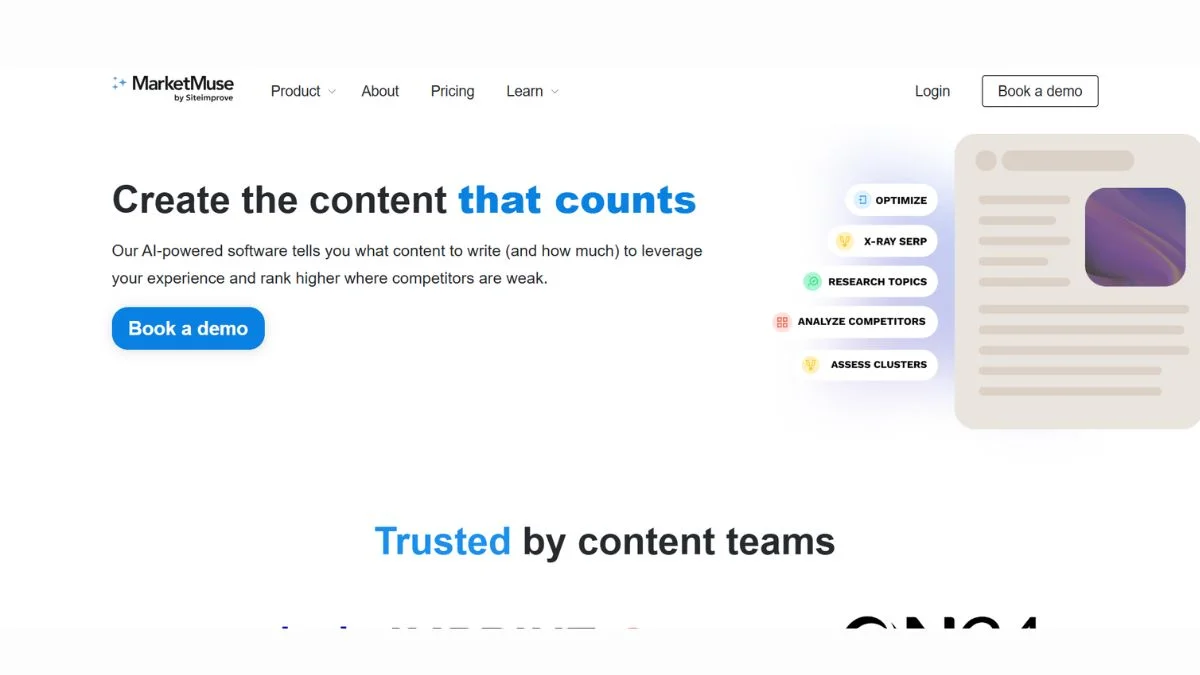
Best MarketMuse Alternatives in 2026 (Free + Paid Tools That Actually Work)

Let's be honest — MarketMuse is powerful, but it's also expensive. Starting at $149/month (and climbing fast for teams), it puts serious AI-powered content intelligence out of reach for most freelancers, small agencies, and indie bloggers.
But here's the thing: you don't need MarketMuse to write content that ranks.
In this guide, I've tested and ranked the best MarketMuse alternatives for 2026. Whether you want a free option, a budget-friendly upgrade, or a tool with better features for your specific workflow — there's something on this list for you.
What you'll find here: A no-fluff breakdown of 10 tools, including what each one does best, honest pros and cons, who it's for, and a comparison table to make your decision easier.
What Is MarketMuse and Why Are People Looking for Alternatives?
MarketMuse is an AI-powered content planning and optimization platform. It analyzes your content, compares it against top-ranking pages, and tells you what topics to cover, what questions to answer, and how to improve your content score.
So why are so many users searching for alternatives?
- Pricing — Plans start at $149/month. For solo creators, that's a hard sell.
- Complexity — The platform has a steep learning curve.
- Limited exports — Some features are locked behind higher tiers.
- Overkill for small sites — You don't need a spaceship to write a blog post.
The good news? Several tools offer overlapping functionality at a fraction of the cost — and some are genuinely free.
The 10 Best MarketMuse Alternatives in 2026
1. Surfer SEO — Best Overall Alternative
What it is: Surfer SEO is the closest rival to MarketMuse in terms of content optimization depth. It scores your content in real-time, tells you exactly what terms to include, and integrates with Google Docs and WordPress.
Best use case: Writers and agencies who publish frequently and need fast, actionable on-page feedback.
Key advantage: The Content Editor gives you a live score as you write — no guesswork involved.
Pros:
- Real-time content score as you type
- Excellent NLP-based keyword suggestions
- Integrates with Google Docs and WordPress
- SERP Analyzer to study competitor pages
- Decent free trial available
Cons:
- Gets pricey at higher content volume
- Audit feature can be slow on large sites
- No deep topical authority mapping like MarketMuse
Who should use it: Content teams, agencies, and bloggers who need a polished, fast content editor with clear optimization signals.
Pricing: Starts at ~$89/month
Want to explore more? Check out SEMrush vs Ahrefs for a broader SEO tool comparison.
2. Frase — Best for Content Briefs + AI Writing (#2 is a steal at this price)
What it is: Frase combines AI research, content brief generation, and an AI writing assistant into one tool. It pulls data from top-ranking pages and builds a brief you can actually use — fast.
Best use case: Content strategists and writers who need research-backed briefs without spending hours in spreadsheets.
Key advantage: Frase's document editor lets you research AND write in the same tab. No switching between tools.
Pros:
- Affordable starting price (~$14.99/month)
- Fast brief generation from SERP data
- Built-in AI writing assistant
- Great for solo creators and small teams
- Clean, intuitive interface
Cons:
- AI writing quality is good but not elite
- Limited keyword discovery compared to Surfer
- Fewer integrations than larger platforms
Who should use it: Freelance writers, content marketers, and budget-conscious teams who create a lot of written content.
Pricing: Starts at $14.99/month
Learn how to build a solid content strategy with On-Page SEO techniques that actually work.
3. Clearscope — Best for Enterprise Content Teams
What it is: Clearscope is a premium content optimization platform built for teams that take content quality seriously. It uses IBM Watson's NLP to identify the most important terms for any topic.
Best use case: Large content teams, enterprise blogs, and SEO agencies running at scale.
Key advantage: Clearscope's grade-based scoring (A+ to F) gives writers a clear, motivation-friendly optimization target.
Pros:
- Extremely clean and simple interface
- Excellent NLP-based term recommendations
- Easy to share reports with writers
- Integrates with Google Docs
- Very reliable content grades
Cons:
- Expensive — starts at $170/month
- No AI writing feature built-in
- Limited to content optimization (not a full SEO suite)
Who should use it: Enterprise content teams and agencies with a dedicated budget who want the cleanest, most reliable optimization scoring available.
Pricing: Starts at $170/month
4. NeuronWriter — Best Budget Alternative With Topical Maps (#4 surprised me)
What it is: NeuronWriter is a Polish-built content optimization tool that punches well above its price. It offers NLP analysis, internal linking suggestions, topical authority maps, and an AI writing assistant — all for far less than MarketMuse.
Best use case: SEO-focused content creators who want topical authority features without the enterprise price.
Key advantage: It offers topical cluster planning — one of MarketMuse's signature features — at a fraction of the cost.
Pros:
- Very affordable (available on AppSumo lifetime deals)
- Topical authority and content planning features
- NLP recommendations powered by Google NLP
- Internal link suggestions built-in
- Active product development and updates
Cons:
- UI isn't as polished as Surfer or Clearscope
- AI writing is hit-or-miss
- Some features still maturing
Who should use it: Budget-conscious bloggers and solo SEOs who want deep features without paying $150/month.
Pricing: Starts at ~$23/month (lifetime deals occasionally available)
5. Semrush Writing Assistant — Best for Semrush Users
What it is: If you're already a Semrush subscriber, the SEO Writing Assistant is a natural extension. It checks your content for readability, SEO, originality, and tone — all in one panel.
Best use case: Semrush users who want content optimization without adding another subscription.
Key advantage: Bundled into Semrush — no extra cost if you're already on a paid plan.
Pros:
- Included in Semrush Guru and Business plans
- Google Docs and WordPress integrations
- Checks readability, tone, SEO, and plagiarism
- Easy to set up in minutes
Cons:
- Less powerful than dedicated tools like Surfer or Clearscope
- Requires a Semrush subscription to use fully
- Content scoring is basic compared to MarketMuse
Who should use it: Current Semrush subscribers who want content optimization without adding a new tool to their stack.
Pricing: Included in Semrush Guru ($249.95/month) and above
Also worth reading: SEMrush vs Google Keyword Planner — Which Is Best for Keyword Research?
6. PageOptimizer Pro (POP) — Best for Technical On-Page SEO
What it is: PageOptimizer Pro is built for SEOs who want to get granular. It analyzes the top-ranking pages for your target keyword and tells you exactly how many times to use specific terms, how long your content should be, and how to structure your page.
Best use case: Technical SEOs and niche site builders who care deeply about on-page precision.
Key advantage: POP uses a weighted scoring model based on actual ranking pages — not guesses. It's math-forward SEO.
Pros:
- Very affordable (~$22–$44/month)
- Chrome extension available
- Precise term frequency recommendations
- Good for niche site SEOs
- Includes entity-based optimization
Cons:
- Dated interface — not the most user-friendly
- No AI writing features
- Best for experienced SEOs, not beginners
Who should use it: Technical SEOs, niche site owners, and anyone who wants to optimize pages with data-backed precision.
Pricing: Starts at ~$22/month
7. Writesonic + SurferSEO Integration — Best for AI Writing + SEO
What it is: Writesonic is an AI writing platform that integrates with Surfer SEO. You get AI-generated content drafts that are already optimized for your target keyword — in one workflow.
Best use case: Teams that need high-volume content output with SEO built into the drafting process.
Key advantage: AI-first workflow — write and optimize simultaneously instead of writing first, then fixing.
Pros:
- Fast AI content generation
- SurferSEO integration for optimization scores
- Large template library (ads, blogs, landing pages)
- Affordable plans available
- Good for scaling content operations
Cons:
- AI content needs careful editing and fact-checking
- Integration requires separate Surfer subscription
- Not ideal for highly nuanced or technical topics
Who should use it: Content teams running at scale who prioritize speed and volume alongside optimization.
Pricing: Starts at $16/month (Surfer integration costs extra)
See the full comparison: Best Writesonic Alternatives for SEO Blog Writing
8. Outranking.io — Best for Automated Content Planning
What it is: Outranking.io combines content research, AI writing, and SEO optimization into a single automated workflow. It can create full content briefs, write drafts, and score them — with minimal manual input.
Best use case: Agencies and teams who need content production pipelines, not just optimization tools.
Key advantage: End-to-end automated content workflows — from keyword to draft to optimized post.
Pros:
- Combines research, writing, and optimization
- Automated brief-to-draft pipelines
- SERP analysis and keyword clustering
- Good internal linking features
- Team collaboration features
Cons:
- Premium pricing for full features
- AI drafts still require significant editing
- Some features in beta
Who should use it: Agencies and scaling content teams who want to automate as much of the production process as possible.
Pricing: Starts at ~$79/month
9. Dashword — Best Simple Alternative for Beginners
What it is: Dashword is a lightweight content optimization tool designed for simplicity. It gives you keyword suggestions, competitor analysis, and a content score — without overwhelming you with features.
Best use case: Beginners, bloggers, and small teams who want clean, simple content optimization.
Key advantage: Extremely easy to use — you can go from keyword input to optimized content in under 10 minutes.
Pros:
- Very beginner-friendly interface
- Clean content scoring and recommendations
- Affordable pricing
- Unlimited reports on higher plans
- Fast setup
Cons:
- Fewer features than Surfer or Frase
- No deep topical authority mapping
- Limited integrations
Who should use it: New bloggers, content writers getting started with SEO, and small teams that want simplicity over complexity.
Pricing: Starts at $39/month
Related: 10 Best Dashword Alternatives
10. ChatGPT + Free SEO Tools — Best Free DIY Option
What it is: Not every content problem needs a paid platform. Combining ChatGPT (free tier) with free SEO tools like Google Search Console, Google Keyword Planner, and Ahrefs Free Keyword Generator creates a surprisingly effective workflow.
Best use case: Bootstrapped creators, students, and anyone who isn't ready to pay for a content tool.
Key advantage: Zero cost. The combination of AI writing + free keyword data is genuinely powerful if you're willing to put in the manual effort.
Pros:
- Free or very low cost
- ChatGPT is excellent for content briefs and outlines
- Google Search Console gives real data on your own site
- No learning curve for basic use
Cons:
- No automated optimization scoring
- Requires more manual work and SEO knowledge
- No real-time content grading
Who should use it: Beginners, students, and budget-constrained creators who want to learn SEO fundamentals without spending money.
Pricing: Free (ChatGPT free tier + free tools)
Learn the fundamentals: SEO for Beginners — The Ultimate Step-by-Step Guide
MarketMuse Alternatives Comparison Table
| Tool | Best For | Price/Month | AI Writing | Content Scoring | Free Plan |
|---|---|---|---|---|---|
| Surfer SEO | Overall best alternative | ~$89 | ✅ | ✅ Excellent | ❌ |
| Frase | Content briefs + writing | $14.99 | ✅ | ✅ Good | ✅ Trial |
| Clearscope | Enterprise teams | $170 | ❌ | ✅ Best-in-class | ❌ |
| NeuronWriter | Budget + topical maps | ~$23 | ✅ | ✅ Good | ❌ |
| Semrush WA | Semrush users | Bundled | ❌ | ✅ Basic | ❌ |
| PageOptimizer Pro | Technical SEO | ~$22 | ❌ | ✅ Precise | ❌ |
| Writesonic + Surfer | AI-first content | $16+ | ✅ | ✅ Via Surfer | ✅ Trial |
| Outranking.io | Content pipelines | ~$79 | ✅ | ✅ Good | ❌ |
| Dashword | Beginners | $39 | ❌ | ✅ Simple | ❌ |
| ChatGPT + Free Tools | Zero budget | Free | ✅ | ❌ Manual | ✅ |
How to Choose the Right MarketMuse Alternative
Still not sure which tool fits your situation? Use this quick decision guide:
Pick Surfer SEO if: You want the best overall content editor with real-time scoring and solid integrations.
Pick Frase if: You're a solo creator or small team who needs fast, affordable content briefs.
Pick Clearscope if: You run an enterprise content team and need reliable, shareable content grading.
Pick NeuronWriter if: You want MarketMuse-like topical features at a fraction of the price.
Pick PageOptimizer Pro if: You're a technical SEO who wants precise, data-driven on-page recommendations.
Pick ChatGPT + Free Tools if: You're starting out and can't justify a monthly subscription yet.
Pro Tips: Getting the Most From Any Content Optimization Tool
No matter which alternative you choose, these practices will sharpen your results:
1. Don't chase the score blindly. Tools like Surfer and NeuronWriter give you content scores, but stuffing every suggested keyword tanks your readability. Write for humans first.
2. Use the tool for research, not just grading. The competitor analysis features in these tools reveal real insights — what questions are being answered, what angles are missing, what topics cluster together.
3. Pair with Google Search Console. Free and irreplaceable. Tracking SEO performance with analytics is what tells you if your optimized content is actually working.
4. Update old content, don't just create new. Tools like Frase and Surfer are excellent for auditing existing pages. Updating old content for SEO can drive more traffic than publishing brand-new posts.
5. Combine tools strategically. Many pros use Frase for briefs, Surfer for optimization, and Google Search Console for monitoring. You don't need one all-in-one tool — you need the right tools for each stage.
More on the topic: How Content Marketing Boosts SEO and Essential Content Optimization Practices Every Marketer Should Know
What Features Should You Actually Look for in a MarketMuse Alternative?
Here's what actually matters when comparing these tools — so you're not paying for things you'll never use:
- Content scoring / optimization grade — Is it based on real SERP data?
- Keyword/term suggestions — NLP-based recommendations vs. basic keyword density
- Competitor analysis — Can you see what top-ranking pages are covering?
- Brief generation — Does it save you the research work?
- AI writing — Is it built-in, or does it require an add-on?
- Integrations — Google Docs, WordPress, Chrome extension?
- Team features — Collaboration, report sharing, multi-user access?
- Price per report — Some tools charge per document, others offer unlimited
Helpful context: How to Do an SEO Audit for Your Website and The 10 Most Important SEO Metrics
Does AI-Generated Content Still Rank in 2026?
This is the elephant in the room when you're evaluating any AI-powered content tool.
Short answer: Yes — if it's genuinely helpful and well-edited.
Google's Helpful Content system evaluates pages on whether they satisfy searcher intent, demonstrate expertise, and provide original value. Tools like Surfer, Frase, and Clearscope don't write your content — they tell you what to cover. That's fundamentally different from just pushing out AI-spun articles.
The risk is relying too heavily on AI drafts without adding your own expertise, data, or insights.
Deep dive: Does AI-Generated Content Hurt Your SEO? What Google Says and How to Fix It
Additional Resources Worth Bookmarking
If you're serious about content SEO, these guides complement whatever tool you choose:
- How to Use Keywords for SEO Effectively
- How to Write SEO-Friendly Meta Descriptions
- How to Optimize Title Tags for SEO
- How to Optimize Featured Snippets for On-Page SEO
- How to Add Schema Markup for On-Page SEO
- On-Page SEO Checklist — The Complete Guide
- How to Improve Content Readability for SEO
- How to Avoid Duplicate Content on Your Site
- URL Structure Best Practices for SEO
- Image Optimization Tips for On-Page SEO
- How to Use H1–H6 Tags for Better SEO
- Best Practices for Internal Linking in SEO
- How to Improve Keyword Density Without Overstuffing
- How to Use LSI Keywords in On-Page SEO
- How to Use Canonical Tags in On-Page SEO
- Zero-Click SEO — How to Optimize for SERP Features
- Free SEO Checker Online — 20 Best Google & YouTube SEO Tools
- Best Free Backlink Checker Tools
- How to Do Keyword Research Without Paying for Expensive Tools
- Website Audit Checklist 2025
- Top 10 Free SEO Tools for Beginners in 2025
- Best Surfer SEO Alternatives
- Best Frase Alternatives
- Best Copy AI Alternatives in 2026
- Best Jasper Alternatives in 2026
- 9 Best Free AI SEO Tools to Rank #1
- Best AI Tools for Content Creators
- How AI Is Changing SEO
- Jasper AI vs Copy AI vs Writesonic — Best AI Copywriter
- Free vs Paid AI Writing Tools — Is Upgrading Worth It?
- Best AI Tools Complete Guide with Pros & Cons
Frequently Asked Questions
What is the best free alternative to MarketMuse?
The best free alternative is combining ChatGPT with Google Search Console and free keyword tools like Ahrefs' Free Keyword Generator or Ubersuggest's free tier. This combination covers research, writing assistance, and performance tracking at zero cost.
It won't match MarketMuse's automated scoring system, but for budget-conscious creators willing to do some manual research, this workflow is genuinely effective. As your traffic grows and revenue increases, you can upgrade to a paid tool.
Is Surfer SEO better than MarketMuse?
For most users, Surfer SEO is a better fit than MarketMuse. It's more affordable, has a more intuitive interface, and its real-time content editor is one of the best in the industry.
MarketMuse has an edge when it comes to topical authority modeling at the enterprise level. But for individual writers, agencies, and small teams, Surfer delivers more practical value per dollar.
Does Frase replace MarketMuse completely?
Frase replaces most of what MarketMuse does for content briefs and optimization, but not everything. Frase excels at research-backed brief generation and is far more affordable, but lacks MarketMuse's deep topical authority modeling.
If your main use case is creating well-researched content briefs and optimizing individual pages, Frase is a strong full replacement. If you need a comprehensive topical gap analysis across your entire domain, MarketMuse still has the edge — but so does NeuronWriter at a much lower price.
Which MarketMuse alternative is best for beginners?
Frase and Dashword are the best options for beginners. Both are affordable, beginner-friendly, and designed to get you writing optimized content quickly without a steep learning curve.
Frase is the better all-rounder with its AI writing features, while Dashword is even simpler if you just want clean content scoring without distractions.
Can I use multiple content optimization tools together?
Yes — and many professional SEOs do exactly that. A common workflow is using Frase for brief creation, Surfer for in-editor optimization, and Google Search Console for tracking performance after publishing.
The key is avoiding redundancy. Pick one tool for each stage of the workflow: research and brief, writing and optimization, and performance monitoring. Don't pay for three tools that all do the same thing.
Is content optimization still important in 2026 with AI everywhere?
Absolutely — possibly more than ever. With AI making it easier to produce large volumes of content, the signal-to-noise ratio on the internet has exploded. Well-optimized, genuinely helpful content is what separates pages that rank from pages that don't.
Tools like Surfer, Frase, and Clearscope don't just help with keyword stuffing — they help you understand what searchers actually want to know, which is exactly what Google's algorithms reward.
Conclusion: Which MarketMuse Alternative Should You Choose?
Here's the bottom line:
- Best overall: Surfer SEO — polished, powerful, and worth the price
- Best budget pick: Frase — affordable and surprisingly capable
- Best for enterprise: Clearscope — clean, reliable, shareable
- Best hidden gem: NeuronWriter — topical mapping at a fraction of the cost
- Best free option: ChatGPT + Google Search Console + free keyword tools
MarketMuse isn't worth it for most people — the alternatives on this list cover 90% of the same use cases at better price points.
The only time MarketMuse is genuinely irreplaceable is if you're managing a large enterprise content program with thousands of pages and need automated topical authority analysis at scale. For everyone else, there's a smarter (and cheaper) option on this list.
Ready to take your content strategy further? Start with SEO for Beginners — The Ultimate Step-by-Step Guide or explore the On-Page SEO Checklist to apply what you've learned today.